
How I’d Configure a Matrice 400 for Remote Forest Capture
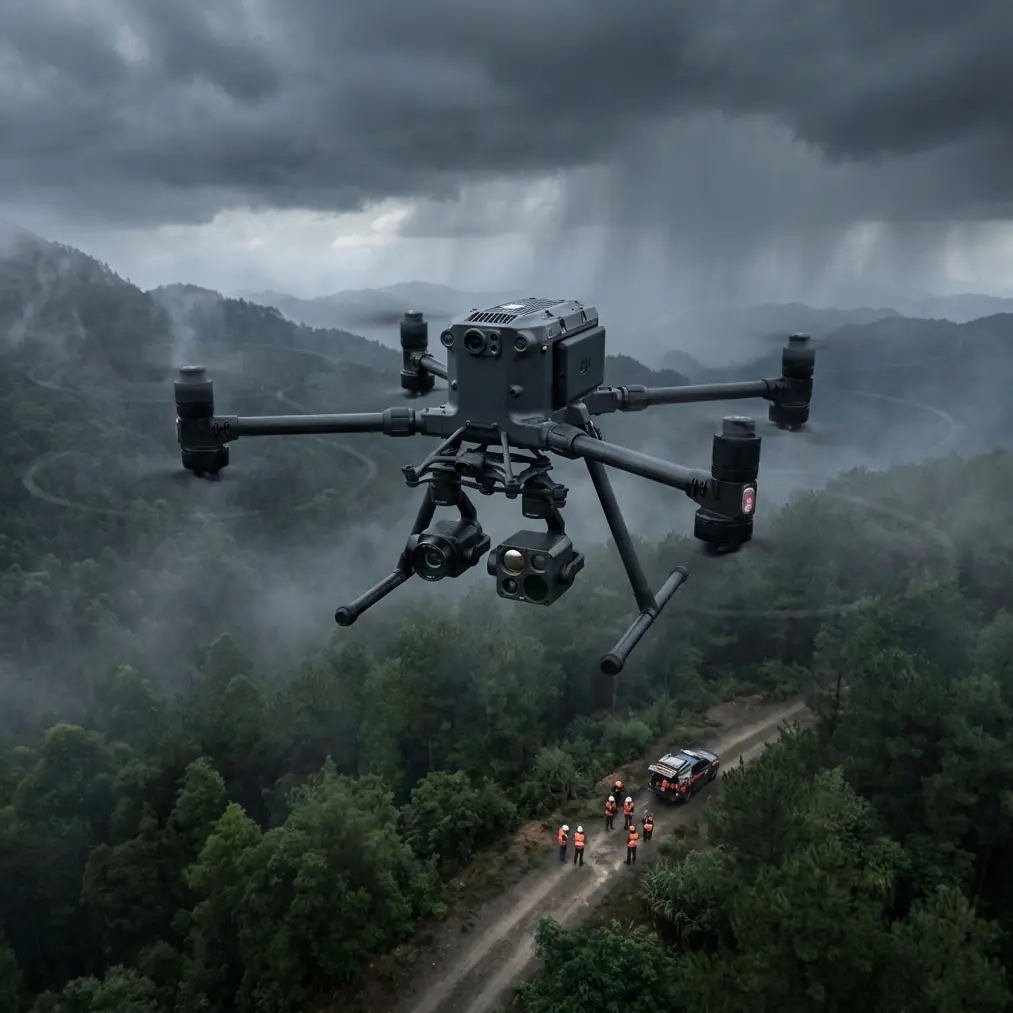
How I’d Configure a Matrice 400 for Remote Forest Capture
META: A specialist’s field guide to using Matrice 400 in remote forest environments, with practical insight on avionics interfaces, video integrity, thermal workflows, materials durability, and accessory planning.
Remote forest work exposes every weak choice in a drone setup.
A platform can look excellent on paper, then fall apart when the mission moves under dense canopy edges, long approach corridors, wet weather, and repeated launch cycles far from support infrastructure. For crews planning to use Matrice 400 for forest documentation, habitat surveys, thermal signature collection, or large-area photogrammetry, the real question is not whether the aircraft can fly the mission. It is whether the entire system architecture can stay coherent when conditions stop being forgiving.
That is the lens I would use for Matrice 400.
This article is not a generic overview. It is a field-minded build strategy shaped around two engineering themes that matter more in remote forests than many operators realize: signal integrity and environmental sealing. Those ideas come straight out of classic aircraft design references on avionics interfaces and aerospace sealing materials, and they map surprisingly well onto modern UAV operations.
Start with the mission, not the payload brochure
Forests create a layered sensing problem.
If your goal is orthomosaic mapping, the aircraft has to hold stable, predictable capture geometry over repeating terrain textures that can confuse reconstruction. If your goal is thermal signature work, the challenge shifts to preserving image quality while managing canopy occlusion, mixed emissivity, and timing. If you are collecting corridor data over inaccessible timberland, transmission resilience and power continuity become just as important as camera specs.
That is why I advise teams to design a Matrice 400 forest workflow around four linked systems:
- Airframe endurance and battery swap logic
- Video and data path reliability
- Sensor mounting and environmental protection
- Ground processing discipline, including GCP strategy for photogrammetry
Each one affects the other. A great sensor on a poorly protected interface is a liability, not an advantage.
Why avionics interface details matter in a forest mission
One of the most useful source references here is an aircraft avionics design section defining interface terms like cable type, communication format, coding, bitrate, block size, video bandwidth, aspect ratio, active lines, and blanking level. At first glance, that may seem far removed from a Matrice 400 in the woods. It isn’t.
It is a reminder that field performance depends on clean electrical and signal relationships, not just headline range.
The reference specifically distinguishes interconnect types such as twisted pair, shielded twisted pair, and coaxial cable, and it also notes that radio frequency signals above 20 kHz are transmitted through coaxial line or waveguide in conventional aircraft systems. The operational takeaway for Matrice 400 crews is simple: every added device in the payload chain should be treated as part of a real signal system, not as an isolated accessory.
That matters when you add a third-party payload hub, external recorder, specialized thermal module adapter, or canopy-penetration LiDAR integration package. I have seen remote capture teams focus heavily on the sensor and barely think about the wiring standard, shielding quality, connector strain relief, or how the accessory handles digital video formatting. Then they lose time chasing intermittent feed dropouts that were built into the installation from the start.
In practical terms, if I were preparing a Matrice 400 for forest capture, I would inspect or verify:
- whether the accessory interconnect uses appropriate shielding for the environment
- whether the video path introduces unnecessary conversion stages
- whether bitrate and block handling remain consistent through the chain
- whether the mount and cable routing reduce vibration transfer and connector fatigue
The avionics source also calls out video parameters like bandwidth, aspect ratio, active lines, and blanking level. For UAV users, that is a useful mental model: a “working video feed” is not the same as a “trustworthy observation feed.” In dense forest operations, where you may be trying to identify tree stress, heat leakage through canopy gaps, or structural changes along trails, degraded video handling can hide subtle details long before the feed fully fails.
This is one reason I’m careful about third-party accessories. The right one genuinely expands Matrice 400 capability. The wrong one adds another conversion bottleneck.
The accessory choice that can quietly improve the mission
A well-designed third-party quick-mount payload adapter or environmental cable management kit can make a real difference in remote forest work.
Not because it sounds sophisticated, but because it reduces field friction. If a crew is alternating between a wide-area photogrammetry payload and a thermal sensor package in the same deployment window, every swap point is a risk point. Better accessory hardware can stabilize mounting geometry, protect connectors, and shorten the period during which dirt, moisture, or handling stress is introduced.
That is especially relevant when teams are relying on hot-swap batteries to keep a mission cycle moving. Fast battery exchange is useful, but battery efficiency only pays off if the payload side is equally disciplined. Otherwise, you save time in the airframe turnaround and lose it back troubleshooting a camera handshake issue or a loose data line.
If you are evaluating accessory compatibility for this kind of build, it helps to discuss the specific sensor stack and mission profile with an integrator who understands more than airframes. A direct field configuration discussion can save days of trial and error; for that kind of planning, I’d suggest using this Matrice 400 setup chat: https://wa.me/85255379740
Power stability is not glamorous, but it decides mission quality
The same avionics reference defines power excitation as supplying equipment with stable AC or DC voltage. That sounds elementary. In the field, it is everything.
Remote forest capture often means repeated sorties, uneven temperatures, damp air, long transport, and accessories running at the edge of their comfort zone. Any instability in payload power can appear as random sensor reboots, dropped recordings, sync drift, or inconsistent thermal output.
When operators talk about BVLOS readiness or O3 transmission reliability, they often frame the conversation around link distance and regulatory procedure. Both matter. But in actual operations, stable onboard power is part of transmission quality too. A video system that is underpowered or poorly regulated does not become trustworthy because the radio link is strong.
This is why I would validate not just battery endurance, but the entire power chain under mission load:
- aircraft with primary payload
- aircraft with thermal payload
- aircraft with any third-party accessory installed
- full recording plus live transmission
- repeated start-stop sequences after hot-swap events
A forest mission rarely fails in the clean, obvious way people expect. More often it degrades a little at a time. Power behavior is usually part of that story.
Materials science matters more than most drone teams think
The second reference source, from an aircraft materials handbook, is about sealants. This is where many UAV articles would lose the thread. I think this is one of the most useful parts.
The document describes silicone-based sealants with operating temperatures typically reaching 230°C, some even 250–270°C, and low-temperature performance down to -70°C. It also highlights strong resistance to heat, air, ozone, light, and atmospheric aging, while noting weaker resistance to fuel and lubricating oils. Another cited material shows a thermal analysis temperature of 515°C and low toxicity, with non-corrosive behavior toward certain alloys.
For Matrice 400 operations in remote forests, the message is not that you should start improvising aerospace chemistry in the field. The message is that environmental durability around connectors, cable exits, enclosures, and sensor interfaces is mission-critical.
Forest work is hard on exposed systems. Moisture is rarely dramatic enough to stop the flight immediately. Instead, it migrates slowly into vulnerable points. Fine particles from bark, soil, and transport cases work their way into interfaces. Daily thermal cycles loosen marginal assemblies. UV exposure ages soft components. Then the operator blames the aircraft when the real issue was preventive materials planning.
The source’s note about silicone sealants being hydrophobic and electrically insulating is especially relevant. In civilian UAV integration, those properties are exactly why thoughtful sealing and potting around non-service connector areas, accessory housings, and protective cable transitions can increase reliability in wet woodland operations. The benefit is not theoretical. It directly supports cleaner electrical behavior and better long-term signal consistency.
Just as important is the caution embedded in the material data: not every sealant is universally resistant. The document notes weaker performance against fuel and lubricating oils for certain silicone materials. For a forest drone team, the broader lesson is to match the protection material to the exposure profile rather than assuming “weatherproof” means everything-proof.
My recommended remote-forest workflow for Matrice 400
If I were advising a survey, ecology, or utility vegetation team, I would structure Matrice 400 deployment like this.
1. Define the sensing objective precisely
“Forest capture” is too broad.
Separate the mission into one of these:
- photogrammetry for terrain or timber stand mapping
- thermal signature collection for wildlife, plant stress, or infrastructure heat anomalies
- mixed optical and thermal inspection
- repeated seasonal monitoring
This determines altitude, overlap, timing, and whether GCPs are necessary. In remote forest terrain, GCP placement can be painful, but if you need strong spatial confidence beneath irregular canopy edges, they still matter. The aircraft cannot solve for weak ground control discipline by itself.
2. Build around transmission reliability, not just distance
O3 transmission and AES-256 are often treated as checklist features. Their real value in remote environments is confidence: consistent command-and-view continuity, secure data handling, and fewer surprises when working around terrain breaks and long lines of sight.
But do not stop there. Protect the full link path. Accessory wiring, shielding choice, and video formatting discipline have to support the transmission system. This is where the avionics reference on cable type, bitrate, and communication format becomes operationally useful.
3. Use thermal intelligently
Thermal signature work in forests is easy to oversell and hard to do well.
Collect early or late in the day when thermal contrast supports the target you care about. Avoid assuming canopy hides nothing. It hides plenty. Pair thermal data with visible imagery whenever possible, and verify whether the mounting and signal path preserve the image fidelity you need.
4. Treat battery workflow as part of data quality
Hot-swap batteries are a productivity tool, but only if the mission can resume without destabilizing the payload stack. After each swap, confirm sensor status, time sync, and storage continuity. In long forest runs, the cost of discovering a recording break after landing is much higher than spending 20 extra seconds on a pre-launch check.
5. Harden the small things
This is where the materials reference earns its keep.
Review:
- exposed connector points
- cable bend zones
- accessory housing seams
- damp case storage routines
- temperature cycling during transport and deployment
The best aircraft in the world cannot compensate for weak sealing around the components you added later.
What separates a good Matrice 400 forest team from an average one
The average team thinks in parts: airframe, camera, batteries, software.
The good team thinks in interfaces.
That means understanding that a shielded cable choice can affect the quality of a thermal observation. A stable DC supply can determine whether a payload records cleanly through a long sortie. A hydrophobic insulating seal around a vulnerable integration point can prevent intermittent faults weeks later. A better third-party mounting accessory can preserve alignment and reduce field handling damage. Those are not side notes. They are often the difference between a dataset you trust and one you merely possess.
Matrice 400 has obvious appeal for remote work because it sits at the center of a serious professional ecosystem. But ecosystem value only appears when the operator respects the engineering chain around it.
If your job is capturing forests in remote areas, that should be the standard. Not flashy flights. Clean data, repeatable sorties, and equipment behavior that stays boring in the best possible way.
Ready for your own Matrice 400? Contact our team for expert consultation.