
Matrice 400 Field Report: Capturing Solar Farms in Low
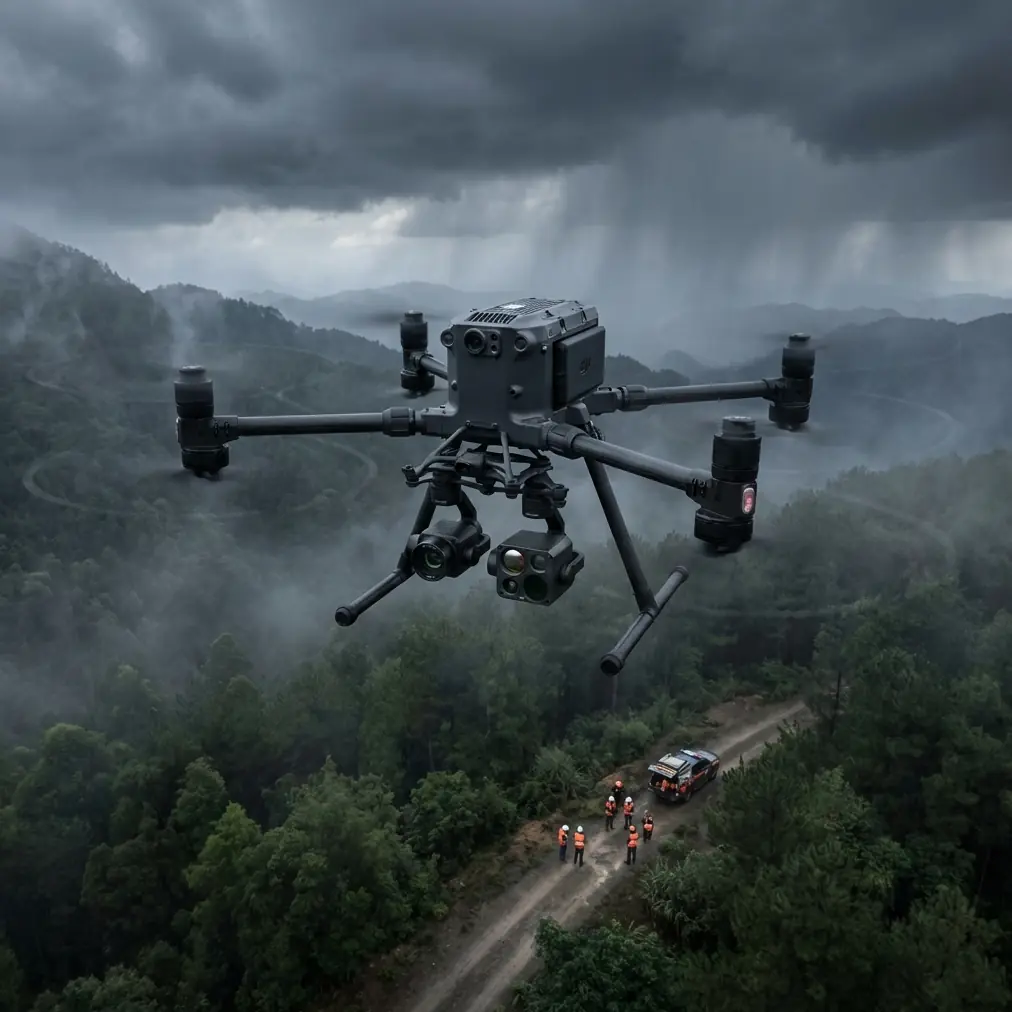
Matrice 400 Field Report: Capturing Solar Farms in Low Light Without Sacrificing Data Quality
META: Expert field report on using the Matrice 400 for low-light solar farm inspection, thermal work, photogrammetry, antenna setup, transmission reliability, and battery strategy.
By James Mitchell
Solar farms look simple from the access road. Long rows. Repeat geometry. Predictable spacing. In the field, especially before sunrise or near dusk, they become one of the more demanding environments to capture well.
Low-angle light exaggerates glare. Panel rows create visual monotony that can confuse less stable mapping workflows. Thermal contrast changes quickly. Wind moves across open land with very little interruption. And if you are covering a utility-scale site, range and link stability stop being abstract specifications and start affecting whether the day stays on schedule.
That is where the Matrice 400 enters the conversation.
This is not a generic praise piece about a flagship airframe. The real question is narrower and more useful: how does the Matrice 400 behave when the job is a low-light solar farm mission, where you need clean thermal signature data, consistent photogrammetry overlap, dependable transmission, and battery management that does not interrupt a narrow inspection window?
From that angle, the platform makes sense.
Why low light changes the job
A solar farm flown at noon and the same site flown at first light are almost different projects.
At midday, visible imagery often suffers from harsh reflections and flattening. Thermal readings can be influenced by strong solar loading, making it harder to separate a true anomaly from a panel that is simply heating unevenly under intense sun. In lower light, particularly early morning, temperature differences that matter operationally can stand out more clearly. Fault strings, hotspot tendencies, and underperforming sections often present with better separation before the site fully heats up.
The tradeoff is obvious. You are asking the aircraft and payload stack to perform in conditions where visual contrast is lower, terrain references are less distinct, and every interruption costs you a larger slice of the usable thermal window.
The Matrice 400 is built for exactly this type of operational pressure: long-duration, repeatable commercial missions where data quality matters more than spectacle.
Thermal work is only useful if the rest of the mission holds together
People often talk about thermal signature as though it begins and ends with the camera. On solar sites, that is a mistake.
A thermal image is only useful when it can be placed in context. Which panel row was it? Which inverter block? Was the aircraft altitude and angle consistent enough to compare one section to another? Was the mission flown smoothly enough that your anomalies are trustworthy and not artifacts of rushed piloting or uneven capture geometry?
This is why the Matrice 400 matters beyond payload support. For low-light solar work, consistency is the asset.
A stable aircraft lets the inspection team collect thermal imagery that can be tied back to a map layer, a string location, or a maintenance work order. If you are pairing thermal with photogrammetry, that stability becomes even more valuable. Solar owners increasingly want both: rapid anomaly detection and a visual dataset they can review over time.
On large farms, adding GCPs can still be the right call when the deliverable requires tighter geospatial confidence, particularly if asset managers intend to compare datasets across multiple survey cycles. The drone does not eliminate sound survey discipline. It rewards it. With the Matrice 400, the practical gain is that you can run those disciplined workflows over bigger sites without operating on a razor-thin endurance margin.
The real value of hot-swap batteries on solar projects
Hot-swap batteries sound like a convenience feature until you use them on a solar farm in low light.
Then they become operational leverage.
The best thermal inspection period is often brief. If your workflow forces a full power-down every time you change batteries, you lose tempo, re-establish systems, and invite alignment drift between mission segments. With hot-swap batteries, the Matrice 400 can keep the aircraft active during battery changes, which means less downtime between blocks of the site.
That matters for two reasons.
First, thermal conditions evolve quickly after sunrise. A delay of even 10 to 15 minutes can change how defects appear across module surfaces. Second, utility-scale sites are large enough that fragmented capture sessions can create inconsistencies in the final dataset. If you can move from one sector to the next with minimal interruption, your thermal and visual record stays more coherent.
This is one of those features that sounds minor in a spec sheet and becomes major in the field. Inspection teams do not get paid for elegant battery design. They get paid for completing a site before the data window closes.
O3 transmission is not just about distance
On paper, operators fixate on range. In practice, transmission quality is about continuity.
Solar farms are usually open environments, which helps. But “open” does not mean problem-free. Substations, maintenance buildings, fencing, parked vehicles, tracker mechanisms, and local RF noise can all affect the quality of your command and video link. On an expansive site, a dropped or degraded feed is not just annoying. It disrupts inspection rhythm and can force you into more conservative flight patterns than the site really requires.
This is where O3 transmission earns its keep. A robust link is valuable not simply because it reaches far, but because it supports smoother, safer execution over long rows and repeating corridors. If you are reviewing thermal response in real time while maintaining the mission path, stable video and command performance make the difference between a decisive inspection and a cautious re-fly.
For operators working under strict data handling policies, AES-256 support also has operational significance. Solar infrastructure owners, EPC firms, and asset managers are often more sensitive about facility imagery than people assume. They may not frame it in aviation language, but they care deeply about secure handling of site data. Encrypted transmission is not a marketing extra in these environments. It is often part of what allows drone programs to move from one-off tests into repeatable enterprise operations.
Antenna positioning advice that actually helps in the field
Range problems on solar farms are often self-inflicted.
The most common issue is not the aircraft. It is controller orientation.
If you want the strongest link from the Matrice 400, do not point the tips of the antennas at the aircraft. That is the weak part of the radiation pattern. Instead, angle the antennas so the broad side faces the drone’s general position. Think of it less like aiming a finger and more like presenting a panel.
On large sites, I tell crews to do three things:
Stand where the first and second mission blocks keep the aircraft mostly in front of you, not off your shoulder.
Repeated torso rotation leads to poor antenna orientation without the pilot noticing.Keep the controller at chest level rather than low near the waist.
Your own body can interfere with the signal path more than many operators realize.Reposition before link quality becomes a problem.
If the aircraft will transition behind structures, inverter stations, or terrain undulations, move your ground position during a planned pause rather than trying to “push through” a weak angle.
This matters even more if you are working toward longer corridor-style missions or future BVLOS-oriented workflows where procedural discipline has to be tighter. Even in standard visual operations, good antenna habits improve consistency, and consistency is what keeps low-light capture efficient.
If your team wants a quick field checklist for controller setup and antenna angle before the next site visit, send a note here: https://wa.me/85255379740
Photogrammetry on a solar farm is harder than it looks
At first glance, solar farms should be easy to map. They are structured, repetitive, and usually unobstructed. The problem is that repetition itself can weaken reconstruction if your capture plan is lazy.
Rows of similar panels create feature ambiguity. Add low light, and image texture can drop further. If the mission is intended to produce a measurable orthomosaic or support asset-level review, the Matrice 400 should be flown with overlap and angle discipline, not with the assumption that “the software will figure it out.”
The strongest approach is usually to separate objectives.
Run the thermal inspection as a thermal inspection. Then run the photogrammetry mission with the overlap, altitude, and visible-light conditions appropriate for mapping. Trying to force one low-light pass to do everything often leaves you with mediocre thermals and mediocre mapping.
Where higher positional confidence matters, use GCPs. On solar sites, they help anchor the dataset in a way stakeholders trust, especially when maintenance teams need to correlate observed defects with exact field locations. The drone gives you efficiency. GCPs give you confidence. Those are not competing ideas.
Wind, repetition, and fatigue
There is another reason the Matrice 400 fits solar work: operator fatigue is real on these sites.
Large farms can induce a strange kind of monotony. Everything looks similar. Flight lines repeat. The pilot’s attention has to stay high while the visual environment provides very little novelty. Add dawn starts, low temperatures in some regions, and pressure to complete the capture window before thermal contrast deteriorates, and you have a mission profile where aircraft stability and workflow design matter a lot.
A more capable platform reduces small frictions that compound over the day. Fewer interruptions. Better link confidence. Smoother battery transitions. More reliable payload performance. None of those alone define the mission. Together, they often define whether the team leaves with a usable dataset.
That is the practical case for the Matrice 400 on solar farms. Not glamour. Reduced friction.
A sensible low-light workflow for the M400
For teams planning a repeatable morning inspection routine, this is the structure I recommend.
Arrive before first light with takeoff and recovery areas already selected. Confirm weather, especially wind trends across the open site. Place GCPs if the mission requires mapping-grade spatial control. Conduct payload checks while ambient conditions are stable. Then stage batteries so the first swap happens fast and clean.
Launch with the thermal objective clearly defined. Do not improvise the route once you are airborne unless site safety requires it. Use a mission structure based on logical electrical blocks or panel sections, not simply the easiest lines to fly. That makes downstream maintenance reporting much cleaner.
As the visible scene brightens, evaluate whether your next sortie should remain thermal-focused or transition to photogrammetry. That call should be driven by data quality, not by habit. Some mornings the thermal window holds well. On others, it collapses quickly.
Throughout the mission, keep checking antenna orientation any time the aircraft changes relative position across the site. It sounds basic. It is also one of the easiest ways to preserve a strong O3 link without touching anything else.
Finally, document environmental conditions alongside the imagery set. Low-light inspections are highly useful, but they are also context-sensitive. A thermal anomaly observed in one ambient condition may present differently on another day. Good reporting keeps that nuance attached to the data.
Where the Matrice 400 fits best
The Matrice 400 is not interesting because it is big or new. It is interesting because it aligns with the way serious infrastructure operators actually work.
Solar inspection teams need endurance, but endurance alone is not enough. They need secure transmission, because infrastructure clients care about data governance. They need hot-swap batteries, because thermal windows do not wait. They need reliable control and transmission performance, because wide sites punish sloppy link management. They need an aircraft stable enough to support both thermal signature work and disciplined photogrammetry, often within the same morning.
That is the field reality.
If your work involves utility-scale solar farms in low light, the M400 is less about headline capability and more about preserving the fragile chain between flight execution and trustworthy data. Break that chain anywhere, and the sortie becomes expensive noise. Keep it intact, and the aircraft turns a narrow morning window into a practical inspection asset.
Ready for your own Matrice 400? Contact our team for expert consultation.