
Matrice 400 in Dusty Venue Work: A Field Case Study
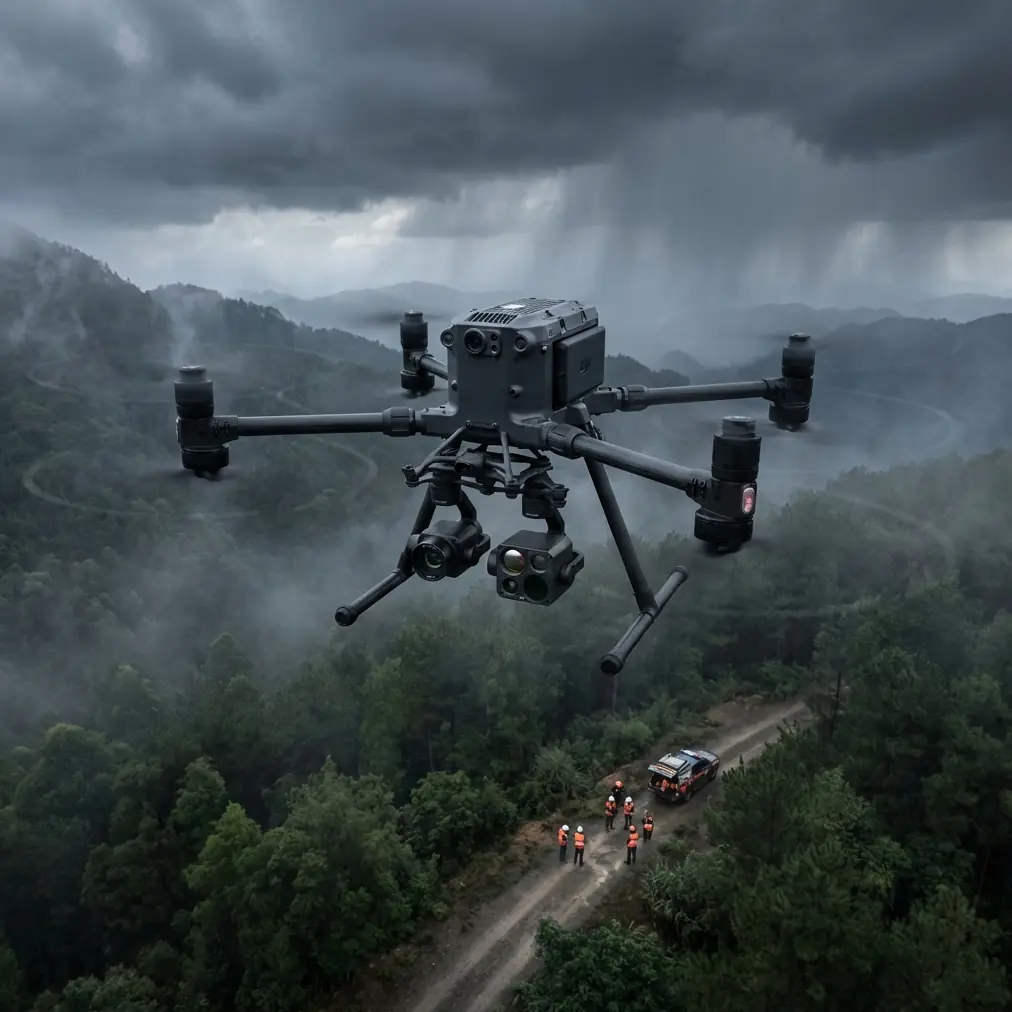
Matrice 400 in Dusty Venue Work: A Field Case Study on Stability, Fast Turnarounds, and What Actually Keeps the Mission Moving
META: A specialist case study on using Matrice 400 for dusty venue capture, with field-tested battery management advice, transmission, thermal workflow, and engineering insights that matter in real operations.
Dust changes everything.
On paper, a venue capture job can look routine: establish control, plan overlaps, launch, collect visual and thermal data, process the photogrammetry, deliver a clean model. In the field, especially around large outdoor venues with loose soil, unsealed service roads, temporary structures, generators, and moving crews, the mission stops being about ideal settings and starts being about resilience. That is where the Matrice 400 conversation becomes interesting.
I have spent enough time around large UAV operations to know that the aircraft itself is only half the story. The other half is whether the platform remains predictable when the site gets messy. Dust is one of the best tests of that predictability because it affects almost every layer of the workflow: visibility, battery swaps, payload handling, takeoff and landing discipline, data continuity, and pilot confidence.
This is why a dusty venue assignment is a useful lens for evaluating the Matrice 400.
The mission profile that exposes weak systems
Consider a common commercial scenario. A production company, venue operator, or construction team needs a current digital record of a large site. They may want orthomosaic outputs for planning, 3D models for logistics, thermal signature checks around temporary electrical infrastructure, or repeatable documentation across multiple setup phases. These jobs often happen under time pressure. Vehicles keep moving. Ground crews do not pause for ideal drone conditions. Dust gets kicked up every few minutes.
In that environment, the Matrice 400 is not just being judged on raw flight performance. It is being judged on whether it helps the crew maintain a stable data pipeline from launch to deliverable.
The reason I frame it this way is simple: many operators still talk about aircraft in isolation. Real jobs do not.
Why structural thinking matters more than spec-sheet thinking
One of the more overlooked ways to understand an aircraft platform is to think like an engineer, not just a pilot. The source material behind this discussion, although drawn from aircraft design references rather than a product brochure, points toward a very practical truth. Large airborne systems are governed by the relationship between stiffness, mass distribution, and vibration behavior.
One reference describes how a continuous elastic structure is discretized into a stiffness matrix [K] and a mass matrix [M], with n degrees of freedom. That sounds abstract until you connect it to field operations. Every time a drone carries a payload, accelerates, brakes in wind, or transitions between climb and hover, the aircraft is experiencing structural and dynamic loads. Those loads do not need to become visible failures to affect output. Small oscillations can show up first as softer mapping results, less consistent thermal alignment, or minor disturbances in gimbal behavior.
The same reference goes deeper into low-order eigenvalue analysis and notes that if the lower bound is taken as 0, the method can solve all lower-order modes below the chosen upper limit. Operationally, that matters because the lower vibration modes are the ones most likely to influence the broad, low-frequency structural responses that pilots actually feel as platform character. On a venue capture mission, the difference between an aircraft that damps these responses well and one that does not can be seen in the consistency of image geometry over long runs.
That is one reason serious enterprise aircraft feel different in practice. Their value is not merely that they fly. It is that they remain composed while carrying the sensing stack needed for mapping, inspection, and thermal work.
Dusty venues are really a logistics test
The second layer is process design.
A dusty venue punishes sloppy ground handling. Crews often focus on airborne exposure, but more contamination happens during staging, landing, battery changes, and payload access than people admit. The Matrice 400 becomes strongest when the team treats it as part of a disciplined rotation rather than a single-aircraft event.
My field tip on battery management is simple and has saved more downtime than any clever setting ever has: never wait until landing to decide your next battery pair or swap sequence.
Instead, decide the next set while the aircraft is still on mission and assign one crew member to protected battery prep. In dusty environments, open compartments and exposed contacts attract trouble exactly when everyone is rushed. If your replacement batteries are staged in sealed cases, brushed clean before insertion, and installed in one deliberate movement rather than a hurried scramble, you reduce both contamination risk and turnaround delays.
This becomes even more valuable when working with hot-swap batteries. Hot-swap capability is often discussed as a convenience feature, but in venue operations it is better understood as a continuity tool. It reduces the need to reboot the entire mission rhythm. That means fewer lost minutes re-establishing systems, fewer opportunities for dust to enter during prolonged ground handling, and a smoother chain of custody for image sets that need consistent overlap and timing.
The practical benefit is not theoretical. When you are trying to preserve photogrammetry consistency over multiple sorties, continuity matters. Battery management becomes data management.
Transmission discipline matters when the site is crowded
Dusty venues are often RF-noisy venues too. Temporary comms gear, event infrastructure, contractor equipment, and dense physical obstacles create a less forgiving operational envelope than an open survey field. That is where O3 transmission becomes part of the conversation, not as a buzzword, but as a risk-reduction layer.
For commercial capture, stable transmission affects more than pilot comfort. It supports cleaner route execution, better confidence when flying edge segments around structures, and fewer interruptions when validating thermal signature views in real time. If the crew is also operating under client confidentiality requirements, AES-256 becomes relevant for the same reason reliable transmission does: it protects the workflow, not just the aircraft.
People sometimes separate communications security from flight operations as if one belongs to IT and the other to aviation. On enterprise jobs, that split is artificial. If you are documenting a venue layout, backstage utilities, rooftop mechanical assets, or temporary infrastructure before a major event, the captured data can be operationally sensitive. Secure links are part of professional practice.
Thermal and photogrammetry do not compete here
One of the smarter ways to use the Matrice 400 on venue jobs is to stop treating thermal payload work and photogrammetry as separate contracts unless they truly need separate scheduling. In dusty conditions, each additional mobilization creates more setup time, more battery cycles, and more opportunities for environmental contamination.
A combined capture strategy is often more efficient. Fly the visual mapping plan with the overlap and altitude needed for your photogrammetry output, anchored by well-placed GCPs, then reserve targeted passes for thermal signature review around generators, distribution panels, temporary HVAC connections, roof zones, or heat-stressed surfaces. This pairing gives operators both a geometric dataset and an operational one.
The operational significance is clear. Photogrammetry tells you where things are and how they relate spatially. Thermal tells you where conditions may be abnormal. On a complex venue, those two layers together can shorten troubleshooting and improve planning before people start moving equipment at scale.
Dust complicates this because thermal interpretation can be skewed by environmental noise if the crew rushes. Surfaces heat unevenly. Airborne particulates can reduce visual clarity. The answer is not to abandon thermal. The answer is to schedule it intelligently, ideally when site heating is meaningful for the question being asked and when your crew can hold stable vantage points.
A useful lesson from classical aircraft design references
The references provided here may seem far removed from a modern enterprise drone, but they contain a mindset that UAV teams should adopt more often.
One source explains the use of Sturm sequence bisection to determine how many eigenvalues fall within a chosen interval by decomposing expressions of the form [K] - λ[M]. It then notes that for large structural eigenvalue problems, this method is rarely used alone and is often combined with approaches such as subspace iteration and the Lanczos method.
Why should a Matrice 400 operator care?
Because that is how serious system performance is built and validated: not by one elegant trick, but by combining methods that each solve part of the problem. Field operations work the same way. You do not protect data quality in a dusty venue with one decision. You combine airframe stability, transmission reliability, secure data links, controlled battery rotation, GCP discipline, payload scheduling, and landing-zone hygiene.
That is the hidden connection between aircraft design theory and enterprise drone practice. Robust outcomes come from layered methods.
Even fasteners tell a story about operational maturity
The second reference, on unified thread standards, looks even less related at first glance. But it matters if you have ever managed payload interfaces, mounting hardware inspections, or field-maintenance checks on enterprise aircraft systems.
The document lays out unified thread series including UNC, UNF, and UNEF, with examples extending to nominal sizes such as 2.0000 in and pitch series values like 6, 8, 12, 16, and 20. It also notes that when used only for external threads, the UN designation may be replaced by UNR.
This is not trivia. It is a reminder that precision hardware standards underpin reliability. On UAV teams, especially those working repeated venue deployments, tiny mechanical details have disproportionate effects. A payload mount that loosens slightly, a field-replaced fastener that does not match the intended profile, or a maintenance practice that ignores thread standards can introduce vibration, alignment drift, or inconsistent sensor pointing. Those issues often get misdiagnosed later as software or calibration faults.
For Matrice 400 crews handling multiple payloads or frequent transport, respecting fastening integrity is part of data quality assurance. Dusty sites add abrasion, repeated setup cycles, and rushed handling. That is exactly when disciplined hardware inspection matters most.
The Matrice 400 advantage is really about preserving confidence
What separates a top-tier enterprise platform from a lighter-duty aircraft is not only endurance or payload support. It is confidence under imperfect conditions.
On a dusty venue mission, confidence means the pilot can keep the grid clean without overcorrecting. It means the visual observer and payload operator trust the link. It means the battery swap is already organized before touchdown. It means the crew can gather thermal signature data and mapping data without turning the day into a sequence of resets. It means the final dataset is coherent enough that the office team does not spend days repairing preventable inconsistencies.
That is the real standard.
For teams preparing BVLOS programs or simply moving toward more sophisticated commercial workflows, this matters even more. Long before BVLOS becomes a procedural question, it is a systems question. Can the organization maintain aircraft discipline, battery discipline, link discipline, and data discipline at the same time? A platform like the Matrice 400 only reaches its value when the answer is yes.
My preferred dusty-site workflow
If I were briefing a venue capture crew around the Matrice 400, I would keep it direct:
- Establish a clean staging zone away from vehicle churn.
- Place GCPs before the site gets busier.
- Assign one crew member to battery custody and dust control.
- Use hot-swap batteries to preserve sortie continuity rather than to rush.
- Capture the core photogrammetry dataset first, while the site state is most controlled.
- Reserve thermal signature passes for the assets that actually justify interpretation.
- Inspect payload mounts and visible fasteners every cycle, especially after transport.
- Keep transmission strategy conservative even if O3 performance appears strong.
- Treat AES-256 as part of client handling discipline, not a checkbox.
That is the difference between flying a mission and managing one.
If your team is planning a Matrice 400 deployment for challenging venue environments and wants to compare field workflows, battery rotation practices, or payload strategies, you can message me directly on this field support line.
The Matrice 400 earns attention when conditions are less than ideal. Dusty venue work is one of those conditions. It exposes whether the aircraft, the crew, and the process are all mature enough to produce clean, repeatable results. In my experience, the teams that succeed are not the ones chasing the most dramatic flight footage. They are the ones that understand a simple truth borrowed from aircraft engineering: system behavior is cumulative. Stiffness, mass, mounting integrity, transmission, and procedure all stack together.
When they stack in your favor, the mission feels easy.
Ready for your own Matrice 400? Contact our team for expert consultation.