
Matrice 400 on Construction Sites: What Actually Matters
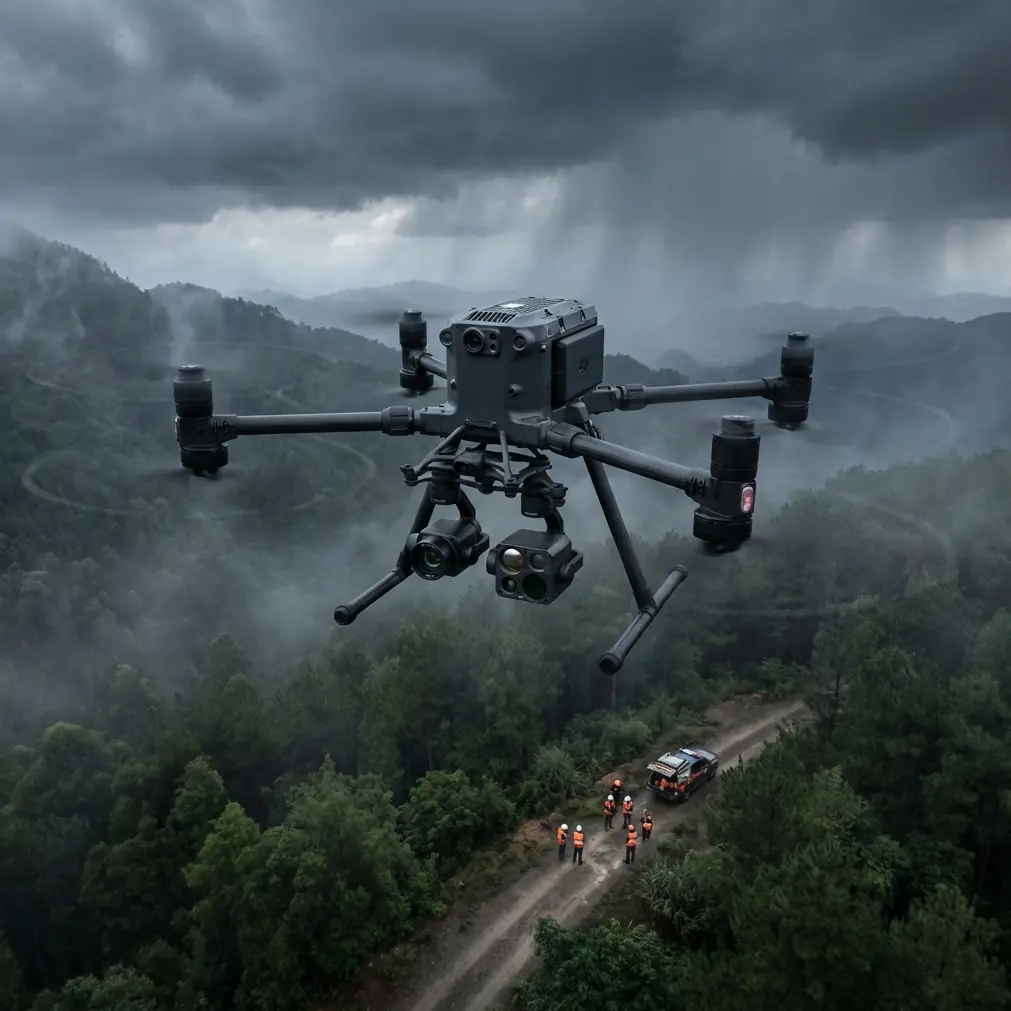
Matrice 400 on Construction Sites: What Actually Matters in Complex Terrain
META: Expert analysis of how the Matrice 400 fits construction delivery and site operations in complex terrain, with practical guidance on range, antenna positioning, thermal workflows, BVLOS planning, and why industrial production depth matters.
Construction delivery sounds simple until the site is cut into a hillside, the access road is half-finished, and the materials team needs something moved from one elevation band to another before weather closes in. That is where the Matrice 400 conversation gets real. Not in brochure language. In terrain, interference, repeatability, and whether the aircraft can fit into an operation that has no patience for downtime.
For construction teams working across uneven ground, the Matrice 400 is interesting for one reason above all: it sits at the point where aircraft capability, sensor flexibility, and industrial support infrastructure begin to matter more than raw flight specs on paper. If you are planning deliveries between staging zones, visual checks on retaining walls, thermal review of temporary power assets, or photogrammetry updates tied to GCPs, the aircraft is only half the story. The other half is whether the wider ecosystem behind it can support hard daily use.
That broader context is easy to miss. One recent report summarized foreign media speculation that China can produce roughly 700,000 drones per month, then argued that even this number is too low. There were no detailed breakdowns attached, but the implication is still significant for commercial operators: the scale of drone manufacturing capacity behind major platforms may be far larger than many outside observers assume. For a construction business evaluating the Matrice 400, that matters less as a headline and more as an operational signal. Deep production capacity usually points to stronger parts availability, more resilient supply chains, and a better chance of keeping aircraft flying through a long project cycle rather than treating them like fragile specialty equipment.
On a remote site, that difference shows up quickly. If a delivery aircraft is grounded because a consumable or structural component takes too long to source, the payload never leaves the laydown yard. The lift plan gets redone by hand crews. Site efficiency evaporates. Large-scale manufacturing depth does not guarantee smooth support, but it often correlates with a healthier service environment. For project managers running multiple flights per day, that is not background noise. It is risk management.
The real problem: terrain breaks neat drone assumptions
Construction in complex terrain creates three problems at once.
First, line of sight degrades unpredictably. Ridgelines, scaffold towers, unfinished concrete cores, temporary steel, and moving equipment all disrupt clean links. A drone can be well within nominal range and still suffer because the geometry is wrong.
Second, every mission type competes for priority. One hour the aircraft may be supporting short-hop delivery of tools or small critical parts. The next, it is collecting photogrammetry for progress claims. Then it is doing a thermal signature pass over generators, switchgear housings, or water ingress zones in a retaining structure.
Third, downtime is expensive in a way many office-side planners underestimate. Construction schedules are not just tight; they are interdependent. Delay one site handoff and three subcontractors lose usable time.
This is why the Matrice 400 discussion should be framed as a systems problem, not a drone purchase decision.
Why the Matrice 400 fits mixed construction missions
A serious construction aircraft has to bridge logistics and information capture. That is where the Matrice 400 stands out in practice. It is relevant because it can sit in the overlap between delivery support, visual inspection, thermal work, and mapping workflows rather than forcing teams to maintain a fragmented fleet.
Take photogrammetry. On complex sites, the challenge is rarely “can the drone take photos?” The challenge is whether those images can be collected consistently enough to produce repeatable models tied to GCP networks. If your cut-and-fill calculations, stockpile measurements, and progress surfaces need to match week over week, the platform has to support stable mission planning and predictable execution. The Matrice 400 conversation belongs here because enterprise construction teams do not just want attractive models; they want data they can defend in coordination meetings.
Thermal operations are another overlooked advantage. Thermal signature review on construction projects is often associated with building envelope work later in the schedule, but it has value much earlier. Temporary electrical assets, overloaded distribution points, water accumulation hidden behind formwork, and heat anomalies in mechanical staging areas all benefit from a platform that can switch from visual to thermal workflows without changing the entire field process. When one aircraft can cover both visual and thermal tasks in the same operating window, the site gets more usable output from the crew already deployed.
Then there is delivery. Not large-scale logistics theater. Practical internal movement. A cable spool adapter, a sensor module, fastening kits, or survey consumables moved between inaccessible areas can save a team from a 40-minute round trip over unstable ground. On some sites, a short aerial transfer is not about novelty. It is the fastest way to preserve labor hours and reduce unnecessary foot traffic in high-risk zones.
Antenna positioning advice for maximum range
This is the point that operators usually ask about after they have already had one bad day on site.
If you are relying on O3 transmission in complex terrain, antenna positioning is not a fine detail. It is mission-critical. The goal is not simply to point the controller at the drone. The goal is to preserve the best possible antenna orientation while minimizing obstruction from your own body, nearby vehicles, steel containers, and terrain edges.
Three rules matter:
1. Stand higher than the clutter, not just closer to the route
Operators often choose launch points based on walking convenience. That is a mistake. In broken terrain, a slightly elevated control position with a clean forward view usually outperforms a closer low point boxed in by equipment or berms. A few meters of added vertical separation can restore link quality far more effectively than reducing horizontal distance.
2. Keep the antenna faces aligned with the aircraft’s expected path
Do not let the controller drift into a casual downward angle while monitoring the screen. If the route bends around a slope, reposition your body early so the antenna orientation follows the aircraft’s line, especially near terrain masks and structural occlusions. The weak point is often not mid-route. It is the transition at the edge of obstruction.
3. Avoid self-shadowing and metallic interference
Standing beside a pickup, on top of rebar bundles, or near stacked steel can wreck a good link budget. The same goes for having your torso between the controller and the aircraft. On paper, transmission systems are robust. On active job sites, they are still subject to basic radio physics.
That matters for more than video comfort. A stable transmission path is tied directly to safer decision-making in delivery corridors, more reliable framing during inspection passes, and smoother handoffs if your operation is moving toward BVLOS planning under approved frameworks.
Security and continuity are not side issues
Construction data is more sensitive than many firms admit. Site layouts, infrastructure progress, utility placements, and project sequencing all have commercial value. If you are running a connected enterprise workflow, AES-256 level protection is not a bullet point to skim past. It matters because drone operations are no longer isolated from project controls. Mapping outputs, thermal records, and route logs are all part of a bigger digital chain.
The same goes for battery workflow. Hot-swap batteries are not exciting until you are trying to keep a survey window open before afternoon winds pick up, or when a delivery flight has to be followed immediately by a thermal inspection while the shutdown window is still active. On a real site, battery swap efficiency often decides whether the aircraft supports the schedule or slows it down.
This is one of those places where the industrial backbone behind the platform again becomes relevant. A drone built for enterprise work is not just a flying camera. It is an asset expected to survive repeated cycles of transport, setup, mission execution, battery exchange, and field handling without turning every sortie into a maintenance event.
What manufacturing depth tells us about field confidence
That earlier reference to the 700,000-drone-per-month speculation deserves a second look. Even though the source did not provide a full methodology, its main claim was clear: outside estimates may still be undercounting actual production capacity.
For Matrice 400 operators, the significance is practical rather than abstract. Scale tends to improve standardization. Standardization supports replacement parts, battery availability, support knowledge, and fleet consistency. On large construction programs, consistency is gold. If one site team learns a workflow for payload integration, battery handling, or antenna management, that procedure should transfer cleanly to another crew. The larger and more mature the industrial base, the easier that usually becomes.
There is a parallel here in the aircraft design references. One document highlights manufacturing realities around stainless steel components, including processing windows such as 950–1050°C water cooling for certain material states and the risk of brittleness or cracking if fabrication and heat-treatment rules are mishandled. Another points to standards for sheet-metal bending and tolerances, including minimum bend radius considerations. These are not drone marketing details, but they reveal something essential about aerospace-grade hardware: reliable flight systems depend on disciplined material control and manufacturing standards, not just design intent.
Why does that matter to a construction operator? Because the aircraft you fly over unstable slopes and half-completed structures is only as dependable as the quality discipline embedded in its components. Welding behavior, heat treatment, deformation limits, tolerance control—those are the invisible factors behind fatigue life, structural repeatability, and service durability. You may never see them directly in the field, but you will feel them in long-term fleet reliability.
A practical Matrice 400 workflow for difficult sites
Here is a simple way to think about deploying the Matrice 400 on a complex construction project.
Start the day with a control-point-aware photogrammetry mission while the light is steady and ground teams can still access GCP markers without conflict. Use that output to update earthworks progress, haul-road changes, and stockpile conditions.
Keep a second mission profile ready for short internal delivery tasks. These should be tightly bounded, repeatable, and coordinated with ground spotters and site logistics. The value is not distance. It is reducing wasted labor movement over rough or hazardous terrain.
Then reserve an inspection block for thermal signature work around temporary utilities, pump stations, power distribution nodes, and moisture-prone structural zones. That sequence makes sense because it pulls the most from the platform in one operational cycle without forcing constant reconfiguration.
If your team is advancing toward BVLOS operations, terrain analysis and communication planning need to happen before route approval, not after the first signal issue. Build your route assumptions around likely occlusion points. Identify alternate operator positions. Test antenna orientation from each point. Do not let “range” remain a theoretical number detached from the actual topography.
Where operators usually go wrong
The common mistakes are predictable.
They launch from where the truck is parked instead of where the radio link is strongest.
They treat delivery, mapping, and thermal tasks as separate drone programs, which multiplies equipment burden and crew complexity.
They ignore battery turnover efficiency until the project enters a compressed schedule.
They assume transmission resilience will overcome poor site geometry.
And they underestimate the value of a platform backed by serious manufacturing scale and industrial process discipline.
That last point is less flashy than payload specs, but it may be the one that decides whether the aircraft remains useful after month six.
Final thought for construction teams evaluating the Matrice 400
The Matrice 400 makes the most sense on construction sites where terrain, schedule pressure, and mission variety all collide. Its value is not simply in moving something through the air or collecting imagery. Its value is in reducing friction across multiple field tasks without asking the site to build a new workflow around every mission.
If you are comparing options, ask harder questions than flight time and payload. Ask how well the aircraft fits a daily sequence of delivery, photogrammetry, and thermal work. Ask how antenna positioning and O3 transmission will behave from the control points your terrain actually allows. Ask whether hot-swap battery workflow matches your schedule reality. Ask whether the ecosystem behind the platform is deep enough to support a long build cycle.
Those are the questions that separate an impressive demo from a useful fleet asset.
If you want to talk through a site-specific layout, routing logic, or control-position strategy, you can send your project setup here: share your construction mission details
Ready for your own Matrice 400? Contact our team for expert consultation.