
Matrice 400 Mountain Delivery: Practical Setup Lessons
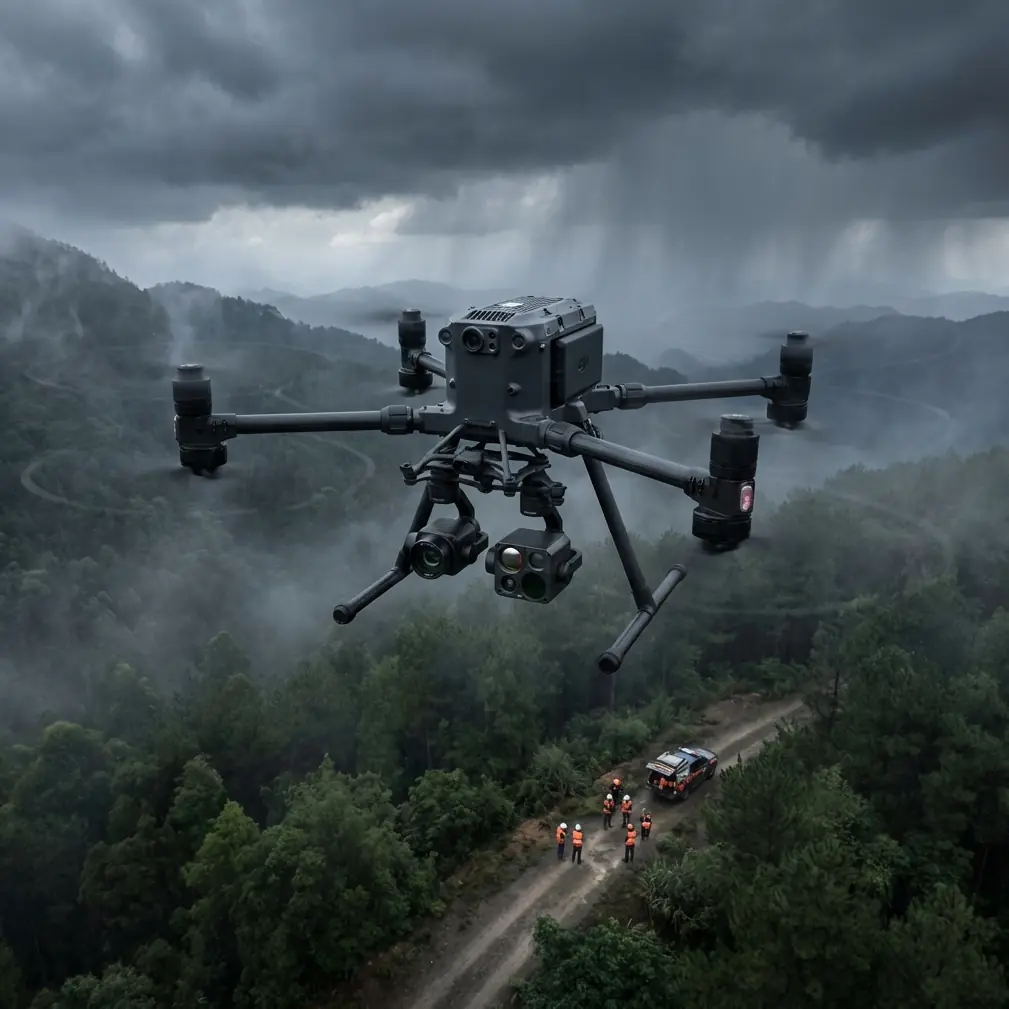
Matrice 400 Mountain Delivery: Practical Setup Lessons from Sling Dynamics and Lock Reliability
META: A field-focused Matrice 400 tutorial for mountain delivery missions, covering suspended-load stability, battery handling, lock behavior, BVLOS planning, O3 transmission, AES-256 links, and photogrammetry-informed route prep.
Mountain delivery looks simple on a whiteboard. Pick up the payload, clear the ridgeline, fly the route, drop or place the load, return home. In actual terrain, the aircraft is rarely the only moving system. The payload moves too. The attachment hardware moves. The air mass changes by the minute. And once you start carrying supplies over steep slopes, the hardest part is often not thrust or endurance, but managing what hangs beneath the drone.
That is where a Matrice 400 workflow needs to be more disciplined than many operators expect.
This tutorial is built around two engineering ideas pulled from helicopter and hydraulic locking design references: first, suspended loads can enter damaging vertical oscillation if system stiffness and natural frequency are not controlled; second, lock mechanisms depend on more than raw force, because geometry, friction, hydraulic assist, and spring preload all affect whether they release and re-engage predictably. Those ideas were developed for larger aircraft systems, but the operational logic carries directly into civilian mountain delivery with a heavy-lift UAV such as the Matrice 400.
Start by treating the payload as part of the aircraft
Operators new to mountain delivery often think in terms of payload mass alone. That is too crude. Two loads with the same weight can behave very differently if one is compact and rigidly attached while the other hangs on a longer, more flexible connection.
One reference point from rotorcraft sling design is especially useful: when oscillation starts building, the practical way to suppress amplified vertical bounce is to control stiffness so the suspended system’s frequency stays below the airframe’s first bending-related response range. The source also notes that if a low-stiffness isolator keeps the external load frequency below about 0.6 times the critical excitation frequency, resonance and structural coupling can be avoided.
Why does that matter to a Matrice 400 pilot delivering into mountain fields?
Because the drone, hook assembly, sling, and cargo are not four separate issues. They form one mechanical system. If your delivery kit is too rigid, short, or mismatched to the load, a route that looked stable over flat ground can become unpleasant once the aircraft climbs through rotor wash recirculation near a slope, crosses a saddle, or brakes sharply over a terrace. The aircraft may still be within payload limits, yet the oscillation can grow enough to degrade control precision, camera visibility, landing placement, and battery efficiency.
The reference text also gives a simple but powerful engineering reminder: when two springs are in series, the combined stiffness is lower than either spring alone. In practical field terms, that means a compliant element inserted between aircraft and cargo can soften the system far more effectively than most crews assume. You do not need to think like a textbook author to use that insight. You just need to stop treating the delivery line as dead weight.
A good mountain delivery rig is not always the shortest rig
In steep agricultural zones, crews love short suspension lines because they feel tidy and reduce perceived pendulum risk. But mountain work is full of tradeoffs. A line that is too short and too stiff can transmit more vertical disturbance directly into the aircraft. The helicopter design reference explicitly points to adjusting line length, material, and cross-sectional characteristics to tune stiffness. It even mentions flight-time length changes via winch systems as a way to reduce bounce once it appears.
For a Matrice 400 operation, that translates into a practical pre-mission question:
Are you choosing your attachment geometry for convenience, or for dynamic behavior?
A compact, high-tension setup may be fine for moving a rigid tool box 200 meters across a calm valley. It may be a poor choice for fertilizer packs, seed trays, irrigation parts, or wrapped supplies delivered onto uneven mountain plots where the aircraft must slow, hover, descend, and reposition in turbulent air.
My preferred field method is to test each delivery kit in three stages:
Static hang test on the ground
Check whether the load settles cleanly or stores obvious torsional energy in the connection. If the rig wants to twist before the motors even spool up, it will not improve in the air.Low-altitude acceleration and braking passes
Fly short, straight segments and deliberately vary speed. Watch for vertical bounce after deceleration, not just side swing.Short hover over uneven terrain upwind and downwind
This exposes how the system reacts when mountain airflow breaks cleanly on one side and tumbles on the other.
If the load starts a rhythmic up-and-down motion, do not only blame pilot input. Revisit the rig stiffness. That is often the root issue.
Why the lock matters as much as the line
The second reference concerns a hydraulic ball-lock mechanism. On paper, it sounds remote from UAV delivery. In practice, it is a sharp reminder that release systems are not binary. They are motion systems with thresholds.
The source explains that during unlocking, a steel ball follows a controlled rolling path around a ring feature, including a 45° tangential line segment in the motion path. During relocking, hydraulic force pushes the piston, reaction force compresses the spring, and the ball rolls back along the arc before being driven up the inclined surface into the locked position. The text then discusses spring-force selection and gives useful operating thresholds: responsive locking should occur at pressures no greater than 2 MPa, maximum unlocking pressure should not exceed 2.2 MPa, and minimum unlocking pressure should not fall below 0.7 MPa.
You are not going to convert those exact hydraulic numbers directly into a Matrice 400 cargo hook checklist. But the principle is gold: reliable release and re-lock depend on force margins, friction, travel path geometry, and neutral positioning. Not just “does it open.”
For civilian mountain delivery, that has real implications:
- A hook that bench-tests perfectly with a clean metal ring may behave differently with dust, fertilizer granules, mud splash, or cold-stiffened straps.
- A release system that works with a centered vertical load may hesitate when the aircraft is slightly pitched and the attachment point is side-loaded.
- A mechanism that unlocks well may not re-seat consistently if the spring force is too weak to establish a stable neutral state after repeated cycles.
That is why I advise operators to do more than a simple release test. Do repeat-cycle tests with realistic field contaminants and with slight off-axis loading. If your mountain route involves multiple drops in one sortie, consistency matters more than a single perfect demonstration at the staging area.
Route planning: use mapping to reduce dynamic surprises
Mountain delivery is often discussed as a pure transport problem. It is really a terrain-model problem first.
If you are flying the Matrice 400 into stepped fields, tea terraces, orchard benches, or remote crop plots, use photogrammetry before regular delivery operations begin. Build a high-quality surface model, tie it with GCP where practical, and identify terrain pinch points that create turbulence and signal shadowing. This is not administrative overhead. It changes route design.
A photogrammetric base map helps you answer questions that matter mechanically:
- Where can the aircraft transition from climb to level flight without aggressive braking?
- Which approach corridor avoids crossing a rotor-prone ridge at low speed?
- Where is there enough vertical clearance for a suspended load to remain well clear of vegetation and utility lines?
- Which delivery spots force the drone to hover over thermally active rock or patchy canopy that can disturb the load?
Pair that map with thermal work if you fly near dawn or late afternoon. A thermal signature survey can reveal sun-heated rock faces and shaded airflow zones that often correlate with localized instability. That is not a replacement for pilot judgment, but it gives you a better first draft of the route.
O3 transmission and encrypted links are not just spec-sheet items
Mountain flying punishes weak communications. Ridge masking, vegetation, and oblique antenna geometry can all degrade the link at the wrong time. For Matrice 400 operators, O3 transmission capacity matters less as a marketing label than as a route-shaping constraint. You need line-of-sight logic, not optimistic assumptions.
The same goes for AES-256. In a delivery workflow, encrypted links are part of operational integrity. They help protect route data, aircraft control sessions, and mission files, which matters when farms, cooperatives, or infrastructure sites expect professional handling of location information. Security in this context is not abstract. If your mapped routes and delivery points are sensitive business data, transmission hygiene belongs in the SOP.
For BVLOS-oriented planning where local regulations and approvals permit, mountain terrain raises the bar. Do not simply ask whether the aircraft can reach the field. Ask whether the entire communications chain, observer plan, emergency path, and return profile remain robust if the payload starts behaving differently from the outbound leg. The suspended-load dynamics discussed earlier should feed directly into your BVLOS risk model.
Battery management tip from field experience
Here is one lesson crews usually learn the expensive way: in mountain delivery, the battery event that hurts you most is often not low percentage. It is voltage sag after a long climb with a moving load, followed by a hover adjustment at the drop zone.
With hot-swap batteries, many teams get comfortable because turnaround is fast. Fast turnaround is useful, but it can hide bad discipline. I tell crews to separate batteries into mission roles: climb-intensive packs, mapping packs, and reserve packs. Do not rotate them randomly all day.
My field rule is simple:
- Never send a battery set straight from a hard climb mission into another mountain delivery without checking temperature balance and recent voltage behavior.
- If one pack in the pair is consistently ending a sortie warmer than the other, investigate before the next flight. That asymmetry often appears before crews notice reduced delivery precision.
- During staging, keep replacement packs out of direct sun and away from cold-soaked stone surfaces. Mountain sites exaggerate both heat gain and heat loss.
A Matrice 400 can tolerate professional duty cycles, but mountain work exposes weak battery habits quickly. Hot-swap capability should be used to preserve mission rhythm, not to encourage rushed decisions between sorties.
Build a delivery SOP around dynamic control, not just navigation
A solid Matrice 400 mountain delivery SOP should include these checkpoints:
1. Payload characterization
Record not only mass but packaging rigidity, center of gravity, attachment type, and whether the load deforms in airflow. A feed bag and a boxed pump may weigh the same and fly completely differently.
2. Rig stiffness selection
Where possible, standardize line materials and lengths by payload class. Remember the reference lesson: system stiffness drives oscillation behavior, and adding compliance in series reduces total stiffness.
3. Release-mechanism validation
Test for contamination, repeated cycles, and off-axis loading. The hydraulic lock reference reminds us that geometry, friction, and spring force all shape lock reliability.
4. Terrain-informed route design
Use photogrammetry and GCP-backed maps to choose corridors that minimize abrupt transitions near slopes and terraces.
5. Link resilience
Validate O3 performance on the exact route, not on a generic site survey. Maintain encrypted operational practice with AES-256-enabled workflows where supported.
6. Battery role management
Segment battery sets by task profile and monitor paired-pack behavior rather than relying on percentage alone.
7. Abort logic
Define explicit criteria for load oscillation, link degradation, and unexpected hover power draw. Crews should not improvise these thresholds in the air.
One operational habit that saves time
Before the first real delivery of the day, fly a “ghost route” with the exact rig but a non-critical training load. Match the expected climb, cruise, slowdown, and hover sequence. This catches two common problems early: a rig that is dynamically too stiff for the morning conditions, and a release setup that behaves differently once dust or moisture enters the mechanism.
If your team wants a second pair of eyes on a route plan or suspended-load workflow, you can message our mountain UAV operations desk here: https://wa.me/85255379740. Use that before scaling from trial runs to regular field deliveries.
The larger lesson for Matrice 400 mountain work
The Matrice 400 is capable, but capability alone does not make a delivery program reliable. Mountain operations reward crews who think in systems.
The first reference teaches that suspended loads become manageable when you control stiffness and avoid frequency coupling. The second shows that lock performance is governed by motion path, preload, and friction, not just a pass/fail release command. Put those ideas together and the result is a better delivery doctrine: tune the rig, test the mechanism realistically, map the terrain properly, protect the link, and manage batteries with more nuance than a charge percentage.
That is how you turn a heavy-lift UAV from a promising platform into a dependable mountain logistics tool for farms and remote fields.
Ready for your own Matrice 400? Contact our team for expert consultation.