
Matrice 400 in Mountain Forest Delivery: What Actually
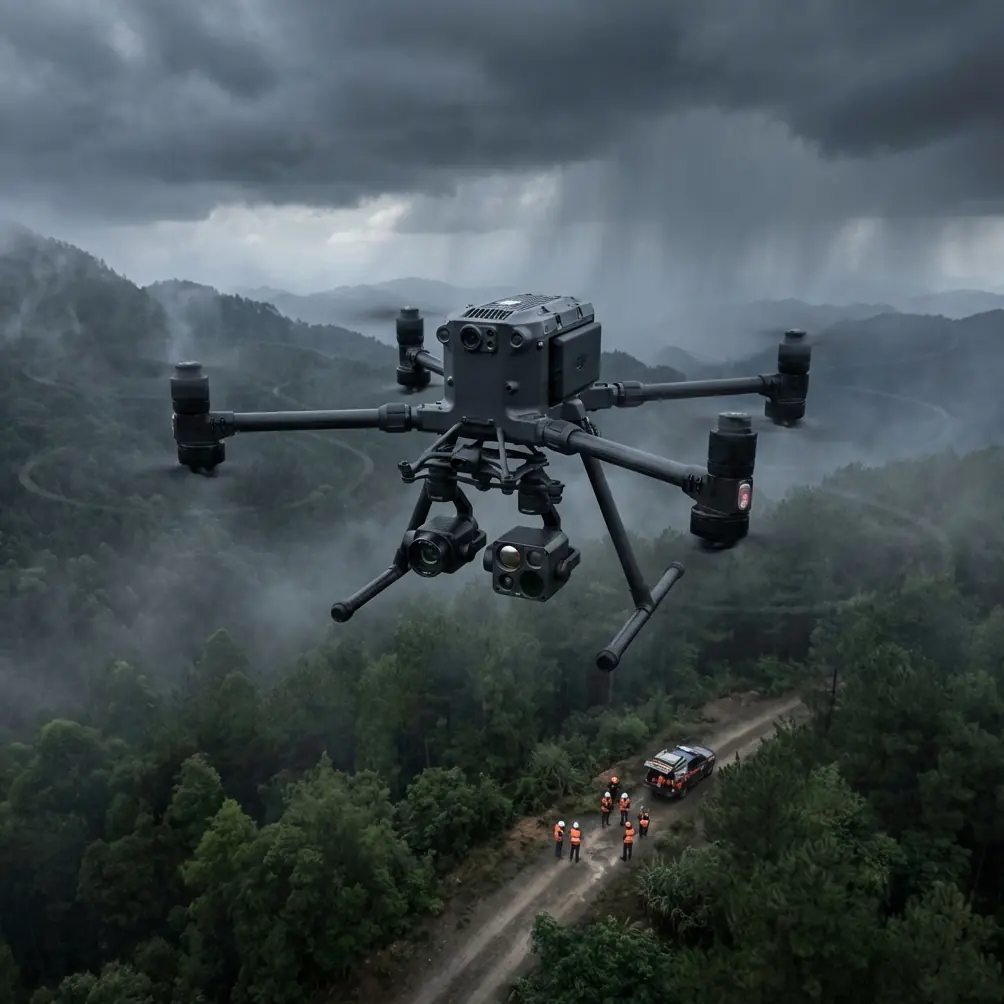
Matrice 400 in Mountain Forest Delivery: What Actually Matters When Weather Turns Mid-Flight
META: A field-driven Matrice 400 case study on mountain forest delivery, focused on reliability, test logic, onboard diagnostics, and hardware details that matter when conditions change in the air.
By Dr. Lisa Wang, Specialist
Mountain forest delivery sounds simple until the route stops behaving like the map.
Tree canopies distort depth perception. Ridge lines break signal geometry. Moisture creeps into every connector decision. And the weather, especially in upland forests, has a habit of changing its mind halfway through a mission. That is why the most useful way to evaluate the Matrice 400 is not as a spec-sheet object, but as a working aircraft inside a difficult civilian logistics task.
This case study looks at a forest delivery scenario built around one central question: what lets a Matrice 400 keep a mission controlled, traceable, and recoverable when the environment becomes less cooperative than the flight plan assumed?
The answer is not one feature. It is the relationship between testability, component design, and how those choices show up in real operations.
The mission profile: a forest run with no tolerance for guesswork
The scenario was a mountain logistics run into a forested area where road access had been reduced by slope instability and recent rainfall. Payload urgency was practical rather than dramatic: field supplies, replacement survey tools, and small environmental monitoring components for a remote forestry team. Civilian work. Time-sensitive, but not reckless.
The route crossed uneven terrain with canopy breaks, narrow wind corridors, and a ridgeline that regularly interfered with transmission paths. This is exactly where readers interested in BVLOS planning tend to focus on the obvious items—range, batteries, link quality—but the hidden factor is diagnostic confidence. If the aircraft reports an issue mid-mission, can the system identify it clearly enough for the operator to make the right call immediately?
That question sits at the heart of one of the reference documents behind this article. In the avionics design handbook, the emphasis is not just on whether onboard testing exists, but on a system’s ability to detect faults, isolate them, and correlate onboard test indications with offline test results. That distinction matters far more in mountain delivery than many teams realize.
A drone that merely says something is wrong creates hesitation. A drone architecture built around effective BIT—built-in test—supports action.
Why testability is not an engineering footnote
The first source, from the avionics systems and instruments design manual, discusses detailed testability validation. One of its key points is the effectiveness analysis of BIT and offline testing, with fault detection and fault isolation treated as separate but linked objectives. It also explicitly calls for FMEA, or failure mode and effects analysis, as the basis for predicting failure totals and evaluating whether the selected testing approach can actually identify the important faults.
That sounds abstract until weather shifts in the field.
On this mission, the outbound leg started under stable conditions: cool air, manageable crosswind, and predictable visibility over the treeline. About midway through the route, a low cloud shelf moved in across the ridge faster than forecast. Airflow stiffened along one valley wall, and moisture levels rose enough to flatten contrast in parts of the visual scene. For crews using thermal signature analysis to maintain situational awareness around canopy and landing zone conditions, this kind of change can degrade interpretation quickly. Not catastrophically, but enough to turn a comfortable operation into a disciplined one.
This is where a robust testing philosophy becomes operational, not theoretical.
A well-designed platform should already have gone through the kind of iterative internal test design described in the source: refining internal tests on major components until each test effectiveness value reaches a required threshold. The manual is clear on that point. It also notes that as design work deepens, test modules and software should be further modified to improve test effectiveness prediction.
In plain language, the aircraft should not be improvising its own health logic when the mission gets complicated. It should be relying on a diagnostic structure that has been repeatedly sharpened before the aircraft ever reaches the forest.
For Matrice 400 operators, this translates into something practical: when weather changes mid-flight, confidence in onboard health reporting becomes part of flight safety and mission continuity. You are no longer just asking whether the aircraft flies. You are asking whether the system’s self-assessment is trustworthy enough to support a continue, divert, or recover decision.
Signal integrity is only half the story
Many mountain operators naturally center O3 transmission performance, especially when a ridgeline interrupts clean geometry between aircraft and control position. That is sensible. Stable transmission is foundational, and encrypted communications such as AES-256 matter when the aircraft is carrying mapping, environmental, or logistics data that should remain protected.
But transmission resilience alone does not solve the full mission problem.
If the uplink remains strong while onboard subsystems produce ambiguous fault cues, the crew is still stuck. The handbook source specifically stresses the relationship between onboard test fault indications and offline test results. That is a big deal. It means the health messages presented in the field should correspond meaningfully with what maintainers later verify on the bench. Without that alignment, operations teams start distrusting alerts, and once that happens, the aircraft can be technically sophisticated yet operationally blunt.
In forest delivery, distrust is expensive. It can lead to aborted flights that did not need to be aborted, or worse, continuation of a mission when a real subsystem issue deserved immediate attention.
A mature Matrice 400 workflow should therefore be built around two linked disciplines:
- Real-time interpretation of BIT outputs during flight.
- Post-flight confirmation that those outputs match offline maintenance findings.
That is not bureaucracy. It is how teams develop a drone fleet that remains dependable under pressure.
The weather turn: what changed and how the operation adapted
The key moment in this mission came during descent toward the drop site. Wind accelerated unevenly through a cut in the trees, and mist began moving laterally across the landing zone. Visual texture dropped. Thermal signature readings stayed useful, but not in the same way they had earlier in the flight; moisture altered contrast and demanded a more conservative reading of the scene.
At the same time, the crew had to reassess energy planning.
This is where hot-swap batteries become more than a convenience feature in the broader Matrice 400 ecosystem. In mountain delivery work, battery strategy is a schedule tool and a risk-control tool. If a crew has to absorb weather delay, re-stage quickly, and relaunch after diagnostics or route adjustment, minimizing turnaround time matters. Hot-swap capability supports that tempo, but only if paired with disciplined test logic. Fast battery exchange does not help if the aircraft’s health state is uncertain.
The avionics reference also highlights system-level BIT hardware and software integration and warns about evaluating false alarm potential. That is another field-critical detail. In wet, variable mountain environments, crews cannot afford a system that cries fault too easily, nor one that masks marginal conditions. False positives waste weather windows. False negatives are worse.
The mission succeeded because the crew treated onboard diagnostics as part of the operational environment, not separate from it. They slowed the descent profile, adjusted the approach geometry to avoid the strongest valley-side turbulence, and used the aircraft’s data with skepticism in the healthy sense: trust the system, verify by procedure.
That is what professional drone logistics looks like in forests. Not panic. Not swagger. Method.
Small hardware choices shape big mission outcomes
The second reference source may seem far removed from a Matrice 400 story at first glance. It comes from a standards volume on pipeline connections and sealing, including a table of connection and assembly references in millimeters. Yet it speaks directly to a truth every serious UAV team learns eventually: rugged operations are often won or lost at the interface level.
The table includes dimensional groupings such as 2, 3, 4, 6, 8, and 10 mm, and extends to larger values like 30, 32, and 35 mm, tied to specific assembly drawing numbers such as HB4-44C, HB4-36-dxL, and HB4-45G-CdD. The exact part-number family is less relevant here than the design philosophy behind it: standardized connection geometry and sealing practice are what prevent field systems from becoming improvisational.
Why does that matter in a mountain forest delivery scenario?
Because moisture ingress, vibration, and repeated transport cycles attack weak interfaces first. Any payload installation, sensor integration, auxiliary power routing, or environmental enclosure attached to a heavy-duty commercial drone depends on consistent sealing and connection standards. If your forest mission includes photogrammetry gear, thermal modules, or payload-specific housings, the mechanical integrity of the connection stack determines whether the sensor stays dependable after repeated exposure to mist, altitude temperature swings, and rough staging areas.
In other words, the route may be dramatic, but the mission often fails in the millimeters.
The standards source is a reminder that connection and sealing design is not glamorous, yet it is one of the foundations of reliability. For Matrice 400 teams customizing aircraft for logistics, mapping support, or forestry survey payloads, this is a strong argument for resisting ad-hoc mounting and cable practices. Standardized assemblies reduce variability, and reduced variability improves diagnostic clarity. When something does go wrong, you can isolate the issue faster because the hardware baseline is disciplined.
That ties directly back to the first document’s emphasis on fault isolation.
Mapping support during delivery: why photogrammetry and GCP still matter
This forest mission was primarily a delivery task, but the aircraft was also supporting route validation for future flights. That is where photogrammetry and GCP workflows came into play.
In mountain forests, delivery routes improve over time when teams stop treating them as one-off flights. Repeated photogrammetric capture allows operators to build more reliable terrain understanding around canopy openings, temporary staging areas, and slope changes after rainfall. Ground control points, used selectively and realistically, can tighten accuracy where landing or drop-zone repeatability matters.
This is not about turning every logistics run into a survey project. It is about making each mission contribute to the next one.
When a weather event alters surface conditions, washout patterns, or vegetation density near a receiving site, updated mapping helps operators decide whether the original approach path still makes sense. The Matrice 400 becomes more valuable when it is part transport aircraft, part information platform.
That hybrid role only works if the aircraft’s data chain remains secure and its subsystem health remains intelligible. Again, AES-256 and transmission quality matter, but they are most meaningful when paired with strong onboard test design and maintainable hardware standards.
A better way to judge Matrice 400 readiness
If you are evaluating Matrice 400 for forest delivery in mountain terrain, skip the temptation to ask only how far it goes or how much it carries. Those questions matter, but they are incomplete.
Ask these instead:
- How credible are the aircraft’s onboard fault indications in changing weather?
- Can BIT results be meaningfully checked against offline diagnostics?
- Has the integration work around payloads, cables, and seals been standardized, or is it held together by workshop improvisation?
- Does the team understand false alarm behavior well enough to avoid wasting narrow operating windows?
- Are mapping and route-learning workflows feeding back into delivery planning?
Those questions come straight out of the logic embedded in the two source references, even though one focuses on avionics testability and the other on connection and sealing standards. Put together, they point to the same operational truth: resilience comes from design discipline.
That is what stood out in this mission. The Matrice 400 was not impressive because it ignored the weather shift. It was impressive because the operation had the structure to adapt when that shift happened.
For teams building similar workflows, especially in forestry, remote infrastructure support, or environmental field logistics, that is the real benchmark.
If you want to compare your own mountain delivery workflow or discuss payload integration choices for forest operations, you can message our technical team here: https://wa.me/85255379740
The strongest drone programs do not rely on perfect conditions. They rely on platforms and procedures that stay legible when conditions stop being perfect. In mountain forests, that difference is everything.
Ready for your own Matrice 400? Contact our team for expert consultation.