
Delivering Through Forest Corridors With Matrice 400
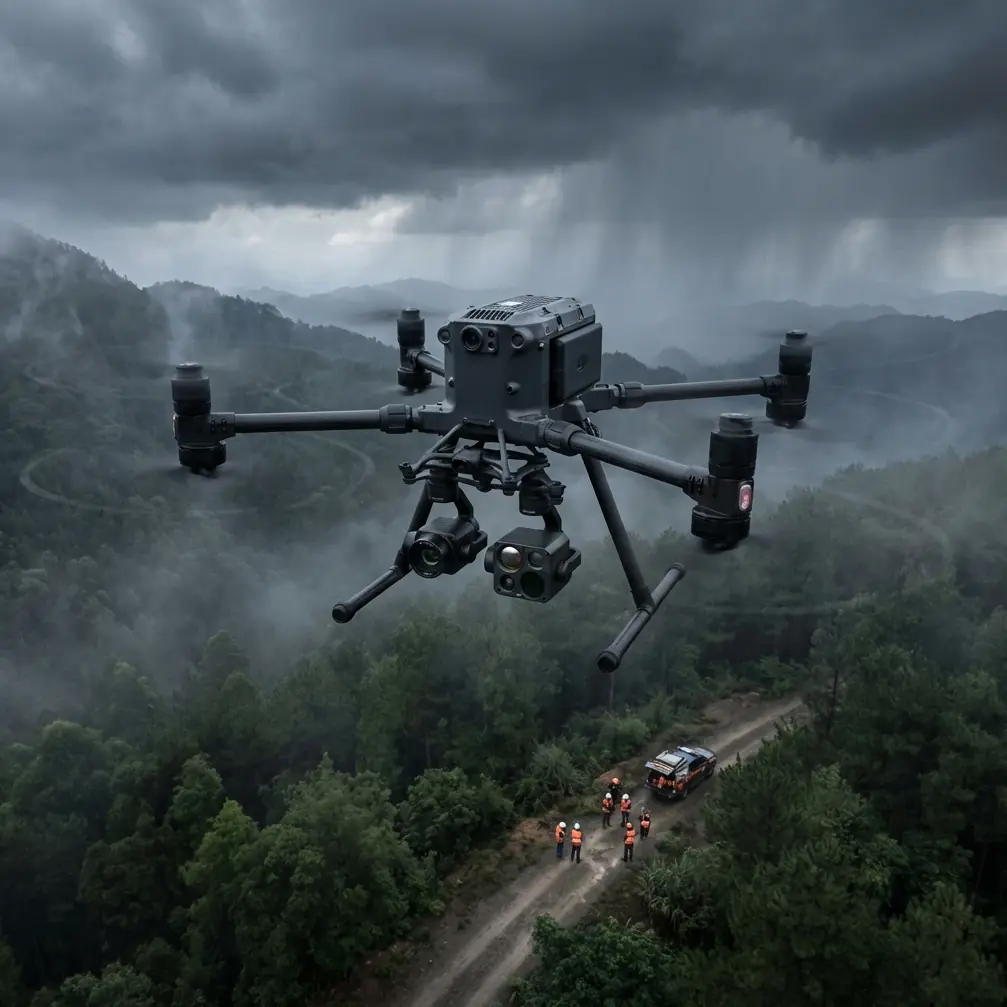
Delivering Through Forest Corridors With Matrice 400: Practical Tips That Actually Matter
META: Expert field guide to using Matrice 400 for remote forest delivery, BVLOS planning, antenna positioning, thermal checks, O3 transmission stability, and safer power management.
Remote forest delivery looks simple on a map. Draw a line from a trailhead to a ranger station, load the aircraft, and fly. In the field, the problem changes shape. Tree canopies block sightlines. Terrain bends radio paths. Payload demands shift power needs from hover to climb to descent. If you are evaluating the Matrice 400 for this kind of work, the most useful discussion is not a brochure summary. It is how control, transmission, and airframe behavior interact when the route is long, isolated, and operationally unforgiving.
That is the lens I would use for the Matrice 400.
The reference material behind this article comes from helicopter design literature rather than a drone manual, but the lesson is surprisingly relevant. One source explains that in rotorcraft, the power system and the rotor system cannot be treated as separate worlds. The free turbine, rotor drive, and associated rotating components are tied together, so speed control becomes a shared aircraft parameter, not just an engine parameter. Another detail from the same source is even more operationally useful: because rotor inertia is large, rapid lift changes are better achieved through quick pitch changes while rotor speed is kept stable. That principle matters in remote delivery because your aircraft’s response to terrain, payload, and wind is never just about “more throttle.” Stable lift management depends on coordinated control.
For Matrice 400 operators, that translates into one core idea: the aircraft performs best when you think in systems, not settings.
Why forest delivery punishes lazy setup
A forest route is rarely a straight RF environment. Even if the mission is legally structured for BVLOS under the proper local framework, the aircraft still has to maintain robust command and telemetry links while moving through variable clutter. Dense trunks and wet foliage attenuate signals. Ridgelines create partial shadowing. A route that is clean at 90 meters above takeoff point may become unstable after crossing into a lower valley where the controller’s effective line of propagation is interrupted.
This is where O3 transmission performance, antenna orientation, and launch-site choice stop being technical trivia.
A lot of missed-link complaints come from crews who position themselves for convenience rather than geometry. They stand beside a vehicle, under a shelter roof, or at the edge of a treeline because it is comfortable. Then they blame the aircraft when the signal margin deteriorates.
The fix usually starts on the ground.
Antenna positioning advice for maximum range
If you only change one habit before flying Matrice 400 in remote forest delivery, change this one: set up your control position for the radio path, not for shade.
Antenna placement should follow three rules.
1. Build the cleanest possible first Fresnel corridor
You do not need a whiteboard derivation in the field. The practical version is enough: keep as much open space as possible between the controller and the aircraft, especially in the first segment of flight where the link establishes its strongest baseline. If you launch with branches, trucks, metal roofs, or a slope immediately in front of the controller, you are wasting signal quality before the mission begins.
A small rise with a clear departure sector will outperform a lower “convenient” spot almost every time.
2. Aim for broadside exposure, not tip-pointing
Many crews instinctively point antennas directly at the aircraft like laser pointers. That is often the wrong mental model. With typical controller antenna behavior, the stronger zone is usually off the face or side pattern rather than the narrow tip. For long forest corridors, keep the antenna surfaces oriented so the aircraft sits in the strongest lobe during the route, and adjust gradually as the aircraft turns or transitions across terrain.
If your team is struggling with field setup details, you can send route notes and terrain screenshots through this WhatsApp line for mission planning support.
3. Elevate the controller position when the route drops away
This matters more than many operators realize. A route that heads downhill into a valley may look visually open from the launch pad, but radio geometry worsens as the aircraft descends relative to your position and the canopy closes around the path. Even a few meters of operator elevation can materially improve signal resilience. In practical terms: a platform, ridge shoulder, or cleared rise can be worth more than extra transmit optimism.
This is not just about range. It is about preserving command confidence when the payload is headed to a remote team that may be counting on time-sensitive delivery.
What the rotorcraft control lesson teaches Matrice 400 pilots
The helicopter reference lays out a principle that deserves more attention in drone operations: power demand changes continuously across takeoff, hover, climb, cruise, descent, and landing. That sounds obvious, but its implication is often missed. A remote delivery profile through forest does not merely consume battery. It asks the aircraft to transition repeatedly between distinct power states, each shaped by payload mass, air density, route elevation, and wind exposure.
The source text describes good power control in three Chinese characters: “稳、准、快” — stable, accurate, fast. That is excellent advice for Matrice 400 mission design.
- Stable means avoiding unnecessary vertical oscillation, abrupt acceleration, and repeated stop-start corrections near obstacles.
- Accurate means matching the route and altitude plan to the actual canopy and terrain, not the rough estimate in your head.
- Fast does not mean aggressive stick work. It means the control system and the mission plan can respond promptly without overshooting the aircraft’s efficient operating envelope.
This is why delivery crews should test their climb and transition segments with representative payload mass before they ever commit to a real forest route. On paper, a route may be short. In the air, a loaded climb over a ridge, followed by a hover drop or controlled descent into a clearing, can turn a modest mission into a high-draw profile.
Keep lift changes smooth when the aircraft is loaded
The same helicopter source makes another valuable point: when you need quick lift changes, it is better to achieve them through coordinated rotor control while keeping rotor speed stable, because the system has inertia and does not like abrupt speed swings. In plain operational language for drone crews, this means avoiding harsh control inputs that force the aircraft into repeated correction cycles.
With Matrice 400 carrying a delivery payload in a confined forest opening, that principle becomes practical:
- Do not chase position with large vertical inputs.
- Do not arrive hot and then “save” the approach with aggressive braking and throttle changes.
- Do not let the pilot and payload release sequence fight each other.
Instead, shape the final segment early. Reduce speed before entering the drop zone. Hold a predictable altitude reference. Let the aircraft settle into a controlled hover or slow pass. That protects energy reserves, stabilizes payload handling, and reduces sensor blur if you are recording thermal signature or visual data during the delivery.
Thermal signature is not just for search tasks
Operators often associate thermal payloads with wildlife surveys or equipment inspection, but in remote forest delivery, thermal signature can solve very practical problems.
A landing or drop area that looks clear in visible light may hide heat sources, people, animals, or machinery under partial canopy or in shadow. A quick thermal verification pass can help confirm whether the receiving zone is truly isolated enough for a safe approach. It also helps identify recently used vehicles, generators, or camp activity that could change your risk picture.
This is especially useful in mixed missions where Matrice 400 is delivering supplies and collecting situational awareness on the same sortie. The key is not to treat the thermal feed as an optional extra. Treat it as a decision layer before the terminal segment.
Mapping the route first pays off later
Photogrammetry has a role here that many delivery teams skip because they think of it as a separate department’s problem. It is not.
If you build a route corridor model in advance using photogrammetry and tie it down with GCPs, your delivery profile becomes far more dependable. Ground control points matter because they reduce positional drift in the map product, which matters when your chosen crossing point over a canopy gap or stream cut is narrower than it looked in a casual survey.
A route map built with good ground reference lets you answer real operational questions:
- Where does the canopy crest highest relative to the flight path?
- Which valley sections are most likely to degrade O3 link quality?
- Where are the best emergency hover or recovery clearings?
- Which receiving locations require a higher or offset approach to remain above obstacles?
In other words, mapping is not paperwork before delivery. It is route insurance.
Battery strategy in remote work: use hot-swap intelligently
Hot-swap batteries are one of the most useful features in serious field operations, but they are often discussed too casually. In a remote forest workflow, hot-swap capability is not just about reducing downtime. It allows you to preserve mission rhythm while maintaining aircraft readiness between repetitive sorties.
That said, battery turnover should be tied to route phase analysis, not just convenience. If your mission profile includes an energy-heavy outbound climb and a lighter inbound return, don’t estimate endurance from average flight time alone. Build your battery decision around the worst segment. A crew that rotates packs quickly but ignores power-intensive portions of the route is still planning poorly.
The helicopter source’s emphasis on changing power requirements across flight states is directly relevant here. Takeoff, hover, climb, cruise, descent, and landing are not equal drains. A forest delivery with frequent vertical maneuvering can punish packs far more than a flat transit route of similar distance.
AES-256 and BVLOS: the less glamorous side of trust
When teams discuss BVLOS operations, they usually focus on waivers, observers, terrain, and communications continuity. They should. But secure transmission also matters. AES-256 support is not the most visible line item in a mission brief, yet it is part of how operators maintain data trust across long-range infrastructure and logistics work.
That matters if the Matrice 400 is carrying route imagery, site footage, delivery confirmation data, or environmental records from remote commercial operations. Forest logistics can involve sensitive ecological sites, private concession land, utility assets, or infrastructure access points. Link reliability and link security belong in the same conversation.
A field workflow that works better than improvisation
If I were building a repeatable Matrice 400 forest delivery workflow, it would look like this:
- Survey the corridor first with photogrammetry where practical, and tie critical areas with GCPs.
- Choose the control point for radio geometry, not operator comfort.
- Validate antenna orientation on the actual departure heading before launch.
- Model battery use by flight phase, especially climb and hover with payload.
- Use thermal signature checks for drop-zone verification when people, animals, or equipment may be present.
- Keep terminal handling smooth, prioritizing stable aircraft behavior over rushed completion.
- Debrief every signal dip against terrain and canopy, then adjust the route instead of repeating the same weak segment.
None of that is flashy. All of it saves missions.
The bigger takeaway for Matrice 400 operators
The most useful message from the reference material is not about helicopters as such. It is about coordination. In the cited design text, the power system and rotor system must be developed together because one cannot be controlled intelligently in isolation from the other. That same mindset separates polished Matrice 400 operations from amateur ones.
Forest delivery is not a payload problem alone. It is a control problem, a transmission problem, a route-modeling problem, and a power-management problem at the same time.
When crews understand that, they stop asking whether the aircraft is “powerful enough” in the abstract. They start asking better questions:
- Is the route shaped around stable power demand?
- Is the O3 link protected by terrain-aware antenna positioning?
- Has the receiving area been validated beyond visual assumptions?
- Are battery decisions based on mission phases, not averages?
- Is the aircraft being flown as a coordinated system?
That is the level of thinking the Matrice 400 deserves, especially when the route disappears into trees and there is no room for vague planning.
Ready for your own Matrice 400? Contact our team for expert consultation.