
Delivering Highways in the City With Matrice 400
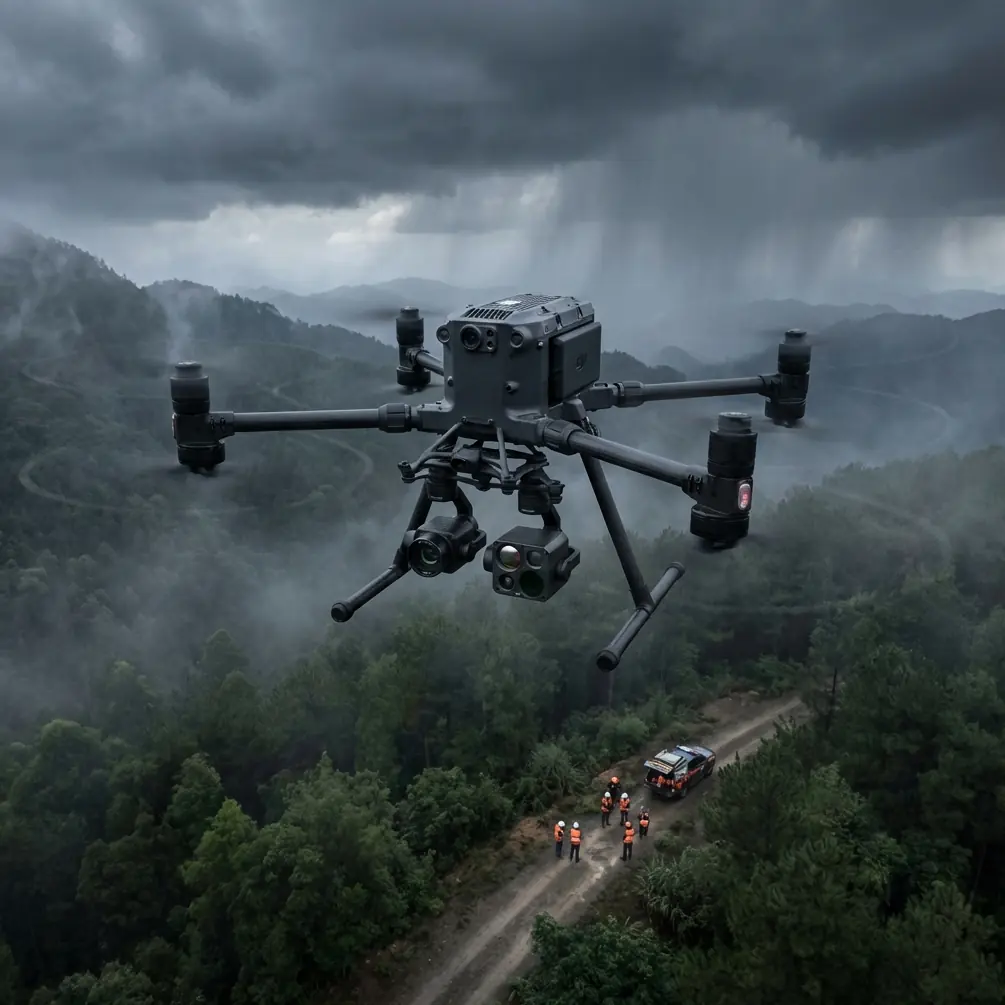
Delivering Highways in the City With Matrice 400: A Field Case Study on Heat, Hardware, and Flight Discipline
META: A specialist case study on using Matrice 400 for urban highway delivery and corridor operations, with practical insight on thermal behavior, fastener durability, sensor decisions, and BVLOS-ready workflow.
I’ve seen plenty of drone mission plans that looked flawless on a screen and started falling apart the moment the aircraft met a real city. Urban highway work does that. Asphalt stores heat. Concrete throws glare. Wind wraps itself around overpasses. Steel structures interfere with line quality and create visual clutter for both pilots and payloads. If the platform is going to carry logistics payloads, survey a corridor, and keep stable data quality in the same operational envelope, the aircraft matters—but the invisible engineering around it matters just as much.
That is the lens I want to use for the Matrice 400.
Not as a brochure subject. As a working machine in a highway delivery scenario inside a dense urban corridor, where reliability is never just about propulsion or camera specs. It is also about how materials behave, how surfaces absorb and shed heat, and how a well-designed airframe handles the little physical realities that usually go unmentioned until they cause delays.
The mission profile
Our scenario involved a highway-adjacent logistics and inspection route through a mixed commercial district. The brief was practical: move lightweight maintenance items between staging points, capture corridor imagery for photogrammetry, and verify thermal anomalies around expansion joints and drainage structures during a midday window. That mix is exactly where a platform like the Matrice 400 becomes interesting. It is not doing one clean task in isolation. It is switching roles inside the same operation.
The client’s concern was not simply whether the aircraft could fly the route. It was whether it could do so repeatedly, with consistent positioning, stable links, and enough thermal awareness to avoid misreading the environment.
That last point sounds abstract until you stand above a sunlit urban highway at noon.
Why thermal behavior changes the mission
Aviation handbooks often contain the kind of details operators skip because they seem too old-school or too component-level. That is a mistake. One of the reference sources here, a design manual section on hydraulic and flight-control related thermal properties, lists striking differences in radiative behavior across common materials. A rough aluminum surface is given a very low value of 0.055, while untreated cast iron can sit around 0.87 to 0.95. Water is listed even higher, around 0.95 to 0.963.
For a drone operator working an urban highway, those numbers are not academic trivia. They explain why thermal signature interpretation can go wrong if you rely on intuition alone.
On this route, the Matrice 400’s thermal payload passed over guardrails, drainage grates, lane barriers, roof flashings, and one shallow water accumulation near an off-ramp culvert. The water patch presented as an intense thermal feature relative to adjacent metallic elements. That was predictable once you consider emissivity. A bright return in the thermal view does not always mean “hot component problem.” Sometimes it means the surface is simply better at radiating energy toward the sensor than the reflective metal beside it.
That distinction saved us from flagging a false maintenance issue on a metal drainage cover that looked visually severe but behaved thermally like a lower-emissivity surface. For corridor inspection teams using Matrice 400, this is where thermal work matures: not by adding more imagery, but by understanding what the sensor is really seeing.
The wildlife moment that changed the route
Midway through the second leg, just as the aircraft was transitioning past a vegetated sound barrier near an elevated interchange, a black kite cut across the flight path from right to left. Urban wildlife interactions are more common than most planners admit, especially around heat-radiating road structures and wind currents formed by ramps and retaining walls.
The useful part was not the encounter itself. It was how the sensor stack handled it.
The Matrice 400’s situational awareness let the pilot identify and adjust early, rather than making a late evasive correction that would have compromised imagery overlap for the photogrammetry run. We widened the turn, paused the corridor pass, and resumed once the bird had cleared and settled on a lighting mast. That small interruption preserved both safety and mapping integrity. In urban highway work, wildlife is rarely a dramatic event. More often, it is a subtle test of whether the aircraft and crew can stay disciplined without breaking the mission.
Corridor mapping: photogrammetry only works if the workflow is honest
A lot of teams say they are doing photogrammetry when they are really just collecting pretty obliques. Highway operations demand more discipline than that. Linear infrastructure exaggerates every small inconsistency—angle drift, speed variation, uneven overlap, poor reference control. A corridor model can look acceptable at a glance and still be weak where it matters, especially near barriers, signage, and retaining walls.
With the Matrice 400, the operational advantage is not just airborne stability. It is the ability to combine repeated route execution with a sensor package that supports consistent image capture over long stretches. We used GCP control at key points where the road geometry changed, especially around merge zones and elevated sections. That gave the reconstruction team something objective to hold onto when matching images through repetitive road texture.
For urban highways, GCP placement is still worth the field effort. GNSS performance can degrade around dense structures, and long corridor datasets can drift in ways that only become visible when the engineering team tries to measure offsets against design references. If your Matrice 400 mission includes delivery on one leg and mapping on the next, don’t let convenience push you into a weak control strategy.
Transmission and data security are operational issues, not IT footnotes
Urban delivery corridors are noisy in every sense: radio congestion, signal reflections, and crowded digital environments. That is why stable transmission architecture matters. The value of O3 transmission in this type of route is not just headline range. It is link resilience in a place where clean signal geometry is rare.
A highway that runs between glass-fronted buildings, overhead signage, and multi-level ramps can create a messy RF picture. When the aircraft is moving along a narrow corridor with repeated obstructions, consistency matters more than peak performance. A stable downlink helps the crew maintain command quality and payload awareness without constantly compensating for link irregularities.
Then there is AES-256. Some readers hear “encryption” and mentally move on. But on urban infrastructure and logistics missions, secure transmission is part of operational trust. You may be capturing traffic-adjacent imagery, infrastructure details, and route timing data that the asset owner does not want casually exposed. Security is not what gets the drone airborne, but it is often what gets the operation approved.
The hardware lesson hidden in the fasteners
The most useful surprise in the reference material came from the structural design handbook’s section on bolt treatments. On the surface, it reads like classic airframe detail work. In practice, it explains why some aircraft age gracefully in hard field conditions while others start showing maintenance friction early.
The handbook notes that certain protective coatings perform well in ordinary atmospheric conditions but poorly in sea-salt vapor, and it also states that one common plated layer has a working temperature limit of 300°C. Another protective treatment is described as offering stronger corrosion protection but poor wear resistance, and not suitable for impact or bending-loaded surfaces.
Why should a Matrice 400 operator care?
Because urban highway routes punish exposed hardware in a very specific way. You get moisture, pollution residues, road spray, vibration, and thermal cycling from repeated operations over heat-soaked pavement. If your aircraft spends time staging near coastal cities or elevated roads with aggressive atmospheric exposure, fastener and surface treatment choices are not theoretical. They affect service life, inspection intervals, and how reliably the aircraft holds tolerance after months of use.
The same source also notes that some oxide-type films barely change part dimensions but have limited wear resistance. That is a subtle yet important detail for drone maintenance logic. In a precision airframe, dimensional stability is valuable, but only if the actual wear environment matches the treatment’s strengths. For operators, the takeaway is simple: inspect not just for corrosion, but for coating degradation at contact and vibration points. A Matrice 400 that looks cosmetically fine can still be telling you, through its hardware, that the environment is getting ahead of your maintenance schedule.
Hot-swap batteries are not a luxury on urban corridors
On paper, hot-swap batteries are a convenience. In field operations, they are a tempo control tool.
Our route included repeated short launches from constrained staging zones near service access roads. Shutting the aircraft down fully between every leg would have increased turnaround time, reset workflow continuity, and added friction to payload handoff. Hot-swap batteries matter here because the aircraft can stay mission-ready while the crew cycles power modules efficiently and keeps the payload and route sequence aligned.
That has another benefit in city work: fewer rushed restarts. Rushed restarts are where checklist quality collapses. An aircraft designed for smooth battery exchange helps crews stay methodical, especially when traffic management windows are tight and the pressure to relaunch is high.
BVLOS thinking starts before regulation enters the room
Even when a mission is not formally flown BVLOS, the best highway teams plan like it might become one. Linear infrastructure naturally pushes operations beyond comfortable visual geometry. Road curves, bridge decks, vegetation edges, and built-up sections all interrupt visual continuity.
That means your Matrice 400 workflow should be structured around corridor discipline: route segmentation, defined contingency points, known alternate landing spots, and predictable communication standards between pilot, visual observers, and ground receivers. If the operation later scales toward approved BVLOS service, the foundations are already there.
This is where the platform’s integrated reliability matters more than individual specs. A drone used for city highway delivery cannot behave like a one-off demo aircraft. It has to be repeatable. Every repeatable mission lowers risk because crews stop improvising around the machine and start building process around what it consistently does well.
What the city taught us about the Matrice 400
By the end of the day, the Matrice 400 had done three things that matter more than any marketing bullet ever could.
First, it maintained mission composure in a thermally messy environment where material emissivity could easily have led to bad interpretation. The difference between 0.055 for rough aluminum and values near 0.95 for water-like surfaces is exactly the sort of field reality that separates superficial thermal use from credible infrastructure analysis.
Second, it supported a multi-role corridor workflow—delivery, thermal review, and photogrammetry—without forcing the team into separate operational silos. That is valuable on urban highway projects where access windows are short and every extra setup burns time.
Third, it proved that the “small engineering” matters. Surface treatments, hardware durability, and coating behavior under heat and moisture are part of drone performance whether operators discuss them or not. The structural reference’s warning that one coating’s service temperature should not exceed 300°C, along with its notes on atmospheric and marine exposure behavior, is a reminder that airframe longevity is built from material choices as much as flight software.
If you are planning Matrice 400 operations for urban highway delivery or corridor work and want to compare route design, payload logic, or thermal inspection workflow, you can message our field team directly here: talk through your corridor setup.
The bigger story is this: successful city drone operations are rarely won by the aircraft alone. They are won by matching the aircraft to the physics of the environment. Heat, reflectivity, corrosion exposure, route geometry, wildlife unpredictability, and secure data handling all show up on the same mission. The Matrice 400 becomes useful when your operation is mature enough to respect all of them at once.
Ready for your own Matrice 400? Contact our team for expert consultation.