
Matrice 400 for Windy Highway Delivery and Inspection
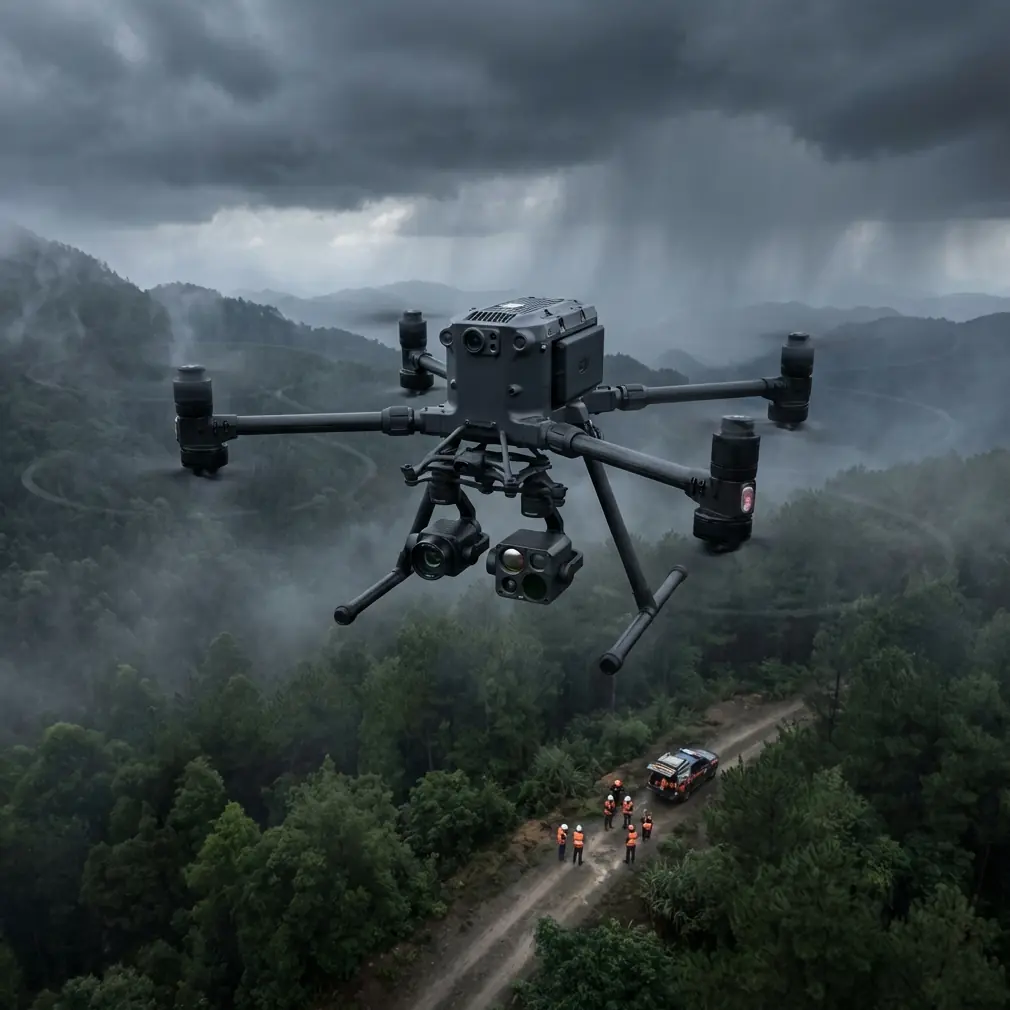
Matrice 400 for Windy Highway Delivery and Inspection: What the Airframe Tells Us
META: A technical review of Matrice 400 for windy highway operations, with expert analysis on structural design logic, transmission security, payload workflow, and why integration discipline matters more than headline specs.
When operators ask whether the Matrice 400 is suitable for highway work in wind, they usually mean three different missions at once.
First, they want stable flight along long, exposed corridors where crosswinds are rarely polite. Second, they need dependable data collection for inspection, mapping, and thermal review without repeated passes. Third, they want an aircraft that can absorb real commercial routines: payload swaps, battery turnaround, secure data handling, and repeatable deployment by crews who do not have time for fragile workflows.
The Matrice 400 sits in that intersection. Not just as a big multirotor with modern avionics, but as a platform whose value shows up when conditions are messy: gusty overpasses, hot pavement, signal reflections around gantries, and job sites that move a few kilometers every few hours.
What makes this worth a closer look is not a generic claim about “enterprise performance.” It is the engineering logic behind platforms in this class. If you understand how serious aircraft are designed and integrated, the Matrice 400’s strengths become easier to judge in the field.
Why windy highway work exposes weak drone platforms fast
Highway missions punish drones in a very specific way. The route is narrow, linear, and often open to crosswind. Bridges create turbulence. Embankments channel airflow. Trucks generate transient wake. If the aircraft struggles to hold line and attitude, that instability leaks into everything downstream: blurred imagery, inconsistent overlap, poor thermal interpretation, and slower progress per battery cycle.
This is where the Matrice 400 tends to separate itself from lighter or less mature platforms. In corridor operations, the winning aircraft is not always the one with the most dramatic spec sheet. It is the one that remains predictable when the environment keeps changing.
That predictability begins with the airframe.
A useful reference from classical rotorcraft structural design is the recommendation that, for complex shapes, transition zones should be smooth, and woven fabric may be preferable to unidirectional material in geometry-change areas to reduce fiber separation. That sounds abstract until you apply it to a professional drone that must tolerate vibration, repeated transport, thermal cycling, and wind loading. Smooth load transfer and sensible composite layup decisions are not cosmetic details. They affect long-term stiffness, fatigue behavior, and how well a platform keeps its geometry after many field hours.
For a highway operator, that matters because repeatability matters. A drone that stays dimensionally stable and mechanically consistent tends to hold calibration better, produce cleaner sensor alignment, and require less babysitting over time.
Composite discipline matters more than most buyers realize
The less glamorous side of enterprise UAV design is often the most decisive. One of the source references notes that when single-direction prepreg is laid up, the gap between parallel fibers should be less than 1 mm, with overlap limited to less than 3 mm, and fiber ends should not be butted together. Those are manufacturing tolerance details, but they reveal a bigger truth: high-performance aircraft depend on strict process control, not broad marketing claims.
Why mention that in a Matrice 400 review?
Because windy highway work is a vibration and durability test disguised as a routine job. Repeated launches from roadside staging points, transport in vehicles, thermal expansion across morning-to-afternoon shifts, and sustained attitude corrections in gusts all feed structural loads back into the aircraft. A platform designed with serious attention to composite transitions, drill quality, co-cured structures, and anti-deformation tooling has a better chance of staying tight, true, and serviceable through that abuse.
Another detail from the design reference deserves attention: for structures needing internal pressurization during manufacture, suitable process holes should be reserved in low-stress areas. This is not directly about a drone operator drilling anything, obviously. The operational significance is different. It shows a design philosophy that respects manufacturability from the start. Aircraft that are easier to build correctly are usually easier to keep consistent across production units. That consistency matters to fleet buyers, especially when one crew trains on aircraft A and expects aircraft B and C to behave the same way on corridor missions.
In practice, this is one reason larger DJI enterprise platforms often feel more settled than smaller competitors pushed beyond their comfort zone. Not because every rival lacks capability, but because airframe maturity and production discipline show up in the details.
The payload question: highways are not one-sensor jobs
A road network does not present one inspection problem. It presents many.
You may need visible imagery for pavement condition and signage, thermal signature analysis for electrical cabinets or overheating assets near tolling and roadside infrastructure, and photogrammetry outputs for embankment, drainage, or construction progress. Add GCP-based survey control where required, and the mission quickly stops being “fly and film.”
The Matrice 400 makes sense here because it fits a multi-role highway workflow better than aircraft that are optimized for only visual capture or only short-hop observation. This is where it excels over many competitor models that feel competent in one lane but clumsy in another. Some platforms map well but become awkward for thermal review. Others inspect well but give away efficiency when you need corridor-grade overlap and geospatial consistency.
For operators delivering along highways in windy conditions, that flexibility has direct consequences:
- fewer redeployments with different aircraft,
- less data fragmentation across software pipelines,
- and better use of favorable weather windows.
If a crosswind corridor gives you two usable hours, an aircraft that can complete thermal screening and photogrammetry in one operational cycle is simply more valuable than one that forces separate mobilizations.
Wind is not only a flight-control issue. It is also a data-quality issue
This is where many reviews stop too early. Holding position in wind is one thing. Capturing usable data in wind is another.
For photogrammetry, attitude stability and consistent speed along track affect image overlap and reconstruction reliability. If the aircraft gets pushed around during turns or over elevated sections, your outputs may show weak geometry, especially in repetitive road scenes with limited vertical features. That increases your dependence on extra passes or denser GCP placement to recover confidence.
For thermal signature work, instability can be even more expensive. Thermal interpretation is sensitive to angle, motion, timing, and environmental context. Highway assets heat unevenly across sun exposure, traffic load, and material type. If the aircraft cannot maintain smooth, repeatable flight lines in crosswind, thermal anomalies become harder to compare and verify.
This is why the Matrice 400’s value for highway work is best judged as a systems platform, not just a flying camera mount. Stable aircraft behavior, secure transmission, battery continuity, and payload integration all compound into data quality.
Integration discipline is the hidden hallmark of serious aircraft
One of the most revealing references in the source material comes not from rotorcraft structure, but from civil aircraft propulsion integration. It states that after an initial matching check, the designer must analyze the effect of bleed air and power extraction on engine performance, evaluate interfaces between systems, and verify whether noise, vibration, pollution, safety, and reliability targets can still be met.
That idea applies cleanly to enterprise drones like the Matrice 400.
Every added payload, processor load, radio demand, and onboard accessory changes the system. Power draw affects endurance. Mounting affects vibration. Data handling affects workflow security. Transmission architecture affects command confidence under interference. The best aircraft are not merely equipped with features; they are integrated so that one subsystem does not quietly degrade another.
For highway operations, this is where O3 transmission and AES-256 style secure communications matter operationally, not just as brochure language. A long corridor can create awkward RF behavior through elevation change, passing vehicles, roadside metalwork, and infrastructure clutter. Strong transmission resilience protects continuity of control and live situational awareness. Secure encryption matters because infrastructure data is often sensitive at the commercial level even when it is not classified. Contractors, utilities, transport authorities, and private operators all have legitimate reasons to protect imagery, thermal results, and route intelligence.
If your team needs a practical discussion about corridor workflow, payload fit, or secure deployment planning, the fastest route is to message a specialist directly: https://wa.me/85255379740
Battery workflow often decides whether a highway mission finishes on schedule
Hot-swap batteries are easy to underrate until you are operating from the shoulder of a service road with a moving work window.
In highway environments, setup and repositioning already consume time. If every battery transition requires an extended shutdown and restart routine, productivity erodes quickly. Hot-swap capability helps preserve momentum, maintain aircraft readiness, and reduce dead time between legs of a corridor mission.
This is especially useful when the task involves segmented delivery or inspection over multiple discrete points along a route. The practical advantage is not simply “more convenience.” It is continuity. Crews can change power sources without turning a tightly sequenced field operation into a stop-start event.
Against some competing platforms, this is exactly where the Matrice 400 feels more like a professional tool than an adapted prosumer machine. The gap is not always obvious in ideal weather. In wind, with shifting traffic control and narrow launch options, it becomes obvious very fast.
BVLOS relevance for highways is real, but only when the workflow supports it
Highway corridors are among the clearest civilian cases for BVLOS-style operational thinking, subject to local rules and approvals. The route is linear, the assets are distributed, and the economic penalty for constant leapfrogging can be significant.
But BVLOS capability is not just a regulatory checkbox. It depends on a stack of prerequisites: robust transmission, dependable navigation behavior, disciplined maintenance, clear emergency procedures, and sensor outputs that remain useful even when the mission profile extends beyond simple visual proximity.
This is another reason the source material on aircraft selection is useful. It emphasizes collecting detailed technical documents from manufacturers, including installation manuals, performance manuals, technical requirements, and interface drawings. That same mindset should guide any organization deploying Matrice 400 for serious highway programs. Do not evaluate the aircraft from summary sheets alone. Evaluate the documentation stack, integration notes, payload behaviors, maintenance model, and operational limitations.
Professionals who do that usually make better fleet decisions than teams chasing isolated peak specs.
Where Matrice 400 stands out against competitors
The cleanest comparison is not against toy-grade drones or generic industrial multirotors. It is against other enterprise platforms competing for inspection, mapping, and corridor work.
The Matrice 400’s edge is that it appears built for multi-domain field use rather than a single narrow showcase. In windy highway scenarios, that means:
- stronger confidence when conditions are less than calm,
- better continuity between thermal and photogrammetry tasks,
- more credible support for secure infrastructure workflows,
- and less operational friction around batteries and mission transitions.
Some competitor systems may offer good imaging or respectable mapping on calm days. Yet they can become less convincing when the mission expands to corridor endurance, exposed wind, payload diversity, and recurring commercial deployment. The Matrice 400 is more compelling precisely because it behaves like a platform architecture, not a one-trick aircraft.
The real buying question is not “Can it fly in wind?”
It is this: can it do highway work in wind without turning every sortie into a compromise between stability, data quality, and field efficiency?
That is the standard commercial operators should apply.
The structural references behind aircraft design remind us that smooth transitions, controlled layup tolerances, and manufacturability discipline influence long-term quality. The propulsion-system reference reminds us that interfaces, power effects, reliability, and vibration must be checked as a whole system. Those are not random textbook ideas. They are the logic behind why some UAV platforms scale into serious infrastructure work and others stall out after demos.
For highway delivery support, inspection, thermal signature review, and photogrammetry in exposed conditions, the Matrice 400 looks strong because it aligns with that systems-thinking approach. It is not only about lift or sensors. It is about keeping the aircraft, payload, transmission, and operator workflow coherent under pressure.
That is what professionals actually pay attention to once the novelty wears off.
Ready for your own Matrice 400? Contact our team for expert consultation.