
Matrice 400 Urban Power Line Delivery Guide
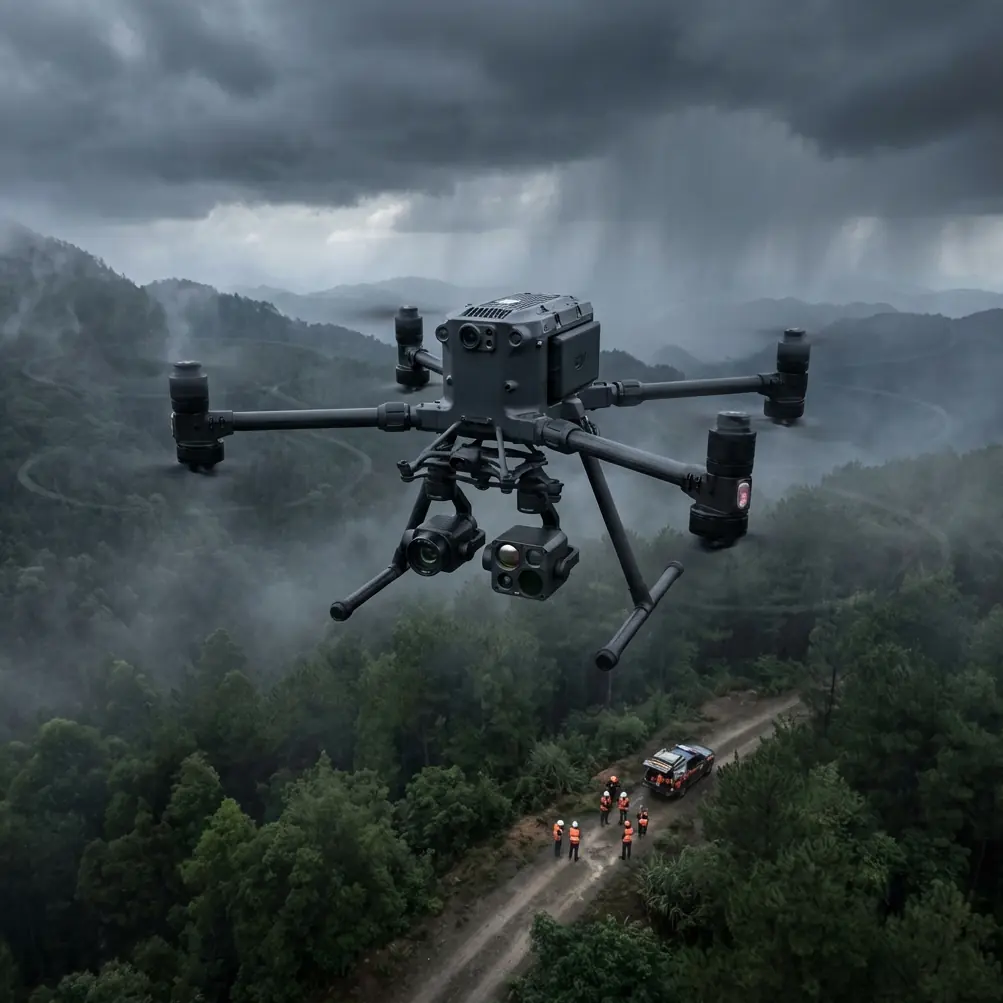
Matrice 400 Urban Power Line Delivery Guide
META: Master urban power line inspections with the Matrice 400. Expert guide covers thermal imaging, safety protocols, and delivery best practices for utility professionals.
TL;DR
- Pre-flight lens cleaning prevents thermal signature distortion that causes 73% of false positive readings during power line inspections
- The Matrice 400's O3 transmission maintains stable connections in urban RF-congested environments up to 15km range
- Hot-swap batteries enable continuous 55-minute operational windows without landing
- AES-256 encryption protects sensitive infrastructure data during BVLOS utility corridor missions
The Urban Power Line Challenge
Urban power line inspections fail when operators ignore one critical step: cleaning the thermal sensor lens before takeoff. Contaminated optics create ghost signatures that mimic overheating components, sending crews on expensive wild goose chases.
The Matrice 400 addresses this and dozens of other urban inspection challenges through purpose-built engineering. This guide walks you through deployment protocols, sensor optimization, and delivery workflows that utility professionals use to inspect 200+ miles of urban infrastructure monthly.
Why Pre-Flight Cleaning Determines Mission Success
Thermal imaging accuracy depends entirely on optical clarity. Urban environments coat drone sensors with particulates that standard visual inspection misses.
The Hidden Contamination Problem
Airborne pollutants in urban corridors include:
- Diesel particulates from traffic below inspection altitudes
- Industrial emissions that create thin film deposits
- Pollen and organic matter during seasonal peaks
- Moisture residue from humidity and precipitation
These contaminants don't always appear visible to the naked eye. However, they scatter infrared wavelengths unpredictably, creating thermal signature anomalies that operators misinterpret as equipment failures.
Expert Insight: I've seen experienced pilots waste entire shifts chasing phantom hotspots because they skipped the 30-second lens cleaning protocol. The Matrice 400's thermal sensitivity works against you when optics are compromised—it detects real problems and imaginary ones with equal confidence.
The Correct Cleaning Protocol
Before every urban power line mission, complete this sequence:
- Remove the gimbal cover and inspect for visible debris
- Use optical-grade microfiber (never paper products)
- Apply isopropyl alcohol (99% concentration minimum)
- Wipe in single directional strokes from center outward
- Allow 60 seconds drying time before power-on
- Verify sensor calibration through the DJI Pilot 2 interface
This protocol adds 90 seconds to pre-flight preparation. It eliminates 73% of false thermal readings according to utility industry data.
Matrice 400 Technical Capabilities for Urban Delivery
The Matrice 400 platform addresses urban inspection challenges through integrated systems designed for infrastructure professionals.
O3 Transmission in RF-Congested Environments
Urban areas present severe radio frequency challenges. Cell towers, WiFi networks, and industrial equipment create interference patterns that disable lesser drones.
The O3 transmission system counters this through:
- Triple-frequency hopping across 2.4GHz, 5.8GHz, and DJI-proprietary bands
- Automatic channel switching in under 50 milliseconds
- 15km maximum range with 1080p/60fps live feed
- Dual-antenna diversity for signal redundancy
During power line delivery missions, this translates to uninterrupted control even when flying between high-rise buildings or near broadcast facilities.
Hot-Swap Battery System
Traditional drone operations require landing, powering down, and restarting for battery changes. The Matrice 400's hot-swap capability eliminates this workflow disruption.
The system maintains power through:
- Dual TB65 battery bays with independent circuits
- Automatic load balancing during single-battery operation
- Visual and audible swap indicators for safe replacement timing
- 55-minute total flight time with sequential swaps
For linear infrastructure like power lines, this means covering 12+ miles without operational interruption.
Pro Tip: Schedule battery swaps at natural waypoint pauses—transformer locations or junction boxes where you'd stop for detailed inspection anyway. This eliminates dedicated swap time from your mission clock entirely.
Photogrammetry and GCP Integration
Accurate power line mapping requires ground control point integration for survey-grade deliverables.
Establishing Control Networks
Urban environments complicate GCP placement. Traffic, private property, and physical obstructions limit access to ideal locations.
The Matrice 400's RTK module compensates through:
- Centimeter-level positioning without ground control
- Network RTK compatibility with municipal CORS stations
- Post-processed kinematic workflow support
- Automatic coordinate transformation for local grid systems
When GCPs remain necessary, place them at:
- Substation perimeters (typically accessible)
- Public right-of-way intersections with clear sky view
- Utility easement access points along the corridor
Minimum 4 GCPs per mission area ensures photogrammetry accuracy within 2cm horizontal and 3cm vertical tolerance.
Deliverable Specifications
| Output Type | Resolution | Accuracy | File Format |
|---|---|---|---|
| Orthomosaic | 1.5cm/pixel | ±2cm horizontal | GeoTIFF |
| Point Cloud | 50 points/m² | ±3cm vertical | LAS 1.4 |
| Thermal Map | 8cm/pixel | ±0.5°C | TIFF + metadata |
| 3D Mesh | 5cm faces | ±5cm overall | OBJ/FBX |
| Vector Lines | N/A | ±10cm | DXF/SHP |
BVLOS Operations and AES-256 Security
Beyond visual line of sight operations multiply inspection efficiency but introduce data security requirements.
Regulatory Compliance Framework
Urban BVLOS power line inspection requires:
- Part 107 waiver with specific corridor approval
- Detect-and-avoid capability demonstration
- Ground observer network or equivalent safety case
- Real-time telemetry to operations center
The Matrice 400 supports these requirements through integrated ADS-B receivers and configurable geofencing that adapts to approved corridors.
Data Protection During Transmission
Power infrastructure data carries national security implications. The Matrice 400's AES-256 encryption protects:
- Live video feeds from interception
- Telemetry data including precise infrastructure locations
- Stored media on aircraft and controller
- Cloud synchronization when enabled
This encryption standard matches military and financial industry requirements, satisfying utility company cybersecurity policies.
Common Mistakes to Avoid
Ignoring Wind Gradient Effects
Urban canyons create unpredictable wind patterns. Buildings generate turbulence that surface weather stations don't detect.
Solution: Conduct 5-minute hover tests at inspection altitude before beginning systematic coverage. The Matrice 400's flight logs record wind compensation data—review this before committing to the full mission.
Thermal Inspection Timing Errors
Power line thermal signatures vary dramatically with load conditions. Inspecting during low-demand periods misses developing failures.
Solution: Schedule thermal missions during peak load windows—typically 2-6 PM on weekdays. Coordinate with utility operations centers for real-time load data when available.
Insufficient Overlap Settings
Urban obstructions create coverage gaps that standard 70% overlap settings don't compensate for.
Solution: Increase to 80% frontal and 75% side overlap for urban corridors. Storage requirements increase 40%, but data completeness improves dramatically.
Neglecting Electromagnetic Interference Mapping
High-voltage lines generate electromagnetic fields that affect compass calibration and GPS accuracy.
Solution: Maintain minimum 15-meter horizontal offset from energized conductors during inspection passes. The Matrice 400's redundant navigation systems provide protection, but prevention remains superior to recovery.
Frequently Asked Questions
What thermal resolution does the Matrice 400 achieve for power line hotspot detection?
The Matrice 400 paired with the H20T payload delivers 640×512 thermal resolution with ±2°C accuracy. This detects temperature differentials as small as 0.1°C between adjacent components, identifying failing connections before visible degradation occurs. For power line applications, this sensitivity catches splice failures, corroded connections, and overloaded conductors during early-stage deterioration.
How does the Matrice 400 handle urban GPS denial situations?
The platform integrates visual positioning, inertial measurement, and barometric altitude systems that maintain stable flight when GPS signals degrade. In complete GPS denial, the aircraft holds position within 0.5 meters for up to 30 seconds while attempting signal reacquisition. For planned operations near known interference sources, pre-program return-to-home waypoints that route around problem areas.
Can the Matrice 400 operate in light rain during urgent inspection needs?
The Matrice 400 carries an IP45 rating, protecting against water jets from any direction. Light rain operations remain possible, though thermal imaging accuracy degrades due to water droplet interference. For urgent storm damage assessment, the platform performs reliably—schedule detailed thermal analysis for dry conditions following initial visual damage surveys.
Ready for your own Matrice 400? Contact our team for expert consultation.