
Matrice 400 Field Report: Best Practices for Delivering
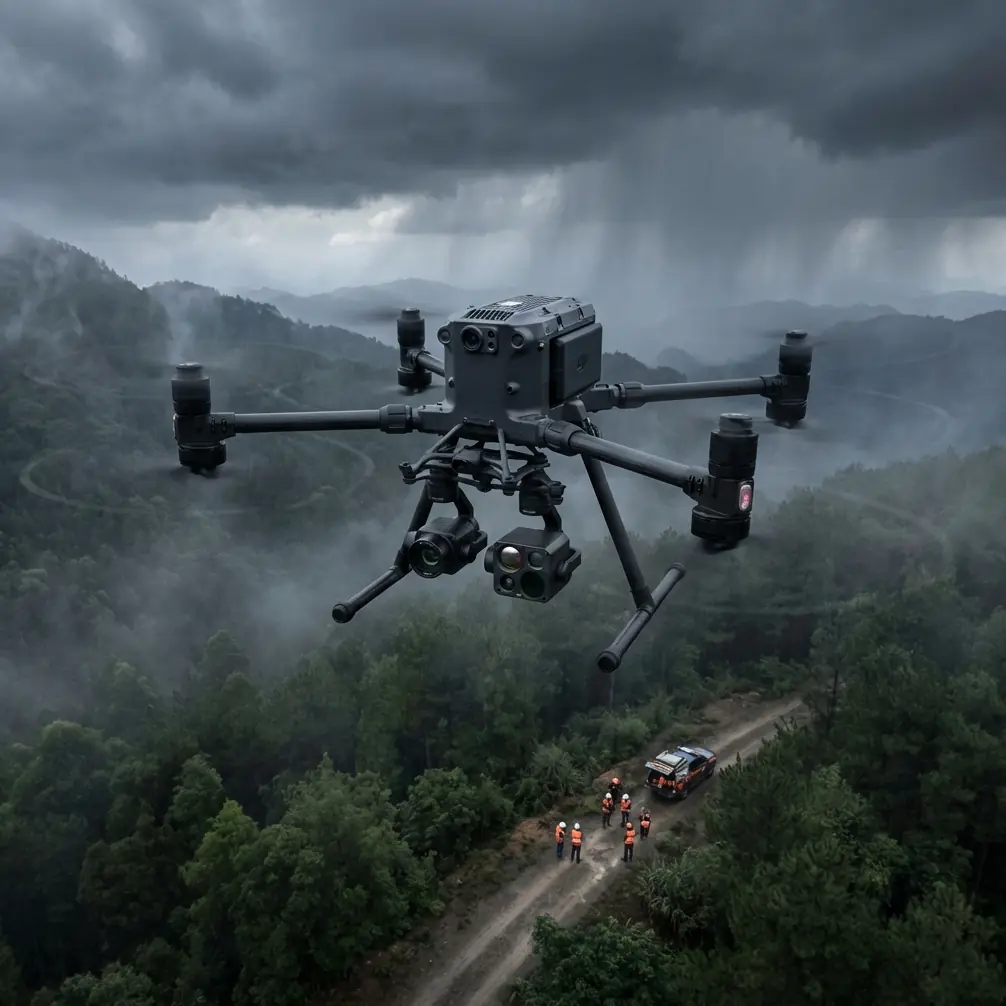
Matrice 400 Field Report: Best Practices for Delivering Along Dusty Power Line Corridors
META: Expert field report on using the Matrice 400 for dusty power line delivery missions, with practical guidance on interference management, thermal checks, O3 transmission, AES-256 security, hot-swap batteries, and BVLOS workflow planning.
Moving payloads along power line routes sounds straightforward until the route starts fighting back. Dust lifts off access roads and hangs in the air. Towers reflect and distort signals. Heat rolls off transformers, insulators, and bare ground, complicating visual judgment. Then there is the less obvious threat: electromagnetic interference that can quietly degrade link quality or unsettle pilot confidence at exactly the wrong moment.
That is where the Matrice 400 enters the conversation. Not as a magic fix, but as a platform that makes hard corridor work more manageable when the operation is designed properly. For teams planning delivery tasks in dusty utility environments, the aircraft’s practical value comes from how its communications, payload flexibility, battery strategy, and mission planning features work together under pressure.
I have seen too many operators frame a power line mission around nominal range figures and payload assumptions, then get surprised by what the corridor actually does to the aircraft. The better approach is to think in layers: route fidelity, thermal awareness, transmission integrity, redundancy, and battery turnover. If you build around those five, the Matrice 400 becomes a very capable working tool rather than an expensive compromise.
The first issue in a dusty power line delivery scenario is not the line itself. It is the route surface and the atmosphere around it. Dust changes launch discipline. It affects takeoff site selection, rotor wash behavior, optics cleanliness, and post-landing inspection routines. A corridor that looks acceptable from a truck window can produce a brownout-style takeoff cloud once the aircraft spools up near a dirt maintenance track. That matters because delivery flying often depends on repeatable departures and arrivals, not just one clean outbound leg.
With the Matrice 400, I would treat every dusty launch zone as a contamination-control problem before it becomes a flight problem. Set up farther from loose surface material than your instinct tells you. Use a launch mat or elevated platform if the site allows. Keep payload interfaces covered until the aircraft is ready to go. Dust intrusion rarely causes dramatic failures on the spot. More often, it degrades connectors, coats lenses, and creates small reliability losses that stack up across repeated missions.
Now add power lines. Utility corridors are loaded with electromagnetic variables. Pilots usually notice interference only when it becomes visible on the control link or shows up as unstable telemetry. That is too late. The more professional method is to anticipate where interference is most likely, then fly the aircraft and its antenna geometry accordingly.
This is where antenna adjustment stops being a checkbox and becomes a field skill. Along transmission routes, I advise crews not to lock into one controller stance for the entire mission. As the aircraft changes altitude, bearing, and relative position to pylons, the pilot or payload operator should actively manage antenna orientation to preserve the strongest possible link path. Small alignment corrections can make a disproportionate difference when steel structures, conductors, and terrain create multipath effects. If your team is using the Matrice 400 with O3 transmission, that link architecture gives you a strong foundation, but only if the human side does its part. O3 is not a substitute for RF discipline. It rewards it.
In practical terms, I tell crews to rehearse three things before live delivery work: where the aircraft is likely to pass near reflective infrastructure, how controller position changes along the route, and when a pilot should physically shift body orientation to keep antennas presented cleanly toward the aircraft rather than toward the line hardware. On a dusty corridor, operators often stay planted in one place because moving stirs debris and feels inconvenient. That habit can cost more than it saves. A two-meter reposition for cleaner line-of-sight can be worth far more than squeezing one more minute out of a static control point.
Security also deserves more attention in corridor operations than it usually gets. Utility-related delivery work can involve sensitive route data, inspection overlays, infrastructure coordinates, or internal maintenance schedules. If your Matrice 400 workflow incorporates AES-256 for protected transmission and data handling, that is not an abstract feature. It has operational significance. It means the mission architecture is better suited to infrastructure environments where the route itself may be sensitive. For teams working with grid operators, contractors, or emergency response units, that matters because trust is often built around how well you control information, not just how well you fly.
There is another layer that sophisticated crews should not ignore: thermal interpretation. A lot of operators think of thermal payload use only in inspection terms, but thermal signature awareness has delivery value too. In dusty power line environments, thermal can help you distinguish between ordinary environmental heat and equipment-related anomalies that may change how or where you operate. A tower component radiating abnormally, a transformer area producing unexpected heat, or a patch of superheated ground near a landing zone can alter the mission plan on the fly. That does not mean every delivery sortie becomes a full inspection mission. It means the Matrice 400’s payload ecosystem can support better decisions when conditions shift.
Thermal is especially useful in late afternoon operations, when visual contrast softens and the corridor can start to flatten into a haze of brown, gray, and glare. A pilot relying only on the visible feed may miss subtle environmental cues. A thermal view can clarify where hot equipment is influencing local air behavior or where people, vehicles, or animals are moving near an intended drop or handoff point. In utility work, those details are not side notes. They shape whether a mission remains routine.
If the route also requires mapping support, photogrammetry should not be treated as a separate department’s concern. Delivery teams benefit when route planning is built on accurate corridor models. A photogrammetry workflow backed by properly placed GCPs gives you a more trustworthy understanding of elevation shifts, vegetation encroachment, service road access, and alternate landing options. That matters in BVLOS planning, where assumptions made from outdated imagery can produce serious downstream errors. A few centimeters of positional confidence from good GCP practice can translate into safer decision-making when you are threading missions through constrained utility spaces.
BVLOS itself changes the tone of everything. Once the Matrice 400 is flying beyond direct visual observation, your route quality, communication discipline, and contingency structure have to be much tighter. Dust is no longer a local nuisance near takeoff. It becomes part of a larger environmental reliability picture. Can the aircraft depart cleanly, transition efficiently, and arrive with enough reserve to handle a missed approach or reroute? Can the crew maintain robust situational awareness if visibility at one segment deteriorates? Can the communications setup handle the corridor’s interference profile without forcing reactive choices?
This is why hot-swap batteries matter so much in real utility operations. Their significance is not convenience. It is tempo and continuity. On a live corridor job, especially when crews are rotating missions in heat and dust, reducing turnaround friction means fewer rushed procedures and less exposure of the aircraft to contaminants during prolonged ground handling. Hot-swap capability helps the Matrice 400 stay in service with tighter mission cycles, which is valuable when the delivery schedule is linked to maintenance windows or line access periods. But it only pays off if the battery process itself is disciplined. Keep packs staged in protected cases, inspect contact points constantly, and never let a fast turnaround turn into a dirty turnaround.
One of the most common mistakes in dusty power line delivery work is treating the aircraft as the center of the operation. It is not. The corridor is the center. The aircraft is simply the method. Once you accept that, better habits follow naturally. You plan around interference hotspots instead of reacting to them. You choose launch sites based on rotor wash and signal geometry, not just truck access. You use thermal data to support safer route judgment. You build photogrammetry and GCP-backed mapping into your planning where repeat corridors justify the effort. You secure route data because infrastructure missions demand it. You exploit hot-swap batteries to maintain cadence without compromising inspection standards.
I also recommend building a standard interference response playbook specific to the Matrice 400 crew. When link quality dips near line infrastructure, the first response should not be improvisation. It should be a rehearsed sequence: confirm aircraft orientation, adjust controller antenna angle, step laterally to improve line-of-sight if safe, reduce unnecessary yawing, and evaluate whether the aircraft is entering a known reflective segment. That kind of drill turns a tense moment into a managed event. If your team wants a practical corridor workflow review, this utility mission chat line is one way to compare notes with people already operating in similar conditions.
Another overlooked point is payload cleanliness during repetitive delivery cycles. Dust accumulation does not just affect image quality. It can interfere with target confirmation, thermal interpretation, and handoff precision at the destination point. The Matrice 400 can carry the right tools for demanding corridor work, but if operators do not build lens checks and quick exterior inspections into each cycle, the data quality degrades before anyone notices. In high-repetition missions, I prefer short, mandatory inspection pauses over long cleaning sessions after performance has already slipped.
There is also a human factor here. Power line environments can make experienced pilots feel overconfident because the route appears linear and predictable. In reality, linear routes create their own trap. Teams relax into repetition, and that is when they stop noticing how wind, dust, heat, and interference are changing throughout the day. A Matrice 400 running an early morning corridor mission is not really flying the same mission at 3 p.m., even if the waypoints are identical. Surface temperature rises, shimmer increases, local winds shift, and RF behavior can feel different around the same structures. Professional crews brief those changes instead of assuming consistency.
For organizations evaluating the Matrice 400 specifically for dusty utility delivery work, the real takeaway is this: the aircraft makes sense when your operation is mature enough to use its strengths properly. O3 transmission helps, especially in complicated corridor geometry, but antenna handling still matters. AES-256 supports secure infrastructure workflows, but only within a disciplined data process. Thermal signature awareness broadens operational judgment, not just inspection capability. Photogrammetry and GCP-backed models improve route reliability where repeat missions justify the mapping effort. Hot-swap batteries support higher sortie tempo, but only if contamination control remains strict. And BVLOS can unlock corridor efficiency, provided the crew treats communication integrity and contingency planning as core flight tasks rather than paperwork.
That is the field reality. The Matrice 400 is not defined by a spec sheet in this environment. It is defined by whether it helps your team move through dust, infrastructure complexity, and electromagnetic noise without losing control of the mission. When used with that mindset, it becomes more than a delivery platform. It becomes a stable operating node in a very unstable working corridor.
Ready for your own Matrice 400? Contact our team for expert consultation.