
How I’d Set Up a Matrice 400 for Power-Line Delivery
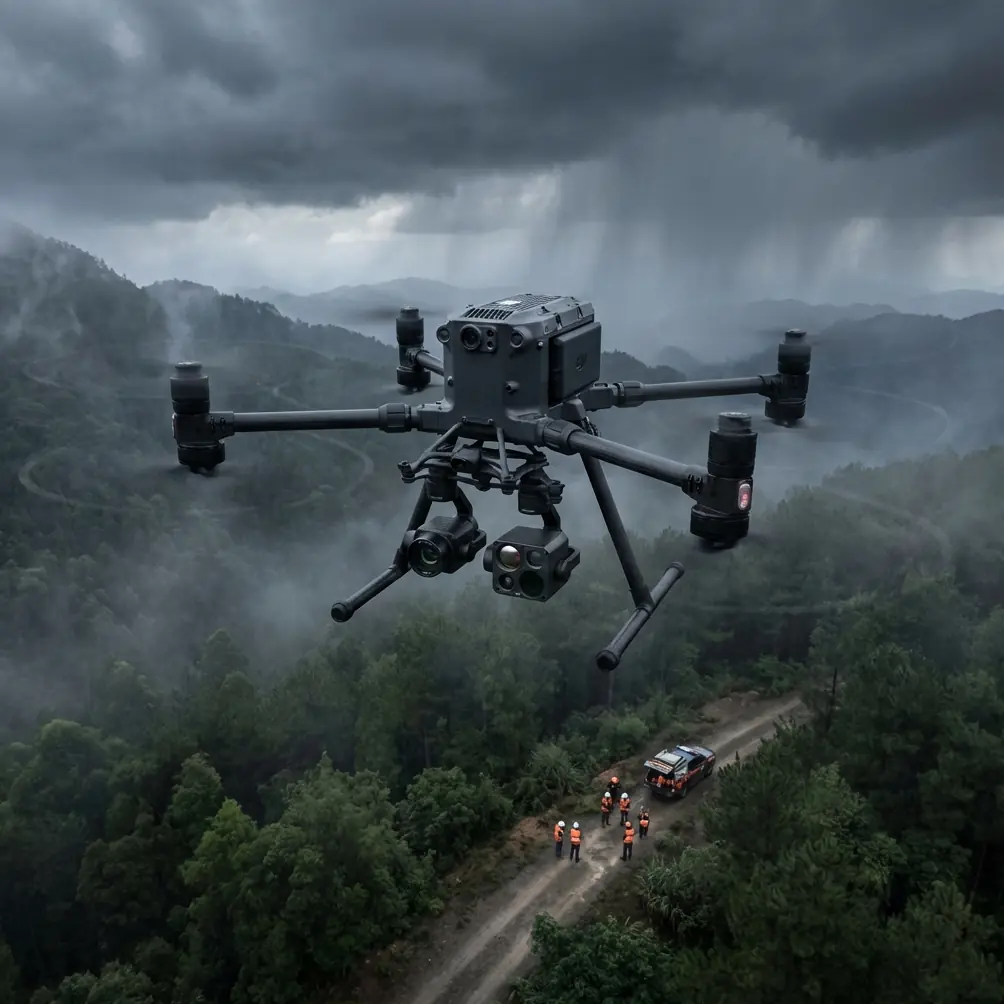
How I’d Set Up a Matrice 400 for Power-Line Delivery in Windy Conditions
META: Practical Matrice 400 guidance for windy power-line delivery missions, focused on reliability, environmental exposure, sensor redundancy logic, and battery discipline in real field operations.
Power-line delivery sounds simple until the weather stops cooperating.
On paper, you are moving a payload from one point to another along a defined corridor. In the field, you are dealing with crosswinds, moisture exposure during idle time, repeated launch-and-recovery cycles, and the unforgiving reality that a small sensing error can cascade into a bad flight decision. If the aircraft in question is a Matrice 400, the right conversation is not just about endurance or payload. It is about how to build a mission method that respects what aircraft structures and flight-control systems actually endure over time.
That distinction matters more in windy utility work than most teams realize.
I want to frame this around two engineering truths drawn from aircraft design practice. First, composite structures do not react to humidity in a dramatic, instant way. Moisture uptake is gradual, faster at first, then slows as the material approaches equilibrium. Second, flight-critical systems are managed through redundancy because aviation has long treated random failure probabilities at an extremely strict level, with civil flight-control loss targets discussed in the range of 10^-5 per flight hour and even tighter allocations for subsystems. Those numbers come from manned-aircraft design, not directly from the Matrice 400 spec sheet, but the operational lesson is highly relevant: for corridor delivery in wind, your safety margin is built long before takeoff.
Why windy power-line delivery is really an exposure-management problem
Most crews think about wind only as a control issue. It is also a structural and environmental issue.
A drone assigned to utility support often spends more time waiting than flying. The old aircraft design literature makes this point in stark terms: more than 60% of civilian aircraft life can be consumed while parked, and for some aircraft categories the percentage is much higher. Operationally, that means the environment on the ground matters almost as much as the environment in the air.
For a Matrice 400 working around power infrastructure, this changes how I’d plan the day. If your aircraft sits on wet grass near a substation, or in a humid truck bed between flights, or under direct sun after an early morning drizzle, that “inactive” time is not neutral. Composite materials absorb moisture slowly, and the balance point rises when humidity and temperature rise. In ordinary climate conditions, relative humidity can matter even more than temperature. The effect is not dramatic on a single mission, but it is real across repeated deployments.
Why does that matter to a utility operator? Because wind missions tend to include exactly the kind of pauses that accelerate hidden wear: setup delays, access constraints, line-clearance coordination, and repeated battery swaps. If you want a Matrice 400 fleet to remain predictable over a season, you need an environmental routine, not just a flight routine.
My field rule: treat the parked aircraft as part of the mission
This is where teams either look disciplined or amateur.
If I’m using a Matrice 400 to deliver line strings, pilot ropes, or lightweight tools to crews along a windy corridor, I do three things before I even think about route optimization:
Keep the aircraft dry during idle windows.
Do not leave it exposed while the ground team sorts out rigging. A moisture cycle begins before you notice any visible issue.Build a location-specific weather profile.
Not a generic forecast screenshot. I want the expected wind direction, gust pattern, humidity, temperature trend, and likely waiting times at each launch site.Separate “flight hours” from “field hours.”
Aircraft stress does not begin at motor start. If the Matrice 400 spends four hours in a humid valley and flies only 70 minutes, those four hours still count toward how you think about inspection intervals and storage discipline.
That approach comes straight from the logic of environmental spectrum planning in aircraft design. Engineers do not just look at flight loads; they combine load spectra with humidity and temperature cycles over the full service life. For drone operations, you can borrow the same mindset without making the workflow complicated.
Wind is not the only thing corrupting your data
In power-line delivery, pilots usually focus on holding course and controlling pendulum motion. Fair enough. But stable delivery depends on reliable sensing, and windy utility corridors can distort assumptions.
Classical flight-control architecture uses multiple air-data sources because a single pressure input can be misleading. One aircraft design example describes a three-redundancy arrangement producing three separate dynamic/static pressure signal sets, often using combinations of nose-mounted and fuselage-mounted probes. Another note warns that a total-pressure tube paired with fuselage surface static ports gives poorer accuracy.
You are not going to bolt manned-aircraft pitot architectures onto a Matrice 400. That is not the point. The point is operational: do not trust a single indicator when wind and terrain begin to interfere with the aircraft’s behavior. In drone terms, that means cross-checking your telemetry sources and looking for consistency between:
- aircraft attitude,
- groundspeed versus apparent wind effect,
- altitude behavior,
- visual drift,
- obstacle-sensing confidence,
- and, where applicable, corridor mapping references.
For delivery near power lines, this matters because localized airflow can be strange. Towers, ridgelines, tree gaps, and thermal gradients can create brief deviations that look like control issues but are really sensing-context issues. If the aircraft appears to “hunt” in position hold, the answer may not be a stick-input problem. It may be that one reference stream is being stressed by the environment.
That is also why I like pairing delivery missions with prior photogrammetry of the corridor when feasible. A clean model tied to solid GCP work gives the crew a reference that survives when visual impressions become unreliable. You do not need a full survey every time, but a well-understood corridor geometry helps the pilot recognize when the drone is behaving oddly versus when the terrain is merely creating a visual trap.
The overlooked risk: repeated high-load moments
Composite structures reward good habits and punish lazy assumptions.
One of the more useful design insights from composite-aircraft practice is that load-spectrum shortcuts accepted for metal structures can become unsafe if copied directly. High loads are especially serious for composites, and the maximum likely load event should not be casually trimmed out of the test or analysis picture. For utility drone work, that translates into one very practical warning:
Do not evaluate your Matrice 400 only on average flight conditions.
The flights that matter most are the short ugly ones:
- the launch into a quartering gust,
- the abrupt payload stabilization after a line snags then frees,
- the recovery leg when the aircraft returns with less battery margin and more pilot fatigue,
- the hard hover correction near a tower edge.
Those are your high-load moments.
They may occupy only seconds, but over dozens of jobs they become the real durability story. If your maintenance notes mention “mission completed” but never capture the number of gusty recoveries, aborted approaches, or payload oscillation events, you are missing the data that actually predicts long-term reliability.
A battery management tip I learned the hard way
Here is the field habit that saves more missions than people expect.
On windy delivery days, I never treat hot-swap batteries as a shortcut to keep flying continuously. I treat them as a tool for temperature control and consistency.
Early in my career, we had a utility corridor day that looked manageable on the forecast. By noon, gusts were sharper than expected and every leg demanded more corrective input. The aircraft was capable, but the battery pairs were not all aging the same way. One pair that looked acceptable on paper sagged more noticeably during the most wind-exposed outbound segment. Nothing dramatic happened, but the telemetry trend was enough to make me cut the mission rhythm and rethink the swap policy.
Since then, my rule is simple:
- keep battery pairs married to each other,
- rotate them in a planned sequence rather than whichever set is closest at hand,
- log wind intensity with each cycle,
- and after a demanding leg, let the next pair start from a controlled thermal state rather than rushing them straight in because hot-swap makes it possible.
Hot-swap capability is excellent on a platform like the Matrice 400 because it reduces turnaround friction. But in windy line work, the temptation is to use that speed to compress decision-making. Resist that. Fast swapping should support better discipline, not replace it.
If your team wants a practical setup checklist for this kind of operation, I usually share one in the field here: message me directly for the windy-corridor checklist.
Building a Matrice 400 workflow that respects redundancy
The deeper lesson from flight-control design is not “add more hardware.” It is “plan for disagreement.”
Manned-aircraft systems use two-channel, three-channel, and even four-channel logic because no single input should be blindly trusted when the consequence of failure is severe. In one cited design context, important switches may use triple or quadruple redundancy, and advanced computer architectures compare triple-redundant systems against four-redundant ones to manage faults more gracefully.
For Matrice 400 operations, the translation is procedural:
1. Redundancy in data interpretation
Do not make go/no-go calls from one value alone. Wind speed estimate, battery behavior, aircraft attitude stability, payload swing, and video confidence should agree.
2. Redundancy in route planning
Have a primary line path, a lower-exposure fallback segment, and an abort route that avoids the most turbulence-prone structures.
3. Redundancy in communications
If you are leaning on O3 transmission for corridor reliability, plan your antenna positioning and relay assumptions before launch, not after signal quality degrades around terrain or infrastructure clutter.
4. Redundancy in documentation
One pilot log is not enough. For serious utility work, I want the flight record, battery record, and weather record tied together. That is how patterns emerge.
5. Redundancy in mission assurance
When sensitive corridor data is involved, secure handling matters. If your workflow includes route files, utility imagery, or inspection overlays, make sure your data practices align with enterprise-grade expectations such as AES-256 protection where applicable in the broader system environment.
None of that is glamorous. All of it reduces surprises.
Thermal effects belong in the conversation too
The aircraft design reference also touches on thermal shock at high speed, where large temperature gradients can initiate microcracking in composite matrix material. The Matrice 400 is not a high-speed jet, obviously, but the principle still helps utility operators think more clearly.
Rapid temperature transitions matter.
A drone moved from an air-conditioned vehicle into humid heat, then flown under load, then packed while still warm is experiencing a miniature environmental cycle. Add direct sun on dark surfaces and heat radiating from nearby equipment pads, and the aircraft can see sharper thermal transitions than crews assume. That becomes especially relevant if you are also using a thermal signature workflow for infrastructure awareness or post-delivery inspection. The imaging mission may be separate from the delivery mission, but the environmental load on the aircraft is cumulative across the workday.
So my advice is basic and strict:
- stage the Matrice 400 in shade when possible,
- avoid sealed-case heat soak between sorties,
- and give the aircraft a few minutes to equalize before the next demanding flight if the last one was flown hard in gusts.
That is not wasted time. It is part of preserving consistency.
A practical how-to sequence for windy power-line delivery
If I were writing the field card for a Matrice 400 team tomorrow, it would look like this:
Pre-mission
Review corridor geometry, likely gust zones, landing alternatives, and humidity trend. If prior mapping exists, bring the photogrammetry model and confirm any GCP-based references that help with approach alignment.
Aircraft staging
Keep the airframe protected from moisture and sun while idle. Treat parked exposure as real wear, not dead time.
Sensor confidence check
Before payload work begins, verify that position behavior, altitude hold, heading, and video all look coherent. In wind, inconsistencies show up early if you pay attention.
Battery pairing
Use matched pairs only. Log which pair flew each windy segment. Do not let hot-swap speed pressure the crew into skipping thermal recovery logic.
Delivery leg
Use smoother acceleration than you think you need. Windy line work punishes abrupt control inputs because they stack with payload oscillation and structural load peaks.
Return and review
After each sortie, note more than battery percentage. Record gust severity, hover corrections, oscillation events, and whether the aircraft spent extended time parked in humid conditions.
End-of-day care
Dry, inspect, and store the aircraft with the same seriousness you give preflight. If the day involved mist, grass moisture, or repeated warm-to-cool transitions, do not pack the system away as if it had operated in a lab.
What separates a capable Matrice 400 operation from a fragile one
Not raw power. Not headline range. Not even pilot confidence.
The difference is whether the team understands that windy power-line delivery is a systems problem. The aircraft’s composite structure is living through humidity cycles. The control system is only as trustworthy as the consistency of the signals and procedures around it. Short, severe load events often matter more than average conditions. And battery management in gusty operations is less about speed than about repeatability.
That is why the smartest Matrice 400 crews I know are slightly obsessive about things that outsiders ignore: where the aircraft sits between flights, how the battery pairs are rotated, what telemetry trends looked odd, and whether the mission profile changed the moment the wind shifted off-axis to the line.
Those details are not administrative clutter. They are the real operating advantage.
Ready for your own Matrice 400? Contact our team for expert consultation.