
Matrice 400 at a Remote Solar Farm: What Battery Supply
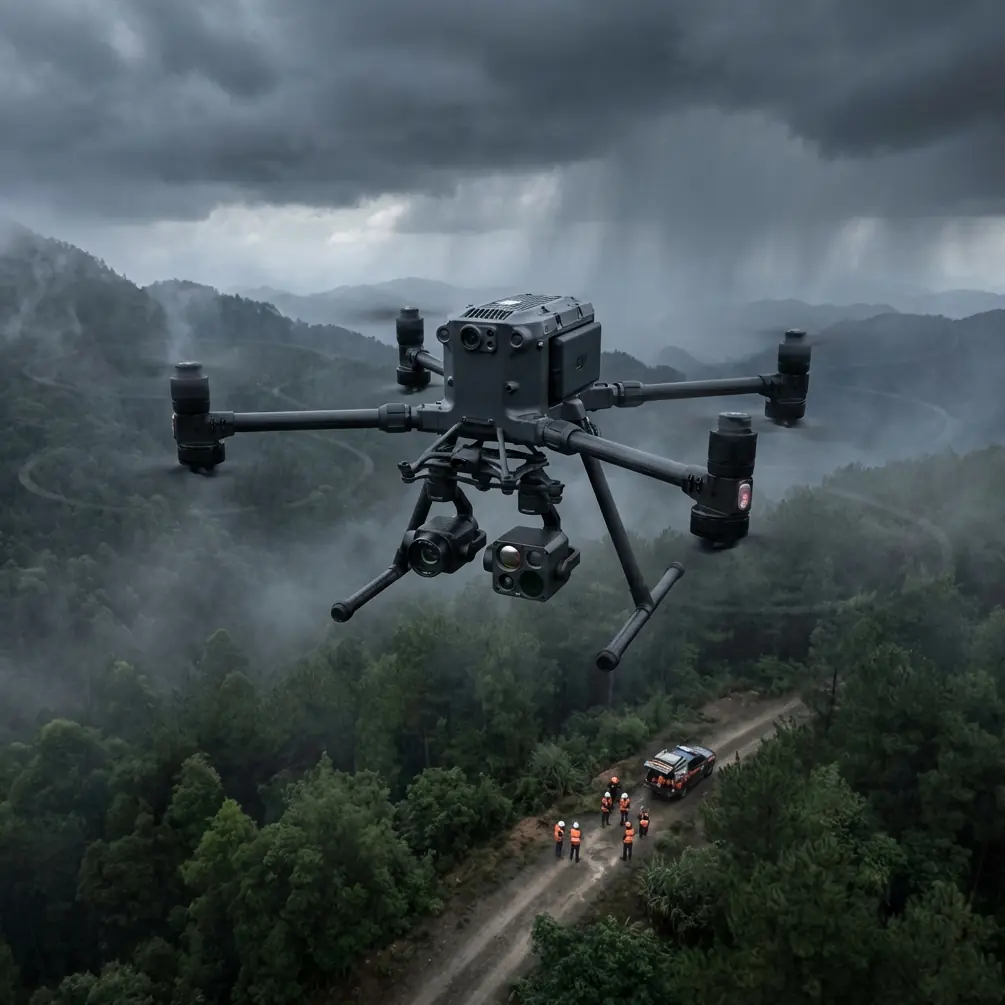
Matrice 400 at a Remote Solar Farm: What Battery Supply and Aircraft-Grade Power Logic Mean in the Field
META: A field-driven Matrice 400 case study for remote solar farm operations, connecting European drone battery manufacturing, power-system protection logic, and practical BVLOS inspection reliability.
By Dr. Lisa Wang, Specialist
Remote solar work has a way of exposing every weak assumption in a drone program.
On paper, a Matrice 400 deployment for utility-scale solar inspection sounds straightforward: plan the corridor, load the mission, capture thermal and RGB datasets, process the photogrammetry, verify anomalies, and move on. In the field, the real variables are less tidy. Crew travel is long. Charging windows are short. Dust and heat stack up by noon. A failed battery shipment can idle a team for days. And if your aircraft power architecture is not treated like a serious aviation system, small electrical problems become operational delays very quickly.
That is why one recent industry development matters more than it may seem at first glance. On May 2, 2026, International Drone Day, Titan Batteries announced the opening of a European drone battery production facility in Tilburg, the Netherlands. Titan, based in Pocatello, Idaho, says the move makes it the first major drone battery maker with full-scale production on two continents.
For Matrice 400 operators supporting remote solar farms, that is not just supply-chain trivia. It is an operational story.
Why a battery factory in Tilburg matters to a Matrice 400 mission
Most drone articles treat batteries as consumables. Serious operators do not. Batteries are part of mission assurance.
A remote solar farm typically demands repetitive flight cycles over a large footprint, often with a mix of thermal signature collection and high-overlap image capture for photogrammetry. If the site is far from a major service hub, battery availability is not merely about convenience. It affects fleet planning, reserve inventory, maintenance rotation, transport timing, and confidence in scheduling BVLOS-style workflows where allowed by local rules and operating approvals.
A dual-continent production footprint changes the conversation in three ways.
First, it can shorten replenishment risk for European and nearby operators. If a battery supplier is producing at full scale in both North America and Europe, the chances of a single regional disruption affecting all deliveries drop. That matters when you are supporting solar assets that cannot wait for an inspection backlog to clear after a heat event, inverter issue, or suspected string fault.
Second, it improves standardization potential across large fleets. Remote energy contractors often operate in more than one country. If the same battery manufacturer can supply from two production bases, operators have a better shot at keeping pack specifications, support channels, and replacement timing consistent across teams.
Third, it shifts how we think about resilience. The Matrice 400 is the kind of aircraft platform that only delivers its value when the entire ecosystem around it is stable: batteries, charging practices, swap routines, firmware discipline, data handling, and maintenance records. A stronger battery supply network supports that ecosystem.
For solar operators, reliability is productivity. Productivity is not the number of flights you can theoretically complete. It is the number you can complete after the third day of dust, heat, travel delays, and changing site conditions.
The field case: a remote solar farm, one hawk, and a narrowed inspection window
A recent remote-site scenario illustrates the point.
The assignment was a broad-area inspection pass over a solar farm far enough from the nearest logistics center that every extra battery cycle needed to be justified. The team’s Matrice 400 configuration was built around thermal imaging for hotspot detection and high-resolution visible-light capture for panel condition review and map-grade reconstruction tied to GCP-backed outputs.
Mid-morning, wind stayed workable, but the environment turned less cooperative. A hawk appeared near one section of array and began crossing the inspection corridor intermittently. This is where platform stability and sensor awareness matter more than marketing language ever will. The crew held position, adjusted the route segment, and used the drone’s sensor picture to avoid pushing through the bird’s path. Wildlife events are not rare on remote energy sites. They are part of real operating life, especially around open land, fence lines, and thermal updraft zones.
That single interruption compressed the remaining flight window. Once that happens, battery performance and turnaround discipline stop being background issues. They become the difference between finishing the thermal run that day or splitting the mission and adding another crew cycle.
Operators who depend on hot-swap batteries understand this instinctively. The battery is not just a power source. It is your schedule.
Aircraft-grade lessons that apply directly to Matrice 400 operations
The reference material here includes two aviation design documents that are not about the Matrice 400 specifically, yet they offer a useful frame for how experienced operators should think about mission-critical drone systems.
One document on inertial reference logic states that NAV mode is the normal operating mode and that switching from OFF to NAV should complete automatic alignment and correction within 10 minutes, with initial position data entered. That same source also notes that routine disturbances such as wind, maintenance activity, and loading should not compromise alignment or navigation accuracy.
Why does that matter for a remote solar farm crew using a Matrice 400?
Because it underscores a core aviation principle: normal field disturbances should not derail the system’s ability to establish trustworthy navigation. For drone teams, that translates into disciplined startup routines, GNSS and inertial confidence checks, and not treating initialization as a formality. If your mapping pass depends on repeatable lines, stable altitude behavior, and clean geotagging for photogrammetry, then navigation integrity is part of image quality. It is also part of thermal repeatability when you return to validate anomalies.
A second detail from the same document is even more revealing. In ATT mode, the system can maintain attitude output while navigation capability is degraded, and heading may require manual correction due to drift. In plain operational terms, attitude alone is not enough when your mission depends on accurate positional behavior.
That distinction matters in solar inspection. A drone that can remain controllable is not automatically a drone that remains useful for precise asset documentation. If the aircraft is forced into a degraded state, your thermal overlays, panel indexing, defect localization, and comparison against prior datasets can all suffer. For Matrice 400 operators, this is a reminder to separate “the aircraft is still flying” from “the data is still decision-grade.”
What electrical protection doctrine has to do with drone uptime
The second aircraft design reference focuses on electrical power protection, especially short-circuit and overvoltage behavior in low-voltage DC systems. One point stands out: short-circuit protection should isolate the fault from the power source and network without causing a total loss of supply. Another warns that both steady and transient overvoltage faults can damage connected equipment, so effective measures must rapidly reduce or cut excitation and disconnect the faulty generator from the network.
This is not abstract engineering trivia. It maps directly onto how professional drone teams should manage Matrice 400 support infrastructure in remote deployments.
A solar farm team rarely operates with the aircraft alone. There are chargers, field power sources, vehicle inverters, generator-backed charging arrangements, battery storage cases, mobile networking equipment, tablets, and data offload stations. If any part of that chain is electrically unstable, you risk damaging the very hardware that determines whether the day’s missions continue.
The practical lesson is simple: treat charging and field power like critical aviation support equipment, not campsite accessories.
If your remote base uses generator or inverter power, overvoltage behavior matters. If your charging chain is poorly protected, a single fault can affect multiple packs or charging devices at once. The aircraft handbook excerpt’s logic is blunt and correct: isolate faults quickly, and do not let one electrical event cascade into broad system loss.
For Matrice 400 users managing long solar-farm days, that means:
- protected charging setups
- clear pack rotation logs
- thermal monitoring during charging
- separation of suspect batteries from normal rotation
- conservative retirement criteria for damaged packs
- backup power plans that do not depend on one improvised source
These are not glamorous practices. They are the reason a high-end drone remains available when the inspection backlog is building.
The data side: thermal, photogrammetry, and why stable operations matter more than peak specs
Solar inspection teams often chase sensor specifications first. Resolution, zoom, thermal sensitivity, transmission range, encryption, and obstacle awareness all matter. On a Matrice 400, features associated with workflows like O3 transmission, AES-256-secured links, and scalable payload operations can be genuinely valuable. But those gains are only meaningful if the aircraft can execute repetitive, clean missions over large sites without operational friction.
Take thermal signature work. A hotspot is only useful if you can trust where it was observed, compare it against adjacent modules, and send a technician to the correct row without confusion. Navigation stability, battery predictability, and clean mission continuity all support that outcome.
The same goes for photogrammetry. If the plan includes dense overlap for map reconstruction with GCP verification, then interrupted sorties and inconsistent flight behavior complicate processing. You can still recover a model, perhaps. But your labor cost rises, your confidence interval widens, and the turnaround to the asset owner slows.
This is why the Tilburg battery story matters beyond procurement. Consistent battery support feeds consistent mission execution. And consistent mission execution is what turns premium hardware into dependable field results.
A more mature way to evaluate Matrice 400 readiness for remote solar delivery
When teams ask whether the Matrice 400 is right for remote solar-farm delivery and inspection work, the best answer is not a yes-or-no based on brochure features. It is a readiness checklist.
Can your operation maintain battery continuity over a multi-day campaign?
Can your field power setup tolerate faults without taking down the whole charging chain?
Can your crew distinguish between a controllable aircraft state and a data-valid aircraft state?
Can your workflow absorb wildlife interruptions, shifting weather, and compressed sortie windows without corrupting the inspection objective?
Can your communications stack support secure transfer and command reliability where AES-256 and robust transmission practices are part of compliance or client requirements?
That is the real threshold. The aircraft itself may be highly capable. The program around it has to be equally mature.
If you are planning a remote deployment and want to talk through battery strategy, payload fit, or BVLOS-oriented workflow design for energy sites, you can reach our field team directly on WhatsApp for deployment planning.
The larger signal behind this news
Titan Batteries opening in Tilburg is a supply-side event, but for Matrice 400 operators it signals something bigger: the drone industry is being forced to grow up around infrastructure, not just airframes.
A serious drone program is now judged by support depth as much as by flight performance. Two-continent battery production is one marker of that shift. Aircraft-style thinking about alignment, degraded modes, and electrical protection is another. Put those together, and you get a more honest picture of what remote solar operations require.
Not a miracle drone. A robust system.
That system includes navigation discipline from startup, awareness of what degraded modes really mean for data quality, and charging architecture designed to survive faults instead of spreading them. It also includes a battery supply chain that is less fragile than it was a few years ago.
For remote solar farms, where every truck roll is expensive and every missed defect can affect generation, those details are not peripheral. They are the job.
Ready for your own Matrice 400? Contact our team for expert consultation.