
Matrice 400 for Urban Venue Deliveries: What Actually
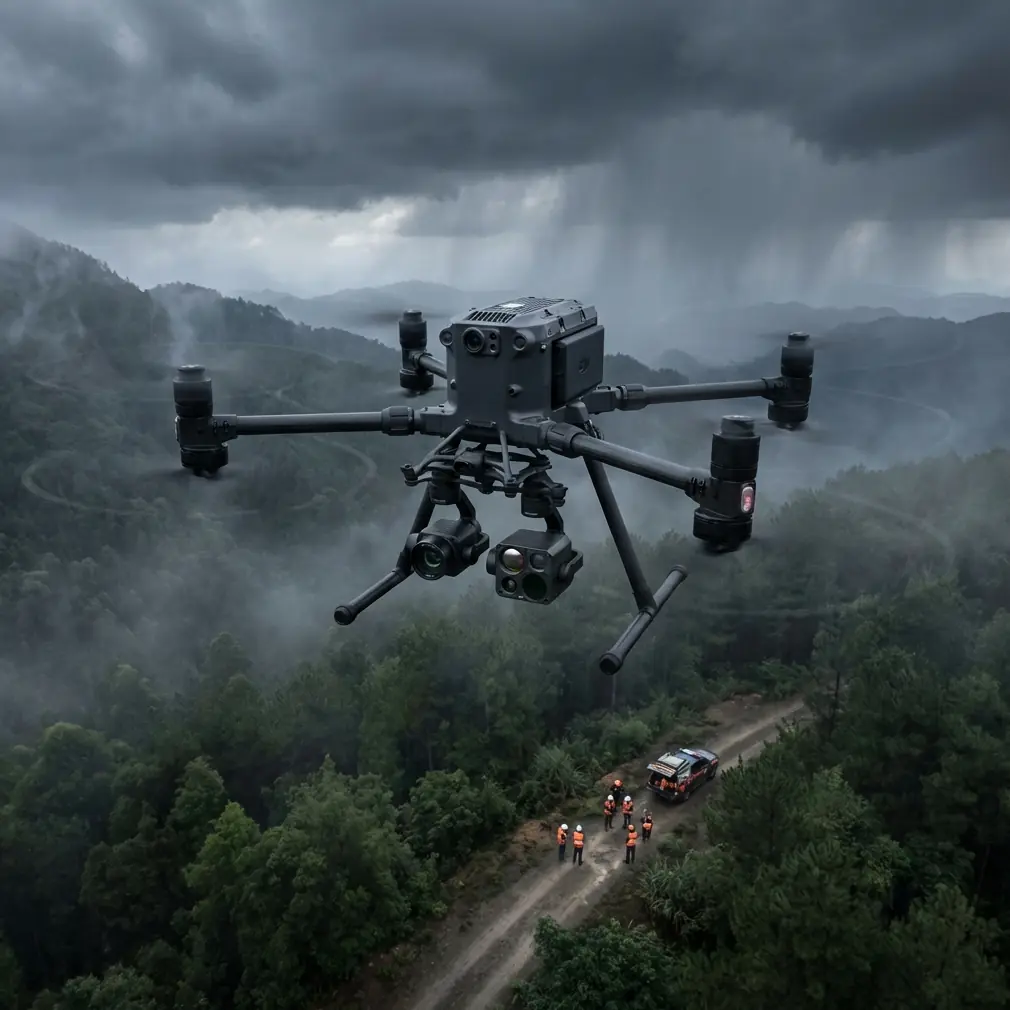
Matrice 400 for Urban Venue Deliveries: What Actually Matters When the Weather Turns Mid-Flight
META: Expert field guide to using Matrice 400 for urban venue delivery missions, covering reliability, O3 transmission, AES-256 security, hot-swap batteries, BVLOS planning, and payload workflows.
Urban venue delivery sounds simple until you try to run it at scale.
On paper, the mission is straightforward: move a small but time-sensitive payload into a dense city environment, hit a narrow arrival window, avoid crowd conflict, maintain signal integrity between buildings, and keep the aircraft productive across repeated sorties. In practice, venue operations are messy. Rooflines interrupt links. Temporary structures change landing or drop zones. RF noise spikes without warning. Wind tunnels form between towers. A clear afternoon can turn into a wet, unstable flight environment before the aircraft is halfway home.
That is where the Matrice 400 becomes interesting—not as a spec sheet item, but as a platform choice for operators who need continuity when the mission gets less predictable than the route plan suggested.
I’m writing this from the standpoint of a commercial UAV specialist looking at a very particular scenario: delivering to urban venues. Not broad package logistics. Not rural long-haul. Dense, operationally constrained, schedule-sensitive venue support. Think stadium concourses, exhibition halls, convention centers, waterfront event spaces, and multi-building campuses where timing and access control matter as much as flight performance.
The real problem: venue delivery is rarely a “straight line” mission
Most urban delivery discussions fixate on range or payload first. For venue work, that often misses the main operational friction.
The bigger issue is mission stability across interruptions.
A venue delivery workflow has to survive five things at once:
- unstable air around structures
- intermittent visual and radio obstruction
- constantly changing ground access conditions
- tight turnaround expectations
- data and operational security requirements
The Matrice 400 fits this category of work best when you think of it as a continuity tool. Its value is not tied to one headline feature. It comes from how multiple systems reduce the number of mission-ending surprises.
That includes O3 transmission for maintaining a robust link in signal-challenging environments, AES-256 for securing command and data pathways in commercially sensitive operations, and hot-swap battery support to keep aircraft uptime high when the delivery schedule does not leave room for long pauses.
Those aren’t just nice-to-have capabilities. In venue operations, they directly affect whether the second, third, and fourth missions of the day happen on schedule.
A weather-change scenario that reveals the platform’s strengths
Let’s use a realistic example.
A logistics team is supporting an urban convention venue during a large event. The aircraft is tasked with transporting urgently needed technical components from a staging rooftop to a service access point near the venue perimeter. The route has already been deconflicted, the site team is in place, and the first leg is clean.
Eight minutes into the mission, conditions shift.
A passing weather cell brings a quick pressure change. Wind direction rotates around nearby high-rises. Light rain begins. The aircraft now has to deal with moving air from multiple angles, reduced visual clarity, and a more demanding return leg than the outbound segment.
This is the moment when platform maturity matters.
A delivery aircraft in this environment needs stable control authority, reliable telemetry, and a transmission system that does not start degrading the instant the urban canyon gets noisier. O3 transmission matters here because urban venue corridors are not radio-friendly. A stronger, more resilient link can be the difference between an orderly route adjustment and an unnecessary mission abort.
From an operational standpoint, secure transmission also matters more than many teams admit. Venue deliveries often involve private site maps, restricted access points, event infrastructure layouts, or sensitive maintenance items. AES-256 encryption is not marketing garnish in that context. It supports a more defensible operating posture for commercial teams moving data and aircraft commands through congested urban environments.
The weather shift also changes payload handling assumptions. If you are transporting equipment that is heat-sensitive or condition-sensitive, monitoring the payload environment becomes part of mission quality. This is where thermal signature analysis can support decision-making, not because the delivery mission is a thermal inspection, but because operators may need to verify whether an item or container is being affected by ambient exposure, rooftop heating, or rain-cooled surfaces before handoff.
That kind of layered awareness is what separates a drone mission from a reliable venue logistics system.
Why hot-swap batteries matter more in cities than many operators expect
Urban venue delivery is often a sequence problem, not a single-flight problem.
One urgent run is manageable with almost any enterprise aircraft. The challenge begins when the venue team needs repeated dispatches while ground access remains blocked, elevators are restricted, or event foot traffic makes traditional movement too slow.
That is where hot-swap batteries become operationally significant.
With hot-swap support, the Matrice 400 can be turned around between missions without the kind of downtime that compounds delay across a busy event window. The benefit is obvious at first glance—less waiting. But the deeper benefit is schedule integrity.
If a weather event interrupts one sortie, the operator may need to relaunch quickly once conditions return within the acceptable envelope. If battery changes are slow and disruptive, the aircraft loses its advantage over the ground team. In a venue environment, that delay can push a delivery past a setup deadline, a speaker changeover, a broadcast segment, or a catering handoff window.
The battery workflow is part of the logistics system. Not an accessory to it.
BVLOS is useful, but only if the operation is built properly
A lot of professionals use BVLOS as shorthand for efficiency. That is too simplistic for urban venue work.
Beyond visual line of sight operations only help when planning, route design, communications reliability, and emergency contingencies are already disciplined. Otherwise, BVLOS just extends complexity.
For the Matrice 400, BVLOS relevance in venue delivery comes from its ability to support repeatable route structures across dispersed urban assets: a warehouse rooftop, an event center loading area, an annex building, a temporary operations compound. If the operation is authorized and structured correctly, BVLOS can reduce dependency on slow or obstructed ground transport and make inter-site movement much more consistent.
But consistency depends on the supporting stack:
- dependable transmission in cluttered environments
- secure command architecture
- battery swap efficiency
- accurate route verification
- disciplined landing or release-zone management
In other words, BVLOS is not the magic. The system around it is.
Photogrammetry and GCPs are not just for survey teams
One of the most overlooked ways to improve urban venue delivery is to borrow methods from mapping operations.
Photogrammetry and GCP-based site preparation can dramatically improve how operators understand a venue before the first logistics mission launches. That may sound excessive if the mission is “just a delivery,” but urban venues are notorious for temporary changes: staging trusses, tents, seasonal signage, scaffold systems, HVAC obstructions, media towers, and restricted roof access points.
Photogrammetry allows teams to build an accurate current model of the venue and its approach corridors. Ground control points, or GCPs, improve geospatial reliability when precision matters. Together, they help answer practical questions:
- Is the designated approach path still clear?
- Has a temporary structure changed rotor-safe clearance margins?
- Is the rooftop handoff zone still viable after event buildout?
- Has rain altered surface conditions enough to require a revised touchdown or transfer procedure?
This is where the Matrice 400 becomes more than a delivery aircraft. It becomes part of a pre-mission intelligence loop. Mapping-grade preparation reduces rushed decisions in live operations, which is exactly what you want when weather changes mid-flight and the margin for improvisation narrows.
What a good venue delivery workflow looks like on Matrice 400
For urban venue operations, the strongest workflows tend to follow a simple pattern.
1. Build the venue model first
Before launch day, conduct a site capture using photogrammetry, ideally supported by GCPs where positional confidence needs to be tighter. This creates a current operating picture rather than relying on outdated architectural plans.
2. Define route and fallback logic
The main route is not enough. You also need alternate corridors, holding positions, and return triggers. Urban wind behaves differently block by block. A route that is comfortable outbound can become awkward on the return leg when weather rotates.
3. Protect the link
O3 transmission should be treated as mission-critical infrastructure. In dense venue zones, RF conditions are not static. Operators should evaluate where buildings, broadcast equipment, and temporary installations may affect control and video continuity.
4. Secure the operation
AES-256 matters for organizations handling sensitive event operations, private infrastructure access, or proprietary equipment movement. Drone logistics is still logistics, and logistics often includes information others should not see.
5. Optimize turnaround
Hot-swap battery procedures should be rehearsed, not improvised. The aircraft may perform well, but poor ground handling can erase the benefit.
6. Add payload condition awareness
Where useful, thermal signature checks can help teams verify whether stored equipment, containers, or rooftop staging areas are being affected by environmental change.
That sequence gives the Matrice 400 a role that is broader than carrying objects from A to B. It becomes a controlled, repeatable airborne leg inside a larger venue support system.
The mid-flight weather change is where trust is earned
Anyone can appreciate a smooth test flight on a calm day.
Operators trust a platform after the mission gets worse than expected and still remains manageable.
In venue delivery, weather rarely needs to become extreme to cause trouble. A moderate gusting shift between buildings can force a route correction. Light rain can change the timing of a handoff. Reduced visibility can increase workload even when the aircraft remains well within capability. The question is not whether the drone can still fly. The question is whether the whole operation can remain composed.
That is why Matrice 400 planning should be less about chasing maximum theoretical performance and more about preserving control when variables stack up.
If the weather changes mid-flight, the aircraft’s communication reliability, secure data pathway, battery turnaround design, and compatibility with structured site modeling all become part of the same answer.
Not separate features. One answer.
Where this platform makes the most sense
For urban venue delivery, the Matrice 400 is best suited to teams that need professional process discipline, not just lift.
That includes:
- event infrastructure support between controlled sites
- technical equipment transfer across large campuses
- urgent maintenance item delivery to rooftops or restricted service areas
- time-critical movement of broadcast, lighting, AV, or operations components
- inter-building logistics where road movement is slower than air movement
These are civilian use cases with one common trait: the aircraft has to fit into a live operational ecosystem. It is not flying for its own sake. It is there to remove friction from a schedule that other teams depend on.
If you are evaluating workflow design, route planning, or payload suitability for venue operations, you can reach out via our urban drone operations line.
The bottom line
The Matrice 400 makes the strongest case for itself in urban venue delivery when you stop treating it as a single aircraft and start treating it as an operational node.
O3 transmission helps preserve command confidence in dense RF conditions. AES-256 supports secure commercial operations. Hot-swap batteries protect sortie tempo. Photogrammetry and GCP workflows improve site precision before launch. Thermal signature awareness adds a useful layer when environmental conditions begin to shift. And if BVLOS is part of the approved mission framework, the aircraft can support a more consistent inter-site logistics rhythm than ground movement alone.
That combination matters most when the day stops behaving.
And on venue jobs, it usually does.
Ready for your own Matrice 400? Contact our team for expert consultation.