
Matrice 400 for Windy Venues: A Field Tutorial
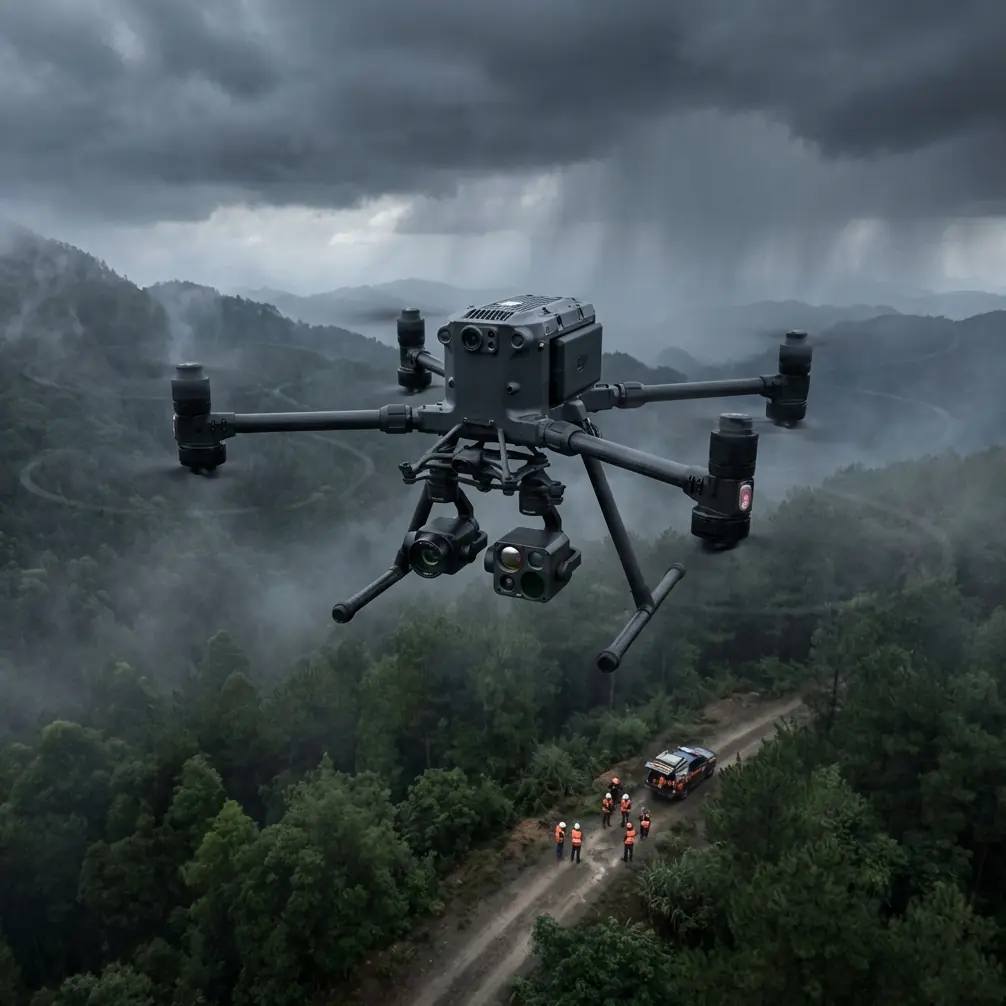
Matrice 400 for Windy Venues: A Field Tutorial from the Ground Up
META: Expert tutorial on using Matrice 400 at windy venues, with practical flight planning, battery management, payload thinking, and ground-handling lessons drawn from real aircraft design principles.
If you’re planning to fly a Matrice 400 around event venues, stadium exteriors, exhibition halls, waterfront properties, or large temporary structures in wind, the real challenge is rarely just “can the drone fly.” The harder question is whether the whole operation stays stable from unpacking to landing.
That distinction matters.
A venue mission in wind is a chain of small decisions: where you stage the aircraft, how you taxi the operation on the ground, when you swap packs, what route geometry keeps the aircraft clear of gust funnels, and how you maintain image consistency when the air is moving and the site is crowded with steel, glass, cable runs, tents, and reflective surfaces. A Matrice 400 can be a very capable platform for this kind of work, but only if the crew thinks like system operators rather than just pilots.
I want to start with a lesson that sounds old-school, because it is. One of the source references here isn’t about drones at all. It’s from an aircraft design handbook discussing ground loads, turning loads, asymmetric braking, tow loads, bounce loads, and the need to assume a vertical load factor of 1 at the aircraft center of gravity during towing. That may seem far removed from a modern UAV. It isn’t. In windy venue operations, those principles become surprisingly practical.
Why venue work in wind punishes sloppy workflow
Venue environments create strange air. Grandstands channel it. Loading bays accelerate it. Roof edges spill it downward. Temporary LED walls and truss systems produce localized turbulence. Even when the wider forecast looks manageable, the air near the structure can feel completely different from what your handheld meter reports in the open.
That is why a Matrice 400 deployment for venues should be treated as three separate phases:
- ground handling
- airborne task execution
- recovery and battery turnarounds
Most crews obsess over phase two. The avoidable mistakes often happen in phases one and three.
The handbook reference on aircraft ground loads highlights several specific cases: landing impact loads, taxi loads from uneven surfaces, braking loads, turning loads created by differential braking or asymmetric thrust, and rebound loads caused by sudden extension in the gear during bounce events. For a venue drone team, the operational significance is simple: wind does not stop being a risk when the motors are at idle or when the aircraft is one meter off the ground.
If you’ve ever watched a large enterprise drone get nudged sideways by a gust during touchdown on a painted service road, you already understand this. The ground may be where your checklist says the risk is ending. In reality, the landing zone is often where mechanical stress and human error briefly stack up.
The first habit: choose your launch surface like an airframe engineer
That same handbook notes that uneven surfaces during takeoff or landing roll can generate the largest vertical loads on the landing gear, especially during takeoff roll in conventional aircraft. The drone equivalent is not a runway roll, obviously, but the logic still holds: bad surfaces amplify load spikes.
For Matrice 400 venue work, don’t launch from the nearest convenient patch of concrete unless you’ve inspected it properly. Expansion joints, drainage lips, cable ramps, anti-slip ridges, and temporary flooring transitions all matter. In gusty conditions, a slightly uneven pad can become the difference between a clean, vertical liftoff and a small lateral hop that starts the mission with unnecessary stress on the airframe and payload mount.
My rule is blunt: if the surface would make me uneasy placing a calibrated camera tripod on it, I do not want to launch a heavy commercial UAV there in wind.
Look for:
- flat, rigid ground
- clean rotor clearance around barriers and banners
- enough stand-off distance from walls that reflect prop wash
- no loose debris that can become a strike hazard
- room for a straight, disciplined recovery path
This sounds basic. It is also where many venue flights are won or lost.
Turning loads are real, even when your aircraft hovers
Another source detail worth translating is the handbook’s explanation of stable turning loads created by differential braking, asymmetric thrust, or steering inputs during ground maneuvering. For manned aircraft, that’s about landing gear load paths during turns. For venue drone operations, it maps neatly onto the hidden stress you create when forcing aggressive corrections near the ground in gusts.
If your Matrice 400 is yawing into crosswind and the pilot is making hurried lateral corrections during a low hover, you are effectively asking the aircraft to absorb repeated directional changes while still in the most turbulent layer around the venue. That is not just a piloting issue. It also affects data quality.
Thermal signature work suffers when the aircraft hunts for position beside warm facades or rooftop plant equipment. Photogrammetry suffers when the platform’s attitude varies too much between image captures, even if your overlap settings looked safe on paper. If your mission needs consistent mapping output tied to GCPs, the aircraft’s ability to maintain stable geometry in disturbed air matters just as much as the camera.
A lot of operators assume wind only reduces endurance. In practice, it can also compromise dataset consistency before it ever forces an RTH decision.
A better windy-venue workflow for Matrice 400
Here is the sequence I recommend when the site is complex and the wind is active.
1. Split the venue into airflow zones
Do not plan the mission as one big polygon unless the site is unusually open. Break it into sections:
- windward face
- leeward face
- roof edge zones
- service lane corridors
- open apron or parking areas
The reason is operational, not theoretical. The aircraft may perform predictably over an open car park, then encounter sharp buffeting along a facade corner. Splitting the venue lets you adjust speed, altitude, camera timing, and emergency landing choices by zone instead of pretending the whole site is one atmosphere.
If you’re collecting photogrammetry data, this zone approach also helps preserve consistency. If one side of the site is unstable, you can refly just that block rather than contaminating the entire mission.
2. Use the first battery to learn the wind, not to prove confidence
This is where field experience beats enthusiasm.
The first pack of the day should be treated as reconnaissance unless the conditions are exceptionally benign. With enterprise platforms, crews sometimes feel pressure to maximize airborne minutes. I’d rather spend the first battery validating the venue’s airflow map, testing control feel at working altitude, checking transmission quality, and confirming recovery lanes.
That is especially true if you expect to use long-range or semi-obstructed links. The O3 transmission ecosystem is useful here because venue structures can produce multipath effects and awkward signal behavior even when the aircraft is not far away. Strong transmission isn’t just a convenience. In urban or event environments, it directly affects your margin for smooth control and clean decision-making.
If the mission has sensitive footage or client data, secure link practices matter too. AES-256 support is not a brochure detail in that context. For commercial venue operators handling private site imagery, construction logistics, back-of-house layouts, or VIP infrastructure, encrypted transmission is part of professional risk control.
3. Keep your orbit plans conservative
Windy venues tempt operators into dramatic reveals around roofs, arches, and grand entrances. The aircraft can often do it. The better question is whether the data or footage benefits enough to justify the turbulence exposure.
For inspections or thermal work, conservative lines usually produce better output. A stable oblique pass often beats a cinematic curved path if your end goal is defect detection, heat anomaly comparison, or repeatable documentation.
This is one place where many Matrice 400 users can gain efficiency. You do not need to fight the venue to make the aircraft look impressive. Let the mission objective decide the route.
The battery management tip I wish more crews used
Here’s the field tip.
In windy venue work, never judge pack health only by total percentage remaining. Judge it by how the aircraft reached that percentage.
Two flights can both return at 58%, but one may have spent the last four minutes fighting gusts beside a grandstand while the other flew an open, efficient grid over a parking apron. Those batteries did not experience the same stress profile, and they should not be treated as interchangeable in your sortie rotation.
On hot-swap battery systems, the temptation is to keep cycling fast. Don’t do it blindly. After a wind-heavy leg, I prefer to let that pair rest and assign the next launch to a set that has had time to normalize. In practice, this can smooth pack temperature behavior and reduce the chance that your “fresh” launch begins with batteries already carrying more thermal burden than you realize.
That becomes more relevant when venue work involves repeated short launches rather than one long mapping mission.
A useful habit is to annotate packs by mission type, not just by cycle count:
- open-area mapping
- facade hover work
- windward inspection
- thermal rooftop pass
That little bit of discipline pays off later when a battery starts behaving differently under load. You’ll have context, not just numbers.
If you want a practical second opinion on a windy site setup or sortie plan, you can reach a field team here: message a drone specialist directly.
Recovery matters more than launch
One of the most useful details in the aircraft handbook is the mention of rebound loads during takeoff and landing runs, where sudden gear extension under high-pressure action can create bounce loads. Again, the drone translation is not literal, but the principle matters: awkward touchdown dynamics create abrupt structural stress.
For Matrice 400 recovery at a venue, avoid descending straight into the worst turbulence pocket simply because it is closest to your takeoff point. If the leeward loading dock is smoother than the original launch pad near the facade corner, recover there if your permissions and safety layout allow it.
I’d rather walk farther to retrieve the aircraft than force a neat-but-rough landing in bad air.
A practical recovery sequence looks like this:
- hold briefly at a moderate altitude to read the air
- align into the cleanest available approach path
- reduce lateral movement early
- avoid last-second yaw corrections close to ground effect
- commit to touchdown without overcontrolling
The biggest mistake I see is pilots trying to “polish” the final meter of descent after the venue has already shown them unstable air. A firm, controlled landing on a good surface is healthier than a fussy hover that invites a gust.
Thermal and photogrammetry each need different wind discipline
Because your context hints include thermal signature and photogrammetry, it’s worth separating them.
For thermal signature missions
Wind changes surface readings. It can cool facades unevenly, scrub rooftop hotspots, and alter the apparent shape of anomalies. Around venues, HVAC discharge zones and shaded wall sections complicate this further. Your Matrice 400 workflow should record not only ambient conditions but also relative wind exposure by surface. That way your inspection notes explain why one wall face reads differently from another.
For photogrammetry missions
Wind mainly attacks consistency. It influences attitude stability, overlap reliability, and motion sharpness. When you’re tying results to GCPs, stable repeatable lines matter more than squeezing every last minute from the battery. Lower speed and cleaner geometry usually outperform aggressive coverage in gusty air.
That is the difference between a dataset that processes cleanly and one that forces rework.
A final thought on “aircraft thinking” for drone crews
The strongest teams flying Matrice 400 at venues tend to think less like gadget users and more like small-aircraft operators. The old aircraft design references in your source material are useful precisely because they remind us that a flying machine is not only judged in cruise. It is judged in towing, turning, braking, bouncing, and ground handling.
Two source facts stand out:
- turning on the ground under asymmetric inputs creates distinct load conditions
- towing calculations must consider a vertical load factor of 1 at the center of gravity
Why do those ideas matter to a venue drone crew? Because they train the right instinct: every phase of movement has a load consequence. When wind is present, seemingly minor handling choices compound quickly. Dragging a cased aircraft awkwardly through a crowded access route, rushing a battery swap on a sloped service lane, or insisting on a launch point beside a turbulent facade are all signs that the crew is thinking only about takeoff clearance, not total system management.
The Matrice 400 is best used by operators who respect that bigger truth. Wind at venues is rarely a single obstacle. It is a multiplier. It magnifies bad launch surfaces, shaky battery discipline, rushed recoveries, and overambitious route design. But if you structure the mission well, read the site in zones, and manage the aircraft like a serious working platform, the same environment becomes very manageable.
That is what separates a stressful windy deployment from a professional one.
Ready for your own Matrice 400? Contact our team for expert consultation.