
Delivering Through Vine Rows and Ridge Lines
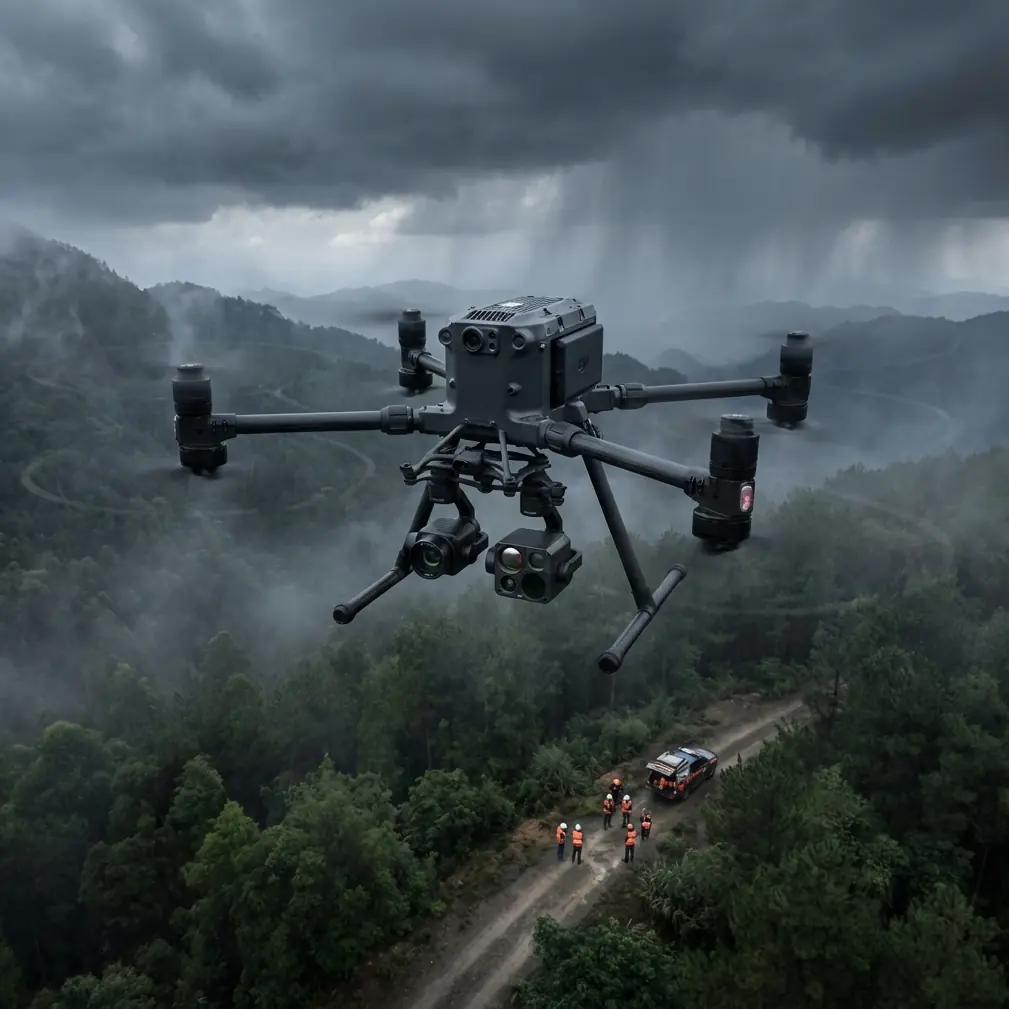
Delivering Through Vine Rows and Ridge Lines: A Practical Matrice 400 Workflow for Vineyard Logistics
META: Learn how the Matrice 400 fits vineyard delivery in steep, weather-shifting terrain, with expert guidance on payload stability, power management, transmission resilience, thermal awareness, and mission planning.
Vineyard delivery sounds simple until the map gets real. A few test plots become terraced rows. A service road disappears behind a ridge. Wind slides down a slope that looked harmless on the forecast. Then the weather changes halfway through the route, which is exactly when a serious aircraft proves whether it belongs in the operation or just in the brochure.
For teams evaluating the Matrice 400 for vineyard logistics, that is the right frame of reference. Not “can it fly from A to B,” but “can it keep a delivery mission stable when terrain, airflow, and communications all get messy at once?”
I’ve spent enough time around commercial UAV programs to know that complex delivery work is never just about payload capacity. It is about systems discipline: power, transmission, mechanical reliability, route design, and what happens when conditions move outside the tidy assumptions made during planning. That is why the most useful way to think about the Matrice 400 in a vineyard environment is as an integrated work platform, not a standalone aircraft.
Why vineyards expose weak drone workflows
Vineyards create a peculiar mix of problems. They often sit on uneven ground with broken sight lines. Some are spread across multiple elevations, with tree lines, irrigation hardware, access tracks, trellis systems, and sheds interrupting clean flight corridors. Even where the straight-line distance is short, the operational difficulty is not.
A drone moving replacement sensors, sampling kits, field tools, or urgent maintenance items between work points may need to cross ridges, descend into cooler air pockets, and hold stable over narrow drop zones. Those are all manageable demands, but only if the aircraft and mission profile were built around consistency.
This is where the broader aerospace references become more relevant than they first appear. One aircraft design source notes that constant-frequency AC generation is built around very tight speed control, with steady-state rotational accuracy in the neighborhood of ±1% in some constant-speed drive systems. That sounds far removed from a vineyard delivery mission, but the principle matters. Stable onboard power is not academic. It underpins how reliably an aircraft supports navigation, comms, sensing, and control when inputs change quickly. In practical terms, a delivery drone in mountainous agricultural terrain needs the electrical equivalent of composure.
The same reference also points out a standard aircraft power architecture with a rated frequency of 400 and 120/208 three-phase output. Again, the point is not that vineyard operators need to become electrical engineers. The point is that higher-end aircraft thinking has always treated power quality as mission-critical. If you are running a Matrice 400 beyond a flat demonstration field and into real terrain with a valuable payload, that mindset is worth adopting.
The delivery mission that looks easy on paper
Let’s walk through a realistic scenario.
A vineyard operations team needs to move a small but time-sensitive package from the main facility to a crew working on an upper block beyond a ridgeline. The item could be a disease sampling kit, calibration tool, field radio battery, irrigation valve component, or a replacement RTK accessory used for mapping alignment and GCP verification. The distance itself is not extreme. The issue is terrain complexity and timing.
The mission begins in stable morning conditions. The route is built with terrain awareness, conservative buffer margins, and a clear return logic if visibility or wind deteriorates. O3 transmission is one of the key enablers here because reliability in signal handling matters more in vineyards than many first-time operators expect. Rows and slopes can create odd dead zones, especially when the aircraft dips behind elevation changes. A robust transmission link is not a luxury; it is what keeps the pilot from chasing uncertainty with bad decisions.
Because some agricultural clients increasingly care about operational privacy, encrypted links matter too. AES-256 is not just a specification line for security-conscious teams. If you are flying logistics around proprietary trials, crop treatment schedules, or infrastructure layouts, secure transmission is part of professional risk management.
Mid-flight weather change: where the mission gets honest
About halfway through the delivery, conditions shift. A crosswind begins to build along the exposed side of the ridge, and a low cloud edge moves in faster than expected. The vineyard floor remains calm, but airflow above the upper rows becomes erratic. This is common in complex terrain. The pilot on the ground may not feel what the aircraft is feeling.
Here, the Matrice 400’s value is less about brute force and more about its ability to remain predictable as the environment stops cooperating. The aircraft does not need to perform heroics. It needs to hold course discipline, preserve link stability, manage energy intelligently, and keep the payload secure without forcing a rushed descent.
This is the point in operations where hot-swap batteries stop sounding convenient and start becoming strategic. For vineyard teams running repeated logistics hops, battery handling is not only about turnaround time. It changes how you schedule sorties around weather windows. If one route is delayed and another work group suddenly needs support before conditions worsen, the ability to keep aircraft availability high can make the difference between a smooth field day and a cascade of delays.
There is a useful parallel in the reference material on aviation oil systems. One source emphasizes that lubrication and cooling arrangements must account for pressure, flow, allowable temperature, heat rejection demand, and radiator environment, and it also notes that oil filtration in the supply system is essential, with washable filter maintenance intervals under 200. That is not vineyard advice directly, but it captures a discipline commercial drone operators often overlook: environmental stress changes maintenance reality. Dust from vineyard roads, pollen load, humidity swings, and repeated thermal cycling all add up. If your Matrice 400 is flying regular logistics missions in agricultural terrain, your maintenance program should become condition-aware, not calendar-only.
Payload delivery is a mechanical problem too
Power and comms usually get the attention. Mechanical endurance should too.
Another aircraft reference draws a line between structural airframe bearings and those used in engines, generators, reduction gears, instruments, and landing gear. It then details aircraft body bearings used in control systems, including self-aligning heavy-load double-row ball bearings to standards such as SAE-AS27643, with operating temperatures from -65 to 350°F. The operational lesson is straightforward: alignment tolerance and load behavior matter when parts are exposed to repeated motion, vibration, and temperature variation.
For a Matrice 400 delivering into vineyards, that translates into how you think about mounting hardware, payload release systems, gimbal behavior, and repeated operations over rough landing zones. If your payload interface develops play, if vibration creeps into the mount, or if a release mechanism starts tolerating slight misalignment, mission precision degrades long before outright failure appears. In vineyards, where delivery points may be cramped and sloped, a small mechanical inconsistency is not a small operational issue.
That matters even more if your workflow combines logistics with sensor work. Some operators use the same aircraft fleet for delivery runs in the morning and photogrammetry or thermal signature surveys later in the day. That is efficient, but only if you protect calibration and mounting integrity across mission types. A delivery setup that introduces vibration or balance issues can quietly erode mapping quality, especially where GCP workflows depend on repeatable geometry.
How I would structure the mission with Matrice 400
If I were building a vineyard delivery program around the Matrice 400, I would not start with distance claims. I would start with repeatability.
1. Survey the route before the first package moves
Use a mapping pass to build a terrain-aware corridor. Photogrammetry helps define the true vertical and lateral constraints between rows, utility poles, netting, storage structures, and slope breaks. If the vineyard already uses GCPs for surveying or block planning, incorporate those datasets so your delivery corridor reflects the same ground truth as the farm’s planning maps.
This creates two benefits. First, the route becomes safer and more consistent. Second, every later mission becomes easier to brief.
2. Build weather triggers that reflect terrain, not just forecasts
Do not rely on a single surface forecast. Create mission thresholds for ridgeline wind, cloud movement, and visibility loss in the upper blocks. The weather that matters is the weather where the drone will actually be.
In our scenario, the mid-flight change did not automatically end the mission. It triggered a disciplined reassessment. That is the difference between professional operations and improvised flying.
3. Use thermal awareness where it adds value
Thermal signature capability is not only for search tasks or equipment inspection. In agriculture, it can help identify warm equipment clusters, active work crews, or microclimate differences in low-light conditions that affect where people and machinery are positioned. During a delivery mission near dawn or late afternoon, thermal context can improve situational awareness around the drop zone.
That does not replace visual confirmation. It supplements it.
4. Plan battery use around route complexity
A short route with ridge crossings can demand more than a longer route over open flat ground. Account for climb profile, hover margin at the destination, and possible reroute or hold needs if the drop zone becomes temporarily unusable.
Hot-swap batteries support tempo, but they should also support prudence. Leave reserve margin for terrain and weather surprises.
5. Protect the data path
If your team is using O3 transmission and AES-256-capable workflows, treat those as operational controls, not feature trivia. Signal resilience helps prevent command interruptions in broken terrain. Encrypted links help protect operational data, especially for vineyards running research blocks, contract growing, or proprietary cultivation programs.
If you need help tailoring that setup to your site layout and workflow, a direct field coordination channel like message our operations desk on WhatsApp can be useful when your team is moving between blocks and can’t sit through long email threads.
BVLOS changes the economics, but only if the foundation is solid
For larger vineyard estates, BVLOS potential is where the Matrice 400 conversation becomes more serious. A properly designed beyond-visual-line-of-sight logistics corridor can reduce the need to move vehicles over steep service tracks just to deliver lightweight but operationally critical items. That can cut delay, reduce wear on ground resources, and improve response time during irrigation faults, weather events, or maintenance interruptions.
But BVLOS should not be the first chapter. It should be the result of good earlier chapters: stable route design, signal confidence, energy discipline, maintenance rigor, and documented procedures for changing weather.
The aerospace references support this systems-first view. Tight speed accuracy, fault protection, self-diagnostic monitoring, lubrication and cooling considerations, maintenance intervals, and load-capable bearing design all point to the same truth. Reliable aircraft operations are assembled from details. The Matrice 400 becomes valuable in vineyard delivery not because one headline feature solves everything, but because the platform can be integrated into a workflow where those details are respected.
What the mid-flight weather event really taught us
Back to the scenario.
The weather changed. The aircraft did not panic the operator. Link quality remained usable. The route logic held. The payload stayed controlled. The team completed the task because the operation had been built for variability, not just for ideal conditions.
That is the standard vineyard logistics teams should aim for with the Matrice 400.
Not spectacle. Not marketing theater. Calm performance when the ridge starts throwing wind across the rows and the morning plan suddenly gets rewritten in the air.
If you are evaluating the platform for vineyard delivery, ask the hard questions early:
- Can your route survive signal interruption risk from terrain?
- Have you mapped true drop-zone constraints with photogrammetry?
- Are your battery reserves based on slope and hover reality, not spreadsheet optimism?
- Is your payload mount mechanically repeatable over repeated agricultural use?
- Do your crews know exactly what changes when the weather shifts mid-mission?
Those questions matter far more than any polished product sheet.
A well-run Matrice 400 delivery program in vineyards can do more than move a parcel. It can compress response times across difficult terrain, reduce unnecessary ground movement, support distributed field crews, and fold into broader mapping and crop-monitoring operations. That is real value. But it only appears when the aircraft is treated as part of a disciplined aviation workflow.
Ready for your own Matrice 400? Contact our team for expert consultation.