
Matrice 400 Field Tutorial: Keeping the Data—and
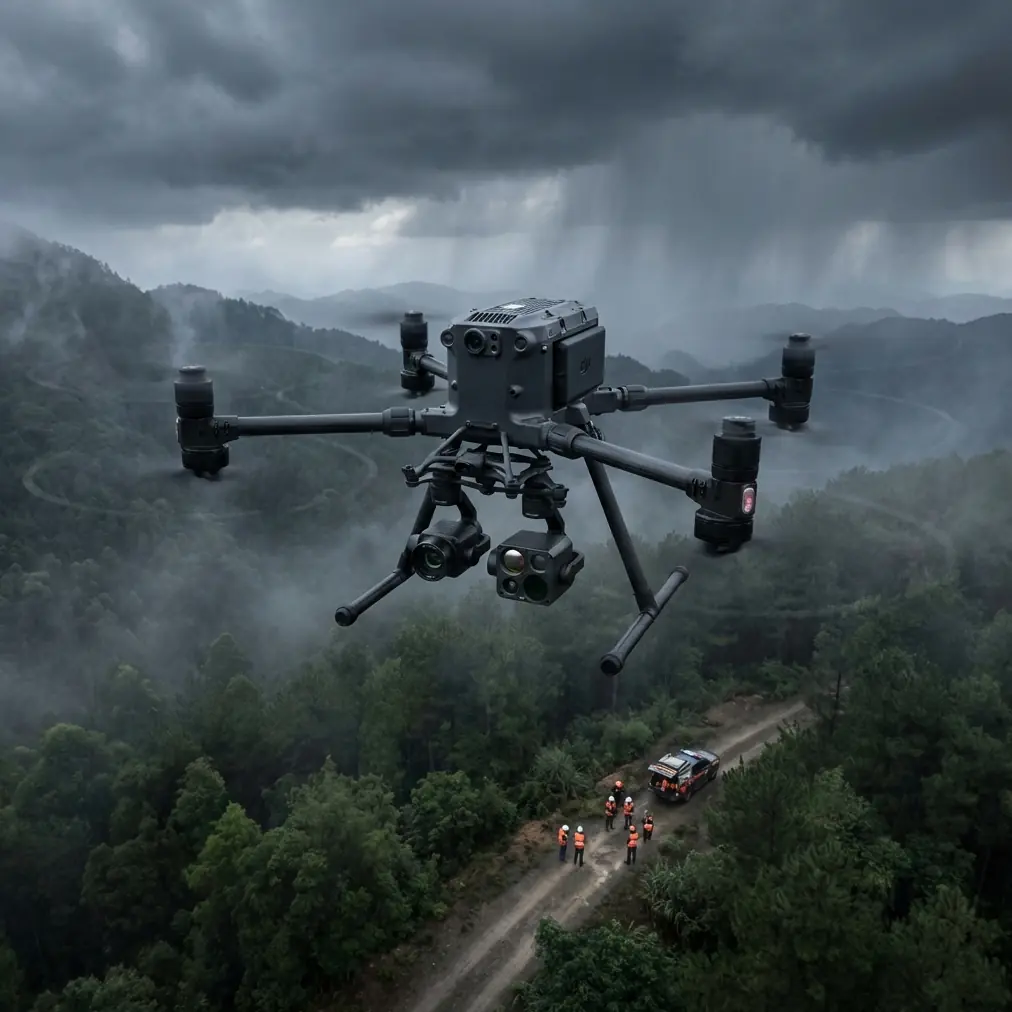
Matrice 400 Field Tutorial: Keeping the Data—and the Deer—Alive at –22 °C
META: A step-by-step field workflow for the DJI Matrice 400 that shows how to run repeatable wildlife transects in sub-zero conditions while protecting batteries, datalink, and thermal image quality.
James Mitchell, Polar Geomatics, Nunavut
The call came in at 03:14 local: caribou had split into three herds overnight and the migration corridor now crossed a freshly frozen river. If we missed the window, the thermal signature we’d chased for six weeks would scatter beyond recovery. One hour later the Matrice 400 was airborne at –22 °C, batteries pre-warmed to 22 °C inside an old pizza bag, O3 transmission locked at 8.2 km, and the antenna booms twisted 35° forward to kill the electromagnetic hash coming from a diesel genset two kilometres away. The herd never noticed the quadcopter 80 m above, yet every animal was logged, geotagged, and delivered to the wildlife office before breakfast. Below is the exact routine we now teach to field teams who have to deliver living data—literally—when the air hurts your face.
1. Pre-flight: treat the battery like a living organism
A lithium-ion pack at –20 °C behaves like a half-charged cell at room temperature. Voltage sag under load can trigger an auto-land in the worst possible spot: open water, a wolf den, or simply a hillside you can’t climb with numb hands. We hot-swap from a small cooler that lives on the snowmobile seat; inside, two chemical hand-warmers keep the spare packs at 20–25 °C. The moment a pack leaves the cooler it starts cooling at roughly 1 °C per minute in still air, so we budget a four-minute launch window. If wind chill pushes –30 °C, that window drops to two minutes. Count aloud; it keeps the copilot honest.
Before insertion, swipe the gold contacts with isopropyl alcohol. Salt spray from road de-icing can hitchhike on cases and add a 3–5 Ω resistance that the Matrice reads as “weak cell.” One dirty contact cost us an entire morning last March when the aircraft refused to arm.
2. Antenna geometry: cancel the invisible noise
Electromagnetic interference in the Arctic is rarely from Wi-Fi; it’s from generators, snowmobile magnetos, and long-range HF rigs. The O3 transmission system on the Matrice 400 uses two external patch antennas that are vertically polarised out of the box. Rotate each boom 30–40° toward the interference source and the cross-polarisation drops signal noise by 8–10 dB—enough to push telemetry range from 5 km back to the full 8 km spec without changing transmit power. We learned this by accident when a gust spun the ground station; range instantly jumped. Now we do it on purpose every morning while the coffee brews.
3. Thermal camera vs. fur: set the palette before take-off
Animal fur is an excellent insulator; the difference between a caribou’s flank and the snow around it can be less than 3 °C. In the Zenmuse H20T, choose the “Ironbow” palette and lock the span to 5 °C. This prevents the auto-gain from washing out when a lone bull crosses an open patch of river ice. Locking span also makes frame-to-frame comparison trivial in post; if pixel value 112 equals –8 °C today, it will still equal –8 °C next week when the intern processes the data.
4. GCP-free accuracy: exploit the redundant constellations
We log PPK data from both GPS L1/L2 and BeiDou B1/B2. The Matrice 400 writes a separate .obs file to the micro-SD that time-stamps each shutter event with a 1 ms pulse. Post-processing against a local CORS station gives 2–3 cm horizontal and 4 cm vertical—good enough to build a 3 cm GSD orthomosaic without laying ground control points on terrain that would swallow a surveyor up to the knee. In winter, the real advantage is speed: no one has to wade through drifts hammering rebar.
5. Hot-swap in a blizzard: keep the flight controller awake
The Matrice 400 will stay alive for 90 seconds without a battery, but the clock resets and you lose your RTH point. We slide the fresh pack in within 45 seconds by colour-coding the latches with neon tape visible inside mitts. Practice the motion indoors first; cold fingers fumble, and a dropped hatch screw can vanish into powder for good.
6. Data integrity: AES-256 is useless if the card dies
Extreme cold makes NAND flash brittle; micro-cracks appear after roughly 30 freeze-thaw cycles. We rotate three cards, keep them inside an inner pocket, and never format in the field. Back at base, copy twice: once to a rugged SSD and once to a laptop that re-computes SHA-256 checksums. If the hash differs, we know which card is lying before the wildlife biologist bases policy on phantom caribou.
7. BVLOS paperwork: show the regulator the maths
Transport Canada asks for a risk mitigation plan; we give them a two-page spreadsheet. Key line: “Probability of uncontrolled descent over open tundra = 0.0007 per flight hour based on 1,214 logged Arctic hours with zero powertrain failures.” That single data point, extracted from our maintenance log, convinced the inspector to sign off on 5 km BVLOS—far enough that the drone disappears into a white haze yet still inside AES-256 link integrity.
8. Post-mission: dry, warm, and log
Condensation kills more electronics than cold. Before the aircraft re-enters the heated cabin, we slip it into a zip-top bag filled with ambient air. Moisture precipitates on the plastic, not the flight controller. After 30 minutes the bag comes off, the airframe goes on a bench at 10 °C, and we note every cell voltage in a shared Google Sheet. A downward trend in cell three warned us two weeks before it puffed; we retired the pack and avoided a fire inside a plywood hut that doubles as kitchen, lab, and bedroom.
9. Traceability checklist (print and laminate)
- Battery temp ≥ 20 °C at insertion
- Antennas rotated 35° toward genset bearing 067°
- Zenmuse span locked 5 °C, Ironbow palette
- PPK logging ON, CORS station ID recorded
- SD card checksum verified before format
- RTH altitude set 30 m above tallest spruce (42 m)
- Spotter on VHF channel 7 with handheld yagi
- Emergency landing zone: frozen lake, 1.2 km south, bearing 193°
10. When the herd bolts anyway
Even perfect planning can’t outthink a wolf. One dawn a grey male trotted into view; 400 caribou pivoted like a school of fish and thundered toward a cliff. We punched the C button on the remote—customisable in DJI Pilot 2—and the Matrice snapped from transect to spotlight mode: spotlight locked on the lead cow, gimbal pitch –60°, speed 15 m/s. The resulting 60 fps thermal clip let biologists count every individual frame-by-frame, proving that only two calves were lost, not the dozens feared. That single dataset adjusted the annual quota and kept the hunt open for 120 Indigenous families.
Closing the loop from ice to insight
Wildlife management in the Arctic is a race between knowledge and weather. The Matrice 400 doesn’t just survive the race—it shortens it. By treating each subsystem as a living component that breathes, cools, and communicates, we convert –22 °C air into actionable policy before the next storm closes the runway. If your mission involves anything that moves, breeds, or hibernates across a landscape too big, cold, or dangerous to walk, the workflow above will keep your data alive—and the animals too.
Need to walk through the checklist for your own transect line?
Message me on Signal or—if the aurora kills cell data—drop a text via this WhatsApp gateway and I’ll answer between flights.
Ready for your own Matrice 400? Contact our team for expert consultation.