
Matrice 400 Field Report: Crosswind Lessons from a Mountain
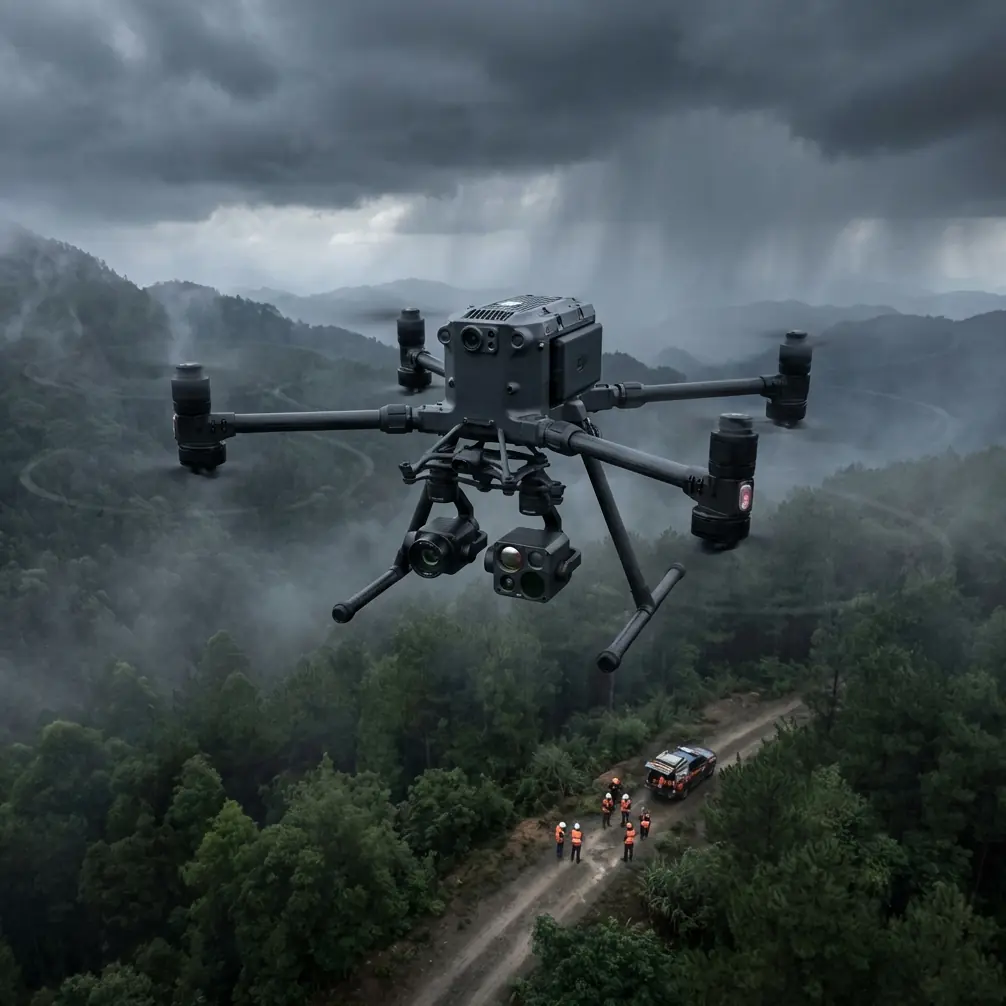
Matrice 400 Field Report: Crosswind Lessons from a Mountain Coastline Shoot
META: A field report on using the Matrice 400 for mountain coastline filming, with practical insight on crosswind control, payload thinking, transmission resilience, thermal workflow, and why integrated aircraft handling matters when weather shifts mid-flight.
By Dr. Lisa Wang, Specialist
The assignment looked simple on paper: capture a rugged mountain coastline at first light, collect overlapping imagery for photogrammetry, and add thermal passes over shaded rock faces where runoff patterns were hard to see in visible light. In practice, it became the kind of flight day that reveals whether an aircraft is merely capable or genuinely usable.
The Matrice 400 earned its keep because the weather refused to stay still.
We launched into a clean window just after sunrise. Sea air was cool, surface visibility was strong, and the headland gave us a stable initial segment for imaging. Ten minutes later, the marine layer began to move differently than forecast. Wind started curling around the ridgeline instead of flowing cleanly across it. That is where coastline work in mountain terrain gets interesting: the drone is not just fighting “wind,” it is dealing with amplified deviations, delayed corrections, and changing aircraft attitude cues as terrain channels air into uneven streams.
That operating reality makes one old flight-training principle surprisingly relevant to a modern enterprise platform like the Matrice 400.
A classic training text on fixed-wing radio aircraft describes aileron-rudder coordination as a way to treat the aircraft as one controlled whole, especially in wind and side-wind conditions. One detail from that source stands out: during ground movement, aileron input has limited effect at low speed, so it does not immediately create a wing-lift imbalance; once speed builds, control inputs become more effective and therefore need to become finer. Another point is even more operationally valuable: coordinated control helps prevent overcorrection and, in windy conditions, allows the pilot to command the aircraft as a whole rather than chasing each disturbance in isolation.
That may sound far removed from a Matrice 400 over a rocky shoreline. It is not.
Why that old control lesson matters to a Matrice 400 mission
Enterprise drone crews working in mountain-coast environments often make the same mistake model-aircraft instructors warned about years ago: they respond to every gust as a separate event. The result is exaggerated stick work, unstable framing, inconsistent overlap, and avoidable energy waste. On a platform used for filming, mapping, thermal inspection, or corridor documentation, “too much pilot” can be as disruptive as too much wind.
The Matrice 400’s value in this setting is not just raw stability. It is the ability to support whole-aircraft thinking.
When the wind shifted on our route, we stopped trying to “fight the nose” frame by frame. Instead, we reoriented the mission around trajectory integrity, sensor continuity, and transmission confidence. That is what the old side-wind principle means in modern UAV terms. The aircraft is not a camera tripod in the sky. It is a coordinated aerial system. If you manage it as one integrated platform, you preserve the shot, the data geometry, and the safety margin.
For our coastline run, that meant three decisions.
First, we adjusted our path lines to reduce exposure to the strongest rotor zone forming near a cliff break. Second, we maintained overlap discipline for photogrammetry rather than chasing cinematic yaw movements. Third, we let the Matrice 400’s transmission and flight-control system do the quiet work of absorbing micro-disturbances while we focused on the larger mission geometry.
This is where O3 transmission matters more than spec-sheet readers often realize. In mountain terrain, the issue is rarely just distance. It is signal quality through changing orientation, reflected surfaces, and terrain shielding. A stable link preserves decision-making tempo. When the weather changed mid-flight, we did not lose time second-guessing image return or aircraft response. That continuity kept the mission orderly.
A coastline shoot is really two missions at once
People often separate filming from survey work as if they demand different aircraft logic. On the mountain coast, they overlap.
Our visible-light pass was built for cinematic framing but also for later photogrammetry processing. That requires repeatable spacing, disciplined altitude management, and attention to GCP strategy on the ground. Even with a strong aircraft, poor geometry will produce weak 3D reconstruction. We placed GCPs where terrain contrast and line of sight supported later identification without exposing the team to unstable edge conditions.
The Matrice 400 was useful here because it let us maintain mission structure after the atmosphere turned messy. Photogrammetry is unforgiving when cross-track drift begins to nibble away at overlap. A pilot who keeps making large manual corrections can degrade the dataset even while believing they are “saving” the flight. That echoes another useful detail from the training reference: if you get used to oversized corrective movements on a forgiving trainer, that habit becomes harmful when precision matters. The same logic applies to enterprise workflows. Big stick habits produce bad mapping.
On this job, smaller and earlier corrections were the difference between a usable model and a patchwork of compromised frames.
Thermal work changed the flight priorities
By the time we transitioned to thermal imaging, the visible drama of the shoreline was no longer the main challenge. The bigger issue was thermal consistency.
The sun angle had begun to touch the upper rock shelves while lower sections remained cool. Water seepage, vegetation pockets, and fractured surfaces all created mixed thermal signatures. If the aircraft wandered too much in yaw or lateral position, comparative interpretation became harder. You want clean, intentional passes so that temperature patterns mean something. The drone’s handling quality affects interpretability.
Thermal signature work in coastal mountain terrain is not just about finding “hot” or “cold” spots. It is about understanding whether anomalies reflect moisture, material variation, solar loading, or airflow effects. A stable platform shortens that ambiguity chain.
Here again, the old idea of integrated control proves its worth. The source text notes that in wind, small deviations can get magnified and correction can become sluggish if the pilot is reacting late. That is exactly what thermal crews face when terrain-generated air movement begins nudging the aircraft off line. If you overcorrect, you introduce more variation. If you anticipate and manage the aircraft as one system, data quality stays coherent.
Weather did what weather does
The turning point came on the third thermal leg.
A lateral gust rolled over the saddle above the cove and pushed through the flight path with enough force to alter our expected ground track. Not dangerous, but unmistakable. The kind of moment that punishes sloppy workflows. We paused the more aggressive shoreline reveal shots, prioritized mission stability, and reassessed battery timing.
This is where hot-swap batteries become operationally meaningful. Not convenient. Meaningful.
When a mountain-coast mission changes shape in the air, the aircraft may still be fully capable, but the safe and productive decision is often to break the work into cleaner segments. Hot-swap capability supports that discipline. Instead of stretching one battery cycle to satisfy a shot list written in calm conditions, you can land, refresh, and relaunch with the mission restructured around the actual weather window. That is a better use of a high-end enterprise platform than trying to prove endurance by gambling on the last portion of the pack.
We did exactly that. Landed. Swapped. Reviewed the first dataset. Tightened the final route. Went back up.
That reset probably saved the mapping output.
Transmission security matters even on a filming job
There is another detail worth addressing because too many crews overlook it during media-heavy operations: AES-256 is not abstract IT language when you are working around sensitive infrastructure or contracted environmental studies.
Our coastline section included privately managed assets above the cliffs and utility traces farther inland. We were not inspecting them, but they were present in the operating environment. Encrypted transmission matters because enterprise flights increasingly combine visual documentation, thermal overlays, and geospatially precise datasets. That package can reveal more than a pretty shot. The Matrice 400’s secure communications posture is part of operational professionalism, especially if project stakeholders include land managers, consultants, and infrastructure operators.
Security, in other words, is no longer separate from field efficiency. It is part of it.
What BVLOS planning teaches even when you stay conservative
This mission was planned conservatively, but BVLOS thinking still shaped the operation.
Not because we intended to push distance for its own sake. Because mountain coastlines force you to think in terms of route continuity, terrain masking, emergency decision points, and communication integrity. Those are BVLOS disciplines, even if the actual flight profile remains more restrained. The Matrice 400 rewards crews that plan this way. It is an aircraft that makes more sense when the mission is built like a professional aviation task rather than a camera outing with extra batteries.
The second source reference, while fragmentary, points toward a design philosophy centered on overall configuration, powerplant selection principles, and economic effectiveness criteria in helicopter design. That may seem broad, but the operational takeaway is sharp: aircraft usefulness is shaped by system-level design choices, not single headline features. On the Matrice 400, that system logic shows up in the way endurance planning, payload flexibility, transmission robustness, and control behavior support each other. You feel that in the field long before you describe it in a report.
A drone that is excellent only in still air is not excellent. A drone that remains organized when terrain and weather become untidy is the one professionals remember.
The real test was not the scenery
Anyone can make a capable aircraft look good on a calm day over open water. The mountain coastline told a different story.
The mission demanded stable imaging for photogrammetry, thoughtful GCP placement, interpretable thermal passes, secure transmission, and enough operational flexibility to adapt when the weather shifted mid-flight. The Matrice 400 handled that combination well because it supported disciplined flying instead of encouraging constant pilot intervention.
That distinction matters.
The training text’s warning about exaggerated control habits deserves to be repeated in enterprise language: if your workflow depends on large corrections, last-minute fixes, or constant manual rescue, your data quality is already deteriorating. The better approach is coordinated, measured control that keeps the aircraft, payload, and route working together. In side-wind conditions, the older text advises treating the aircraft as a whole. That is exactly how we got the job done.
Not by forcing the coastline shoot to behave like a studio set, but by respecting the aircraft as an integrated platform and reshaping the mission as the environment changed.
For teams planning similar work, that is the Matrice 400 story worth paying attention to. Not hype. Not brochure language. A field truth: when the sea breeze swings, the ridgeline starts spilling turbulence, and your visible mission turns into a thermal-and-mapping hybrid, the aircraft has to hold together as one coherent system.
If you are planning a similar coastal mountain workflow and want to compare payload strategy or route structure, you can message our field team here: https://wa.me/85255379740
Ready for your own Matrice 400? Contact our team for expert consultation.