
Matrice 400 Guide for Filming Construction Sites in Complex
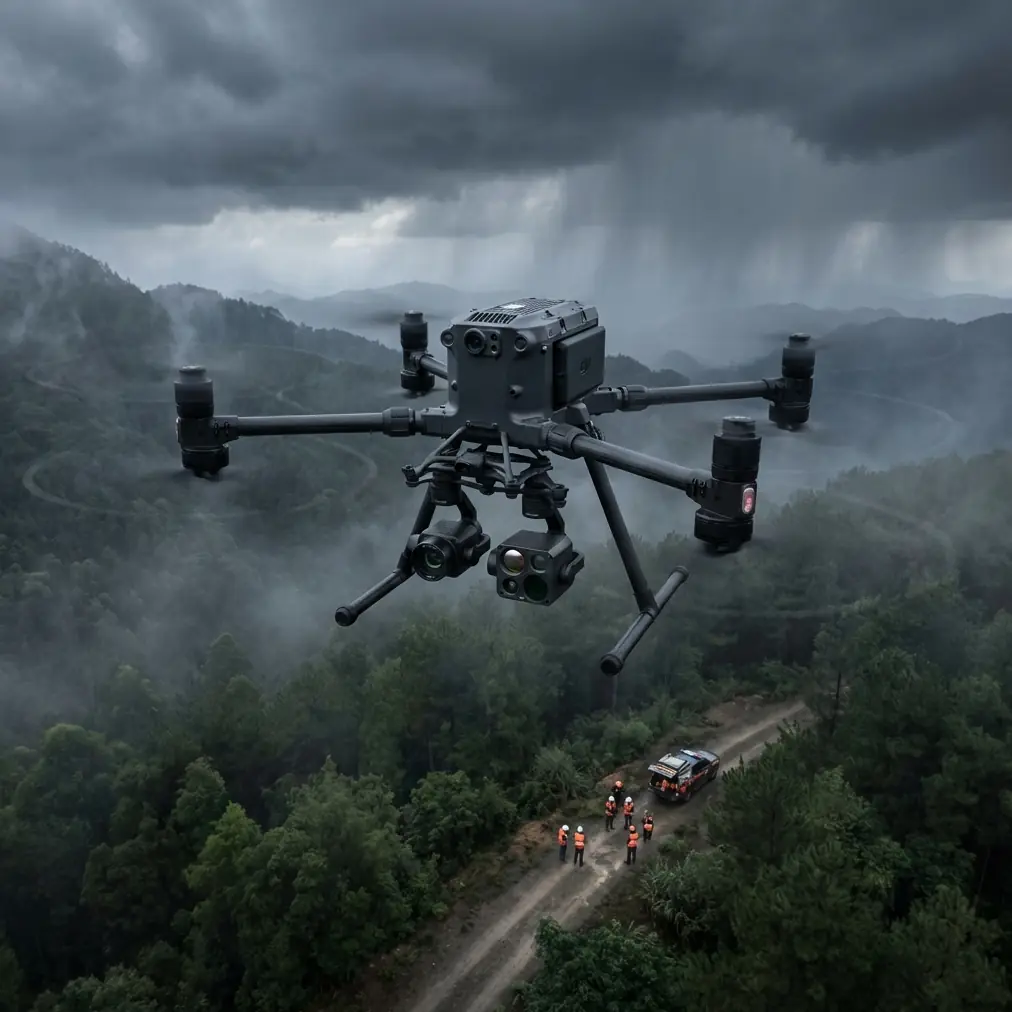
Matrice 400 Guide for Filming Construction Sites in Complex Terrain
META: A practical Matrice 400 tutorial for construction-site filming in difficult terrain, covering payload integration, vibration control, transmission security, thermal workflows, and mapping accuracy.
When you film a construction site in broken terrain, the aircraft matters less than the system around it. That’s the difference many crews discover after the first windy ridge survey, the first bridge approach with unstable airflow, or the first long utility-corridor capture where video, thermal data, and map-grade imagery all have to line up in one deliverable.
That is exactly where a Matrice 400 workflow becomes interesting.
Not because it is simply a larger enterprise drone, but because complex-site filming is really an integration problem. You are not just flying a camera. You are hanging a payload package under a moving airframe, asking for stable imagery, reliable transmission, safe behavior near changing terrain, and clean data handoff to engineering teams. The reference material behind this article comes from aircraft structural and fuel-system design literature, and while it was written for manned aircraft engineering, the core lessons are surprisingly relevant to serious UAV operations: how external systems connect to the main structure, how stiffness changes vibration behavior, and why load-state assumptions affect stability.
For construction imaging teams, those are not abstract engineering ideas. They show up in your footage.
The hidden issue behind shaky data: payload integration, not just pilot skill
A lot of operators blame poor video or soft mapping results on wind, camera settings, or the gimbal. Sometimes that’s right. Often it’s incomplete.
One of the most useful technical details in the reference material is the description of an external system model being attached to a wing-surface finite element model through 4 rigid links connected to 4 nodes. That sounds far removed from a Matrice 400 filming mission, but the operational lesson is direct: the way an external payload is mechanically connected to the airframe strongly affects how loads and vibration move through the platform.
In drone terms, every added component changes the behavior of the aircraft:
- dual-sensor gimbals
- spotlight or loudspeaker alternatives for site coordination
- RTK modules
- third-party LiDAR or oblique camera rigs
- aftermarket mounts, brackets, and quick-release plates
On a construction site, crews often add a third-party accessory for a specific task and assume the aircraft will absorb the change without consequence. I have seen a third-party oblique mapping bracket dramatically improve facade coverage on steep retaining-wall projects, especially where standard nadir capture left gaps along cut slopes. It enhanced capability, no question. But it also changed the aircraft’s vibration response and required rechecking hover stability, gimbal tuning, and shutter timing before the team could trust the photogrammetry output.
That is the practical significance of the “4 rigid links” detail. The payload interface is not a trivial attachment point. It is part of the aircraft system.
If you are flying a Matrice 400 over a mountain road expansion, quarry edge, or terraced infrastructure site, treat every accessory installation as a structural event, not a convenience upgrade.
Why asymmetric payload setups can still be workable
Another detail from the source material deserves attention. It states that experience shows the flutter speed of an asymmetric configuration can be higher than the lower flutter speed of the two corresponding configurations, and that there may be no need to build a full left-and-right aircraft finite element model for vibration and flutter analysis in that case.
Translated into a UAV operator’s world, this suggests something useful: not every non-perfectly-balanced setup is automatically a dealbreaker, but every asymmetric setup must be understood on its own terms.
This matters for construction filming because your mission package is rarely static. You may fly with:
- a primary EO sensor on one mission
- EO plus thermal on the next
- a custom mount for corridor inspections on another
- a small third-party lighting or positioning accessory for dawn operations
The lesson is not “asymmetry is fine.” The lesson is that configuration-specific behavior matters more than assumptions. If your Matrice 400 carries an unusual setup for thermal signature capture on a large earthworks site, or for facade progress imaging over a canyon-side build, do not assume yesterday’s tuning applies.
Run a short test sequence every time the mission stack changes:
- low-altitude hover stability check
- gradual yaw and lateral translation
- gimbal response during stop-start movement
- brief climb and descent at conservative speed
- review footage for rolling vibration or micro-jitter
That small discipline can save an entire survey day.
Vibration control matters more in complex terrain than most crews realize
The structural reference also points to another issue with real operational value: connection stiffness affects mode shapes, including bending behavior, and therefore affects aeroelastic stability. It also notes that once the broader system model is established, calculated spring stiffness may need to be adjusted.
For drone operators, “spring stiffness” maps neatly to the broader concept of mechanical compliance in the payload and mounting chain. If a third-party accessory mount has too much flex, or if a quick-release assembly introduces tiny but real play, the aircraft may still fly, but your data quality can drift in subtle ways:
- photogrammetry tie points become less consistent
- thermal images lose alignment with visible imagery
- zoom footage becomes harder to stabilize in post
- repeatability between progress-monitoring flights drops
Construction sites in complex terrain amplify this because the air is rarely clean. Ridge lift, recirculation near blasted faces, rotor wash reflecting off structural steel, and thermal updrafts from exposed rock all excite the aircraft differently. A setup that looks stable over a flat staging yard can behave very differently beside a high retaining wall or over a stepped excavation.
This is where the Matrice 400 platform should be evaluated not just for payload capacity, but for how well it maintains usable sensor stability when the mounting ecosystem gets complicated.
A practical Matrice 400 filming workflow for difficult construction terrain
Let’s move from theory to field method.
1) Start with the deliverable, not the flight route
Before the first battery goes in, decide what the site team actually needs:
- cinematic progress footage
- orthomosaic output
- volumetric analysis
- slope monitoring
- thermal signature review for drainage, curing, or equipment heat anomalies
- facade documentation
On mixed-terrain construction sites, one flight rarely serves all purposes well. A Matrice 400 mission plan should separate:
- visual storytelling passes
- photogrammetry grid work
- thermal capture windows
- detail inspection or oblique runs
That separation keeps sensor settings and flight speeds aligned with the output.
2) Validate the payload stack after every hardware change
If you install a thermal camera, swap a lens package, or add a third-party accessory, re-qualify the aircraft. The engineering logic from the reference material is clear: attachment configuration changes system behavior.
My preferred field check:
- inspect all mounting points physically
- confirm no rotational play in the payload bracket
- hover at multiple altitudes
- record a fixed subject at zoom
- make a short lateral pass across high-contrast geometry such as scaffolding
- review footage at full resolution before committing to a full mission
You are looking for tiny oscillations. They often show up first on diagonal steel members, roof edges, or repeating facade lines.
3) Use thermal as a structural context layer, not a gimmick
Thermal signature data is useful on construction sites when it answers a site question. In complex terrain, thermal can help reveal water paths, uneven drying, exposed utilities, overheated machinery zones, or insulation inconsistencies on partially completed structures.
But thermal should be planned around environmental timing. Early morning often gives the cleanest separation for certain materials before sun loading starts to flatten contrast. On steep sites, sun angle changes rapidly, so thermal and visual runs should be sequenced carefully, not mixed casually.
A Matrice 400 carrying thermal and RGB sensors can be effective here, especially when paired with a disciplined capture plan and stable mounting.
4) For photogrammetry, protect geometry first
Construction clients may ask for beautiful footage and mapping in the same breath. Give them both, but not with the same flight settings.
For photogrammetry in complex terrain:
- maintain consistent overlap
- use terrain-aware altitude planning where available
- build in oblique passes for slopes, walls, and cut faces
- place and verify GCP points if the project requires higher confidence than onboard positioning alone
In steep terrain, GCP strategy matters more than many teams expect. If all control is clustered on flat access roads while the real work sits across elevation changes, model accuracy can drift where it matters most. Spread control across elevation bands and near critical edges.
This is also where a capable third-party oblique accessory can earn its keep. If it improves side-face coverage on tall structures or benches, it may reduce reconstruction gaps that standard top-down capture misses. Just remember the earlier rule: enhanced capability is only valuable if the mounting and stability remain trustworthy.
5) Plan for transmission resilience, not just maximum range
On a construction site with rock faces, cranes, temporary buildings, and steel clutter, transmission can fail in messy ways. Signal reflection and shadowing matter as much as line-of-sight distance.
That’s why O3 transmission capability is operationally significant. For Matrice 400 crews filming complex terrain, a robust transmission link helps maintain video confidence during terrain transitions, especially when the aircraft moves behind partial obstructions or down into cuts and depressions. It does not replace safe planning, and it does not grant permission to ignore local flight rules, but it gives the pilot and camera operator a stronger working link when the site itself is hostile to clean RF behavior.
If your client requires sensitive project handling, secure data paths also matter. AES-256 support has practical value here, especially for infrastructure projects where imagery, site progress records, or thermal datasets should not move casually across unsecured systems. Security is not a marketing bullet in these environments. It is part of contract hygiene.
6) Use battery strategy to preserve continuity on large sites
Big terrain breaks concentration because every relocation costs time. If your Matrice 400 workflow supports hot-swap batteries, use that advantage to preserve mission continuity. On large roadworks, hillside developments, or spread-out civil projects, hot-swapping helps the crew hold the same launch area, camera logic, and mission sequence without a full system reset between sorties.
Operationally, that matters in two ways:
- less downtime when light conditions are changing fast
- better consistency between segmented flights used for one final map or video package
This is especially helpful when you are trying to keep thermal capture within a narrow environmental window.
7) Treat BVLOS discussions carefully and professionally
Some construction and infrastructure corridors naturally raise interest in BVLOS operations, especially where the site extends through valleys or along long utility alignments. If BVLOS is relevant to your project, it must be planned within the local regulatory framework, client permissions, and operational risk controls. From a production standpoint, BVLOS can expand efficiency on long linear projects, but only when the safety case, communication procedures, and site coordination are mature.
For many crews, the smarter immediate gain is not full BVLOS ambition but simply better segmented mission design with reliable relay planning and disciplined repositioning.
A field example: steep-site filming without wasting the mapping run
Imagine a construction team building access roads and drainage structures across a stepped hillside. The client wants:
- weekly progress video
- a cut-and-fill visual record
- thermal review of drainage outfalls after installation
- updated photogrammetry every two weeks
A strong Matrice 400 workflow might look like this:
First sortie: visual establishing passes at safer morning wind conditions
Second sortie: photogrammetry grid and obliques with GCP verification
Third sortie: thermal signature capture timed for best material contrast
Fourth sortie if needed: targeted detail work around retaining structures or culverts
If the team adds a third-party oblique mount to improve slope-face reconstruction, they should not immediately launch into the full grid. They should test hover, yaw response, and image sharpness first. That one habit reflects the core lesson from the structural engineering reference: attachment mechanics affect dynamic behavior, and assumptions should be checked against the actual configuration.
Why this engineering perspective gives Matrice 400 crews an edge
Most drone articles talk about specs. That has limited value on a difficult construction site.
What matters more is understanding the aircraft as a dynamic platform. The source material makes that plain in two ways:
- an external system connected through 4 rigid links to 4 structural nodes changes how the system behaves
- model assumptions such as stiffness often need adjustment after the whole configuration is considered
That is not just aircraft-design theory. It is a better way to operate a Matrice 400 in the field.
If your footage is unstable, if your thermal alignment is inconsistent, if your photogrammetry quality changes after a hardware swap, the answer may not be in the camera menu. It may be in the way the full aircraft-payload system is assembled and validated.
For teams building a more dependable workflow around construction filming, this is usually the turning point. They stop treating accessories as add-ons and start treating them as part of flight engineering.
If you are reviewing a Matrice 400 setup for a terrain-heavy site and want a second opinion on payload pairing, mapping workflow, or accessory fit, you can message our UAV team directly here.
Ready for your own Matrice 400? Contact our team for expert consultation.