
Matrice 400 Filming Guide: Windy Field Mastery
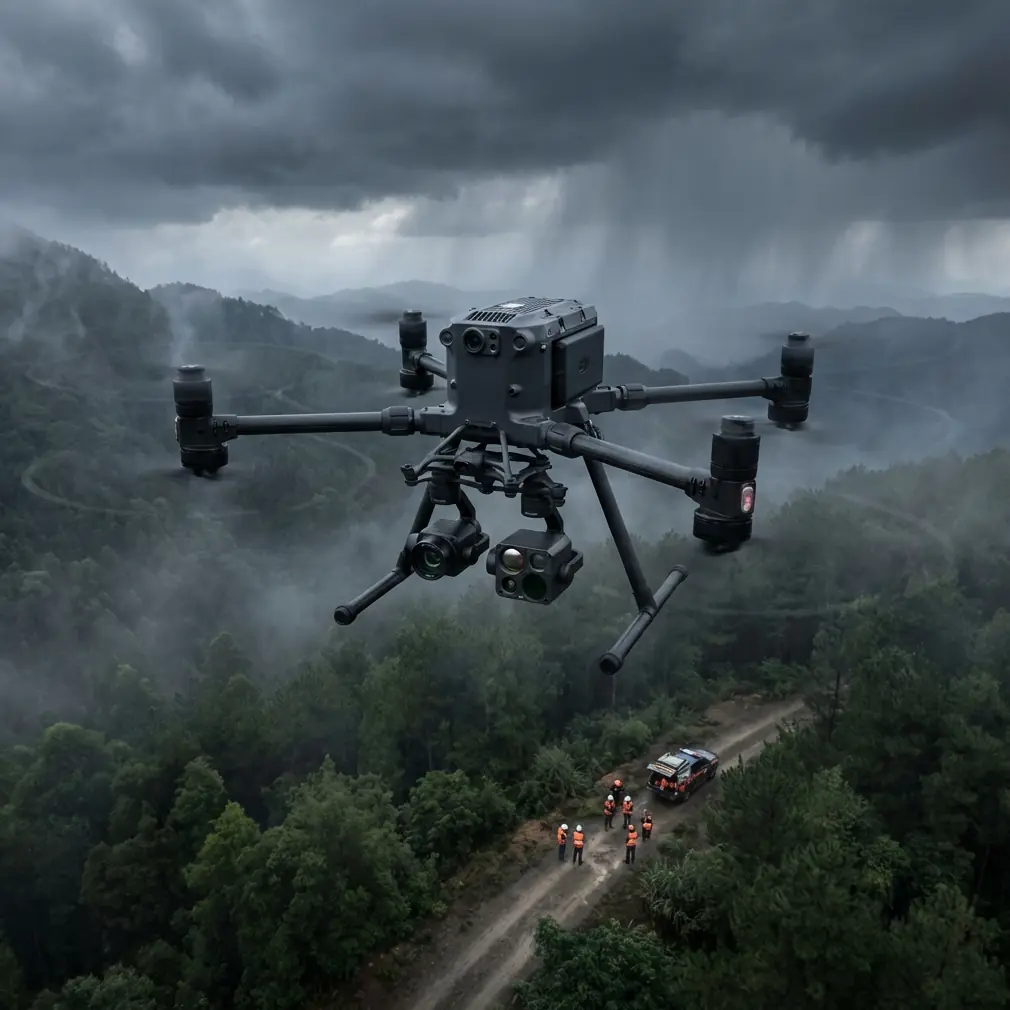
Matrice 400 Filming Guide: Windy Field Mastery
META: Learn how to film agricultural fields in windy conditions with the DJI Matrice 400. Expert tips on battery management, camera settings, and BVLOS workflows.
TL;DR
- Wind thresholds matter: The Matrice 400 maintains stable footage in sustained winds up to 12 m/s, but planning around gust patterns saves battery and improves shot quality.
- Hot-swap batteries are your lifeline during long agricultural filming sessions—master the swap rhythm to avoid grounding your operation.
- Photogrammetry-ready workflows require precise GCP placement and overlap settings that shift when wind alters your drone's ground speed.
- O3 transmission keeps your live feed reliable across vast open fields where interference is minimal but range is critical.
Why Filming Fields in Wind Demands a Different Approach
Agricultural aerial filming sounds straightforward until a 15 km/h crosswind starts dragging your drone off its planned survey line. Standard consumer drones lose footage quality fast. The Matrice 400 was engineered for exactly this kind of punishment—but only if you know how to configure it properly.
This tutorial walks you through a complete field-filming workflow for windy conditions, from pre-flight battery strategy to post-processing photogrammetry data. Every recommendation comes from real operations over wheat, corn, and soybean fields across the American Midwest.
By James Mitchell | Drone Operations Expert
Step 1: Pre-Flight Planning for Windy Field Shoots
Check Wind Layers, Not Just Surface Speed
Surface-level weather apps lie. A field might show 8 m/s at ground level while gusts at 120 meters AGL hit 14 m/s. Use aviation weather tools like METAR reports and wind aloft forecasts to understand what your Matrice 400 will actually encounter at filming altitude.
Key pre-flight wind checks:
- Sustained wind speed at planned altitude (not ground level)
- Gust differential—the gap between sustained and peak gusts
- Wind direction relative to your survey lines (headwind vs. crosswind changes everything)
- Thermal activity windows—midday thermals over dark soil create turbulence that smooth morning air avoids
- Forecast trend—is wind building or dying throughout your shoot window?
Orient Your Flight Lines with the Wind
This is the single biggest efficiency gain most pilots overlook. Flying survey lines parallel to the wind rather than perpendicular reduces battery consumption by up to 18% in moderate wind conditions. The Matrice 400's flight controller compensates for drift automatically, but compensation costs power.
When your lines run with the wind, your drone flies fast downwind and slow upwind, but the total energy expenditure drops compared to constant lateral correction on crosswind passes.
Pro Tip: During a 400-acre soybean survey last season, I switched flight line orientation from east-west to north-south to align with a steady 10 m/s southerly wind. The result: I completed the mission in 3 battery cycles instead of 4. That single adjustment saved nearly 25 minutes of total operation time, including swaps and re-launches.
Step 2: Battery Management in the Field
The Hot-Swap Discipline That Saves Shoots
Here is the hard-won field lesson that changed how I run every long operation. During an early-season corn emergence survey, I drained my first battery set down to 12% trying to squeeze out one more pass. The Matrice 400 triggered a forced RTH, and I lost the final two survey lines. Re-launching with fresh hot-swap batteries meant re-establishing position, re-calibrating the gimbal, and burning 8 minutes of a rapidly closing weather window.
Now I follow the 30-25-20 rule:
- 30%: Begin your return-to-home sequence
- 25%: You should be on final approach or landed
- 20%: Absolute floor—if you're still in the air at 20%, something went wrong
Hot-Swap Battery Best Practices
The Matrice 400's hot-swap batteries are a genuine operational advantage for field work, but they demand discipline:
- Pre-warm batteries in an insulated bag during cool-morning shoots—cold cells deliver up to 15% less capacity
- Label your battery pairs and rotate them consistently to ensure even wear cycles
- Track cycle counts in a field notebook or app—mismatched degradation between paired batteries creates voltage imbalances
- Keep contacts clean using isopropyl alcohol wipes, especially in dusty agricultural environments
- Stage your next pair before the current set drops below 50% so swaps take under 90 seconds
Expert Insight: Wind doesn't just affect flight dynamics—it directly impacts battery drain. In 12 m/s sustained winds, expect your effective flight time to drop by 20–30% compared to calm conditions. Plan your battery inventory accordingly. For a full-day agricultural filming shoot, carry at minimum 6 battery pairs instead of the typical 4.
Step 3: Camera and Sensor Configuration for Windy Conditions
Shutter Speed and Stabilization
Wind-induced micro-vibrations can degrade image sharpness even with the Matrice 400's advanced gimbal stabilization. Compensate with these settings:
- Shutter speed: Minimum 1/1000s for RGB mapping in gusty conditions (versus the typical 1/500s in calm air)
- ISO: Keep at 100–400 to avoid compounding noise with motion blur
- Gimbal mode: Set to FPV stabilization off, locked gimbal mode for survey work—this isolates the camera from airframe yaw corrections
- Interval: Tighten your capture interval to compensate for ground speed variation caused by wind
Thermal Signature Capture in Agricultural Fields
For crop stress analysis and irrigation mapping, thermal imaging from the Matrice 400 reveals patterns invisible to RGB sensors. Wind actually helps thermal signature accuracy by reducing solar heating artifacts on leaf surfaces—but it introduces its own challenges:
- Calibrate your thermal sensor at altitude before starting passes, not on the ground
- Fly thermal surveys early morning when wind is typically lower and plant canopy temperatures haven't equalized with air temperature
- Account for wind-driven evapotranspiration—stressed crops lose their thermal signature faster in windy conditions
- Set radiometric parameters for emissivity values between 0.95–0.98 for green vegetation
Step 4: Photogrammetry Workflow Adjustments
GCP Placement for Windy Field Surveys
Ground Control Points (GCP) are non-negotiable for survey-grade photogrammetry. Wind introduces ground speed variation that affects image overlap, making GCP accuracy even more critical.
- Place minimum 5 GCPs distributed across the survey area, with at least one near each corner and one center
- Use weighted GCP targets—standard vinyl markers blow away in anything above 6 m/s wind
- Survey GCP positions with RTK GPS to ±2 cm accuracy
- Increase your planned front overlap to 80% and side overlap to 75% to compensate for wind-induced spacing irregularities
O3 Transmission Reliability Across Open Fields
The Matrice 400's O3 transmission system performs exceptionally well over agricultural fields. Open terrain with minimal RF interference allows you to maintain strong video downlink at distances that would fail in urban environments.
Field-specific O3 tips:
- Mount your ground station antenna on a 2-meter mast to clear crop canopy obstruction
- Keep your controller antenna oriented toward the drone, not angled toward the ground
- Monitor link quality metrics—if signal drops below 80%, reduce your distance or altitude before the feed cuts entirely
- For BVLOS operations (where permitted under appropriate waivers), O3 transmission paired with AES-256 encrypted command links provides both range and security compliance
Technical Comparison: Matrice 400 Wind Performance vs. Competitors
| Feature | Matrice 400 | Competitor A | Competitor B |
|---|---|---|---|
| Max Wind Resistance | 12 m/s | 10 m/s | 8 m/s |
| Hot-Swap Batteries | Yes | No | Yes |
| Transmission System | O3 | Standard WiFi | Proprietary |
| Encryption Standard | AES-256 | AES-128 | AES-256 |
| Max Flight Time (calm) | 55 min | 42 min | 45 min |
| BVLOS Capability | Full support | Limited | Full support |
| Gimbal Stabilization | 3-axis + EIS | 3-axis | 3-axis |
| Photogrammetry Overlap Control | Automated adaptive | Manual | Semi-auto |
Common Mistakes to Avoid
1. Ignoring wind direction when planning survey lines. Flying perpendicular to strong wind burns batteries fast and creates uneven image spacing that ruins photogrammetry accuracy.
2. Draining batteries below 25% in wind. Wind means your return flight could take twice as long as the outbound leg. That "safe" 15% remaining can evaporate if you're fighting a headwind home.
3. Using calm-weather overlap settings. Standard 70% front overlap falls apart when gusts accelerate your drone mid-pass. Increase to 80% minimum.
4. Skipping GCP weight or anchoring. Lightweight GCP markers migrate in wind. A 3 cm GCP shift can cascade into 15+ cm error in your orthomosaic.
5. Launching without a thermal sensor calibration at altitude. Ground-level calibration doesn't reflect the atmospheric conditions your sensor will encounter at 80–120 meters AGL. Always perform a flat-field calibration in flight.
6. Neglecting AES-256 encrypted channels during BVLOS operations. Security compliance isn't optional. Unsecured command links over agricultural BVLOS corridors create regulatory and operational risk.
Frequently Asked Questions
What is the maximum wind speed for safe Matrice 400 filming operations?
The Matrice 400 is rated for sustained winds up to 12 m/s (approximately 27 mph). However, operational best practice is to plan missions for winds at or below 10 m/s to preserve battery life and maximize image quality. If gusts exceed 15 m/s, ground the aircraft regardless of sustained wind readings.
How many hot-swap battery pairs do I need for a full-day agricultural shoot?
For a standard 500-acre field survey in moderate wind, plan for 6 battery pairs minimum. Each pair delivers approximately 40–45 minutes of effective flight time in wind (versus the rated 55 minutes in calm conditions). Factor in charging time and always maintain at least 2 fully charged pairs in reserve.
Can I use the Matrice 400 for BVLOS agricultural surveys?
Yes, the Matrice 400 supports BVLOS operations with its O3 transmission system and AES-256 encrypted command links. You must hold the appropriate regulatory waivers (such as an FAA Part 107 waiver in the United States) before conducting BVLOS flights. The platform's redundant communication architecture and automated return-to-home failsafes make it well-suited for extended-range agricultural applications where visual line of sight isn't practical over large parcels.
Ready for your own Matrice 400? Contact our team for expert consultation.