
Filming Dusty Forests With the Matrice 400
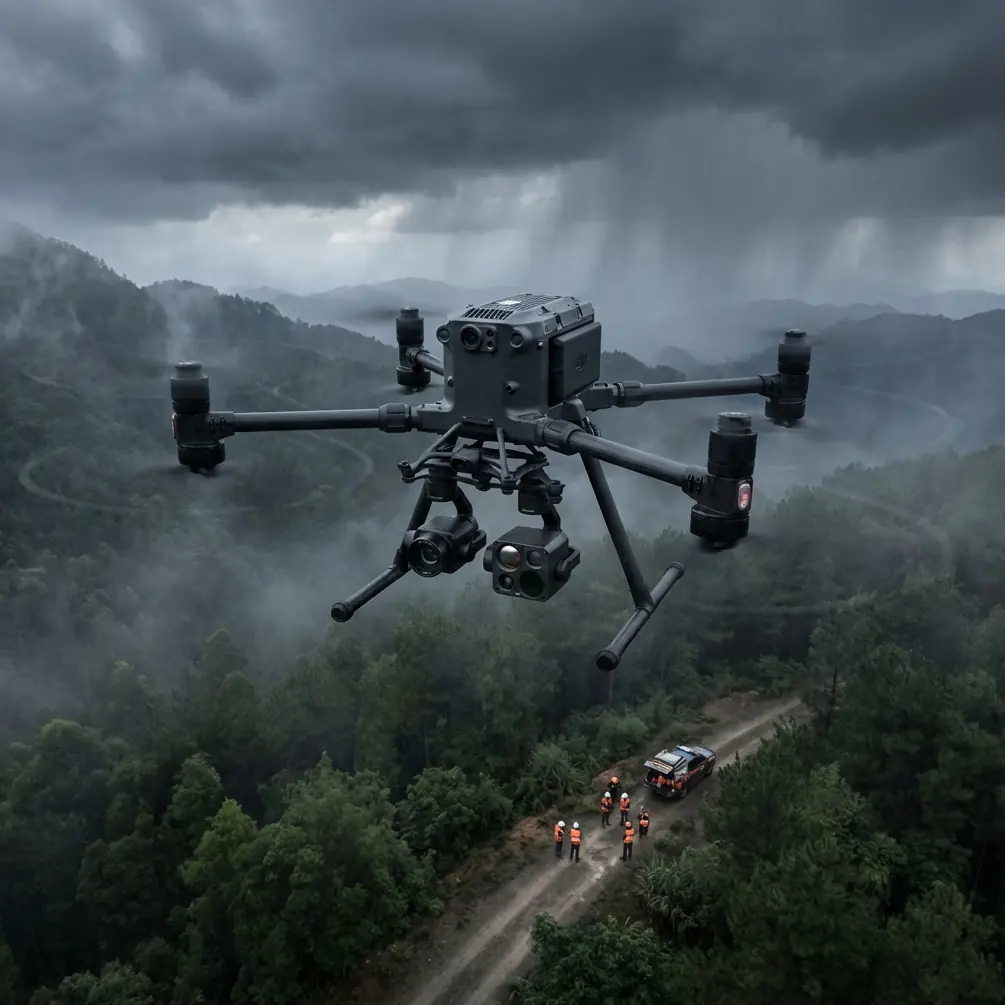
Filming Dusty Forests With the Matrice 400: Practical Field Methods That Actually Hold Up
META: A field-tested Matrice 400 tutorial for filming forests in dusty conditions, covering payload planning, thermal workflows, transmission reliability, battery strategy, and safer mission execution.
I learned this lesson the hard way on a forest edge survey that turned into a filming job before lunch. We started with clean light, moderate wind, and what looked like manageable ground conditions. By the second sortie, every landing zone was coated in fine dust. The canopy blocked line of sight in patches, the heat signature under the trees shifted by the minute, and our original flight plan no longer made sense. That kind of day is exactly where the Matrice 400 earns its place.
This is not a generic overview of the aircraft. It is a practical guide for crews filming forests in dusty conditions, built around the kinds of decisions that matter once the props spin up: how you protect image quality, how you avoid contaminating your workflow with bad data, and how you keep the mission moving without turning each battery change into a delay.
Why the Matrice 400 fits this job
Dusty forest operations are awkward because they combine two environments that punish drones in different ways. Dust attacks reliability at ground level, especially during takeoff and landing. Forests challenge navigation, transmission, and scene interpretation once you are airborne. A platform used here needs to do more than carry a camera. It has to support disciplined field procedures.
The Matrice 400 is particularly useful in this setting because its mission profile aligns with real operational pain points: long-endurance work, support for demanding payload workflows, secure communications through AES-256, robust O3 transmission for difficult environments, and hot-swap batteries that reduce the downtime and chaos between flights. Those are not brochure-friendly extras. In the woods, they directly affect whether you bring back usable footage and defensible data.
Take O3 transmission as one example. In open country, link quality is easy to take for granted. In forests, signal behavior changes as the aircraft slips behind trunks, terrain edges, or dense canopy. Stronger transmission performance does not magically remove every obstacle, but it gives the crew more margin when working low over uneven tree cover or when repositioning around a ridge line. That margin matters because video confidence affects piloting decisions. If the live view degrades at the wrong moment, operators tend to either overcorrect or back off too early, both of which cost the shot.
AES-256 also deserves more attention than it usually gets in filmmaking conversations. If you are filming utility corridors, fire-damaged woodland, protected habitat, or private forestry assets, secure transmission is not just an IT checkbox. It is operational hygiene. The aircraft may be collecting thermal imagery, reference footage, and geo-linked scene data that should not be casually exposed. Security features only matter if they stay out of your way, and on a serious field platform, that is exactly the point.
Start with the landing zone, not the camera settings
If you are filming in dust, your first creative decision is really a ground operations decision.
The biggest mistake I see is crews obsessing over payload setup while treating the launch area as an afterthought. In dusty forests, the launch area shapes the whole mission. Fine debris gets kicked up during lift-off, then settles where you do not want it: lens surfaces, gimbal assemblies, connector points, battery interfaces, and exposed cases during swaps.
With the Matrice 400, I recommend building a routine around separation and timing:
- Choose a launch point away from loose topsoil if possible, even if it adds a short walk.
- Lay down a stable pad or use a compact raised surface to reduce dust recirculation.
- Prep payloads and batteries before the aircraft is placed on the ground.
- Keep battery swaps fast and deliberate to take advantage of hot-swap capability without exposing the airframe longer than necessary.
Hot-swap batteries are one of those features that sound merely convenient until you use them under pressure. In dusty forest work, they do more than save time. They reduce the number of full shutdown cycles and minimize unnecessary handling at the dirtiest stage of the mission. That means fewer opportunities for contamination, fewer delays while talent or environmental conditions drift, and a smoother rhythm when you are collecting repeatable passes over the same location.
If your shoot includes several low-altitude reveal shots through clearings, followed by top-down mapping passes, a battery strategy based on hot-swapping can keep your scene continuity intact. You are not rebuilding the whole setup between sequences. You are sustaining it.
Pick the right imaging logic for the forest, not just the scene
Dusty forests create visual ambiguity. The human eye sees atmosphere, shade, and texture. Cameras often see glare, haze, and contrast instability.
This is where many crews underuse thermal signature data. They think of thermal only for inspection, wildlife, or emergency response. In reality, thermal context can be extremely useful during scouting and shot planning. It reveals hidden differences in ground moisture, recent vehicle activity, heat retention on stumps and rock, and subtle pathways under partial canopy. If the mission includes storytelling around land management, fire recovery, habitat study, or search support, thermal imagery can sharpen both your operational awareness and your editorial choices.
Operationally, thermal matters because it changes how you interpret a forest floor that is partially obscured by dust and vegetation. A regular visual pass may suggest one route is clear and uniform. A thermal pass can reveal inconsistent heat patterns that indicate machinery tracks, disturbed soil, or residual hotspots. That affects flight safety, subject framing, and what you decide is worth filming closely.
The Matrice 400 is well suited to this kind of mixed-payload thinking because it belongs in workflows where visual, thermal, and mapping objectives intersect. That matters more than people admit. Forest jobs are rarely pure cinema or pure survey anymore. One client wants a hero sequence. Another wants orthomosaics. A third needs thermal confirmation before crews go in on foot. The aircraft has to support all three without turning the mission into a patchwork of compromises.
Use photogrammetry discipline even when the end goal is video
This may sound counterintuitive for a filming guide, but dusty forest shoots improve when you borrow habits from photogrammetry.
If you are documenting a site over time, or if the footage may later be used alongside mapping outputs, you need repeatability. That starts with consistent altitude, overlap-aware route planning, and reliable ground reference. Even for a cinematic assignment, bringing photogrammetry discipline into the operation makes your footage more useful later.
Ground control points, or GCPs, are a good example. In forest environments, especially where terrain undulates and canopy openings are irregular, GCP placement can anchor a broader data package around your shoot. They are not always practical under dense cover, but where clearings or road edges exist, they help align later mapping and progress comparisons. If the client eventually asks, “Can we match this footage to the area we surveyed last month?” you are already ahead.
That operational significance is easy to underestimate. A beautiful tracking shot over a thinning zone has more long-term value when it can be tied back to measurable coordinates and repeatable flight geometry. The Matrice 400 becomes more than a camera truck in the sky. It becomes a reliable acquisition platform.
Transmission planning in forests is a safety skill
People often talk about BVLOS as though it is purely a regulatory or infrastructure issue. In practice, even flights conducted within visual constraints benefit from BVLOS-style planning discipline. Forests are full of partial obstructions, terrain masks, and moments where your line of sight is technically present but operationally weak.
The Matrice 400’s O3 transmission capability is especially relevant here because forests are not open test ranges. They are cluttered RF environments with biological material, uneven moisture, and shifting angles. If your route takes the aircraft behind a stand of denser trees and your signal margin is already thin, the mission gets fragile fast.
So plan your forest shoot like a corridor operation:
- Identify likely signal shadow zones before takeoff.
- Establish observation positions for the pilot and visual observers that preserve angle, not just distance.
- Build critical shot sequences so the aircraft exits difficult geometry before battery thresholds become conservative.
- Avoid improvising low-level passes deep into canopy edges unless you have already proven link behavior there.
This is where the Matrice 400 supports more confident execution. A stronger transmission system does not encourage reckless flying. It allows experienced operators to hold cleaner control authority in places where weaker platforms start to feel vague.
If you are coordinating a more complex forest filming workflow and want to compare route logic with another pilot, I usually suggest sending a mission sketch first through this quick field chat link before the day gets busy.
Battery rhythm is part of shot quality
Forest filming can be deceptively energy-intensive. It is not always the long transit that drains you. It is the hovering, repositioning, cautious vertical adjustments, and repeated setup for matched passes under changing light.
That is why hot-swap batteries matter beyond convenience. In a dusty woodland mission, every smooth battery exchange helps preserve the tempo of the work. Tempo affects image consistency. If your team loses ten or fifteen minutes every cycle dealing with shutdowns, dusty handling, and reinitialization, the environment shifts. Wind picks up. Sun angle changes. Dust plumes settle differently. The sequence you intended to match no longer matches.
The Matrice 400 helps crews defend continuity because the aircraft is designed for operational endurance, not just isolated flights. If you are filming a logging boundary at first light, then moving to thermal documentation of shaded understory later in the morning, battery strategy is not a background concern. It is central to whether those deliverables still belong to the same coherent mission.
What I would do differently now on a dusty forest job
Looking back at that difficult day I mentioned earlier, the failure was not equipment-related. It was workflow-related. We treated the forest as a visual problem when it was really an operational systems problem.
With a platform like the Matrice 400, I would now structure the mission in four blocks:
First, a clean reconnaissance pass at safer altitude to identify canopy gaps, dust movement, and thermal anomalies if that payload is available.
Second, a technical acquisition phase using disciplined route geometry so the site can support later photogrammetry or comparison work, ideally with GCP support where terrain allows.
Third, a cinematic phase focused on specific story shots once the route hazards and transmission weak points are already known.
Fourth, a short verification pass after battery rotation to confirm that dust contamination has not degraded image quality or gimbal behavior.
That sequence sounds stricter than many creative teams prefer, but it produces better footage. More importantly, it produces footage you can trust.
Final field checklist for this exact scenario
Before flying a Matrice 400 in dusty forest conditions, I would personally verify these points:
- Launch and recovery surface is stabilized and offset from loose debris.
- Lens, thermal window, and connectors are protected during staging.
- O3 transmission route is planned around terrain and canopy density, not just straight-line distance.
- AES-256 settings and broader comms hygiene match the sensitivity of the site.
- Hot-swap battery process is rehearsed so exchanges stay fast and clean.
- If mapping or repeat documentation is even remotely possible, photogrammetry settings and GCP strategy are considered before filming begins.
- Thermal signature use is defined in advance, whether for safety, narrative context, or hidden feature detection.
- Any mission with extended route complexity is treated with BVLOS-style planning discipline even when flown more conservatively.
That is the real value of the Matrice 400 for forest work. It is not simply that it flies longer or carries serious payloads. It gives professionals enough operational structure to work well in environments that tend to break loose workflows. Dust, canopy, heat variation, and signal complexity all stack against you. A platform that reduces friction across those variables lets the crew focus on judgment instead of recovery.
And that, in my experience, is what separates an aircraft that looks capable on paper from one that quietly saves the job.
Ready for your own Matrice 400? Contact our team for expert consultation.