
Matrice 400 for Low-Light Forest Filming
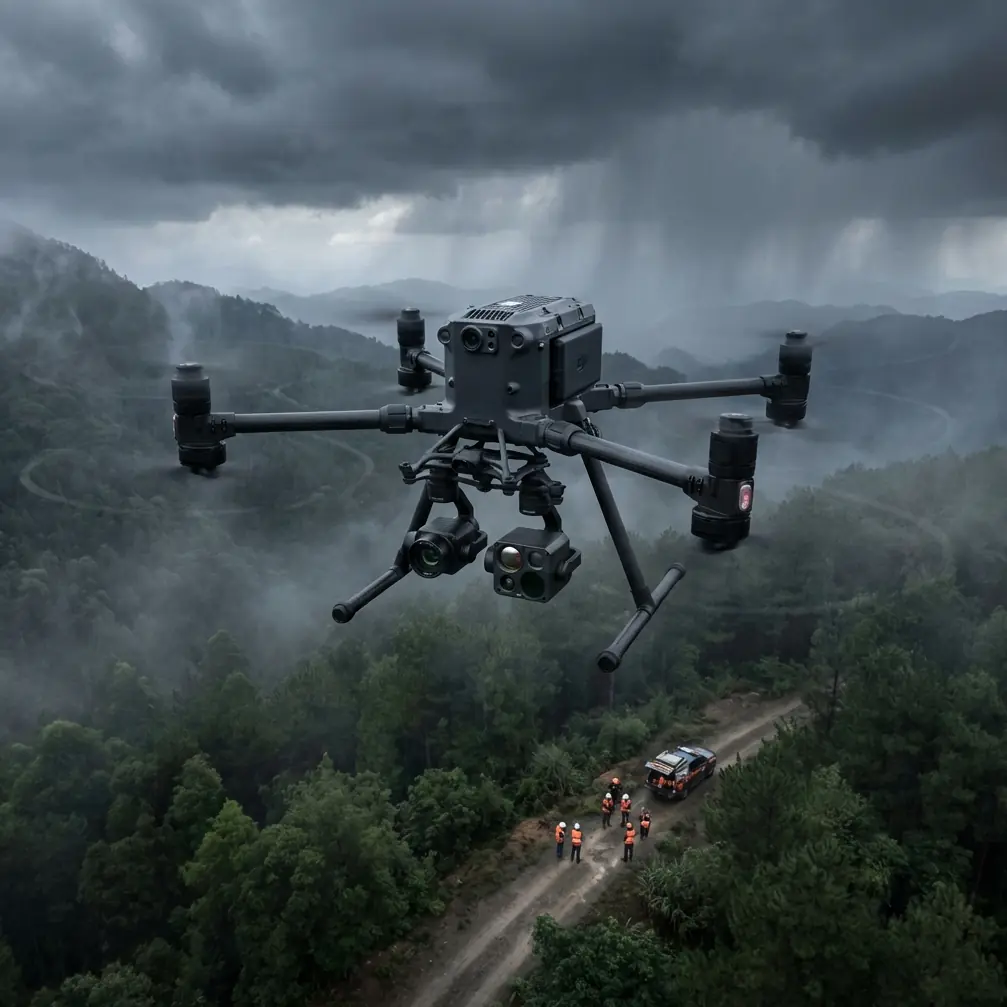
Matrice 400 for Low-Light Forest Filming: What Aircraft Design Rules Reveal About Real-World Reliability
META: An expert technical review of Matrice 400 for low-light forest filming, using aircraft structure and surface-protection principles to explain durability, inspection priorities, and mission readiness.
Low-light forest filming sounds cinematic on paper. In practice, it is one of the harsher civilian drone missions you can assign to a heavy-lift platform. Moisture hangs in the canopy. Temperature shifts arrive fast. Branch strikes are usually minor, until they are not. Optical systems work at the edge of their comfort zone, and every weak point in the airframe tends to show itself after sundown.
That is why a serious review of the Matrice 400 should not begin with marketing copy. It should begin with aircraft logic.
The reference material here comes from two sections of Chinese aircraft design manuals that, at first glance, seem far removed from a forest filming workflow. One deals with surface protection and special inspection of aircraft parts. The other discusses interior spacing and structural section design, including dimensional allowances such as 17–35 mm decorative layer thickness in manned cabins and a recommended minimum 75 mm clearance above a standing passenger’s head in the aisle. Those passenger-cabin figures are obviously not drone design targets. But they point to something useful: mature aerospace engineering is built around margins, environmental protection, and fit-for-purpose geometry. That mindset is exactly how the Matrice 400 should be judged if your job is to capture usable footage in dark woodland conditions.
The biggest low-light problem is rarely the camera
Operators planning to film forests in weak light often fixate on sensor performance first. Fair enough. Shadow detail, dynamic range, and thermal signature separation all matter. But under tree cover, the mission is often lost earlier than that.
A low-light forest flight stresses four systems at once:
- Airframe surfaces exposed to moisture and abrasion
- Composite structures that may hide damage better than metal does
- Inspection discipline after repeated transport and branch contact
- Payload integration that must remain stable despite awkward, damp conditions
The structural design reference is especially relevant because it highlights how aircraft protect different surfaces differently. It mentions separate treatments for components such as radomes, carbon-fiber composite parts on windward surfaces, and non-windward composite areas, with temperature-related usage limits including 140°C and 150°C in specific coating systems. A drone like the Matrice 400 is not a manned aircraft nose section, but the principle is transferable: not all external surfaces age the same way, and not all damage mechanisms deserve the same inspection standard.
That matters in forest filming because a Matrice 400 working around sap mist, wet leaves, fine dust, and repeated setup cycles will not degrade uniformly. The front-facing surfaces, landing gear fairings, antenna housings, payload mounts, and composite shell sections each live different lives. If your maintenance routine treats them as one generic exterior, you are already behind.
Why coating and surface protection matter more in damp woodland than open-field work
One of the most practical details in the reference material is the emphasis on protective finishes with resistance to salt fog, humidity heat, and water exposure. Another passage cites an epoxy polyamide putty noted for good resistance to moisture-related stresses and water. Again, these are aircraft handbook details, not a Matrice 400 maintenance bulletin. But for experienced operators, the lesson is straightforward.
Forest filming in low light often means:
- early morning deployment before evaporation
- operations after rainfall
- landing zones with mud splash and leaf litter
- repeated condensation cycles when equipment moves from vehicle to field and back again
In those conditions, surface protection stops being cosmetic. It becomes a reliability issue. Composite exterior panels and small protective covers can trap moisture around fasteners, mounting interfaces, and seams. Paint and clear protective layers are part of the environmental defense system, especially on aircraft that carry expensive stabilized imaging payloads.
This is one reason the Matrice 400 stands out when configured properly for professional field work. Its value is not just that it can carry sophisticated imaging tools. It is that the platform is meant to survive recurring commercial use where weather, transport, and mission tempo are all working against it. For low-light forest crews, that means the smartest practice is to inspect the aircraft the way manned aviation treats vulnerable parts: by environmental exposure class, not by casual visual glance.
If your aircraft has worked three dawn missions in mist-heavy pine stands, check the forward shell, landing hardware, antenna covers, and payload connectors with more skepticism than the rear upper shell. The reference manual’s distinction between windward and non-windward composite surfaces is operationally meaningful here. The surfaces that meet airflow, debris, and moisture first deserve tighter attention.
Special inspection is not bureaucracy; it is uptime insurance
The strongest insight from the structural handbook is not about paint chemistry. It is about inspection philosophy.
It states that a qualified aircraft part needs more than good design and manufacturing. It also needs a strict inspection regime, including destructive and non-destructive methods, so defects from raw materials or production can be found early and judged against design requirements. It goes even further: special inspection items should be selected according to part load and function. High-strength materials used in primary load-bearing roles are described as more sensitive to defects and therefore deserving stricter inspection requirements.
That translates directly to Matrice 400 ownership.
If you are flying low-light missions over forest terrain, your inspection standard should not be the same for every component. The arms, landing gear structure, motor mounts, gimbal interface, and payload retention points deserve a higher standard than cosmetic shell surfaces. This is especially true after:
- minor branch brushing
- hard case transport over rough access roads
- repeated battery swaps in cold, wet air
- long mapping or photogrammetry sorties where vibration exposure accumulates
A lot of drone downtime comes from a bad habit: operators wait for obvious failure instead of screening for subtle degradation. The aircraft design reference warns against exactly this mindset. Choose the wrong inspection method and you may miss defects that threaten function or service life. For a Matrice 400 running expensive payloads in dark, cluttered woodland, that is not an academic point.
A practical field program should include close inspection of composite skins for hairline cracking, fastener-zone stress whitening, landing gear alignment, motor-mount rigidity, connector cleanliness, and gimbal damping behavior. If your team uses the aircraft for both filming and photogrammetry, the threshold should be even tighter. Imaging work intended for accurate reconstruction can tolerate surprisingly little vibration before quality slips.
Forest filming rewards geometry and clearance, not just raw flight performance
The second reference document discusses manned-aircraft section design and comfort geometry. On the surface, cabin wall clearance and decorative layer thickness have nothing to do with the Matrice 400. But the underlying logic is very relevant: geometry always carries a penalty or a benefit.
The document notes interior trim thickness commonly in the 17–35 mm range and mentions a minimum 75 mm head clearance above a standing passenger in the aisle. These are human-factors numbers from larger aircraft, yet they remind us that every added layer, protrusion, or dimensional compromise changes usable space and operating margin.
For drone work in forests, margin is everything.
Dense trees compress your approach paths, especially at dusk when visual depth perception degrades. A Matrice 400 setup with a larger payload, auxiliary lighting, RTK module, or third-party accessory may gain capability while also changing swing radius, landing footprint, or branch-clearance comfort. Experienced operators understand that the real question is never “Can the aircraft lift it?” The real question is “How much geometric margin did the accessory consume, and what did that do to mission risk?”
I have seen one third-party addition make a genuine difference here: a high-output downward auxiliary lighting module mounted for cleaner visual landing and obstacle context in dim understory clearings. Used properly, that kind of accessory can improve pilot confidence during takeoff and recovery without changing the core filming payload. But it also introduces another exposed surface, another mount interface, and another inspection point. The aircraft handbook mindset applies again: any added function should trigger a corresponding inspection and environmental-protection discipline.
If you are building a Matrice 400 package for this kind of work and want to compare mounting options or payload fit, it can help to message a field integration specialist here before committing to a configuration that looks tidy on a bench but behaves poorly around trees.
Low-light filming is where transmission security and link stability become practical, not theoretical
The context hints around the Matrice 400 ecosystem include O3 transmission and AES-256. In a forest setting, those are not box-ticking features.
Low-light flying makes it harder to visually validate aircraft attitude against background clutter. That increases dependence on a stable, low-latency downlink and trustworthy telemetry. If the signal path is inconsistent under canopy or around ridgelines, the crew’s decision-making degrades quickly. Reliable transmission is not just about distance. It is about confidence when the live view contains deep shadows, repetitive vertical textures, and very few bright reference points.
AES-256 matters in commercial workflows for another reason: forestry, utilities, ecological survey, and infrastructure-adjacent filming often involve sensitive sites or proprietary data. Secure transmission protects the mission data chain, particularly when thermal overlays, survey lines, or georeferenced imagery are involved. That is a practical requirement in enterprise work, not a brochure flourish.
Thermal payloads change the job after sunset
In low-light forest production, thermal is often treated as a specialist add-on. I think that undersells it. A thermal payload on a Matrice 400 can reshape how the mission is planned, not only what is captured.
Thermal signature separation can reveal game trails, water flow patterns, residual heat in service roads, stressed equipment at remote utility corridors, or structural contrasts hidden by foliage. For environmental documentation, search support for authorized civilian teams, and infrastructure inspection near wooded rights-of-way, this creates a second layer of situational awareness when the visible camera is running out of light.
The catch is that thermal utility depends on stability and repeatability. If the aircraft has minor unseen structural issues, if the gimbal interface has developed play, or if the shell and connector zones are carrying hidden moisture contamination, your data quality suffers first and your reliability suffers next. That is why the reference material’s focus on special inspection based on function and loading is so relevant to a Matrice 400 configured for thermal and optical dual-use missions.
What this means for photogrammetry and GCP work under tree cover
Photogrammetry in forests is inherently messy. Canopy blocks features, shadows reduce tie-point confidence, and low-angle light can create sharp contrast transitions that look dramatic but process poorly. When teams push the Matrice 400 into mixed missions—cinematic capture one day, mapping with GCP support the next—the aircraft must deliver repeatable platform stability, not just acceptable video.
This is another place where aircraft-style inspection pays off. The same handbook logic that calls for stricter oversight on high-load, function-critical parts should influence how enterprise operators maintain the drone between survey flights. Tiny mechanical shifts at the payload mount or frame level can ripple into alignment consistency and reconstruction accuracy. If you care about geospatial quality, post-flight inspection is part of image acquisition.
The right way to think about the Matrice 400 in dark forests
The Matrice 400 should not be judged solely as a camera carrier. For low-light forest filming, it is better understood as an airborne system whose value depends on how well it preserves margins.
Margins in environmental protection.
Margins in structural integrity.
Margins in payload clearance.
Margins in transmission confidence.
Margins in inspection discipline.
That is where the aircraft design references become surprisingly useful. The details about windward versus non-windward composite protection, coating systems rated up to 140°C and 150°C, and stricter inspection for defect-sensitive high-strength load-bearing materials all point to one core truth: reliability comes from treating different parts according to the stress they actually face. The section-design reference adds another layer: dimensions and clearances are never incidental. They shape whether a machine remains comfortable, usable, and safe within its intended environment.
For a Matrice 400 crew working in dim forests, those ideas are not abstract engineering doctrine. They are the difference between bringing home clean footage and burning field time on preventable issues.
The operators who get the most out of this platform are not always the ones with the most elaborate payload stack. They are the ones who respect the aircraft like an aircraft. They inspect it by function. They protect it from moisture as if coatings matter. They understand that every accessory changes geometry. And they build mission procedures around what low light takes away from the human eye.
That is the level where the Matrice 400 starts to make real sense.
Ready for your own Matrice 400? Contact our team for expert consultation.