
Matrice 400: Master High-Altitude Highway Filming
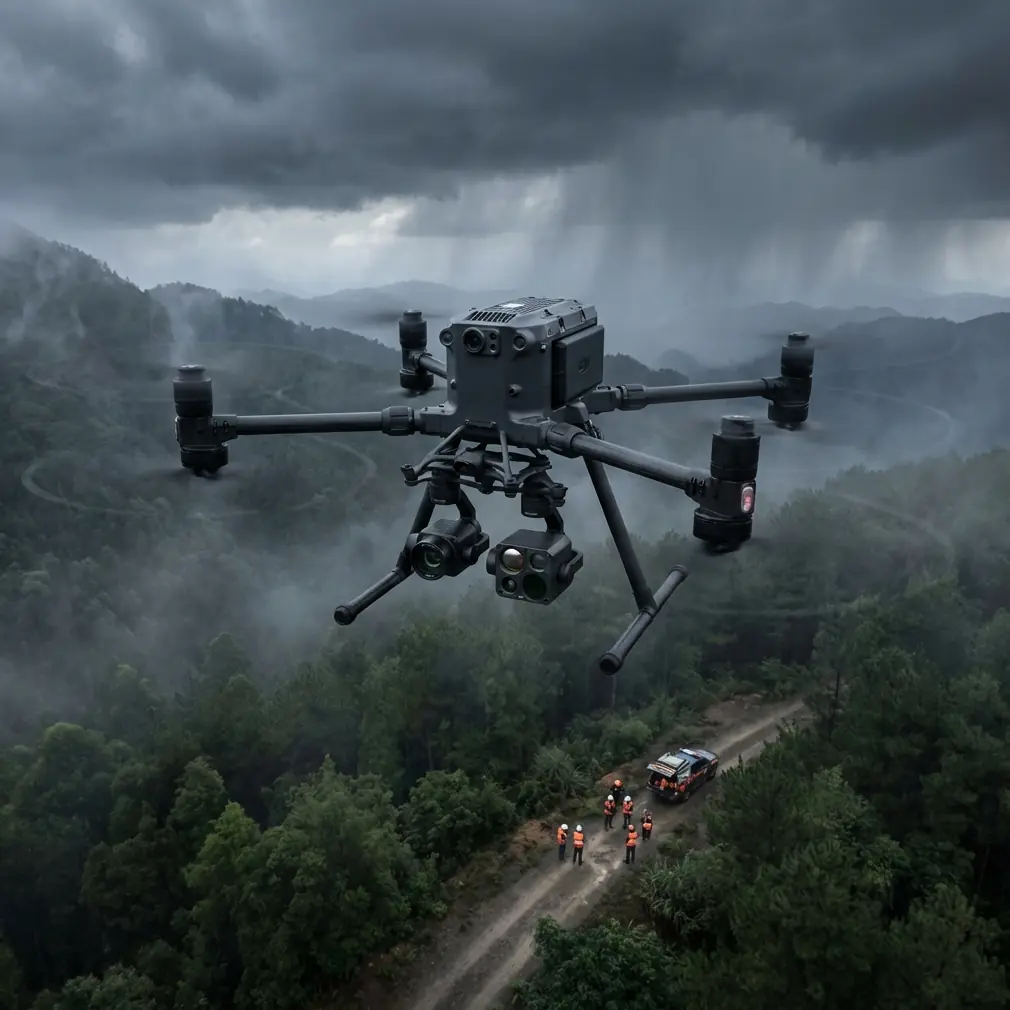
Matrice 400: Master High-Altitude Highway Filming
META: Discover how the Matrice 400 excels at filming highways in challenging high-altitude conditions. Expert guide covers setup, techniques, and real-world weather handling.
TL;DR
- Matrice 400 operates reliably at altitudes up to 7,000 meters, making it ideal for mountain highway documentation
- O3 transmission maintains stable video feed up to 20 kilometers, critical for extended linear infrastructure filming
- Hot-swap batteries enable continuous filming without landing during long highway survey missions
- AES-256 encryption protects sensitive infrastructure footage during transmission and storage
Why High-Altitude Highway Filming Demands Specialized Equipment
Filming highways that snake through mountain passes presents unique challenges that consumer drones simply cannot handle. Thin air reduces lift capacity. Unpredictable weather windows shrink to mere hours. Temperature swings stress batteries and electronics.
The Matrice 400 was engineered specifically for these demanding scenarios. Its industrial-grade construction and intelligent flight systems make it the go-to platform for infrastructure documentation teams working above 3,000 meters.
This guide walks you through the complete workflow for capturing professional highway footage in high-altitude environments—from pre-flight planning to post-processing considerations.
Understanding High-Altitude Flight Physics
Air Density and Lift Compensation
At 5,000 meters elevation, air density drops to approximately 60% of sea-level values. This reduction directly impacts rotor efficiency and maximum payload capacity.
The Matrice 400 compensates through:
- Automatic motor output adjustment based on barometric readings
- Increased rotor RPM to maintain stable hover
- Real-time power consumption monitoring with adjusted flight time estimates
- Dynamic flight envelope protection preventing dangerous maneuvers in thin air
Expert Insight: Always reduce your payload by 15-20% when operating above 4,000 meters. The Matrice 400's flight controller will allow takeoff at full payload, but your safety margins for emergency maneuvers shrink dramatically in thin air.
Temperature Management at Altitude
Mountain environments often present 40-degree temperature swings between dawn and midday. The Matrice 400's thermal management system actively regulates battery and processor temperatures.
Key thermal features include:
- Self-heating batteries that maintain optimal chemistry below freezing
- Ventilated motor housings preventing overheating during high-output climbs
- Processor thermal throttling that prioritizes flight stability over image processing
Pre-Flight Planning for Highway Documentation
Route Mapping and GCP Placement
Effective photogrammetry of highway corridors requires strategic Ground Control Point placement. For high-altitude roads, this presents logistical challenges—many sections are inaccessible by vehicle.
Recommended GCP strategy for mountain highways:
- Place primary GCPs at accessible pullouts every 2-3 kilometers
- Use natural features as secondary reference points (distinctive rock formations, bridge abutments)
- Document GCP coordinates with RTK GPS for sub-centimeter accuracy
- Photograph each GCP from ground level for post-processing verification
Weather Window Identification
Mountain weather patterns follow predictable daily cycles. The optimal filming window typically falls between 6:00 AM and 10:00 AM before thermal updrafts develop.
Critical weather parameters to monitor:
- Wind speed below 12 m/s at planned flight altitude
- Cloud ceiling minimum 500 meters above highest terrain
- Precipitation probability under 20% for the mission duration
- Temperature above -15°C for optimal battery performance
Mission Execution: A Real-World Scenario
The Setup
Last September, our team documented a 47-kilometer highway section crossing a 4,800-meter pass in the Andes. The project required complete photogrammetric coverage for road condition assessment.
We positioned our ground station at kilometer marker 23, roughly midway along the route. The Matrice 400's O3 transmission system would maintain connection across the entire survey area.
When Weather Changed Everything
Three hours into our morning mission, conditions shifted rapidly. A thermal cell developed over the eastern ridge, generating 15 m/s gusts that exceeded our planned parameters.
The Matrice 400's response demonstrated why professional-grade equipment matters:
- Automatic wind compensation maintained camera stability despite gusts
- Flight path adjustment kept the aircraft upwind of terrain obstacles
- Real-time power recalculation updated remaining flight time based on increased motor output
- Obstacle avoidance sensors remained active despite challenging lighting conditions
Rather than aborting the mission, we adjusted our flight plan. The aircraft's hot-swap battery system allowed us to land briefly, exchange power units, and continue filming as the weather cell passed.
Pro Tip: Program your return-to-home altitude 200 meters above the highest terrain in your survey area. Mountain winds accelerate over ridgelines, and you need vertical clearance for safe returns during unexpected weather.
Thermal Signature Applications
Beyond visible-spectrum filming, the Matrice 400's thermal imaging capabilities proved valuable for identifying road surface issues invisible to standard cameras.
Thermal signature analysis revealed:
- Subsurface water infiltration appearing as cold spots in morning footage
- Pavement delamination showing differential heating patterns
- Bridge deck deterioration visible through thermal gradient mapping
- Drainage system blockages identified by water pooling signatures
Technical Specifications Comparison
| Feature | Matrice 400 | Previous Generation | Consumer Alternative |
|---|---|---|---|
| Maximum Altitude | 7,000 m | 5,000 m | 4,000 m |
| Wind Resistance | 15 m/s | 12 m/s | 10 m/s |
| Transmission Range | 20 km (O3) | 15 km | 8 km |
| Operating Temperature | -20°C to 50°C | -10°C to 40°C | 0°C to 40°C |
| Encryption Standard | AES-256 | AES-128 | None |
| Hot-Swap Capability | Yes | No | No |
| BVLOS Certification Ready | Yes | Limited | No |
| Flight Time at Altitude | 42 min | 35 min | 25 min |
Optimizing Footage for Photogrammetry
Overlap and Sidelap Requirements
Highway corridor mapping requires specific image overlap patterns for accurate 3D reconstruction.
Recommended settings for the Matrice 400:
- Front overlap: 80% for continuous surface modeling
- Side overlap: 70% when flying parallel passes
- Altitude consistency: ±5 meters throughout each flight line
- Speed: 8-10 m/s for optimal image sharpness
Camera Settings for High-Altitude Conditions
Intense UV radiation and reduced atmospheric haze at altitude affect image quality. Adjust your camera settings accordingly:
- ISO: 100-200 to minimize noise in bright conditions
- Shutter speed: 1/1000 or faster to freeze motion
- Aperture: f/5.6-f/8 for maximum sharpness
- White balance: Manual at 5500K for consistent color
Common Mistakes to Avoid
Underestimating battery drain in cold conditions. Even with self-heating batteries, expect 20-30% reduced flight time when temperatures drop below freezing. Plan your missions with conservative power reserves.
Ignoring wind gradient effects. Wind speed at your takeoff location often differs dramatically from conditions at flight altitude. The Matrice 400's telemetry shows real-time wind data—monitor it continuously.
Skipping pre-flight sensor calibration. Magnetic interference varies significantly in mountain terrain. Always perform compass calibration at your actual launch site, not at base camp.
Flying without BVLOS authorization. Highway corridor surveys often extend beyond visual range. Secure proper regulatory approval before conducting extended linear infrastructure missions.
Neglecting backup data storage. The Matrice 400 supports dual SD card recording. Enable it. High-altitude missions are expensive to repeat, and card failures happen.
Post-Processing Considerations
Data Management
A single highway survey mission generates substantial data volumes. The Matrice 400's AES-256 encryption protects this sensitive infrastructure information throughout the workflow.
Recommended data handling:
- Download footage immediately after each flight
- Verify file integrity before clearing aircraft storage
- Maintain encrypted backups on separate physical media
- Document flight logs with corresponding footage timestamps
Photogrammetry Software Integration
The Matrice 400's imagery integrates seamlessly with industry-standard processing platforms. Embedded metadata includes:
- Precise GPS coordinates for each frame
- Gimbal orientation data for accurate reconstruction
- Altitude and speed information for quality filtering
- Timestamp synchronization across multiple sensors
Frequently Asked Questions
Can the Matrice 400 operate in BVLOS conditions for highway surveys?
Yes, the Matrice 400 is designed with BVLOS operations in mind. Its O3 transmission system maintains reliable command and control links up to 20 kilometers, while ADS-B receivers provide traffic awareness. However, BVLOS operations require specific regulatory approval in most jurisdictions—work with your aviation authority to secure proper waivers before conducting extended-range missions.
How does hot-swap battery capability benefit highway filming?
Hot-swap functionality allows you to replace depleted batteries without powering down the aircraft. For highway surveys, this means continuous data collection across long corridors without gaps in coverage. The Matrice 400 maintains hover on one battery while you swap the other, reducing total mission time by eliminating repeated startup sequences and sensor recalibration.
What thermal imaging applications work best for road infrastructure?
Thermal signature analysis excels at detecting subsurface moisture infiltration, pavement delamination, and bridge deck deterioration. Early morning flights capture optimal thermal gradients as surfaces warm differentially based on material composition and structural integrity. The Matrice 400's radiometric thermal sensor provides calibrated temperature data suitable for engineering analysis, not just relative heat mapping.
High-altitude highway documentation demands equipment that performs when conditions challenge lesser platforms. The Matrice 400 delivers the reliability, range, and imaging capabilities that infrastructure professionals require.
Ready for your own Matrice 400? Contact our team for expert consultation.