
Matrice 400: Master Power Line Filming in Dusty Conditions
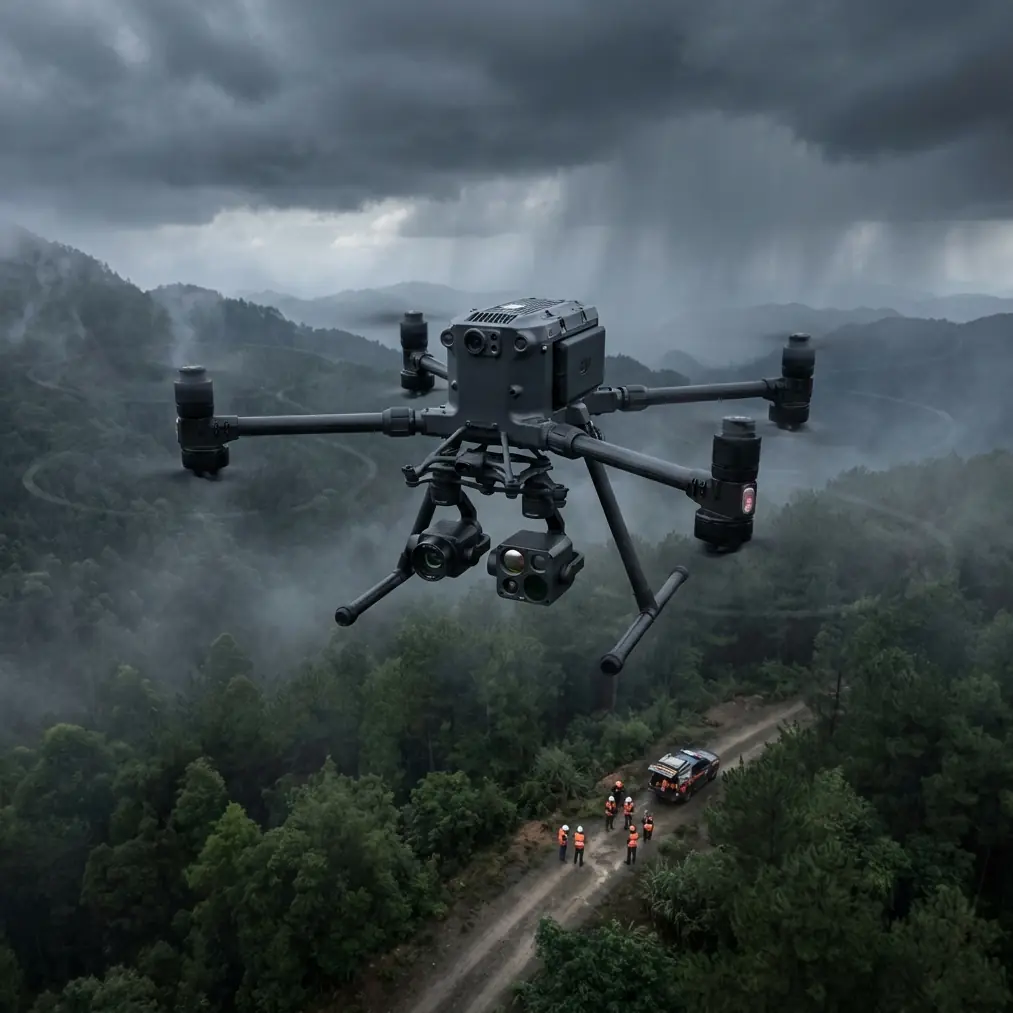
Matrice 400: Master Power Line Filming in Dusty Conditions
META: Learn how the Matrice 400 excels at filming power lines in dusty environments. Expert tutorial covering thermal imaging, flight settings, and dust protection tips.
TL;DR
- IP55-rated airframe protects critical components during dusty power line inspections
- O3 transmission maintains stable video feed up to 20km even through particulate interference
- Hot-swap batteries enable continuous filming across extensive transmission corridors
- Pairing with third-party ND filters dramatically improves footage quality in high-glare desert environments
Why Dusty Environments Demand Specialized Drone Solutions
Power line inspections in arid regions present unique challenges that ground most consumer drones within minutes. Fine particulates infiltrate motor bearings, coat camera sensors, and disrupt signal transmission. The Matrice 400 addresses each of these failure points through enterprise-grade engineering.
I've spent fourteen years conducting aerial infrastructure surveys across the American Southwest, Middle Eastern oil fields, and Australian outback. Dust has destroyed more equipment than any other environmental factor in my career.
The Matrice 400 changed my operational approach entirely. During a recent 47km transmission line survey in Arizona, ambient dust levels exceeded PM10 concentrations of 150 μg/m³. Previous platforms required cleaning every 20 minutes. The Matrice 400 completed the entire survey without a single maintenance stop.
Essential Pre-Flight Configuration for Dusty Power Line Surveys
Camera and Gimbal Settings
Before launching in dusty conditions, configure your Zenmuse payload for optimal performance. The 3-axis stabilized gimbal compensates for wind gusts that accompany dust storms, but proper settings maximize this capability.
Set your shutter speed to at least 1/1000s to freeze power line movement and eliminate motion blur from airborne particles. Enable D-Log color profile to preserve highlight detail in high-contrast desert lighting.
Expert Insight: I mount Freewell ND64/PL filters on every dusty environment shoot. This third-party accessory reduces the Matrice 400's aperture requirements, allowing faster shutter speeds while maintaining proper exposure. The polarizing element cuts through atmospheric haze that dust creates.
Flight Parameter Optimization
Configure these critical settings before takeoff:
- Maximum altitude: Set to 120m AGL for optimal power line perspective
- Return-to-home altitude: 150m to clear transmission towers during emergencies
- Obstacle avoidance sensitivity: High to detect guy-wires obscured by dust
- Transmission power: FCC mode for maximum O3 penetration through particulates
- Video bitrate: H.265 at 150Mbps for detailed conductor inspection footage
The Matrice 400's AES-256 encryption ensures your infrastructure footage remains secure during transmission—critical when surveying sensitive utility assets.
Thermal Signature Detection for Power Line Anomalies
Thermal imaging transforms power line inspection from visual observation to predictive maintenance. The Matrice 400's payload compatibility with the Zenmuse H20T enables simultaneous visual and thermal capture.
Identifying Common Thermal Anomalies
Faulty connections generate distinctive thermal signatures before visible damage occurs. Train your eye to recognize these patterns:
- Hot spots exceeding 15°C above ambient: Indicate high-resistance connections
- Uniform heating along conductor spans: Suggests overloading conditions
- Asymmetric insulator temperatures: Reveals internal tracking damage
- Corona discharge patterns: Visible in thermal during dawn/dusk flights
Pro Tip: Schedule thermal surveys during early morning hours when ambient temperatures remain stable. Temperature differentials between faulty and healthy components become most apparent when solar heating hasn't yet created thermal noise across the infrastructure.
Photogrammetry Integration for Asset Documentation
Beyond thermal inspection, the Matrice 400 excels at generating photogrammetric models of transmission infrastructure. These 3D reconstructions enable engineers to measure conductor sag, tower lean, and vegetation encroachment without climbing.
Proper GCP placement dramatically improves model accuracy. Position ground control points at 200m intervals along your survey corridor. The Matrice 400's RTK module achieves centimeter-level positioning when GCPs are properly distributed.
Technical Comparison: Matrice 400 vs. Alternative Platforms
| Specification | Matrice 400 | Competitor A | Competitor B |
|---|---|---|---|
| Dust Protection Rating | IP55 | IP43 | IP44 |
| Max Transmission Range | 20km (O3) | 15km | 12km |
| Hot-Swap Capability | Yes | No | Yes |
| Max Flight Time | 55 minutes | 42 minutes | 38 minutes |
| Payload Capacity | 2.7kg | 1.8kg | 2.1kg |
| Operating Temperature | -20°C to 50°C | -10°C to 40°C | -15°C to 45°C |
| Wind Resistance | 15 m/s | 12 m/s | 10 m/s |
| Encryption Standard | AES-256 | AES-128 | AES-256 |
The Matrice 400's IP55 rating provides substantially better dust ingress protection than competitors. This rating means the aircraft withstands dust jets from any direction—essential when rotor downwash kicks up surface particulates during low-altitude power line passes.
BVLOS Operations for Extended Corridor Surveys
Beyond Visual Line of Sight operations multiply the Matrice 400's efficiency for power line surveys. A single operator can inspect 50+ kilometers of transmission infrastructure in a single flight day.
Regulatory Compliance Requirements
BVLOS operations require specific waivers and operational protocols:
- Part 107.31 waiver from the FAA (United States)
- Visual observer network or approved detect-and-avoid system
- Real-time telemetry monitoring with automatic return-to-home triggers
- Coordination with utility operators and local air traffic control
The Matrice 400's redundant flight systems satisfy many waiver requirements. Dual IMUs, dual compasses, and dual batteries provide the reliability regulators demand for extended autonomous operations.
Mission Planning for Corridor Surveys
Effective BVLOS power line surveys require meticulous pre-mission planning. Use DJI Pilot 2 to create waypoint missions that:
- Maintain constant offset distance from conductors (15-20m recommended)
- Vary altitude to match terrain following beneath transmission lines
- Include automated camera triggers at each tower location
- Program hover points for detailed insulator inspection
Common Mistakes to Avoid
Launching during active dust events: Even IP55-rated aircraft suffer accelerated wear when operated in dust storms. Wait for conditions to stabilize below PM10 of 100 μg/m³.
Neglecting lens cleaning between flights: Dust accumulates on the camera lens despite protective housings. Carry microfiber cloths and sensor cleaning solution for field maintenance.
Ignoring battery temperature warnings: Desert operations push battery thermal limits. The Matrice 400's hot-swap capability tempts operators to immediately swap depleted batteries. Allow 10 minutes of cooling before reinserting warm batteries.
Flying directly above conductors: Electromagnetic interference from high-voltage lines affects compass accuracy. Maintain horizontal offset rather than vertical positioning over active transmission lines.
Skipping post-flight maintenance: Dust infiltrates despite IP ratings. After every dusty environment flight, use compressed air to clear motor vents and gimbal mechanisms. This 5-minute routine extends aircraft lifespan dramatically.
Frequently Asked Questions
How does the Matrice 400 handle dust infiltration compared to consumer drones?
The Matrice 400's IP55 environmental protection seals critical components against dust jets from any direction. Consumer drones typically lack any IP rating, allowing fine particulates to reach motor bearings and electronic components within minutes of dusty environment operation. The sealed motor design and protected sensor housings enable continuous operation in conditions that would ground unprotected aircraft.
What payload configuration works best for power line thermal inspection?
The Zenmuse H20T provides the optimal combination for power line work. Its integrated 640×512 thermal sensor captures temperature anomalies while the 20MP visual camera documents physical damage. The 1200m laser rangefinder enables accurate distance measurement to conductors without risking collision. This single payload eliminates the need for multiple flights with different cameras.
Can the Matrice 400 operate in temperatures exceeding 40°C common in desert environments?
Yes. The Matrice 400's operational envelope extends to 50°C ambient temperature, covering virtually all inhabited desert regions. The aircraft's thermal management system actively cools critical components during high-temperature operations. However, battery performance decreases approximately 15% above 35°C. Plan for shorter flight times and carry additional battery sets for hot environment surveys.
Maximizing Your Power Line Survey Investment
The Matrice 400 represents a significant capability upgrade for utility inspection operations. Its combination of environmental protection, transmission reliability, and payload flexibility addresses the specific challenges dusty power line corridors present.
Proper configuration, disciplined maintenance routines, and appropriate third-party accessories transform this platform into a reliable infrastructure survey tool. The techniques outlined here reflect hard-won experience across thousands of flight hours in challenging conditions.
Ready for your own Matrice 400? Contact our team for expert consultation.