
Matrice 400 Case Study: Filming Dusty Power Lines Without
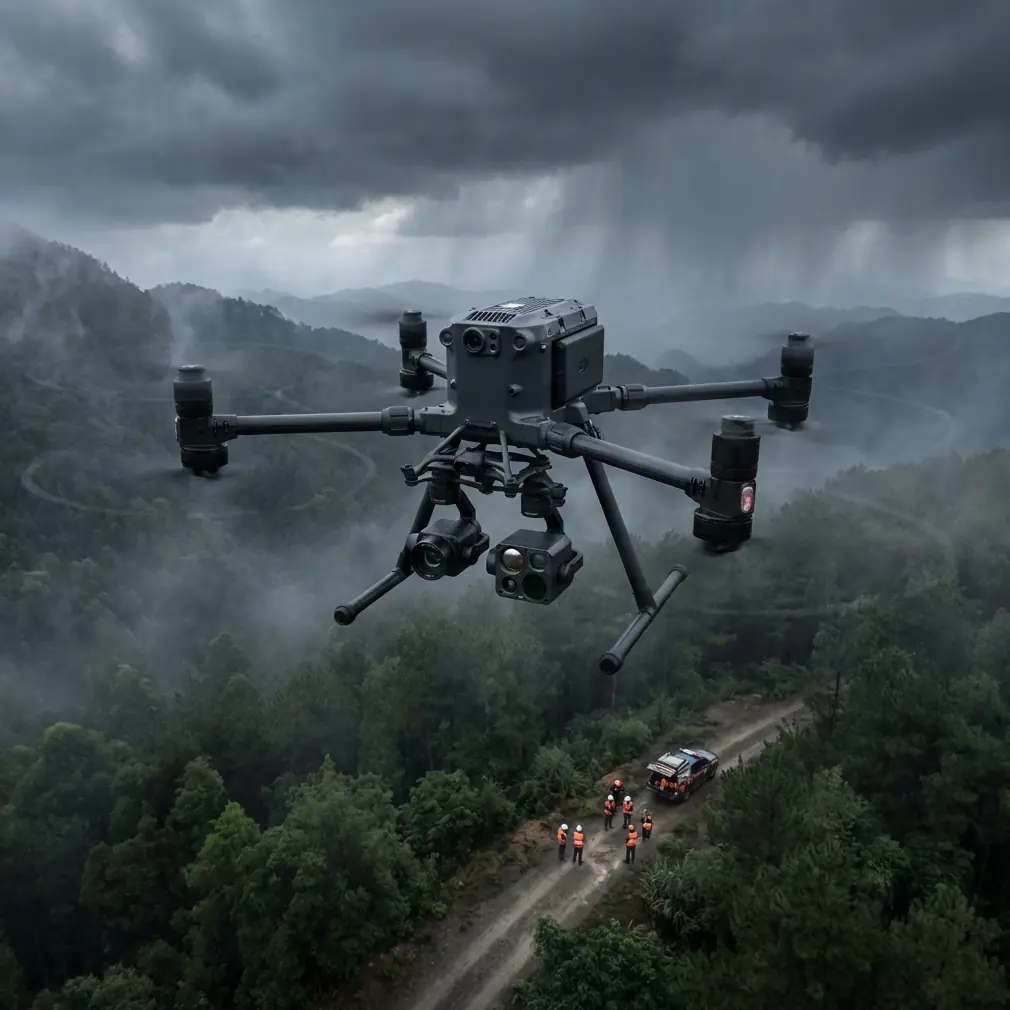
Matrice 400 Case Study: Filming Dusty Power Lines Without Losing the Mission
META: A field-based Matrice 400 case study for filming power lines in dusty conditions, covering thermal signature work, O3 transmission, hot-swap batteries, AES-256 security, and practical inspection tactics.
A dusty transmission corridor exposes weak aircraft decisions fast. You see it in the gimbal first, then in battery timing, then in the quality of the data. That was the lesson from one of the more frustrating utility jobs I dealt with years ago, when a crew tried to document overheating connectors and line hardware in a dry inland zone using an aircraft that looked fine on paper but struggled once the wind picked up and the rotor wash started lifting grit off the service road.
The aircraft stayed airborne, but the mission quality slipped. Fine dust softened visible-light footage. Landing cycles multiplied because battery swaps took too long. The pilot kept repositioning to preserve signal confidence near steel structures and rolling terrain. We completed the work, but it felt like managing limitations rather than running an efficient inspection.
That experience is why the Matrice 400 matters most in exactly this kind of environment: utility filming where dust, distance, thermal interpretation, and uptime all collide in one sortie.
This is not a generic “big drone for industrial work” story. For power-line filming in dusty conditions, the value of the Matrice 400 shows up in operational continuity. It reduces the friction between image capture and mission completion.
Why dusty power-line work is unusually demanding
Filming overhead lines sounds straightforward until you break the task into real field variables. The crew needs stable close-in footage of conductors, clamps, insulators, towers, and surrounding vegetation corridors. They may also need thermal signature data to identify hot spots that are not visible in RGB imagery. In some cases, the same mission expands into a photogrammetry deliverable for structure modeling or right-of-way mapping.
Dust complicates all of it.
Airflow around the aircraft can kick loose particles back into the payload area during low-altitude takeoff and landing. Horizon clarity drops. Contrast can flatten in visible footage, especially around pale hardware in harsh midday light. The pilot often spends more time repositioning because dusty air and long linear infrastructure rarely create forgiving signal geometry. A line route can stretch far beyond the comfortable envelope of older aircraft systems.
This is where the Matrice 400’s design priorities line up with utility reality.
The operational advantage is not one feature. It is the stack.
When pilots evaluate a platform for corridor inspection, they often focus on camera options first. That is understandable, but it misses the bigger point. For dusty power-line missions, the aircraft earns its keep through a stack of capabilities working together: dependable transmission, secure data handling, efficient power management, and support for mixed payload workflows.
Two details deserve special attention here: O3 transmission and hot-swap batteries.
O3 transmission matters because utility corridors are linear, irregular, and often cluttered by terrain, structures, and electromagnetic noise sources. In a power-line filming scenario, strong and stable transmission is not a convenience feature. It is what allows the pilot to hold an inspection angle long enough to confirm whether a suspected issue is real, while keeping the aircraft in a safe position relative to wires and towers. Better link confidence means fewer unnecessary repositioning moves, fewer broken passes, and cleaner footage.
Hot-swap batteries matter for a simpler reason: inspections do not happen in laboratory conditions. On dusty sites, every extra landing-and-power-cycle interruption increases the chance of contamination, delay, and operator fatigue. A hot-swap workflow shortens turnaround between flights and keeps the mission rhythm intact. When a utility team is chasing changing light, wind, and access windows along an active corridor, those saved minutes are not trivial. They directly affect how much line can be documented in one field day.
A third detail deserves mention because power infrastructure owners increasingly care about it as much as image quality: AES-256. Secure transmission and data protection are not abstract IT concerns when you are collecting imagery of critical infrastructure. If a platform supports AES-256, that materially improves suitability for sensitive utility work, especially for contractors operating under strict client cybersecurity protocols.
A practical dusty-corridor workflow with the Matrice 400
If I were planning a Matrice 400 mission for filming power lines in dusty conditions today, I would structure it around three capture layers rather than one.
First, I would use visible imaging for asset context. This is the layer that shows hardware orientation, conductor sag, bolt condition, contamination buildup, and vegetation proximity. The goal is not cinematic footage for its own sake. It is footage that gives maintenance teams enough context to interpret what they are seeing without sending another crew back out.
Second, I would add thermal signature collection where operationally justified. Thermal inspection is especially useful for identifying abnormal heating at connectors, splices, clamps, and other load-bearing electrical components. In dusty environments, thermal can reveal problems that ordinary visual capture may understate, particularly when grime, glare, or flat light obscures fine surface detail. The key is disciplined thermal practice: maintain consistent angles where possible, understand emissivity limitations, and avoid overinterpreting heat patterns without contextual RGB support.
Third, if the utility needs engineering-grade mapping around structures or access routes, I would separate photogrammetry capture from close visual inspection passes. This is one of the most common mistakes in mixed missions. Pilots try to do inspection and mapping in the same improvised flight pattern, then get mediocre results from both. With the Matrice 400, the better approach is to treat photogrammetry as its own deliverable. Use a repeatable flight plan, maintain overlap discipline, and tie the model to GCP where survey confidence matters. GCP is not a ceremonial extra. It is what turns a visually impressive reconstruction into a dataset that engineering teams can actually trust.
That separation of tasks matters because each mode answers a different operational question.
- Inspection footage asks: What is wrong with this asset?
- Thermal asks: Where is the abnormal heat?
- Photogrammetry asks: What is the precise spatial condition of this site?
The Matrice 400 becomes more valuable when the crew respects those distinctions.
What changed from the older way of working
On older utility jobs, one of the biggest inefficiencies came from uncertainty. Signal uncertainty. Endurance uncertainty. Data security uncertainty. Even crew confidence uncertainty.
The Matrice 400 changes the character of the mission because it removes enough of those unknowns that the pilot can focus on line work instead of platform management.
Take long corridor segments. With O3 transmission in the mix, the crew can plan for more stable downlink behavior over extended inspection paths. That does not mean reckless standoff or sloppy airmanship. It means the remote pilot can make cleaner tactical decisions when evaluating line hardware along difficult stretches. For teams operating under BVLOS frameworks or preparing for BVLOS-adjacent utility workflows as regulations and waivers allow, transmission reliability becomes even more consequential. You cannot build a scalable corridor program around a weak link budget.
Then look at battery handling. Hot-swap batteries reduce dead time between sorties, which is particularly valuable when the aircraft is supporting a rolling field team moving from tower to tower. In dusty conditions, less unnecessary handling is a practical win. Fewer prolonged stoppages at improvised launch points usually leads to smoother mission pacing and better discipline around payload care.
Finally, there is the matter of trust. When a client knows the platform supports AES-256, the conversation changes. The crew spends less time defending the security posture of the operation and more time discussing inspection objectives, reporting logic, and data handoff requirements. That may sound administrative, but in utility work, administrative friction often determines whether a drone program expands or stalls.
The dust problem is partly a flight problem
Pilots sometimes talk about dusty environments as if they are mainly a maintenance issue. They are not. Dust also changes how you should fly.
With the Matrice 400 on a power-line filming job, I would avoid treating every structure as a static orbit target. In dusty terrain, low hover time near unprepared ground can degrade visibility more than crews expect, especially during launch, recovery, and low repositioning legs. Better results usually come from more deliberate stand-off framing, smoother lateral passes, and disciplined altitude transitions that keep rotor wash from constantly stirring the same particulate layer.
This matters for thermal too. If the aircraft is constantly repositioning aggressively in marginal visibility, the thermal story gets noisier. Clean interpretation depends not just on sensor quality but on stable acquisition technique. A platform that helps the pilot maintain confident control and transmission clarity improves thermal usefulness indirectly, even before we discuss the payload itself.
That is one reason I tell utility teams to think in terms of “data conditions,” not just weather conditions. A dusty day may still be flyable, but is it thermally interpretable? Is the visible footage likely to preserve fine hardware detail? Is the route geometry favorable enough to maintain safe and efficient signal continuity? The Matrice 400 gives the crew more room to answer yes, but it does not eliminate the need for judgment.
A real-world planning model for line crews
For a dusty power-line mission, I would brief the crew around five field priorities.
First, define the inspection question before takeoff. Are you trying to confirm hardware degradation, compare thermal anomalies, document vegetation encroachment, or build a model for engineering review? The flight pattern changes depending on that answer.
Second, separate capture products. Inspection footage, thermal signature work, and photogrammetry should each have their own acquisition logic. If survey-grade outputs matter, establish GCP up front rather than trying to correct uncertainty later in software.
Third, protect the turnover cycle. The value of hot-swap batteries is greatest when the team already has a disciplined battery and launch routine. Fast swaps only help if the site choreography is clean.
Fourth, plan communications and security as operational requirements, not paperwork. O3 transmission quality supports safer decision-making along linear assets, while AES-256 helps satisfy client expectations around critical infrastructure data.
Fifth, build the mission for continuity, not hero shots. Utility footage succeeds when it is repeatable, interpretable, and tied to maintenance outcomes.
If a crew wants help structuring that kind of workflow in the field, I usually recommend they start with a quick mission planning exchange rather than trial-and-error at the substation gate. A simple briefing through our utility operations chat can save hours of avoidable repositioning and recapture.
Where the Matrice 400 fits in a serious utility program
The Matrice 400 is most compelling when used by teams that already understand that asset inspection is a data discipline, not just a flying exercise. For casual capture, its strengths can be underused. For power-line filming in dusty conditions, those strengths become obvious.
Its practical edge is not about spectacle. It is about reducing the number of small failures that erode a mission: weak transmission on awkward line segments, excessive downtime during battery changes, insecure handling of sensitive infrastructure imagery, and muddled workflows that confuse inspection with mapping.
That combination is what would have changed the outcome on that frustrating corridor job I mentioned at the start. The old mission succeeded technically, but only just. The Matrice 400 would have made it cleaner, calmer, and more productive. Fewer interruptions. Better thermal confidence. Stronger corridor coverage. More useful footage for the maintenance team waiting back at the office.
And that is the real standard for evaluating an aircraft in utility work. Not whether it can fly the line once, but whether it helps the crew deliver dependable inspection intelligence day after day in the kind of dusty, inconvenient conditions where the grid still has to be maintained.
Ready for your own Matrice 400? Contact our team for expert consultation.