
Matrice 400 for Windy Solar Farm Missions
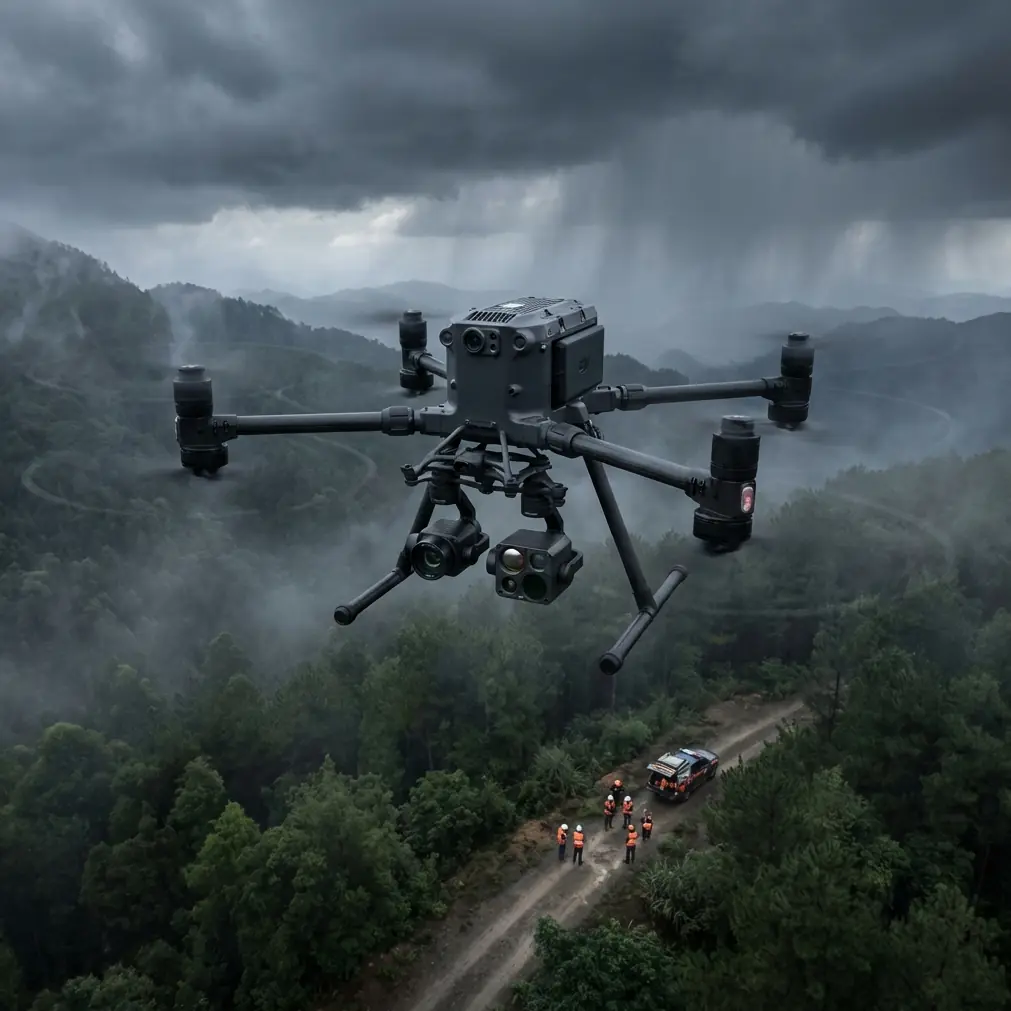
Matrice 400 for Windy Solar Farm Missions: What Actually Matters in the Air
META: Expert tutorial on using the Matrice 400 for solar farm inspection and filming in wind, with practical guidance on flight stability, thermal workflows, transmission reliability, battery strategy, and weather-aware mission planning.
Filming and inspecting a solar farm sounds simple until the weather stops cooperating.
Open sites create their own problems. Long rows of panels funnel crosswinds. Heat shimmer distorts the image just when you need clean thermal signature data. A sky that looks stable from the truck can turn rough halfway through a mapping run. That is where the aircraft stops being a spec sheet and starts being a tool.
For a Matrice 400 mission over a solar farm, especially in windy conditions, the real question is not whether the platform can lift a payload or complete a route. The question is whether it can keep producing trustworthy data when the environment gets less forgiving. If you are collecting photogrammetry outputs, verifying hotspot patterns, or capturing client-facing footage around active energy infrastructure, consistency matters more than drama.
I want to frame this guide around one operational reality: weather can change mid-flight, and the aircraft has to stay predictable when it does.
Why solar farms are a different kind of flight environment
Solar sites are wide, repetitive, reflective, and usually exposed. That combination affects every stage of the mission.
The repetitive geometry is good for structured flight paths but not forgiving when your overlap drops because wind pushes the aircraft off its line. Reflection from panel surfaces can challenge visual interpretation, while thermal work has its own timing window. Add even moderate gusts, and your mission shifts from simple capture to active flight management.
This is also one of the clearest examples of why aircraft design principles matter even if the operator never sees the engineering underneath. The reference material behind this article comes from civil aircraft design verification, and two details stand out.
The first is fuel indication accuracy being verified both on the ground and in flight, with calibration expected to match usable onboard fuel readings. The second is validation of system behavior during horizontal flight, climb, and descent, including conditions where usable supply becomes constrained and the system still has to behave predictably. Those are fixed-wing fuel-system references, not drone battery notes, but the operational lesson carries over directly: an aircraft used for serious work must give the operator honest state awareness during changing flight profiles, not just during ideal cruise.
That is highly relevant to the Matrice 400 mindset. On a solar farm job, you do not need a platform that feels fine in one hover over the launch point. You need one that remains readable and stable through transit, low-altitude passes, ascent for overview shots, descent into inspection height, and wind shifts at the far edge of the array.
The mid-flight weather shift that tests the platform
A recent solar-site workflow is the kind of scenario that exposes weak aircraft behavior quickly.
We launched in steady conditions for a combined visual and thermal pass. Early legs were routine: broad overview footage first, then tighter inspection lines prepared for photogrammetry and defect review. About a third of the way into the run, the site wind changed character. Not stronger in a dramatic sense. Just more uneven. Gusts began rolling across the rows at an angle, and the aircraft started dealing with the sort of airflow that turns neat planning into small, constant corrections.
This is the moment when platform confidence matters.
With the Matrice 400, the key advantage is not that it eliminates the wind. No aircraft does. The advantage is that it gives you enough control and enough situational trust to decide whether to continue, adjust, or break off without losing the mission picture. That includes stable transmission through O3, clear telemetry, and the confidence to change altitude or route structure while keeping payload output usable.
A lot of operators talk about wind only in terms of whether the aircraft can remain airborne. That is too low a bar. For solar work, the better question is whether image geometry, thermal consistency, and route discipline stay inside acceptable limits. If the aircraft is fighting to hold line, your orthomosaic quality suffers. If angle and speed vary too much during thermal capture, comparisons across strings become less reliable. If the transmission becomes noisy, the operator becomes reactive instead of methodical.
In those conditions, the Matrice 400’s value is its ability to keep the workflow coherent. You may widen spacing. You may rerun one sector. You may switch from a full-site pass to targeted inspection. But you are still making informed decisions rather than trying to rescue a deteriorating flight.
What battery strategy really means on a windy site
Battery discussions often get flattened into endurance claims. That misses the operational point.
The civil aircraft reference data spends unusual attention on usable quantity, system accuracy, and what happens during climb, descent, and non-normal conditions. Again, it is written around fuel systems, including verification in multiple flight states and checks tied to safety-critical system behavior. For drone operators, the equivalent discipline is battery management that reflects actual mission phases, not brochure numbers.
On a windy solar farm, your power draw is not uniform. The outbound leg may be easy. The return leg against the wind may not be. An ascent for a cinematic reveal is not the same load case as a low, linear inspection run. If weather degrades, reserve planning stops being a formality.
That is why hot-swap batteries matter in practice. Not because swapping is convenient, but because it changes how you stage the day. Instead of stretching one sortie to cover too much acreage, you can segment the site into cleaner mission blocks and relaunch fast while keeping the payload stack, controller context, and operator rhythm intact.
That approach also protects data quality. Fresh batteries at the start of each block reduce the temptation to rush the final rows of an inspection pass. On a solar project, the expensive mistake is rarely “we had to land and relaunch.” It is “we came back with coverage gaps, poor overlap, or thermal inconsistencies.”
Transmission and security are not side issues
Solar farms are often in open country, but that does not mean connectivity is trivial. The site can be large enough that the far end feels operationally distant, especially when you are tracking a low-altitude route across repetitive terrain. Reliable O3 transmission matters here because the pilot and camera or payload operator need a stable picture, stable command response, and enough confidence to continue precise work when the aircraft is no longer visually close in any practical sense.
There is another layer that gets ignored too often: data handling. Infrastructure clients are increasingly sensitive about imagery, thermal outputs, asset condition records, and site layout information. If your workflow includes AES-256, that is not a marketing detail. It is part of presenting yourself as an operator who understands that energy clients care about more than flight performance. They care about where the data goes, who can access it, and whether the workflow is professionally controlled.
This becomes even more relevant if your operation is scaling toward more advanced authorizations or BVLOS-aligned workflows in the future. Even when today’s mission remains within your local regulatory boundaries, the habits you build around transmission trust, route discipline, and data security shape whether your operation is ready for more complex inspection work later.
Thermal and visual capture: don’t fly them as if they are the same job
One mistake I still see is treating thermal capture as a visual mission with a different camera attached.
It is not.
When you are flying the Matrice 400 over a solar farm, thermal signature collection should be planned around environmental consistency first. That includes time of day, panel loading conditions if available, flight speed, angle, and the repeatability of pass geometry. Wind complicates all of that because it can alter aircraft attitude, groundspeed behavior, and the steadiness of your dataset.
Visual footage can absorb some artistic variation. Thermal inspection cannot.
If your mission requires both photogrammetry and thermal review, split the logic of the job. Use one plan optimized for mapping overlap and GCP-supported positional reliability. Use another plan optimized for thermal comparability. Ground control points still matter when the client expects defect locations to reconcile with maintenance records, especially across large arrays where “that panel over there” is not a useful description.
The Matrice 400 fits this type of split-workflow operation well because it supports the kind of professional sequencing that larger sites demand. You are not just flying for one beautiful clip. You are building a chain of evidence: overview, map, thermal anomaly, location confirmation, and follow-up footage the client can actually use in a report.
What the aircraft design references teach drone operators indirectly
The source material behind this article is not a drone brochure. It comes from civil aircraft design manuals, including a section on fuel-system verification and another on lightning protection and corrosion-related structural considerations.
That matters more than it may seem.
One reference notes that system validation is performed not only in normal conditions but also during abnormal flight states, and that venting behavior must be checked during climb, cruise, and emergency descent. Another points to lightning current waveforms, lightning damage mechanisms in resin-based carbon-fiber composites, and corrosion environments including seawater exposure.
For a Matrice 400 operator, the practical takeaway is this: serious aviation thinking is built around verification under stress, not assumption under ideal conditions.
Translate that to solar farm operations and you get a sharper standard for drone work:
- Do your power assumptions still hold after repeated climbs and wind-corrected passes?
- Does your mission plan remain valid if conditions shift after takeoff?
- Is the aircraft’s structure and system design suited to repeated exposure to harsh environments, dust, moisture, and electrically complex industrial sites?
- Are you managing the platform like a professional aviation tool rather than a flying camera?
Even if you never read a line of aircraft certification literature, that mindset improves your drone outputs.
A practical Matrice 400 workflow for windy solar farm missions
Here is the structure I recommend.
1. Start with the inspection objective, not the route
Decide whether the priority is thermal anomaly detection, visual defect documentation, client presentation footage, or photogrammetry. Build separate plans if needed.
2. Use a conservative first sortie
The first flight should tell you what the site wind is doing above the panel rows, not just at your takeoff zone. Treat it as an information-gathering leg as much as a capture leg.
3. Watch for attitude-driven data drift
If gusts force repeated corrections, check whether your overlap, image angle, or thermal consistency is starting to drift. That is the real cue to adapt.
4. Segment the farm
Use hot-swap batteries to break a large site into blocks. Cleaner blocks are easier to QA later and easier to rerun if one section gets compromised by weather.
5. Ground your map products properly
If deliverables include measurable outputs, use GCPs where appropriate. On solar assets, positional confidence matters when maintenance crews need to find the exact module or string.
6. Keep transmission quality part of your go/no-go logic
Do not think of O3 as just a nice feature. Stable signal quality supports better pilot decisions, especially when the weather shifts and the route needs real-time adjustment.
7. Treat security as operational professionalism
If you are handling infrastructure imagery, use AES-256-enabled workflows and brief the client on how data is managed. It builds trust because it shows you understand the asset class.
When to stop the mission
There is a point where discipline beats persistence.
If wind changes are degrading thermal repeatability, if line holding becomes inefficient, or if the return profile starts eating into your reserve logic, land and reset. The civil aircraft reference emphasis on usable quantity and system verification across flight phases is a useful mental model here. The mission is not “successful” because the aircraft stayed airborne. It is successful because the data remained reliable from launch to landing.
That distinction separates casual flying from professional aerial inspection.
Final thought
The Matrice 400 makes the most sense on solar farm work when you use it as a stability platform for disciplined data collection, not as a substitute for mission planning. Windy environments expose shortcuts quickly. They also highlight what a serious aircraft does well: preserve control, preserve awareness, and preserve usable results when the site stops being easy.
If you are building or refining a solar inspection workflow around the Matrice 400 and want to compare payload setups, route structure, or thermal capture strategy, you can message James directly here.
Ready for your own Matrice 400? Contact our team for expert consultation.