
Matrice 400 Field Report: Filming Dusty Venues Without
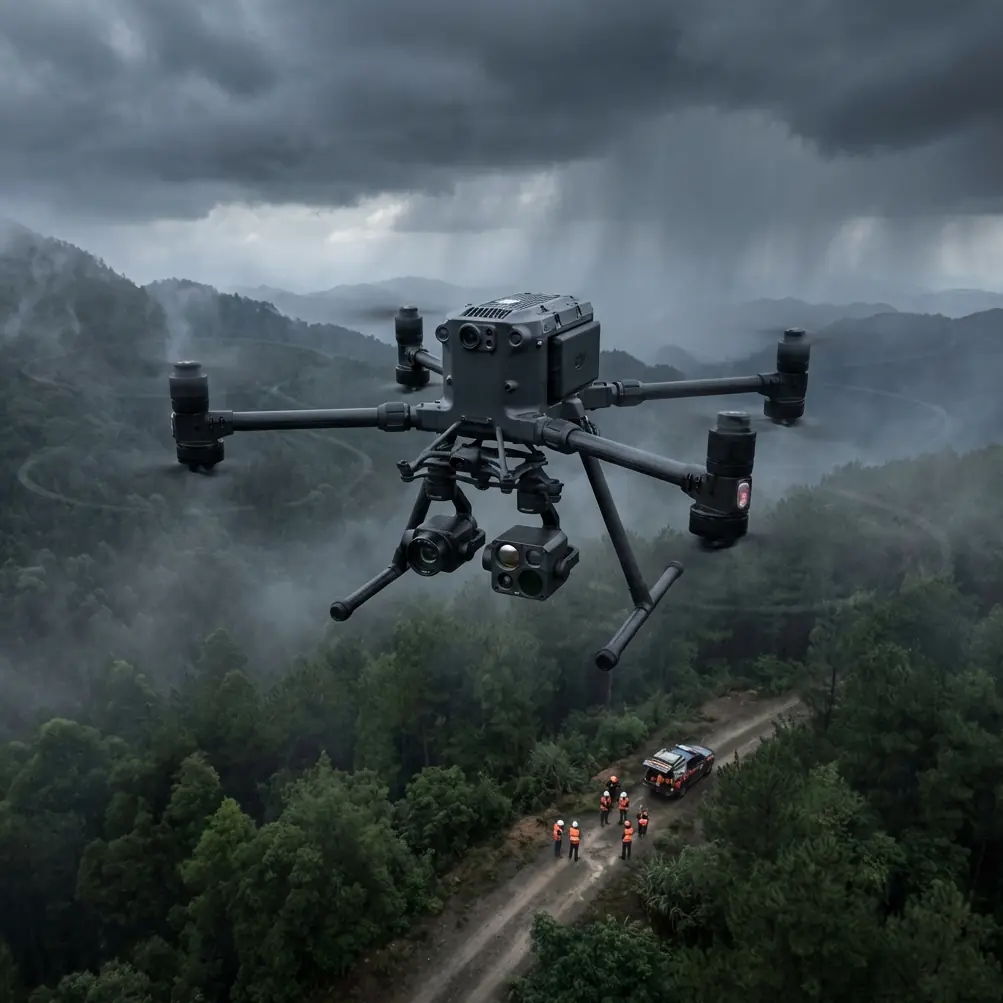
Matrice 400 Field Report: Filming Dusty Venues Without Losing Image Quality or Uptime
META: Expert field report on using the Matrice 400 for filming in dusty venues, with practical guidance on thermal workflows, O3 transmission, AES-256 security, hot-swap batteries, and third-party accessories.
Dust changes everything.
It softens contrast, contaminates optics, reduces cooling efficiency, and turns a routine filming day into a maintenance problem by lunch. For crews working large outdoor venues, quarries, race sites, festival grounds, demolition zones, or desert-edge event spaces, the drone is not just a camera platform. It becomes a reliability test. That is exactly where the Matrice 400 starts to separate itself from lighter airframes.
I have been asked a version of the same question many times: is the Matrice 400 actually useful for venue filming in dirty, abrasive environments, or is it simply too much aircraft for a content job? The short answer is that it makes sense when the venue itself is operationally difficult. Dusty sites punish weak links. Transmission stability, battery handling, payload flexibility, and data security all become more consequential than they look on a spec table.
This field report is built around that use case: filming venues in dusty conditions where the mission is not limited to pretty reveal shots. The crew may also need thermal checks before public opening, quick surface documentation for site managers, and repeatable mapping passes for post-event or construction records. In that mixed workflow, the Matrice 400 earns its keep because it can do more than capture a hero shot and come home.
The first operational advantage is persistence. Dusty venues rarely reward stop-start flying. You often need to hold position while waiting for machinery to clear, adjust camera angle to avoid haze bands, or repeat a path after a gust pushes particulate through the frame. Hot-swap batteries matter here in a very practical way. Instead of powering the aircraft down, breaking rhythm, and stretching the turnaround long enough for light to change, the crew can cycle packs and stay in sequence. That is not a convenience feature. It preserves continuity. If you are trying to maintain consistent shadows across multiple takes or complete a structured pass around a venue before gates open, the difference is measurable in usable footage.
The second advantage is transmission confidence. Dusty venues are often wide venues. Motor tracks, aggregate plants, temporary outdoor stages, industrial campuses, and sports facilities force the pilot and camera operator to work around obstructions, moving vehicles, scaffolding, and RF noise from support equipment. O3 transmission becomes more than a marketing term in that environment. It affects whether the camera team can confidently frame through interference-prone areas without stepping dangerously close to active operations. Stable video downlink is what lets the operator judge haze density, monitor focus behavior, and decide whether a pass is cinematic enough to keep. If the image drops out just as the aircraft enters the most visually complex part of the shot, the mission becomes guesswork.
Security also deserves more attention than most filming teams give it. A lot of venue work happens before openings, during closed builds, or around infrastructure that owners do not want casually exposed. AES-256 encryption is a serious operational detail, not a box-tick. If the production includes unreleased layouts, VIP access staging, utility corridors, or temporary security patterns, encrypted links reduce exposure risk while the aircraft is transmitting live imagery. I would not frame that as a niche concern. More venue operators now expect their aerial contractor to think like a secure systems provider, not only a creative vendor.
Then there is the payload question. Dusty filming jobs often reveal their own next assignment halfway through the day. The client starts with cinematic coverage, then asks whether the same aircraft can inspect rooftop HVAC heat patterns, confirm electrical equipment loading visually, or document disturbed ground after vehicle traffic. That is where thermal signature analysis becomes valuable. On a venue site, thermal is not only for emergency services or infrastructure inspections. It can help identify overheating generators, stressed temporary power connections, or uneven heat dispersion around concession or staging equipment. In practical terms, this lets the filming crew capture a more useful operational record rather than just a promotional reel.
That hybrid role becomes even stronger when photogrammetry enters the workflow. A dusty venue does not stay static. Surfaces change. Access roads widen. Temporary structures come and go. If the aircraft is used to generate a current site model, the team can produce deliverables that support planning after filming ends. Good photogrammetry still depends on discipline, especially around GCP placement. Ground control points are not glamorous, but they are what separate a rough visual map from a defensible site record. On dusty terrain, where surface features can look repetitive and low-contrast from altitude, GCPs help anchor the data and reduce ambiguity. That matters for organizers tracking temporary installations, civil teams monitoring wear, or insurers reviewing site conditions after a major event.
One issue I have seen repeatedly in dusty environments is crews underestimating accessory value. A well-chosen third-party addition can improve a Matrice 400 deployment more than another hour of debating lens preferences. In one venue workflow, a third-party payload protection and lens-filter system made a meaningful difference. The aircraft was already capable, but adding a high-quality aftermarket filter and protective front-end setup helped suppress glare from pale dust surfaces while also reducing the frequency of lens cleaning between sorties. That sounds minor until you are landing every few minutes to clear fine grit from glass. Less interruption means better continuity, lower contamination risk during handling, and a smoother shooting rhythm.
The same logic applies to landing discipline. Dust ingestion often starts on takeoff and landing, not in cruise. An elevated third-party landing pad or portable launch platform is one of the smartest upgrades for venue crews operating from loose soil or compacted aggregate. It keeps the Matrice 400 farther from its own rotor wash plume during critical moments. The operational significance is simple: cleaner sensors, cleaner gimbals, less abrasive buildup, and lower probability of small particles compromising moving components. I have watched teams spend serious money on high-end camera payloads while launching from bare dirt. That is false economy.
Dust also changes how pilots should think about shot design. Long low passes may look dramatic, but they can put the aircraft into the thickest particulate layer and degrade image quality just when the composition is strongest. With the Matrice 400, the more effective approach is often to exploit altitude intelligently, then descend only when the air column and surface disturbance allow it. Because the platform supports more advanced workflows, it is well suited to a layered mission profile: establish clean high-angle scene geometry first, gather mid-level movement shots second, and reserve low dynamic passes for brief windows when ground activity and wind align. That sequencing reduces cleaning downtime and protects the best footage from the worst air.
For teams working toward more ambitious operational frameworks, BVLOS enters the conversation carefully. Not every venue mission supports it, and regulatory approval remains the governing factor. But the Matrice 400 belongs in that discussion because venue-scale documentation can stretch beyond the line-of-sight comfort zone of smaller ad hoc crews. If the project includes perimeter analysis, repeated infrastructure checks, or wide-area environmental monitoring before and after an event, the platform’s transmission and system architecture make it more suitable for structured, compliance-driven expansion than a lightweight filmmaking drone pressed into industrial duty. The key point is not that every filming team should fly BVLOS. It is that some venue projects are no longer purely cinematic and benefit from an aircraft designed for operational depth.
There is also the matter of human fatigue. Dusty site work is tiring in a very specific way. Crews clean gear constantly, monitor changing wind, protect exposed connectors, and manage batteries under pressure. A platform that reduces unnecessary handling steps has value beyond specs. Hot-swap battery support lowers interruption stress. Strong transmission reduces repeated repositioning. Secure links reduce client anxiety. Multirole payload options reduce the number of separate aircraft needed on site. Those gains compound over a full day.
One of the more underestimated advantages of using a serious enterprise platform for venue filming is client perception after the first hour. Initially, some teams assume a Matrice 400 is excessive for “just video.” Then the site manager asks for a heat check on a bank of temporary equipment. The operations lead wants a quick orthomosaic reference. Security asks whether the feed is protected. Suddenly the aircraft is not overbuilt. It is appropriately built.
If you are planning this kind of mission, my advice is straightforward.
Start with contamination control, not camera creativity. Build the launch area before the first battery goes in. Use a raised pad if the ground is loose. Keep sensor and lens cleaning tools sealed until needed. Decide in advance which shots justify low-level dust exposure and which can be achieved from cleaner air.
Second, treat transmission as part of image quality. O3 reliability directly affects framing confidence and mission efficiency. On large venues, lost composure often starts with weak downlink, not pilot skill.
Third, use thermal intentionally. Do not bolt on a thermal workflow just because the payload allows it. Use it where it adds operational context, such as identifying abnormal heat around generators, electrical clusters, or stressed machinery before or after crowd activity.
Fourth, if mapping is part of the job, respect GCP setup and repeatability. Dusty surfaces can produce deceptively uniform visual textures, and lazy control-point work will show up in the outputs.
Fifth, spend money on the right accessories. In real field conditions, an elevated launch platform and a high-quality third-party protective or filter solution can produce more day-long value than another marginal tweak elsewhere. That is the sort of upgrade I routinely recommend when teams ask how to make the Matrice 400 more effective in abrasive venues. If you want to compare field setups or talk through a deployment plan, here is a direct line for mission questions: message our UAV specialist.
The Matrice 400 is not defined by one spectacular feature. Its strength is that several operational details line up at once. Hot-swap batteries keep the schedule intact. O3 transmission protects shot execution across difficult sites. AES-256 supports sensitive venue work. Thermal broadens the mission from visual capture to operational insight. Photogrammetry and GCP discipline turn a filming day into a site documentation asset. Add one or two smart third-party accessories, and the aircraft becomes notably better suited to dust-heavy reality rather than brochure conditions.
That is why I would not describe it as merely a filming drone for venues. In dusty environments, it functions more like an aerial work platform that happens to be excellent at filming. For the right crew, that distinction changes the economics of the day, the quality of the deliverables, and the confidence of the client standing beside the monitor.
Ready for your own Matrice 400? Contact our team for expert consultation.