
Matrice 400 in Dusty Wildlife Work: A Technical Review
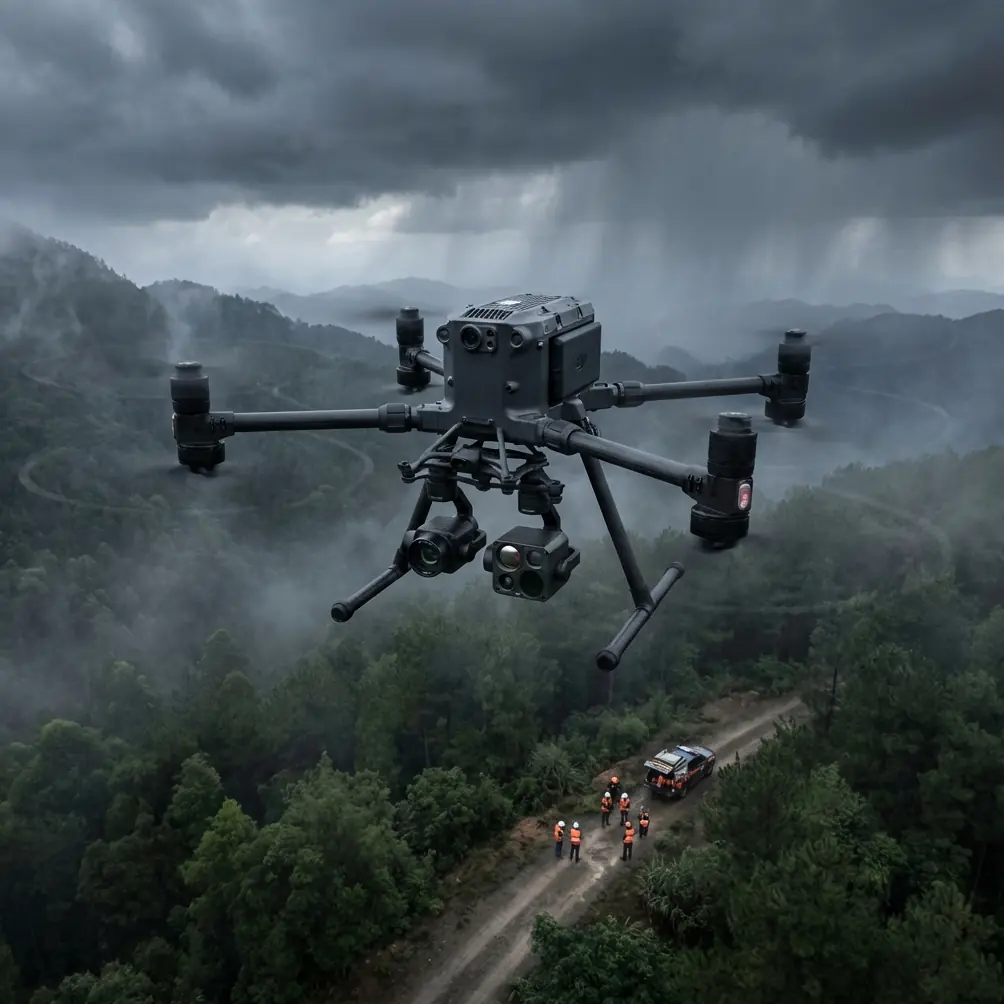
Matrice 400 in Dusty Wildlife Work: A Technical Review from the Field
META: A field-focused technical review of the DJI Matrice 400 for dusty wildlife filming, covering endurance, payload flexibility, thermal work, transmission reliability, battery strategy, and real-world operating practices.
Dust changes everything.
It gets into gimbals, settles on lenses, confuses autofocus, and turns what should be a clean day of wildlife filming into a maintenance exercise. I learned that the hard way years ago while tracking ungulates across dry scrubland at first light. The aircraft itself was capable enough, but the workflow around it was fragile. Too many battery interruptions. Too much hesitation about flying farther from the crew vehicle. Too much compromise between visible imaging, thermal signature work, and the stability needed for long observation sequences.
That is the lens through which I look at the Matrice 400.
This is not a generic platform overview. It is a practical review of why a heavy-duty enterprise aircraft like the Matrice 400 matters specifically for dusty wildlife operations, where flight endurance, payload flexibility, transmission confidence, and battery handling have a direct effect on whether you capture behavior cleanly or miss the moment entirely.
Why dusty wildlife filming is harder than most spec sheets admit
Wildlife work in dry environments is a strange mix of patience and urgency. For long stretches, nothing happens. Then, in twenty seconds, everything happens at once: a herd shifts direction, a predator appears at the edge of frame, or heat shimmer suddenly reveals what the naked eye could not. In that setting, your drone is not just a camera carrier. It is a sensor platform, an observation post, and often the difference between invasive presence and respectful distance.
Dust adds three operational pressures.
First, launch and recovery become higher-risk moments. The issue is not only contamination. Dust kicked up by rotor wash can reduce visual clarity right when precision matters most.
Second, endurance becomes more valuable than raw agility. If you need to land frequently, you increase exposure to dusty takeoff zones and lose continuity in your footage.
Third, payload selection becomes less forgiving. Wildlife filmmakers often want a daylight camera for editorial value, but thermal capability has become increasingly useful for early morning locating, nest awareness, post-sunset tracking in legal and ethical conditions, and identifying animals concealed by vegetation through heat contrast rather than visual detail.
That is where the Matrice 400 starts to make sense.
The real advantage: a platform built around mission continuity
The strongest enterprise aircraft are not defined by a single headline feature. They are defined by how many small interruptions they remove from the day.
The Matrice 400 sits in that category. It is designed as a serious multi-role industrial platform, and that matters even for filming. The reason is simple: professional wildlife capture in harsh environments behaves more like an inspection mission than a hobby shoot. You plan around time on station, signal integrity, payload relevance, and repeatable launch procedures.
One of the biggest practical gains is support for hot-swap batteries. Anyone who has done repeated observation flights in dust knows why that matters. Every additional full shutdown and restart cycle stretches your turnaround, invites more contamination during handling, and breaks concentration for both pilot and camera operator. Hot-swapping reduces those interruptions. Operationally, that means better sortie rhythm, less time with equipment open to dust exposure, and a more realistic chance of staying aligned with animal movement patterns over a long morning session.
That detail may sound minor on paper. In the field, it changes tempo.
Endurance is not just about flying longer
Many buyers fixate on headline flight time, but endurance on a platform like the Matrice 400 should be understood differently. Longer time aloft is useful, of course, yet the deeper value is reduced decision pressure.
When you are filming wildlife, rushed aviation decisions are usually bad ones. Pilots cut a pass short, reposition too aggressively, or descend when they should have held altitude. More endurance gives the crew room to wait. It allows wider orbits. It makes it easier to hold off until dust disperses over a waterhole or game trail.
This is especially relevant when pairing visible imaging with thermal signature observation. Thermal is often most helpful at the edges of the day, when heat contrast can reveal animals that blend into earth-toned terrain. But those same windows can demand patient loitering rather than fast movement. A platform intended for industrial workloads is well suited to that kind of discipline.
For documentary teams, conservation projects, and ecological survey support, that patient loiter capability can be the difference between acquiring behavior naturally and forcing the scene with repositioning.
Payload flexibility matters more than camera hype
The Matrice 400 should be judged less as a drone with a camera and more as a stable aircraft that can be configured around the job.
That distinction matters because wildlife filming in dusty areas is rarely one-dimensional. One sequence may need a long-lens visual perspective from a respectful stand-off distance. Another may need thermal assistance to identify movement through scrub before the camera operator commits to a framing plan. In adjacent workflows, the same aircraft may support photogrammetry for habitat documentation, erosion mapping, or watercourse monitoring.
This is one reason enterprise crews often standardize around a platform class rather than a single sensor. The airframe becomes the stable constant; payloads adapt to mission goals.
The Matrice 400’s relevance is strongest in mixed operations where filming overlaps with survey work. A conservation team might document herd movement in visible imagery in the morning, collect thermal scans around shaded vegetation by dawn, and later perform terrain capture for mapping. If you are tying that mapping to GCP workflows, the aircraft’s value extends beyond cinema. It becomes part of a repeatable documentation pipeline for habitat change, vehicle track impact, or restoration planning.
That crossover is not theoretical. It is increasingly how field teams justify aircraft deployment budgets: one system, multiple outcomes.
Transmission confidence changes how you film
In dry, open environments, visual line of sight may feel simple. In practice, terrain undulations, vegetation, and distance create enough uncertainty that transmission quality has a direct effect on footage quality and crew confidence.
The inclusion of O3 transmission in the discussion around the Matrice 400 matters because stable, high-quality video downlink changes operator behavior. A camera operator who trusts the feed makes finer framing decisions. A pilot who trusts control link resilience is less likely to “play it safe” with awkward repositioning that disrupts animal behavior or ruins smooth motion.
This becomes even more relevant in workflows that edge toward BVLOS planning under the right regulatory framework and with proper approvals. To be clear, wildlife crews should only operate within local laws and organizational procedures. But from a platform assessment standpoint, strong transmission architecture has operational significance beyond convenience. It expands the envelope in which the aircraft can be used professionally for observation over broad tracts of land, especially where access roads are poor and repositioning the ground crew is slower than repositioning the aircraft.
In dusty ecosystems, that can be a major efficiency gain. Less vehicle movement also means less disturbance to wildlife.
Security is not just an IT department problem
When people see AES-256, they often file it mentally under enterprise procurement and move on. That would be a mistake.
Encrypted transmission and data security are genuinely relevant in civilian wildlife work. Conservation organizations, private reserve operators, ecological consultants, and documentary teams may all handle location-sensitive material. Nest sites, migration staging areas, breeding behavior, and protected habitat imagery are not data sets you want exposed casually.
AES-256 therefore has operational significance. It supports a more secure chain for downlink and communications, which matters when field footage includes sensitive ecological information or restricted site access. Security in this context is not abstract. It is part of responsible environmental stewardship.
Dust discipline: where the Matrice 400 helps and where it does not
No aircraft makes dust disappear. What the Matrice 400 does is reduce how often dust can punish your workflow.
The battery strategy is part of that. So is the broader enterprise design philosophy: reliable payload integration, robust mission planning logic, and a platform built for repetitive professional use rather than occasional recreational flights.
Still, dusty wildlife crews need discipline.
I recommend avoiding ad hoc launches from loose powder whenever possible. Use compacted surfaces, portable landing pads, or elevated launch tables if your operating area allows it. Keep lens changes and battery handling structured. Stage cleaning tools before the first takeoff, not after the first problem. If thermal is part of the mission, check lens cleanliness obsessively; dust contamination can degrade the practical usefulness of thermal interpretation more quickly than many operators expect.
The Matrice 400 makes this manageable because it supports a more organized sortie pattern. Fewer rushed battery changes. Fewer unnecessary landings. More confidence that each takeoff is serving a real objective.
Where this platform fits best
The Matrice 400 is not the right answer for every wildlife project. If your work is highly mobile, tightly packed, or centered on minimal-footprint travel in remote areas where every kilogram matters, smaller aircraft still have a place.
But if your environment is dry, your operating days are long, and your mission profile blends filming with documentation, the Matrice 400 becomes compelling very quickly.
It suits teams that need:
- stable observation over extended periods
- flexible payload planning for visible and thermal work
- dependable transmission for precise framing
- secure communications through AES-256
- efficient field rhythm with hot-swap batteries
- crossover capability into photogrammetry and GCP-supported mapping workflows
That last point deserves emphasis. Many wildlife and land-management teams are no longer separating “media capture” from “data capture.” They want one aircraft to support outreach, environmental reporting, habitat modeling, and archive-grade documentation. The Matrice 400 is aligned with that reality.
A field memory that explains the appeal
One morning in a dry reserve landscape, we were trying to film animal movement along a shallow drainage line just after sunrise. Dust hung in the air every time the support vehicle moved. We had visual sightings, but not clean confirmation of position once the animals slipped under sparse canopy. We were also burning time on battery transitions and resetting the crew’s coordination every time the aircraft came down.
A platform with stronger endurance and hot-swap workflow would have changed that day immediately. Add thermal signature support and more confidence in transmission, and the team could have held farther back, moved the vehicle less, and waited for cleaner behavioral sequences rather than forcing reacquisition after each interruption.
That is the essence of the Matrice 400’s appeal. Not spectacle. Friction reduction.
It is the kind of aircraft that makes hard field days feel more controlled.
Final assessment
For dusty wildlife filming, the Matrice 400 stands out not because it is flashy, but because it is operationally mature. It addresses the parts of the day that usually go wrong: too many landings, too much uncertainty in signal, too little flexibility in sensor planning, and too many compromises between creative footage and practical field documentation.
If your work sits at the intersection of observation, conservation, environmental media, and mapping, that matters a great deal. An aircraft that can support thermal interpretation, photogrammetry, secure transmission, and disciplined long-duration operations is not just another enterprise drone. It is a better field instrument.
If you are building a workflow around this platform and want to compare payload strategy, battery planning, or best practices for dusty wildlife locations, you can message a field specialist here.
Ready for your own Matrice 400? Contact our team for expert consultation.