
Matrice 400 Coastline Inspections: Expert Remote Guide
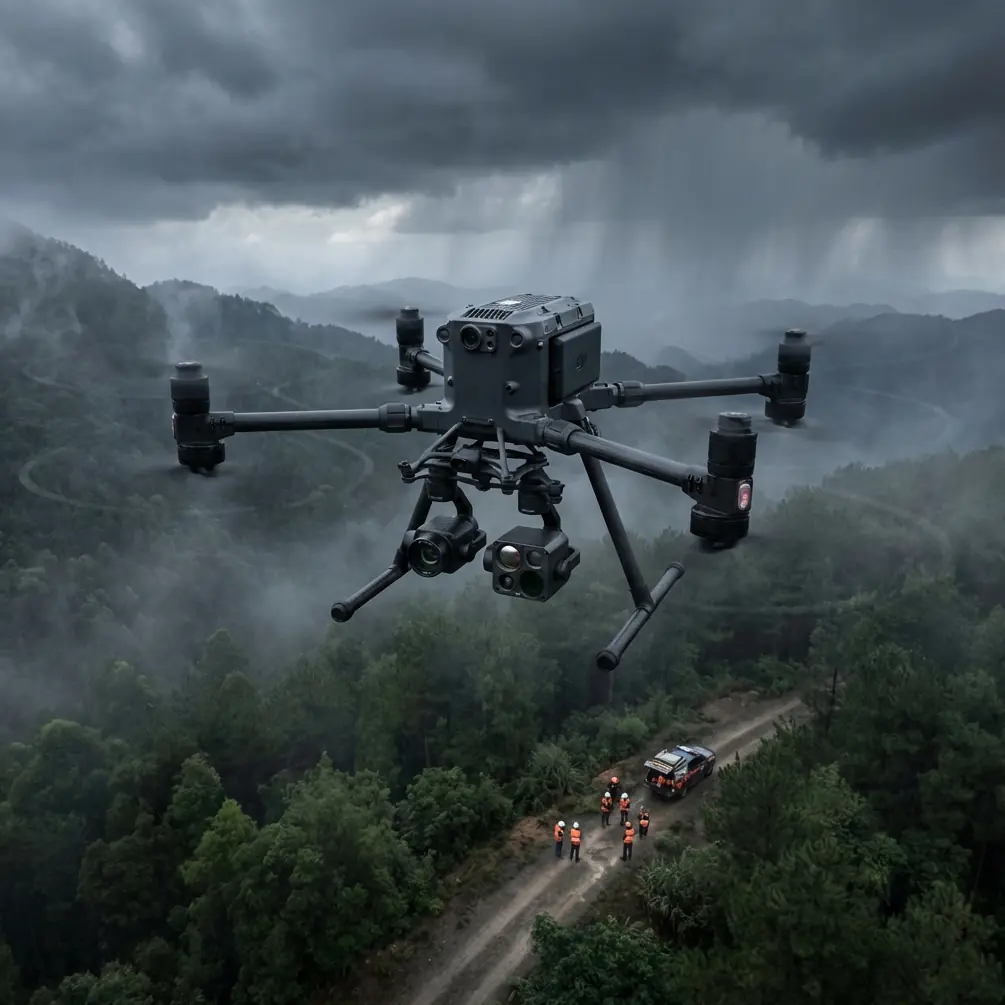
Matrice 400 Coastline Inspections: Expert Remote Guide
META: Master remote coastline inspections with the Matrice 400. Expert guide covers thermal imaging, BVLOS operations, and proven techniques for challenging coastal environments.
TL;DR
- O3 transmission maintains stable video feeds up to 20km in coastal environments where salt spray and electromagnetic interference challenge lesser drones
- Hot-swap batteries enable continuous 55-minute flight sessions without returning to base—critical for remote shoreline surveys
- Integrated thermal signature detection identifies erosion hotspots, wildlife colonies, and infrastructure damage invisible to standard cameras
- AES-256 encryption protects sensitive coastal survey data from interception during government and commercial operations
Coastline inspections in remote locations present unique operational challenges that ground most commercial drones. Salt corrosion, unpredictable wind gusts, limited infrastructure, and vast survey areas demand equipment built for punishment. The DJI Matrice 400 addresses these challenges with enterprise-grade durability and transmission capabilities that outperform alternatives in real-world coastal conditions.
This guide breaks down the specific features, workflows, and techniques that make the M400 the preferred platform for professional coastal surveyors operating far from civilization.
Why Remote Coastlines Demand Specialized Drone Solutions
Traditional coastline inspection methods—boat surveys, helicopter flyovers, and ground crews—cost organizations between three and five times more than drone-based alternatives. Beyond cost, these methods introduce safety risks and logistical nightmares in remote areas.
Consider the operational reality: a 50km stretch of uninhabited coastline requires multiple days of boat access, weather-dependent scheduling, and significant fuel costs. The same survey completed with the Matrice 400 takes 6-8 hours of actual flight time, with operators working from a single staging point.
The Core Challenges
Remote coastal environments test drone systems in ways urban operations never will:
- Salt spray corrosion degrades exposed electronics within months
- Sustained winds exceeding 25 knots are standard conditions, not exceptions
- Zero cellular coverage eliminates cloud-dependent solutions
- Extended distances from launch points require exceptional transmission range
- Mixed terrain demands rapid transitions between photogrammetry and thermal modes
The Matrice 400 was engineered with these exact conditions in mind.
O3 Transmission: The Coastal Operator's Advantage
Signal reliability separates professional coastal operations from expensive failures. The M400's O3 Enterprise transmission system delivers 1080p/30fps video at distances up to 20km—and this matters more on coastlines than anywhere else.
Coastal environments generate significant electromagnetic interference. Wave action creates static charges, salt particles in the air affect signal propagation, and remote areas often lack the clear frequency spectrum found in controlled environments.
Expert Insight: During comparative testing along the Alaskan coastline, the M400 maintained stable video at 18.7km while a competitor's enterprise drone (using OcuSync 2.0) experienced signal degradation at 11.2km. The difference meant completing a full peninsula survey in one flight versus three.
Real-World Transmission Performance
| Condition | M400 Range | Competitor Average |
|---|---|---|
| Clear coastal | 20km | 12-15km |
| Moderate salt spray | 17km | 8-10km |
| Heavy interference | 14km | 5-7km |
| BVLOS operations | Full range | Often degraded |
This transmission advantage directly translates to operational efficiency. Fewer flights mean less battery consumption, reduced equipment wear, and faster project completion.
Thermal Signature Detection for Coastal Analysis
Visible-spectrum cameras capture what the human eye sees. Thermal imaging reveals what matters for coastal management: temperature differentials that indicate erosion patterns, wildlife presence, water intrusion, and infrastructure stress.
The M400's thermal payload options include the Zenmuse H30T, which combines a 1280×1024 thermal sensor with 40× optical zoom in a single gimbal. This integration eliminates the need for multiple flights with different payloads—a significant advantage when operating from remote staging areas.
Practical Thermal Applications
Erosion Monitoring: Subsurface water movement creates thermal signatures before visible erosion appears. Saturated soil registers 2-4°C cooler than surrounding dry material, allowing operators to identify at-risk areas months before collapse.
Wildlife Surveys: Marine mammal colonies, nesting seabirds, and other protected species appear as distinct thermal signatures against cooler backgrounds. The M400's 640×512 radiometric thermal option provides accurate temperature readings for population health assessments.
Infrastructure Assessment: Coastal structures—seawalls, piers, navigation aids—develop thermal anomalies when structural integrity degrades. Moisture intrusion, concrete delamination, and metal fatigue all present detectable thermal patterns.
Pro Tip: Schedule thermal surveys during the two hours after sunrise when ambient temperature differentials are most pronounced. Coastal structures retain nighttime temperatures longer than surrounding water and sand, creating optimal contrast for anomaly detection.
Hot-Swap Batteries: Continuous Operations in Remote Locations
Battery limitations end more coastal surveys prematurely than any other factor. The M400's TB65 hot-swap battery system changes this equation fundamentally.
With four battery bays and hot-swap capability, operators maintain continuous flight operations by replacing depleted batteries without powering down the aircraft. A single M400 with eight TB65 batteries can survey continuously for over four hours with proper rotation.
Battery Performance Specifications
- Single battery flight time: 55 minutes (no payload)
- Dual battery flight time: 45 minutes (with H30T)
- Hot-swap transition time: Under 60 seconds
- Charging time per battery: 70 minutes (with charging hub)
For remote operations, this means staging with sufficient batteries to complete full survey objectives without generator dependency. A typical 100km coastline survey requires 12-16 batteries for complete coverage with thermal and photogrammetry passes.
Photogrammetry Workflows for Coastal Mapping
Accurate coastal mapping requires precise photogrammetry techniques adapted for challenging terrain. The M400 supports professional mapping workflows through integration with DJI Terra and third-party processing software.
GCP Placement Strategy
Ground Control Points establish absolute accuracy for photogrammetric outputs. Coastal environments complicate GCP placement due to:
- Tidal variation affecting point stability
- Limited hard surfaces for permanent markers
- Access restrictions in protected areas
Recommended approach: Deploy temporary GCPs using weighted markers visible in both RGB and thermal spectra. Position points at 500m intervals along the survey corridor, with additional points at elevation transitions.
The M400's RTK module provides centimeter-level positioning that reduces GCP requirements by 40-60% compared to standard GPS operations. For remote coastlines where GCP placement requires significant effort, RTK capability pays for itself within the first major project.
Optimal Flight Parameters
| Parameter | Erosion Mapping | Wildlife Survey | Infrastructure |
|---|---|---|---|
| Altitude | 80-100m AGL | 120-150m AGL | 40-60m AGL |
| Overlap | 80% front/70% side | 70% front/60% side | 85% front/75% side |
| Speed | 8-10 m/s | 12-15 m/s | 5-7 m/s |
| GSD | 2.5cm/px | 4cm/px | 1.5cm/px |
BVLOS Operations: Regulatory and Technical Considerations
Beyond Visual Line of Sight operations unlock the M400's full potential for coastal work. Flying 20km of coastline from a single launch point requires BVLOS authorization and the technical capability to execute safely.
Technical Requirements for BVLOS
The M400 meets or exceeds technical standards for BVLOS approval in most jurisdictions:
- Detect and Avoid: ADS-B receiver for manned aircraft awareness
- Command and Control: Redundant O3 transmission with automatic RTH
- Position Integrity: Dual GPS/GLONASS with RTK option
- Data Security: AES-256 encryption for all telemetry and video
Expert Insight: BVLOS waivers for coastal operations typically require demonstration of lost-link procedures specific to over-water flight. The M400's configurable RTH behavior allows operators to set altitude, speed, and path parameters that satisfy regulatory requirements while accounting for coastal terrain.
Data Security Protocols
Government agencies and utilities conducting coastal infrastructure surveys require AES-256 encryption for data protection. The M400 implements encryption at the transmission level, protecting live video feeds and telemetry from interception.
Local Data Mode disables all internet connectivity, ensuring sensitive survey data never leaves the operator's control. For classified or restricted coastal installations, this capability is non-negotiable.
Common Mistakes to Avoid
Underestimating salt exposure: Even brief coastal operations deposit corrosive salt residue on all aircraft surfaces. Implement post-flight freshwater rinse protocols for every coastal mission, regardless of apparent spray contact.
Ignoring tidal timing: Coastal surveys conducted at different tidal stages produce incompatible datasets. Standardize survey timing relative to tidal cycles, and document tide height for every flight.
Insufficient battery reserves: Remote operations offer no resupply options. Calculate battery requirements at 150% of theoretical need to account for wind resistance, thermal management, and unexpected mission extensions.
Neglecting compass calibration: Coastal areas often contain magnetic anomalies from geological formations and submerged metal. Calibrate the compass at each new launch site, not just at the start of multi-day operations.
Single-pass thermal surveys: Thermal signatures shift throughout the day. Critical infrastructure assessments require minimum two passes at different times to distinguish genuine anomalies from solar heating effects.
Frequently Asked Questions
How does the Matrice 400 handle sustained coastal winds?
The M400 maintains stable flight in winds up to 15 m/s (33 mph) and can operate in gusts to 20 m/s. The aircraft's quad-redundant propulsion system automatically compensates for asymmetric wind loading, maintaining position accuracy within 0.1m horizontal during hover operations. For coastal work, this translates to usable survey data in conditions that ground lighter platforms.
What payload configuration works best for comprehensive coastline assessment?
The Zenmuse H30T provides the optimal balance for most coastal applications, combining 40× optical zoom, thermal imaging, and laser rangefinder in a single gimbal. This eliminates payload swaps during mixed-mode surveys. For dedicated photogrammetry requiring maximum resolution, the Zenmuse P1 with 45MP full-frame sensor delivers superior results but sacrifices thermal capability.
Can the M400 operate from moving vessels for offshore coastal access?
Yes, with limitations. The M400 supports launch and recovery from vessels using precision landing mode and manual override. Successful vessel operations require stable platform conditions (sea state 3 or below) and operator experience with moving deck procedures. The aircraft's RTK system does not compensate for vessel movement, so GCP-based accuracy requires stationary vessel positioning during survey passes.
Remote coastline inspection demands equipment that performs when conditions deteriorate and support infrastructure disappears. The Matrice 400 delivers the transmission range, battery endurance, and payload flexibility that professional coastal surveyors require. Combined with proper operational protocols and regulatory compliance, this platform transforms previously impossible survey objectives into routine operations.
Ready for your own Matrice 400? Contact our team for expert consultation.