
Matrice 400 Coastline Inspection in Urban Areas
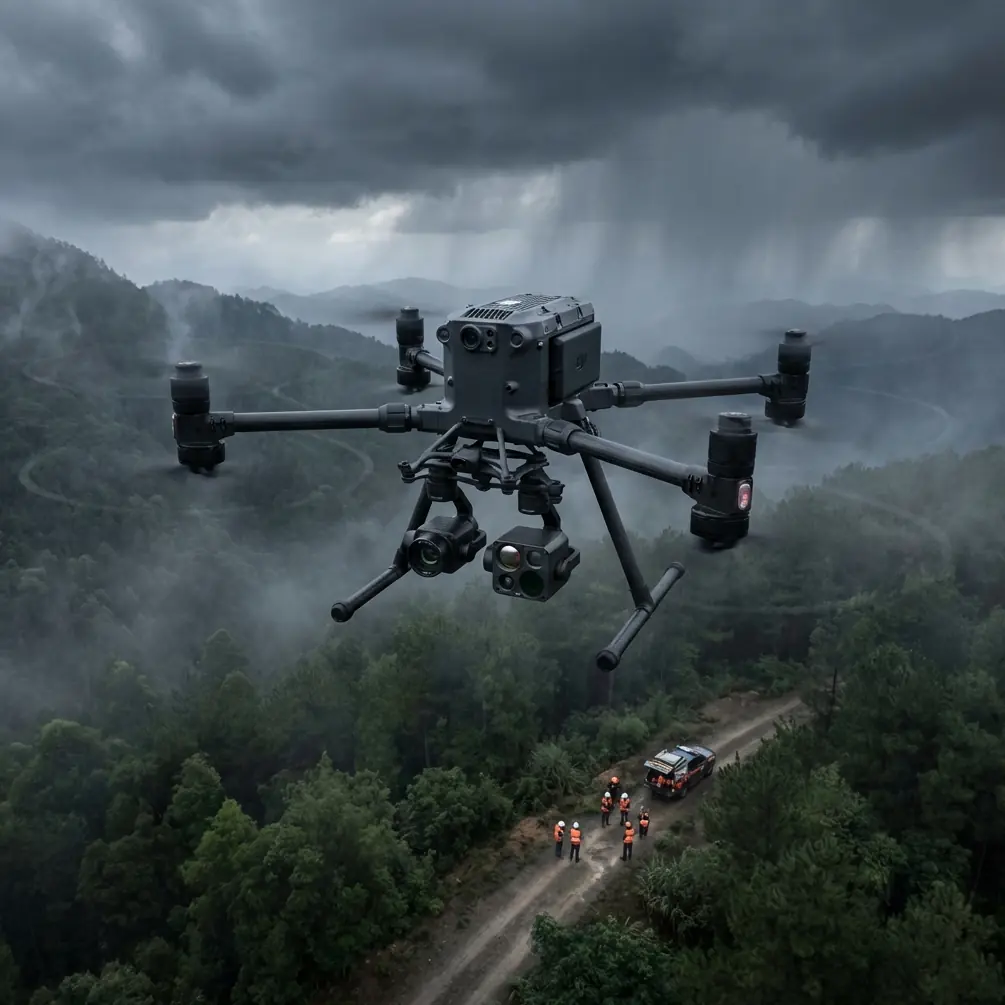
Matrice 400 Coastline Inspection in Urban Areas: What a Drone Food Delivery Rollout in Abu Dhabi Teaches Us
META: A case-study style expert article on using the Matrice 400 for urban coastline inspection, drawing operational lessons from a Middle East drone delivery deployment built for high heat, humidity, controlled handoff, and city logistics.
Urban coastline inspection looks simple from a distance. Waterline. Seawall. Marina edge. Rooflines facing salt spray. A few piers, a few drainage outlets, maybe a promenade packed with people. In reality, it is one of the more demanding environments you can hand to a serious enterprise drone crew.
Salt hangs in the air. Humidity creeps into everything. Wind shifts off buildings and across open water. GNSS can behave oddly near high-rise clusters. The mission rarely ends at image capture either. The real job is repeatable evidence: thermal signature review, photogrammetry outputs, defect tracking, and secure data handling when the site sits inside a dense urban footprint.
That is why an unexpected reference point matters here: a recent Middle East drone food delivery deployment announced at the Dubai Airshow on November 17. On the surface, meal delivery and coastline inspection are different missions. Operationally, they share several constraints that are highly relevant to a Matrice 400 workflow.
The delivery project was rolled out through a partnership involving United Aircraft, Abu Dhabi delivery platform Talabat, and K2 AeroSpace. Users place orders in the Talabat app, the drone departs from a restaurant or Talabat kitchen, and the package is sent to a fixed drop-off station. The customer retrieves it by scanning a QR code or entering a password. Just as notable, the Q20 drone and its packaging were designed specifically for the UAE’s high-temperature, high-humidity conditions.
That last point deserves more attention than it usually gets.
Why this delivery project matters to a Matrice 400 inspection team
If you inspect coastlines in an urban Middle Eastern environment, you are dealing with the same broad stressors that shaped that delivery system: heat, humidity, controlled transfer points, and predictable operation inside a city framework.
A Matrice 400 crew is not dropping off meals, but it is managing something just as sensitive: inspection data that may inform maintenance priorities, public-safety repairs, insurance documentation, corrosion analysis, or shoreline asset planning. The lesson from the Abu Dhabi-style delivery concept is not about payload type. It is about system discipline.
Two details from that rollout stand out.
First, the aircraft and packaging were adapted for high heat and humidity. That matters because urban coastline inspections expose the drone, payload, and support kit to exactly those environmental loads. Salt-laden moisture can cloud sensors, contaminate connectors, and reduce confidence in thermal readings if basic field handling slips. A Matrice 400 operator who treats a humid coastal morning like a normal inland inspection day is creating avoidable risk.
Second, the project used fixed drop-off stations with QR code or password retrieval. Operationally, that is a chain-of-custody model. For an inspection team, the equivalent is not package retrieval but data and equipment control: clearly defined launch zones, controlled media handling, protected handoff of deliverables, and documented site procedures in crowded urban areas where public proximity is part of the mission environment.
Those are not abstract ideas. They directly affect how I would run a Matrice 400 coastline inspection program.
The case: inspecting an urban coastline with the Matrice 400
Picture a mixed-use waterfront district. Seawall sections run behind cafes and retail units. A marina extends into a channel lined with residential towers. Concrete shows surface staining. A few metal elements at the edge suggest corrosion. Drainage outfalls need visual confirmation after a storm cycle. The client wants a single mission package: RGB imagery, thermal signature checks on suspect assets, and a photogrammetry dataset tied to GCPs for measurable change detection.
The Matrice 400 is a logical fit because this is not a hobby mapping exercise. This is a mission that rewards endurance, stable transmission, payload flexibility, and field efficiency. Urban coastlines punish weak procedures.
Before flight, I start with a step crews too often rush: cleaning and verifying the safety-critical surfaces and interfaces. In a salt-air setting, that means checking obstacle sensing windows, camera glass, landing gear contact points, vent areas, and battery connection surfaces for residue, moisture film, and fine particulate contamination. A clean sensor stack is not cosmetic. It protects obstacle avoidance performance, preserves image quality, and reduces false confidence when the aircraft is threading around masts, light poles, and waterfront structures.
This pre-flight cleaning step becomes even more meaningful in a climate like the UAE, where the delivery project’s drone and packaging had to be designed for high temperature and humidity. If a logistics platform had to engineer around that environment just to move food reliably, an inspection crew should assume the same environment can quietly degrade mission quality unless every launch begins with disciplined preparation.
Heat and humidity change the inspection playbook
Many people think of heat as a battery issue and stop there. That is incomplete.
Yes, heat affects battery behavior, and hot-swap batteries are a practical advantage when you need to keep the Matrice 400 rotating through sectors without long downtime. On a coastline job, that can mean staging replacement packs in a shaded, monitored area, swapping quickly, and maintaining flight continuity while preserving safer battery temperatures.
But humidity is just as disruptive. It influences lens clarity, electronics exposure, and field handling. It can complicate thermal interpretation too. If your brief includes thermal signature review of façade edges, electrical housings near the waterfront, or drainage infrastructure, environmental conditions must be recorded and respected. A hot, humid shoreline is not a laboratory. Thermal anomalies need context.
This is one reason the Abu Dhabi delivery reference is useful. The fact that the Q20 airframe and the packaging were adapted for local high-heat, high-humidity conditions tells us something basic but operationally powerful: environmental adaptation is not optional in the Gulf and similar coastal climates. It is a design principle. A Matrice 400 inspection team should mirror that thinking in mission planning, battery rotation, lens management, payload checks, and post-flight cleaning.
Fixed stations, controlled zones, and why urban coastlines need choreography
In the delivery model, the drone does not simply arrive anywhere. It flies to a fixed drop-off station, and retrieval is controlled through a QR code or password. That is a smart city operations pattern. Defined endpoint. Defined access. Less ambiguity.
Urban coastline inspection benefits from the same philosophy.
I prefer to establish fixed operating nodes along the inspection corridor: launch zone, observation point, battery service point, and if needed, a secondary recovery area. If the mission spans promenade sections or marina infrastructure, the crew should know exactly where handoffs happen, where pedestrians are excluded, and where asset data is logged. In tight city environments, that structure matters more than raw flying skill.
It also helps with BVLOS planning where regulations and approvals permit it. A long waterfront often tempts crews into stretching visual comfort zones. A better approach is segmented coverage supported by pre-defined operating points, robust observer positioning, and stable transmission architecture. O3 transmission reliability is especially useful when water reflections, urban clutter, and line-of-sight interruptions can combine in awkward ways. The objective is not just signal range. It is stable command and clean situational awareness.
Data security is not separate from flight safety
The food delivery workflow used QR code or password-based retrieval for the end user. In an inspection context, that same logic translates into access control and data protection.
Urban coastline surveys often touch sensitive commercial assets, residential edges, utility features, or critical maintenance records. If your Matrice 400 operation captures detailed imagery and thermal datasets across a dense waterfront, the security of that data is part of professional practice. AES-256 level protections, secure media handling, locked mission devices, and controlled upload procedures are not IT add-ons. They are operational safeguards.
The handoff model matters too. Who takes possession of the imagery? When are files copied? How are flight logs stored? Which version is considered the master set? A disciplined team can explain all of that before first takeoff.
That level of structure is what separates repeatable inspection work from “we got some good shots.”
Photogrammetry over water-facing assets: the details that save a mission
Coastline mapping near urban edges is unforgiving. Water surfaces reduce useful tie points. Repetitive sea-wall textures can confuse processing. Reflections from glass towers and changing sun angles can affect consistency. If the final product includes measurable outputs, GCP strategy becomes critical.
I would not rely on visual overlap alone if the client expects accurate change detection. Ground control points, placed where they can be safely and legally maintained, anchor the dataset. On a promenade or structured waterfront, that may involve coordinated marker placement away from pedestrian traffic and close enough to the target features to support reliable reconstruction.
The Matrice 400’s value in this scenario is not just in flying the route. It is in carrying the mission with enough stability and endurance to capture complete, consistent data blocks without introducing unnecessary resets. Longer uninterrupted collection windows usually mean cleaner processing and fewer stitching headaches later.
When thermal work is added, the planning gets tighter. Thermal signature review should not be treated like an afterthought attached to an RGB mission. It needs target prioritization, environmental notes, and repeatable capture geometry. A corroding metal element at a marine edge may not reveal itself thermally in the same way at midday as it would in a more favorable window. Context drives interpretation.
One overlooked issue: salt contamination after landing
Teams talk plenty about pre-flight checks. Fewer are equally disciplined after landing.
On coastal jobs, the Matrice 400 should not be packed away the moment the props stop. Post-flight wipe-down and inspection are part of airworthiness culture. Salt residue is patient. It does not need dramatic exposure to cause problems over time. Even when the aircraft never flies through visible spray, the atmosphere alone can leave deposits.
My field routine is simple: once safe and powered down, inspect exterior surfaces, payload glass, and critical interfaces for moisture haze or salt film; clean according to approved maintenance practices; verify battery contacts and compartment condition; then log any anomalies before the next sortie. If a team skips this because the aircraft “looks fine,” they are borrowing trouble.
Again, the delivery example reinforces the point. If a commercial drone logistics program had to account for environmental stability in both aircraft and packaging just to preserve meal quality, inspection crews should be even more serious about preserving sensor integrity and aircraft reliability.
What this means for Matrice 400 buyers and operators
If you are evaluating the Matrice 400 for urban coastline inspection, do not frame the decision around aircraft specs alone. Frame it around mission resilience.
Can your workflow maintain image consistency in humid, reflective, salt-heavy conditions?
Can your team manage hot-swap batteries without disorder at a crowded waterfront site?
Can you maintain O3 transmission confidence across mixed open-water and urban geometry?
Can you protect client datasets with strong access controls, including AES-256-grade security practices where required?
Can your photogrammetry plan handle GCP placement and water-adjacent reconstruction challenges?
Can your thermal signature findings be defended with proper environmental context?
Those questions matter more than headline features.
And there is a useful broader takeaway from the Abu Dhabi drone delivery rollout. Civil UAV operations mature when they become boring in the best possible sense: repeatable, controlled, climate-aware, secure, and easy to audit. The delivery chain there was built around fixed endpoints, authenticated retrieval, and equipment adapted for harsh local weather. That same discipline is exactly what urban coastline inspection demands.
If you are shaping a Matrice 400 workflow for coastal assets and want to compare deployment ideas with someone who understands these environmental constraints, you can message James Mitchell directly on WhatsApp.
The aircraft can do the work. The harder question is whether the operation around it is designed to hold up when the air is wet, the concrete is hot, the public is nearby, and the client expects data they can trust six months from now.
That is where serious operators separate themselves.
Ready for your own Matrice 400? Contact our team for expert consultation.