
Matrice 400 Field Report: Low-Light Construction Inspection
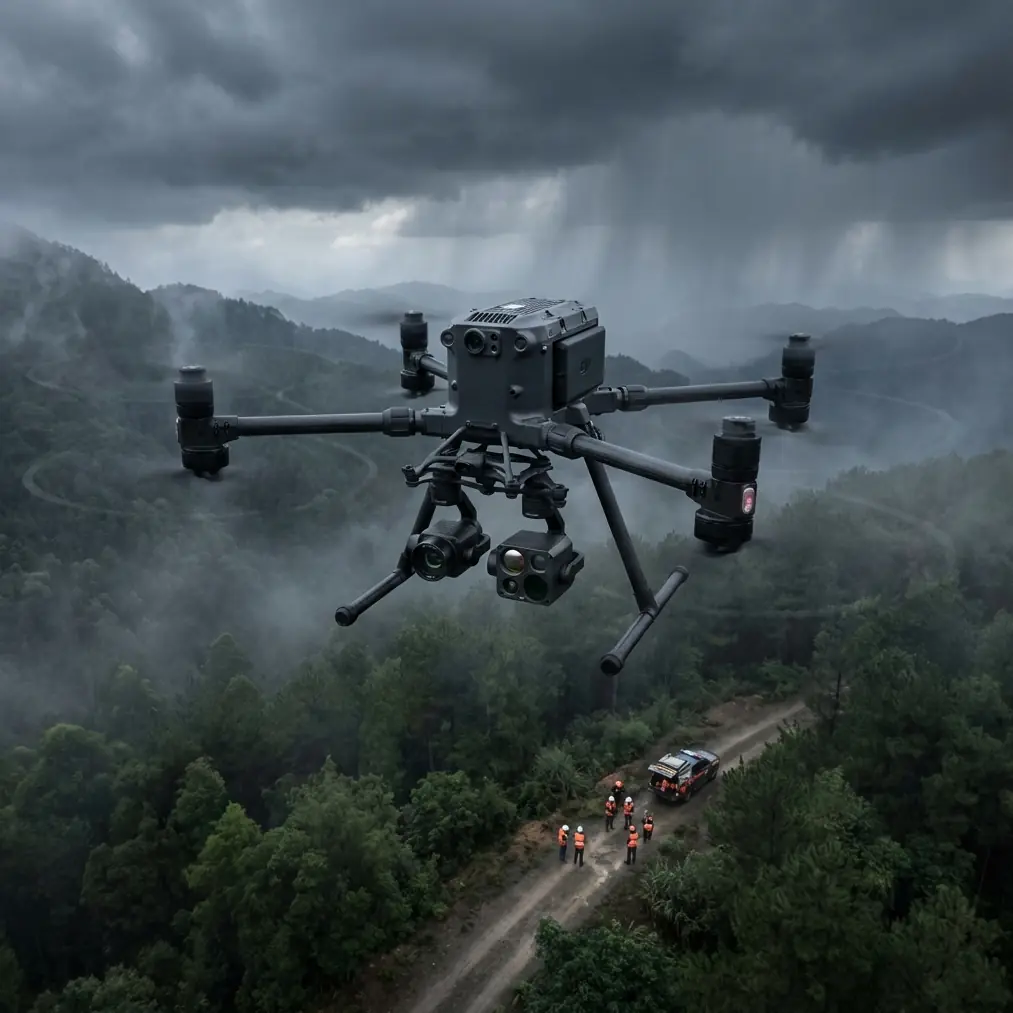
Matrice 400 Field Report: Low-Light Construction Inspection Through a Structural Engineer’s Lens
META: Expert field report on using Matrice 400 for low-light construction inspection, with practical insight on thermal signature interpretation, O3 transmission reliability, damage tolerance thinking, and mission planning.
I spent last week reviewing a dusk inspection workflow for a construction site team preparing to deploy the Matrice 400 on a mixed concrete-and-steel project with limited lighting, active earthworks, and a lot of unfinished geometry. The aircraft itself is only part of the story. What determines whether the mission produces usable engineering data is the chain between sensor behavior, structural thinking, pilot discipline, and what happens when the site stops behaving like a clean CAD model.
That last part matters more in low light.
Construction inspections at dusk or before sunrise are attractive for two reasons. First, thermal contrast often becomes easier to read when surfaces are no longer saturated by daytime heat. Second, site activity may be lower, which gives cleaner flight paths and fewer moving vehicles in the capture area. But poor light also amplifies every weakness in planning. Reflective cladding hides edges. Rebar shadows confuse visual interpretation. Crane booms and temporary facades create cluttered backgrounds. A drone can still fly well in those conditions and still return bad information.
The Matrice 400 is interesting in this setting not because it is simply “advanced,” but because it supports a style of inspection where redundancy in sensing and redundancy in decision-making become practical rather than theoretical. If you are inspecting active construction in low light, you are rarely relying on a single image stream. You are comparing visible imagery against thermal signature, checking transmission stability, and deciding whether the area needs a photogrammetry pass later under better light with tighter GCP control.
That is how serious site teams reduce rework.
Why low-light construction work demands engineering logic, not just flight skill
A lot of drone articles treat inspection as image collection. On a construction site, especially at nightfall, inspection is closer to structural triage.
One of the most useful reference points comes from classic aircraft damage-tolerance methods. In the source material, one scenario assumes a leading crack of 25 mm can rapidly connect with a nearby hole and suddenly become a 127 mm crack. That is an aviation fracture case, not a drone operating manual, but the underlying lesson carries over directly: small discontinuities do not stay small when geometry, load path, and local stress concentrate in the same place.
For a Matrice 400 operator inspecting a jobsite, that changes how you look at thermal and visual anomalies. A faint linear thermal irregularity along a bolted connection on temporary steel, or a repeating pattern of slight separation in facade anchors, should not be dismissed because it looks minor on one frame. Under low light, your workflow has to assume local defects may be part of a broader pattern. The aircraft is there to help you detect continuity, not just capture isolated images.
The second reference detail I keep coming back to is the assumption of damage zones as large as 305 mm, 610 mm, and 152 mm in fuselage analysis, depending on failure source. Again, those numbers belong to manned-aircraft structural assessment. Their operational significance for site inspection is not that buildings behave like aircraft. It is that professionals in safety-critical industries do not evaluate damage as a pinprick when system-level consequences are possible. On a construction site, that translates into wider scan envelopes around visible defects, impact areas, or heat anomalies. If a column edge shows suspicious thermal bleed, don’t inspect only the exact hot spot. Expand the mission box. Track adjacent panels, weld lines, anchor groups, and neighboring spans.
The Matrice 400 becomes valuable when you use it this way: as a platform for disciplined evidence gathering.
The sensor moment that changed the flight plan
On the second evening simulation, we built a route around perimeter retaining walls, partially enclosed utility corridors, and a tower crane staging zone. Light levels were dropping fast, and the visible feed was beginning to flatten fine surface detail on dark waterproofing membranes.
Then the thermal view picked up movement near the drainage swale along the northern haul road.
At first it looked like a warm patch drifting across compacted soil. A quick cross-check showed it was a civet moving between stacked pipe sections and brush at the edge of the site. This is exactly the kind of real-world interruption glossy spec sheets ignore. The right response was not to push through because the drone had enough obstacle intelligence. The right response was to slow, widen lateral separation, avoid chasing the subject with the camera, and recalculate the line over the swale. The Matrice 400’s sensor stack helped the crew identify the animal early enough to avoid a low pass over the area, which protected both the wildlife and the integrity of the inspection.
That single moment also highlighted something practical about thermal signature use in low-light construction. Not every heat source is a defect. Some are wildlife. Some are generators. Some are wet insulation cooling unevenly. Some are curing differences in concrete. The value is in interpretation, not mere detection.
Material thinking still matters, even when you are “just” flying a drone
Another reference thread from the source material concerns structural materials and heat-treatment states: 2024 T42, 7075 T6, 7050/7175 T7351, and similar combinations used for thin curved sheet, machined thick plate, frames, and extrusions. Those are aircraft alloy design choices, but they offer a sharp reminder for construction inspection teams using the Matrice 400: materials behave differently under load, heat, and environmental exposure, and your image interpretation must reflect that.
Why does that matter on site?
Because low-light inspection often leans heavily on thermal imagery, and thermal behavior is not universal across surfaces. A steel connection plate, aluminum facade element, FRP cover, wet concrete edge, and composite rooftop assembly can all produce very different thermal patterns even when exposed to the same conditions. The aircraft gives you data. Material literacy tells you whether that data indicates concern or just different emissivity and cooling behavior.
The aircraft-handbook detail on 2024 T42 being used for doubly curved thin sheet is especially interesting in principle. Thin formed material often reveals stress, deformation, or attachment inconsistency differently than thick machined members. On a building site, the analogous lesson is that thin sheet systems—cladding, flashing, duct casings, enclosure skins—deserve a different inspection eye than heavy structural members. In low light, a thermal irregularity on a thin panel may be tied to fastening, voids, moisture intrusion, or minor deformation long before it appears obvious in RGB imagery.
So if you are flying the Matrice 400 over curtain wall installation or roofing transitions, do not process every anomaly through the same lens. Build material-specific expectations into the mission plan.
O3 transmission and AES-256 are operational tools, not brochure filler
Low-light inspections tend to expose communication weaknesses because pilots often work farther from the asset face than they would in daytime. Safer stand-off distances, visual clutter, and uneven terrain all encourage more remote operation. In that environment, O3 transmission reliability matters because delayed or degraded video is not just annoying; it directly affects defect confirmation and obstacle judgment.
When you are tracing the edge of an unfinished slab or checking temporary bracing under poor light, you need confidence that what you are seeing is current enough to support decisions. If the feed becomes unstable, inspection quality degrades before safety margins visibly collapse.
The same goes for AES-256. Construction teams working on critical infrastructure, industrial upgrades, data centers, utilities, or high-profile commercial sites are increasingly aware that imagery itself is sensitive. Thermal views can reveal active equipment locations, temporary power layouts, occupancy patterns, and construction sequencing. Strong encryption is not abstract IT language. It is part of responsible site data management.
If your team shares mission plans and inspection outputs across consultants, owners, and contractors, that security layer should be treated as standard operating discipline.
Hot-swap batteries change the pace of real inspection work
Low-light windows are short. Thermal contrast improves, then disappears. Site access opens, then closes. Wind drops for twenty minutes, then comes back around the tower.
That is why hot-swap batteries are more than a convenience on a Matrice 400 program. They compress turnaround time between sorties when conditions are worth exploiting. For an inspection manager, that can mean completing a thermal sweep of retaining structures, then relaunching quickly for a separate oblique photogrammetry set before ambient conditions shift too far.
On active sites, this speed matters even more because you are coordinating with other people’s work: crane lifts, concrete pours, lighting towers, delivery trucks, and access restrictions. A battery workflow that keeps the aircraft available without a full stop lets the drone team operate like part of the project rather than as an interruption to it.
Photogrammetry in low light: use discipline, not optimism
There is a bad habit in some UAV teams of trying to force every mission into a mapping deliverable. Low light is useful for thermal inspection, but it is often a compromise for photogrammetry unless the scene is properly lit and controlled.
If your objective is dimensional accuracy, bring GCP discipline into the plan and be honest about whether the light supports reliable feature matching. The Matrice 400 can absolutely support sophisticated site documentation, but no aircraft can manufacture texture where the environment offers none. Fresh concrete pads, dark membranes, shadowed scaffold decks, and repetitive steel framing can all reduce tie-point quality.
A practical approach is to split deliverables:
- use dusk for thermal and visual anomaly detection,
- use a separate daylight pass for high-accuracy photogrammetry,
- tie both datasets to the same GCP framework so the engineering team can compare condition and geometry without guessing alignment.
That is how you keep the drone useful to both the superintendent and the survey lead.
Thinking ahead to BVLOS, even when the current mission is local
Many larger construction and infrastructure corridors are moving toward workflows that anticipate BVLOS expansion, especially on long linear sites, utility works, haul roads, and distributed industrial campuses. Even if your Matrice 400 missions are currently within standard visual constraints, choosing procedures now that scale well later is smart.
That means:
- standardized preflight checklists,
- repeatable sensor settings,
- documented lost-link behavior,
- disciplined battery logs,
- clear chain-of-custody for imagery,
- and route design that does not depend on one pilot improvising everything in real time.
Low-light operations amplify the need for that structure. If your team cannot run a clean twilight mission close-in, it will not suddenly become rigorous when the operational area expands.
What I would tell a construction team before their first Matrice 400 night-adjacent deployment
Start with the defect hypothesis, not the aircraft.
Ask what you are actually trying to confirm. Moisture intrusion? Facade attachment consistency? Temporary works alignment? Hot electrical terminations? Settlement indicators? Missing insulation? Once the defect logic is clear, build the route around expected evidence and likely false positives.
Then brief for materials. Thermal interpretation over concrete, steel, waterproofing, glass, and aluminum is not interchangeable.
Next, widen your inspection buffer around anything suspicious. The damage-tolerance references cited earlier—like the jump from a 25 mm crack to 127 mm, or assumed damaged sections of 305 mm and 610 mm—are a useful mental model here. Small visible cues can belong to larger affected zones. Inspect context, not just symptoms.
After that, protect your data path. Stable O3 transmission and AES-256 should be treated as mission enablers, especially where image sensitivity matters.
And finally, preserve the low-light window. Hot-swap batteries help only if your payload settings, file handling, and relaunch sequence are already organized.
If your team is building out that workflow and wants a practical checklist tailored to your site conditions, I’d suggest sending the project brief here before the first evening deployment.
The real value of Matrice 400 on construction sites
The best use of the Matrice 400 in low-light construction inspection is not cinematic flying and it is not generic mapping. It is structured observation under conditions where human eyesight alone starts missing things.
Its value shows up when:
- thermal detections are interpreted with material awareness,
- visual anomalies are expanded into wider inspection zones,
- battery changes do not interrupt the capture window,
- transmission quality preserves confidence in what the pilot is seeing,
- and data security is treated as part of the job rather than an afterthought.
That is what separates a drone flight from an inspection program.
Dr. Lisa Wang would put it more bluntly than most marketing copy ever will: the aircraft is useful only when the method is sound. On a dim construction site, with unfinished edges, mixed materials, and a civet crossing the work zone, that method is everything.
Ready for your own Matrice 400? Contact our team for expert consultation.