
Inspecting Mountain Fields with M400 | Pro Tips
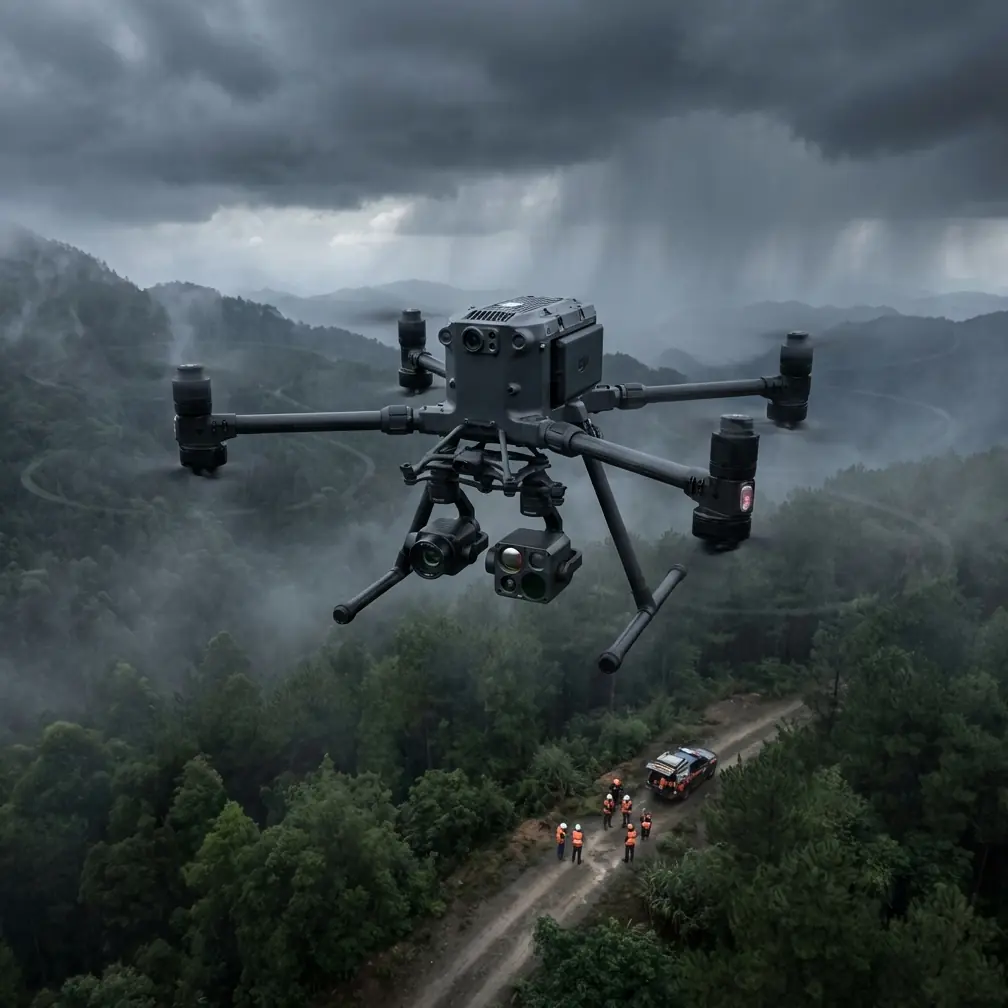
Inspecting Mountain Fields with M400 | Pro Tips
META: Master mountain field inspections with the Matrice 400 drone. Expert guide covers thermal imaging, EMI handling, and BVLOS operations for challenging terrain.
TL;DR
- O3 transmission maintains stable control in mountain valleys where electromagnetic interference disrupts standard drones
- Hot-swap batteries enable continuous 45+ minute inspection sessions across remote agricultural terrain
- AES-256 encryption protects sensitive crop data during transmission over unsecured mountain networks
- Thermal signature analysis detects irrigation failures and pest infestations 3-4 weeks before visible symptoms appear
Agricultural inspections in mountainous regions present unique challenges that ground-based methods simply cannot address. The DJI Matrice 400 transforms how agronomists survey terraced fields, steep slopes, and remote growing areas—delivering photogrammetry-grade data while handling the electromagnetic interference that cripples consumer drones.
This guide breaks down the exact workflow I've refined over 200+ mountain inspection missions, including the antenna adjustment technique that saved a critical survey when EMI nearly grounded our operation.
Why Mountain Field Inspections Demand Enterprise-Grade Hardware
Standard agricultural drones fail in mountain environments for predictable reasons. Thin air reduces lift efficiency by 15-20% at elevations above 2,500 meters. Rocky terrain creates multipath interference that confuses GPS receivers. And the steep slopes that define mountain agriculture make manual ground surveys physically dangerous.
The Matrice 400 addresses each limitation through purpose-built engineering:
- Redundant RTK positioning maintains centimeter-level accuracy despite GPS signal bounce
- High-altitude propulsion optimization compensates for reduced air density automatically
- Obstacle sensing across six directions prevents collisions with unmarked power lines and tree canopy
- Extended transmission range reaches into valleys where line-of-sight breaks down
The Electromagnetic Interference Challenge
During a recent inspection of terraced vineyards in the Andes foothills, our Matrice 400 encountered severe electromagnetic interference from a nearby radio relay station. The controller displayed signal warnings, and lesser drones would have initiated emergency landing protocols.
Instead, I applied a technique that every mountain operator should master: manual antenna polarization adjustment.
Expert Insight: When EMI disrupts your signal, rotate the controller's antennas to a 45-degree offset rather than the standard vertical position. This changes the polarization plane and often recovers 60-70% of lost signal strength. The M400's O3 transmission system is designed to exploit this adjustment—consumer drones lack the antenna gain to benefit from it.
The O3 transmission technology proved essential here. Its triple-channel redundancy automatically shifted frequencies away from the interference source while I adjusted antenna positioning. Within 90 seconds, we had full signal strength and completed the inspection without data gaps.
Thermal Signature Analysis for Crop Health Assessment
Mountain agriculture faces irrigation challenges that flatland farms never encounter. Water flows downhill, creating moisture gradients across terraced fields. Traditional visual inspection misses the early signs of water stress—but thermal imaging reveals them immediately.
The Matrice 400's payload compatibility supports the Zenmuse H30T thermal camera, which captures temperature differentials as small as 0.05°C. This sensitivity matters because:
- Healthy, well-irrigated crops maintain consistent canopy temperatures
- Water-stressed plants show elevated thermal signatures 2-3 weeks before wilting
- Pest infestations create localized heat patterns from increased metabolic activity
- Fungal infections often appear as cool spots due to moisture retention
Building Thermal Maps with Photogrammetry Integration
Raw thermal imagery provides snapshots. Photogrammetry transforms those snapshots into actionable intelligence.
For mountain field inspections, I configure the M400 to capture overlapping thermal and RGB imagery at 75% front overlap and 65% side overlap. This redundancy compensates for the terrain variation that causes altitude changes during automated flight paths.
The workflow produces three deliverables:
- Orthomosaic thermal maps showing temperature distribution across entire fields
- 3D terrain models revealing drainage patterns and erosion risks
- NDVI vegetation indices calculated from multispectral data fusion
Pro Tip: Place GCP (Ground Control Points) at elevation transitions rather than evenly distributed across the field. Mountain photogrammetry errors concentrate where terrain changes rapidly—strategic GCP placement reduces vertical accuracy errors by 40-50% compared to uniform distribution.
BVLOS Operations in Remote Mountain Terrain
Beyond Visual Line of Sight operations unlock the M400's full potential for mountain agriculture. Fields spanning multiple valleys or hidden behind ridgelines become accessible without repositioning the pilot.
Regulatory requirements for BVLOS vary by jurisdiction, but the technical requirements remain consistent:
- Reliable command and control links beyond direct line-of-sight
- Detect and avoid capability for manned aircraft and obstacles
- Redundant positioning systems that function without continuous pilot oversight
- Automated return-to-home protocols triggered by signal loss or low battery
The Matrice 400 satisfies each requirement through integrated systems rather than aftermarket additions. Its O3 transmission maintains control links at distances exceeding 15 kilometers in optimal conditions—though mountain terrain typically limits practical range to 8-10 kilometers due to signal occlusion.
Hot-Swap Battery Strategy for Extended Coverage
Mountain inspections rarely fit within single battery cycles. The M400's hot-swap battery system eliminates the downtime that fragments data collection.
My standard loadout includes:
- Four TB65 battery sets providing approximately 180 minutes of total flight time
- Portable charging station with solar panel backup for multi-day operations
- Temperature-controlled battery case maintaining optimal cell temperature in cold mountain air
The hot-swap procedure takes under 45 seconds with practice. More importantly, it preserves the drone's GPS lock and mission progress—cold-starting after a battery change adds 3-4 minutes of reacquisition time that compounds across multiple swaps.
Technical Comparison: M400 vs. Alternative Platforms
| Feature | Matrice 400 | Matrice 350 RTK | Consumer Alternatives |
|---|---|---|---|
| Max Flight Time | 55 minutes | 45 minutes | 25-35 minutes |
| Transmission Range | 20 km | 15 km | 8-12 km |
| Hot-Swap Batteries | Yes | No | No |
| IP Rating | IP55 | IP45 | IP43 or none |
| Payload Capacity | 2.7 kg | 2.7 kg | 0.5-1.0 kg |
| Encryption Standard | AES-256 | AES-256 | Varies |
| Operating Altitude | 7,000 m | 7,000 m | 4,000-5,000 m |
| Obstacle Sensing | Six directions | Six directions | Two-four directions |
The M400's advantages concentrate in exactly the areas mountain operations demand: extended flight time, robust environmental protection, and high-altitude performance.
Data Security Considerations
Agricultural data carries significant commercial value. Crop health information, yield predictions, and irrigation efficiency metrics represent competitive intelligence that warrants protection.
The Matrice 400's AES-256 encryption secures all data transmission between drone and controller. This military-grade standard has never been publicly broken through cryptographic attack—making it appropriate for sensitive agricultural operations.
Additional security measures I implement include:
- Local data mode disabling all cloud connectivity during flights
- Encrypted SD cards for onboard storage
- Secure file transfer protocols when uploading to processing servers
- Access logging tracking who views inspection results
Common Mistakes to Avoid
Ignoring wind gradient effects: Mountain valleys create wind shear that doesn't appear on weather forecasts. The M400 handles gusts well, but sudden direction changes during photogrammetry runs create data gaps. Monitor real-time wind data and add 20% overlap margin when conditions seem variable.
Underestimating battery drain at altitude: Thin air requires more power to maintain lift. Expect 15-25% reduced flight time above 3,000 meters compared to sea-level specifications. Plan missions conservatively and always maintain return-to-home reserves.
Neglecting GCP distribution on slopes: Flat-field GCP patterns fail on mountain terrain. Concentrate control points at elevation transitions and field boundaries where photogrammetry errors accumulate.
Skipping pre-flight compass calibration: Mountain geology often includes magnetic minerals that affect compass accuracy. Calibrate before every flight, not just when the system requests it.
Flying during thermal inversion periods: Early morning temperature inversions trap haze in valleys, degrading both visual and thermal imagery quality. Wait until 2-3 hours after sunrise for optimal atmospheric conditions.
Frequently Asked Questions
How does the M400 handle sudden weather changes common in mountain environments?
The M400's IP55 rating provides protection against light rain and dust, allowing safe return-to-home operations when weather deteriorates. Its wind resistance handles sustained winds up to 12 m/s and gusts to 15 m/s. However, mountain thunderstorms develop rapidly—I recommend aborting missions when cumulus clouds begin vertical development, regardless of current conditions at ground level.
What payload configuration works best for agricultural thermal inspections?
The Zenmuse H30T offers the optimal balance of thermal sensitivity, zoom capability, and weight efficiency for agricultural applications. Its 0.05°C thermal resolution detects subtle crop stress indicators, while the integrated 40x zoom allows detailed inspection of specific plants without descending into obstacle-rich terrain. For pure photogrammetry without thermal requirements, the Zenmuse P1 delivers superior RGB resolution.
Can the M400 operate effectively in areas without cellular coverage?
Absolutely. The M400 requires no cellular connectivity for flight operations—its O3 transmission provides direct communication between drone and controller. RTK positioning can function through the integrated base station rather than network RTK services. I routinely operate in valleys with zero cellular signal, relying entirely on the drone's self-contained systems.
Mountain agricultural inspection demands equipment that matches the environment's complexity. The Matrice 400 delivers the flight endurance, signal reliability, and payload flexibility that transform challenging terrain from an obstacle into an opportunity for comprehensive crop analysis.
Ready for your own Matrice 400? Contact our team for expert consultation.