
Matrice 400 in Extreme Field Inspections: A Cold
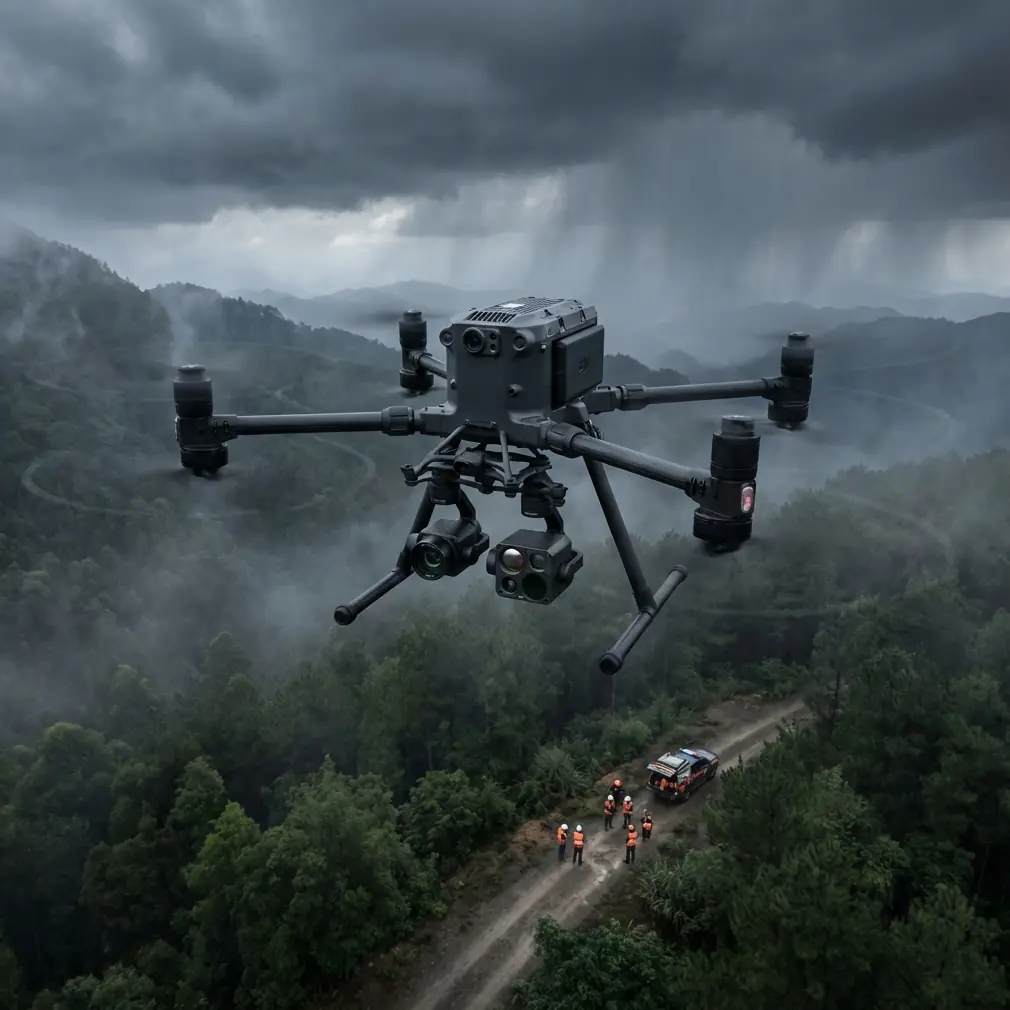
Matrice 400 in Extreme Field Inspections: A Cold-Morning Case Study from the Edge of Usable Light
META: Expert case study on using the Matrice 400 for field inspections in extreme temperatures, covering thermal signature capture, photogrammetry workflow, hot-swap batteries, O3 transmission, AES-256 security, and BVLOS planning.
At dawn, the field looked stable. The map said one thing, the air said another.
This is where the Matrice 400 starts to separate itself from drones that perform well only under mild conditions and forgiving timelines. When you are inspecting large agricultural fields in extreme temperatures, whether that means hard frost before sunrise or punishing midday heat over exposed soil, the mission is not just about getting airborne. It is about collecting reliable data before the environment distorts it, the batteries sag, the wind shifts, or a small anomaly turns into a season-long problem.
I recently worked through a field inspection scenario built around the Matrice 400 for a client managing mixed acreage with drainage concerns, wildlife pressure, and narrow weather windows. The aircraft was selected for one reason above all: operational continuity. In real field work, continuity matters more than spec-sheet theater. If your thermal pass, RGB mapping run, and follow-up verification flight do not align in time and quality, your decision-making degrades fast.
The morning started below freezing. That matters because extreme cold changes everything at once. Battery behavior changes. Surface temperature contrast changes. Moisture on the ground changes the way thermal signatures appear. Even pilot judgment changes because the margin for reflight narrows when conditions are moving minute by minute.
The inspection objective was straightforward on paper: identify irrigation inconsistencies, verify drainage pathways, document frost damage zones, and produce a photogrammetry model accurate enough to compare against prior survey data tied to GCP markers. In practice, the work was more layered. The client also suspected wildlife intrusion near a low-lying section bordering brush and wanted confirmation without sending a ground team through saturated terrain before full light.
That final point became more relevant than expected.
About 11 minutes into the first sensor pass, the thermal view picked up a moving heat source crossing one of the outer rows. Not a person. Not a stray dog. A deer, moving slowly across the colder ground and then stopping near a drainage cut. On a weaker platform, this would have been a distraction or a lost frame. On the Matrice 400, it became useful context. The aircraft’s sensor package allowed us to distinguish the animal’s thermal signature from the colder surrounding vegetation and avoid contaminating the interpretation of adjacent crop stress areas. Just as important, the drone did not need to descend aggressively or reposition in a way that would spook the animal and distort the scene. That small moment captured what experienced operators already understand: in field inspections, you are not collecting abstract imagery. You are reading a live environment full of moving variables.
The deer encounter also highlighted why thermal work in agricultural inspection has to be interpreted, not merely captured. A warm body in a cold field can draw attention away from subtle but operationally significant temperature gradients. Those gradients may indicate standing water beneath the surface, delayed frost release, clogged flow paths, or uneven plant vigor. With the Matrice 400, the job is not simply seeing heat. It is isolating the thermal signature that matters and preserving enough mission stability to validate it with follow-on imagery.
That is where mission design becomes inseparable from aircraft capability.
For this operation, we split the inspection into three phases. First, a low-light thermal sweep before the sun erased useful contrast. Second, an RGB photogrammetry run once illumination improved. Third, a targeted verification flight focused on flagged anomalies and edge-of-field conditions. This sequencing sounds simple. It is not. Extreme temperatures compress your useful windows, and if you lose momentum between phases, you lose data quality.
The Matrice 400’s hot-swap batteries were central to keeping that sequence intact. In field conditions, battery handling is often treated as a logistical detail. It is not. It is a mission integrity issue. In cold weather, especially, a delayed turnaround can mean your thermal baseline is gone by the time you relaunch. Hot-swap capability allowed the aircraft to remain operational without forcing a full reset between passes, which preserved continuity across the inspection timeline. That continuity is the difference between saying “there may be an issue here” and saying “this anomaly persisted across thermal, RGB, and elevation-derived review, so it deserves intervention.”
The second detail that carried real operational weight was transmission reliability. Large fields are deceptively difficult places to fly well. They look open, but distance, terrain undulation, reflective moisture, tree lines, and changing atmospheric conditions can all work against a clean control link. For expansive properties, O3 transmission matters because it supports stable situational awareness over long linear inspection paths. That becomes even more important if the operation is being structured with future BVLOS workflows in mind, where disciplined route planning, predictable link performance, and risk controls need to be built from the start rather than added later as paperwork.
I want to pause on that point because it is easy to misuse the term BVLOS in marketing-heavy drone discussions. For serious field inspection teams, BVLOS is not a buzzword. It is a planning framework. If your current missions are visual line-of-sight but your acreage, staffing model, or response times are pushing the limits of that approach, you should be flying today in a way that supports tomorrow’s compliance pathway. The Matrice 400 fits that discussion because it is not just about carrying sensors. It is about supporting repeatable, controlled operations over distance with the data and command confidence those operations require.
Security also deserves more attention than it usually gets in agricultural drone coverage. Field data is often treated as low sensitivity until someone realizes it includes infrastructure layouts, crop performance patterns, access routes, and historical condition records. In this case, the client had outside agronomy consultants and internal operations staff working from the same inspection outputs. AES-256 support mattered because the mission data was not just a set of images. It was a business intelligence asset moving across teams. If you are documenting drainage failure, crop stress corridors, equipment access damage, or perimeter vulnerabilities, protecting that information is not optional professionalism. It is baseline professionalism.
Once the sun cleared the horizon, we shifted into photogrammetry. This is where many field teams make a costly mistake: they assume that if the drone flies well, the map will be good enough. That is not how precision inspection works. The aircraft can be excellent and the deliverable can still be weak if the ground control strategy is sloppy. We used GCP references to anchor the mapping output because the client needed more than a visually pleasing orthomosaic. They needed spatial consistency they could compare against prior surveys and future remediation work.
The Matrice 400 was effective here not because photogrammetry is novel, but because it supported a smooth handoff from thermal scouting to structured mapping without introducing unnecessary friction. That is a practical advantage, not a glamorous one. But practical advantages are what keep field programs alive over multiple seasons. If every inspection requires a different aircraft, a different workflow, or a different set of compromises, teams stop scaling and start improvising. Improvisation is expensive.
The resulting model revealed a subtle but critical pattern: a slight elevation inconsistency along one edge of the field was redirecting runoff into an area the client had previously interpreted as isolated frost injury. The thermal imagery had shown delayed warming. The RGB pass showed uneven vigor. The mapped surface model, aligned with GCPs, showed why. One shallow flow path had become a recurring stress amplifier. Without combining those layers, the client might have treated the symptom and missed the cause.
That is the strongest argument for the Matrice 400 in extreme field inspections. Not that it flies in hard conditions. A number of aircraft can fly in hard conditions. The real value is that it helps you connect conditions, sensor outputs, and timing into a coherent diagnosis. That is what field managers, agronomists, and inspection contractors actually need.
The wildlife encounter returned as a useful footnote later in the review. The deer had paused near a compromised edge section where vegetation density and moisture levels were already masking ground truth from a distance. In the final analysis, that movement served as a reminder that field edges are rarely static. They combine drainage, habitat, access, and crop variability in one place. A platform that can safely observe those transitions with stable imaging and disciplined stand-off is more than convenient. It changes the quality of the inspection.
For operators planning similar missions with the Matrice 400, a few lessons stand out.
Start your thermal mission before the landscape equalizes. In extreme cold, that means exploiting the narrow window when meaningful contrast still exists. Once sunlight starts flattening the differences, your best clues fade quickly.
Do not treat battery management as an afterthought. Hot-swap batteries support more than efficiency. They protect the continuity of the inspection sequence, especially when thermal, RGB, and verification flights need to happen as one operational block.
Build your photogrammetry run around the decision you need to make, not around the fact that the aircraft can map. If drainage, frost pockets, compaction, or equipment damage are in question, use GCPs and collect data that can stand up to comparison, not just presentation.
Use O3 transmission capability to design cleaner routes and safer standoff, particularly on large tracts where field edges, tree lines, and low terrain can complicate link confidence. Transmission quality affects not only safety but also how decisively you can inspect anomalies without wasting time.
Protect the data. AES-256 is not a checkbox for compliance theater. It is relevant whenever inspection outputs inform land management, infrastructure planning, or third-party decision-making.
And finally, leave room in your planning for the field to behave like a field. Wildlife moves. Moisture shifts. Frost releases unevenly. A drainage issue rarely announces itself in perfect geometric lines. The Matrice 400 is most useful when it is flown by a team that respects those realities and uses the platform to reduce uncertainty rather than simply generate media.
If you are building out an inspection workflow for extreme environments and want to compare mission profiles, sensor setups, or field mapping logic, you can reach me through this direct field ops chat: https://wa.me/example
The Matrice 400 is not valuable because it promises everything to everyone. It is valuable because in difficult field conditions, it supports disciplined work: thermal interpretation when temperature contrast is fleeting, photogrammetry tied to GCP-backed accuracy, secure data handling through AES-256, stable long-range awareness via O3 transmission, and uninterrupted sortie flow through hot-swap batteries. Those are not isolated features. Together, they create a platform that makes sense for operators who need dependable answers before the weather, the light, or the field itself changes the question.
Ready for your own Matrice 400? Contact our team for expert consultation.