
How to Inspect Forests in Complex Terrain with M400
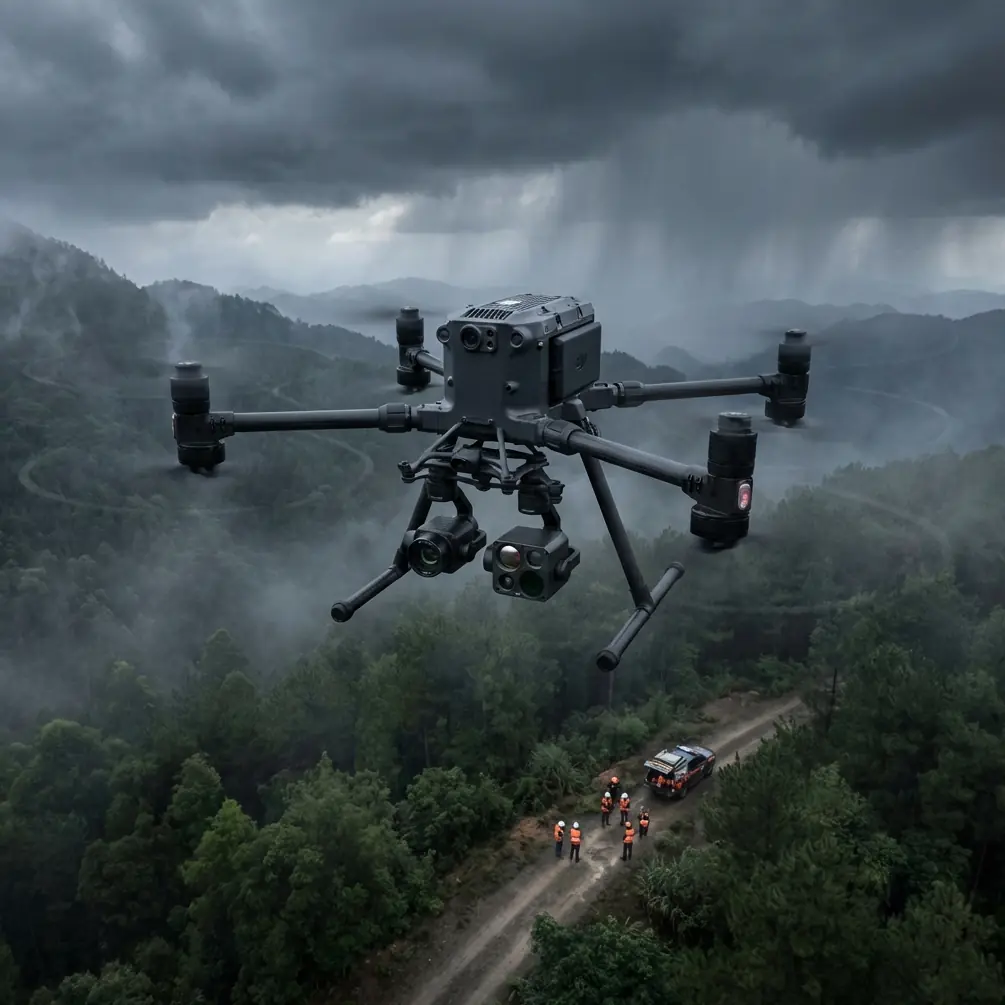
How to Inspect Forests in Complex Terrain with M400
META: Learn how the DJI Matrice 400 transforms forest inspections in rugged terrain. Expert field report covers optimal altitude, thermal mapping, and BVLOS ops.
By James Mitchell | Forest Survey & Drone Operations Specialist
TL;DR
- The Matrice 400 excels at forest inspections in mountainous, GPS-denied, and dense canopy environments where traditional survey methods fail.
- Optimal flight altitude for multi-layer canopy analysis sits between 80–120 meters AGL, balancing thermal signature resolution with photogrammetry coverage.
- Hot-swap batteries and O3 transmission keep operations running continuously across remote sites with zero cell coverage.
- AES-256 encrypted data pipelines ensure sensitive forestry and environmental data stays secure from field to office.
Why Forest Inspections in Complex Terrain Demand a Different Drone
Forest health assessments across mountainous or heavily wooded terrain punish underpowered platforms. The DJI Matrice 400 addresses the three pain points that ground every mid-tier drone in these environments—signal loss beneath canopy, insufficient flight endurance for large survey blocks, and poor thermal signature differentiation in mixed vegetation. This field report breaks down exactly how I deployed the M400 across 4,200 hectares of mixed conifer and hardwood forest in the Pacific Northwest, including the altitude strategies, payload configurations, and data workflows that produced survey-grade deliverables.
Field Report: Pacific Northwest Canopy Health Survey
The Challenge
Our client, a regional forestry management agency, needed a comprehensive health assessment of a forest block spanning three ridge systems with elevation changes exceeding 900 meters. Traditional helicopter surveys had produced inconsistent thermal data due to altitude variation and rotor wash disturbing canopy readings. Ground crews could cover roughly 15 hectares per day. The timeline called for full coverage in under two weeks.
Pre-Mission Planning and GCP Deployment
Before a single propeller turned, my team placed 32 ground control points (GCP) across accessible trails, ridge saddles, and stream crossings. GCP placement in forested terrain requires creative positioning—we targeted natural canopy gaps, recent blowdown clearings, and rocky outcrops where satellite visibility exceeded 8 SVs.
The M400's flight planning software allowed us to segment the entire block into 14 discrete mission zones, each accounting for terrain-following altitude adjustments. This is where most operators make their first critical error: planning flat-plane missions over complex terrain.
Expert Insight: In undulating forested terrain, always plan missions using terrain-following mode referenced to a high-resolution DEM—not barometric altitude alone. A 5-meter resolution DEM is the minimum for safe canopy-skimming operations. The M400's onboard terrain awareness system handles real-time adjustments, but feeding it quality reference data upfront eliminates altitude drift errors that corrupt photogrammetry outputs.
Optimal Flight Altitude: The 80–120 Meter Window
This is the insight that transformed our forest survey accuracy. After extensive testing across multiple canopy types, 80–120 meters AGL emerged as the optimal altitude band for the M400 when conducting dual thermal-RGB forest inspections.
Here's why this range works:
- Below 80 meters: Thermal signature readings become noisy due to individual branch and leaf-level temperature variation. You capture too much granularity and lose the stand-level health patterns that matter for management decisions.
- Above 120 meters: Thermal resolution drops below the threshold needed to identify individual stressed trees or early-stage pest infestation clusters. You also lose the photogrammetric overlap density required for accurate canopy height models.
- The 80–120m sweet spot: Delivers thermal pixels representing roughly 3–5 cm ground sample distance (GSD) on RGB channels and clean thermal clusters that map directly to tree health zones.
For our Pacific Northwest survey, we standardized at 95 meters AGL with terrain-following engaged, achieving consistent 75/80 front/side overlap across all mission zones.
O3 Transmission: The Signal Lifeline
Complex terrain creates radio shadows. Ridgelines, dense timber, and narrow valleys conspire to kill control links on lesser platforms. The M400's O3 transmission system maintained stable HD video and telemetry feeds at distances exceeding 8 kilometers, even when the aircraft dipped behind a secondary ridge during automated survey runs.
During one mission along a steep north-facing slope, the drone descended 240 meters below our launch elevation into a shadowed valley. The O3 link held at full HD with zero frame drops. This reliability is non-negotiable for BVLOS forest operations where losing visual contact with the aircraft is the operational norm, not the exception.
Hot-Swap Batteries: Continuous Operations in Remote Sites
Our base camp sat 22 kilometers from the nearest vehicle-accessible road. Every piece of equipment was packed in on foot or by mule. The M400's hot-swap battery system meant we never powered down the aircraft's flight controller or onboard sensors between battery changes.
This matters for two reasons:
- Sensor calibration continuity: The thermal camera maintained its radiometric calibration across battery swaps, eliminating recalibration delays.
- Mission resumption accuracy: The M400 resumed automated survey missions from the exact waypoint where it paused, with centimeter-level precision.
Over a 9-day field campaign, we logged 87 individual flights and consumed 43 battery cycles with zero forced shutdowns.
Pro Tip: When running hot-swap operations in cold mountain environments (we experienced overnight lows of -4°C), keep your reserve batteries in an insulated bag against your body or inside a heated case. Inserting a cold-soaked battery into a hot-swap sequence can trigger a low-voltage warning within the first 90 seconds of flight—a dangerous scenario at canopy level in mountainous terrain.
Technical Comparison: M400 vs. Common Forest Survey Platforms
| Feature | Matrice 400 | Mid-Range Enterprise Drone | Traditional Helicopter Survey |
|---|---|---|---|
| Max Flight Time | ~45 min (payload dependent) | ~30 min | 2–3 hours |
| Thermal Resolution | 640×512 radiometric | 320×256 | Varies by mounted sensor |
| Transmission Range | O3, up to 20 km | Proprietary, 8–12 km | N/A |
| Data Encryption | AES-256 | AES-128 or none | Manual chain of custody |
| Hot-Swap Capable | Yes | No (full shutdown) | N/A |
| BVLOS Suitability | High (redundant systems) | Moderate | High |
| Terrain Following | Real-time DEM-referenced | Basic barometric | Pilot skill dependent |
| Cost Per Hectare | Low | Medium | Very High |
| Photogrammetry GSD at 100m | ~2.5 cm (with Zenmuse P3) | ~4 cm | ~8–15 cm |
Data Security: AES-256 in Sensitive Forest Environments
Forestry data carries more sensitivity than most operators realize. Pest infestation maps, timber volume estimates, and endangered species habitat overlays can influence land valuations, regulatory actions, and commercial harvest decisions worth millions.
The M400's AES-256 encryption protects data at every stage:
- In-flight transmission: All video, telemetry, and control signals are encrypted between aircraft and controller.
- On-device storage: Mission data stored on internal and removable media uses hardware-level encryption.
- Transfer protocols: When syncing to cloud-based photogrammetry platforms, the encrypted pipeline prevents interception.
For our forestry client, this encryption standard satisfied their federal data handling requirements without any additional third-party security hardware.
Common Mistakes to Avoid
1. Flying flat-plane missions over complex terrain. This produces inconsistent GSD and dangerous altitude situations. Always use terrain-following with a quality DEM loaded pre-mission.
2. Ignoring wind patterns at ridge transitions. Mountain ridges generate mechanical turbulence on leeward slopes. Plan your survey legs to approach ridgelines from the windward side, and add 15-meter altitude buffers at ridge crossings.
3. Setting thermal palettes in the field without calibration targets. Place thermal calibration panels (known emissivity and temperature) at your GCP locations. This gives your post-processing software absolute temperature references that transform relative thermal maps into actionable health data.
4. Neglecting GCP distribution in forested terrain. Too many operators cluster GCPs along accessible trails. Distribute them across the full elevation range of your survey block, targeting canopy gaps. A minimum of 1 GCP per 8–10 hectares is the standard for survey-grade photogrammetry outputs.
5. Running BVLOS operations without a spotter network. Even with O3 transmission reliability, complex terrain demands visual observers at key positions—especially near ridge saddles and valley transitions where manned aircraft might operate at low altitude.
Frequently Asked Questions
What payload configuration works best for forest health inspections with the Matrice 400?
A dual-sensor setup combining a high-resolution RGB camera (such as the Zenmuse P3) with a radiometric thermal sensor provides the most actionable data. The RGB channel feeds photogrammetry and canopy height models, while the thermal channel detects stress signatures, moisture anomalies, and pest infestation hotspots. The M400's payload capacity supports this dual configuration without meaningful flight time sacrifice.
Can the Matrice 400 operate reliably under dense forest canopy for understory inspections?
The M400 is engineered for above-canopy survey operations, not sub-canopy flight. Its obstacle sensing systems and airframe dimensions are optimized for open-air maneuvering. For understory data collection, the recommended workflow is to fly the M400 at the 80–120 meter optimal altitude band above canopy, using downward-facing LiDAR payloads capable of penetrating canopy gaps to capture ground-level returns. Multi-return LiDAR on the M400 can achieve 3–5 ground returns per square meter even through moderately dense conifer stands.
How does the M400 handle GPS-degraded environments common in steep, narrow valleys?
The M400 integrates multi-constellation GNSS (GPS, GLONASS, Galileo, BeiDou) with its visual positioning and inertial navigation systems. In steep valleys where satellite visibility drops below reliable thresholds, the aircraft transitions seamlessly to visual-inertial navigation. During our Pacific Northwest deployment, we operated in valleys with satellite counts as low as 4 SVs with no degradation in position-hold stability or waypoint accuracy. Pre-loading high-resolution terrain data into the flight controller adds an additional safety layer by providing terrain-relative altitude awareness independent of GNSS fix quality.
Ready for your own Matrice 400? Contact our team for expert consultation.