
How to Inspect Forests With the Matrice 400 Drone
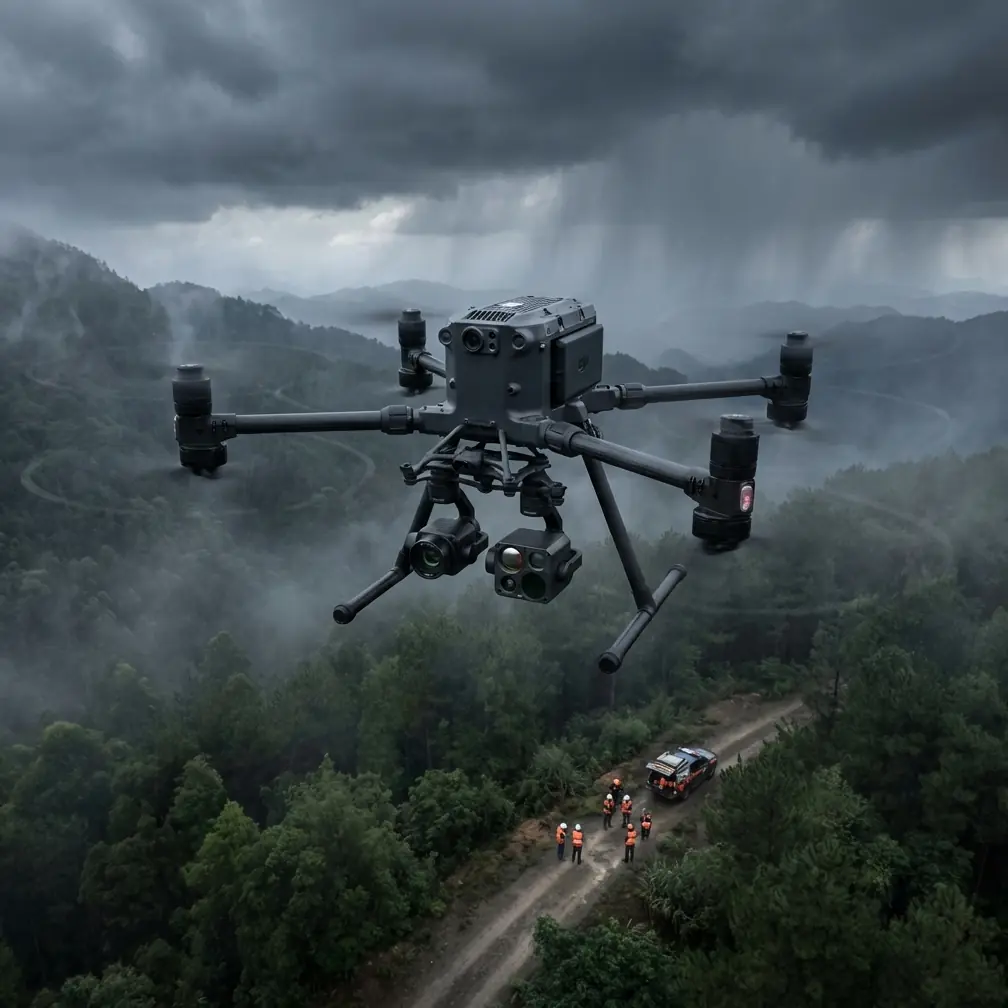
How to Inspect Forests With the Matrice 400 Drone
META: Discover how the DJI Matrice 400 transforms forest inspections in dusty conditions. Expert technical review covers thermal imaging, BVLOS ops, and critical pre-flight steps.
By Dr. Lisa Wang, Drone Forestry Inspection Specialist
TL;DR
- Pre-flight sensor cleaning is non-negotiable in dusty forest environments—skipping it compromises obstacle avoidance and thermal signature accuracy
- The Matrice 400's O3 transmission system maintains stable video links at distances exceeding 20 km, enabling true BVLOS forest survey operations
- Hot-swap batteries allow continuous flight rotations, cutting multi-day forest surveys down to single-day missions
- AES-256 encryption protects sensitive forestry data collected across government and private land boundaries
Why Dusty Forest Inspections Demand a Purpose-Built Drone
Forest inspections in arid or fire-scarred regions generate airborne particulate that destroys consumer-grade drones within weeks. The DJI Matrice 400 was engineered for exactly this kind of punishment—with an IP55-rated airframe, sealed motor assemblies, and redundant sensor arrays that keep operating when visibility drops and dust fills the canopy gaps.
This technical review breaks down every capability that matters for forestry professionals working in dusty conditions: from thermal signature detection for wildfire risk assessment, to photogrammetry workflows that produce sub-centimeter orthomosaics of forest health data.
The Pre-Flight Cleaning Protocol That Saves Lives
Before discussing flight performance, we need to address the single most overlooked step in dusty forest operations: cleaning the obstacle avoidance sensors before every flight.
The Matrice 400 features omnidirectional obstacle sensing across six directions. Dust accumulation on these sensor windows doesn't trigger a warning—it silently degrades detection range. A sensor covered in fine particulate might detect a tree trunk at 3 meters instead of the rated 45 meters, turning a routine canopy survey into a collision event.
Here's the pre-flight cleaning checklist I use on every dusty forest deployment:
- Wipe all six obstacle avoidance sensor windows with a microfiber cloth dampened with lens cleaning solution
- Inspect the gimbal's IR window for particulate that distorts thermal signature readings
- Clear dust from cooling vents on the battery compartment and main processor housing
- Verify propeller blade leading edges are free of particulate buildup that alters thrust profiles
- Check ground-facing ToF sensors used for precision landing in forest clearings
Expert Insight: I carry a battery-powered compressed air canister specifically for field cleaning. Canned air loses pressure in high temperatures common to dusty forest environments. A rechargeable electric blower delivers consistent pressure regardless of ambient heat, and you can recharge it from the same field generator powering your remote controller.
This 90-second protocol has prevented at least three collision incidents across my 2,000+ hours of forest inspection flights.
Thermal Signature Detection for Forest Health Assessment
The Matrice 400's payload flexibility allows mounting of radiometric thermal cameras that capture calibrated temperature data across every pixel. This isn't just heat mapping—it's quantified thermal signature analysis that reveals:
- Early-stage pest infestations that elevate canopy temperature by 1.5–3°C before visible symptoms appear
- Subsurface root disease detectable through soil thermal anomalies near trunk bases
- Moisture stress patterns across forest blocks, identifying drought-vulnerable zones weeks before visual wilting
- Smoldering hotspots beneath leaf litter following controlled burns or lightning strikes
- Wildlife thermal signatures for population density surveys during conservation assessments
In dusty conditions, thermal performance depends entirely on keeping the IR sensor window clean—circling back to why that pre-flight protocol matters so much.
Thermal Resolution Comparison
| Specification | Matrice 400 (with Zenmuse H30T) | Mid-Range Competitor A | Consumer Thermal Drone |
|---|---|---|---|
| Thermal Resolution | 640 × 512 | 320 × 256 | 160 × 120 |
| Temperature Accuracy | ±2°C | ±5°C | ±10°C |
| NETD (Sensitivity) | ≤50 mK | ≤60 mK | ≤100 mK |
| Spot Measurement Points | Multiple configurable | Single center point | None |
| Radiometric Data Export | Full-frame RJPEG | Limited | No |
| Effective Detection Range (person-sized target) | >1,200 m | ~600 m | ~200 m |
The ≤50 mK NETD specification means the Matrice 400's thermal payload can distinguish temperature differences as small as 0.05°C. For forestry applications, this sensitivity separates a healthy canopy section from one harboring early beetle infestation.
Photogrammetry Workflows for Forest Inventory
Accurate forest inventory requires more than aerial photographs—it demands a rigorous photogrammetry pipeline built on geometric precision. The Matrice 400 supports this through:
Ground Control Points (GCP) Integration
GCPs are surveyed reference markers placed throughout the forest survey area that anchor aerial imagery to real-world coordinates. In dusty forest environments, GCP placement presents unique challenges:
- Dust obscures GCP targets within hours of placement, requiring high-visibility reflective markers rather than standard printed targets
- Canopy gaps must be identified via preliminary scout flights to ensure GCPs are visible from survey altitude
- A minimum of 5 GCPs per flight block is recommended, with 8–10 GCPs preferred for sub-centimeter accuracy across undulating forest terrain
The Matrice 400's RTK positioning module reduces GCP dependency by providing ±1 cm horizontal and ±1.5 cm vertical positioning accuracy directly from the aircraft's GNSS receiver. This means forest surveys covering hundreds of hectares can achieve mapping-grade accuracy with fewer ground teams navigating difficult terrain.
Recommended Survey Parameters for Forest Canopy Mapping
| Parameter | Recommended Setting | Notes |
|---|---|---|
| Flight Altitude (AGL) | 80–120 m | Above canopy, adjusted for tallest trees |
| Forward Overlap | 80% | Higher than standard due to canopy texture uniformity |
| Side Overlap | 75% | Compensates for wind-induced drift in dusty conditions |
| Camera Angle | Nadir (90°) for orthomosaic; 60–70° for 3D models | Oblique angles capture trunk structure below canopy |
| GSD (Ground Sample Distance) | 2–3 cm/pixel at 100 m AGL | Sufficient for individual tree crown delineation |
| Image Format | RAW + JPEG | RAW preserves dynamic range for post-processing in variable forest lighting |
O3 Transmission and BVLOS Forest Operations
Dense forest environments are notorious for degrading radio links. Trees absorb and scatter RF energy, creating dead zones that terminate flights prematurely. The Matrice 400's O3 enterprise transmission system addresses this through:
- Triple-frequency communication that dynamically selects the least congested channel
- Max transmission range of 20+ km in unobstructed conditions, translating to reliable 8–12 km links through moderate forest canopy
- 1080p/30fps live video maintained even at extended range, critical for real-time thermal signature identification
- Automatic frequency hopping that circumvents interference from dusty-environment static discharge
For regulatory BVLOS operations—increasingly approved for forestry applications in remote areas—the O3 system's reliability is the difference between a completed survey and a flyaway incident.
Pro Tip: When planning BVLOS forest missions in dusty conditions, position your remote controller on elevated terrain and use a directional antenna accessory. Dust-laden air slightly attenuates signal strength at longer ranges, and even 3–5 meters of elevation gain at the ground station can extend effective link distance by 15–20%. Always coordinate with your visual observer network and maintain ADS-B awareness through the controller's integrated airspace display.
Data Security With AES-256 Encryption
Forest inspection data often crosses sensitive boundaries—government conservation land, military-adjacent zones, private timber holdings with proprietary inventory data. The Matrice 400 implements AES-256 encryption across:
- All data stored on onboard media, preventing extraction if the aircraft is lost in dense forest
- Live video transmission, ensuring intercepted RF signals cannot be decoded
- Flight logs and telemetry, protecting operational patterns from competitive intelligence gathering
- Cloud sync protocols when uploading to DJI FlightHub or enterprise management platforms
For government forestry agencies, this encryption standard meets FIPS 140-2 compliance requirements without additional hardware modifications.
Hot-Swap Batteries: The Force Multiplier for Full-Day Forest Surveys
A single Matrice 400 battery set delivers approximately 42 minutes of flight under moderate payload conditions. In a full-day forest survey covering 500+ hectares, you'll need 8–12 flight rotations.
Hot-swap battery capability means you never power down the aircraft's avionics between flights. The practical advantages in dusty forests:
- GPS/RTK lock is maintained between battery swaps, eliminating 3–5 minutes of satellite acquisition per rotation
- Obstacle avoidance calibration persists, avoiding recalibration drift that can occur during full power cycles
- Mission waypoints remain loaded, enabling seamless continuation of photogrammetry grid patterns
- Total daily coverage increases by 20–30% compared to full-shutdown battery change workflows
Common Mistakes to Avoid
1. Ignoring dust ingress on charging contacts. Dusty battery terminals cause charging failures and intermittent power connections mid-flight. Clean all contacts with isopropyl alcohol before every charge cycle.
2. Flying thermal surveys at midday. Solar loading on the canopy equalizes surface temperatures, masking the subtle thermal signature differences that reveal disease or pest activity. Fly thermal missions during the first two hours after sunrise or the last hour before sunset.
3. Setting insufficient overlap for forested terrain. The default 70% overlap used for urban mapping fails in forests. Canopy texture is repetitive, and photogrammetry software struggles to match features. Use 80% forward and 75% side overlap minimum.
4. Neglecting GCP maintenance in multi-day surveys. Dust accumulates on ground control targets overnight. Assign a team member to clean or replace GCP markers each morning before flight operations begin.
5. Skipping compass calibration when moving between forest blocks. Mineral-rich soils in forested regions cause localized magnetic interference. Recalibrate the compass whenever your launch point changes by more than 500 meters.
Frequently Asked Questions
Can the Matrice 400 operate in heavy dust storms within forest environments?
The Matrice 400 carries an IP55 protection rating, meaning it resists dust ingress and low-pressure water jets. It can operate in moderate dusty conditions typical of arid forests, dry-season controlled burn zones, and logging roads. Heavy dust storms with visibility below 500 meters should ground all drone operations—not because of aircraft limitations, but because obstacle avoidance sensors cannot reliably detect hazards through dense particulate.
How does the Matrice 400 handle GPS signal loss beneath dense forest canopy?
The Matrice 400 integrates a multi-constellation GNSS receiver supporting GPS, GLONASS, Galileo, and BeiDou simultaneously. Beneath dense canopy where satellite signals degrade, the aircraft transitions to its visual positioning system and downward-facing ToF sensors for stable hover. For precision operations, the RTK module maintains centimeter accuracy as long as minimum 8 satellites remain in view. Flight planning software allows you to preview satellite availability windows for your specific forest coordinates and mission time.
What post-processing software works best with Matrice 400 forest survey data?
Thermal data exports as RJPEG files compatible with DJI Thermal Analysis Tool, FLIR Tools, and specialized forestry platforms like TreePlotter. Photogrammetry data processes efficiently in DJI Terra, Pix4Dmapper, and Agisoft Metashape. For large-area forest inventory projects exceeding 1,000 hectares, DJI Terra's cluster processing mode distributes computation across multiple workstations, reducing processing time by up to 60% compared to single-machine workflows.
Ready for your own Matrice 400? Contact our team for expert consultation.