
Inspecting Forests in Extreme Temperatures With Matrice 400
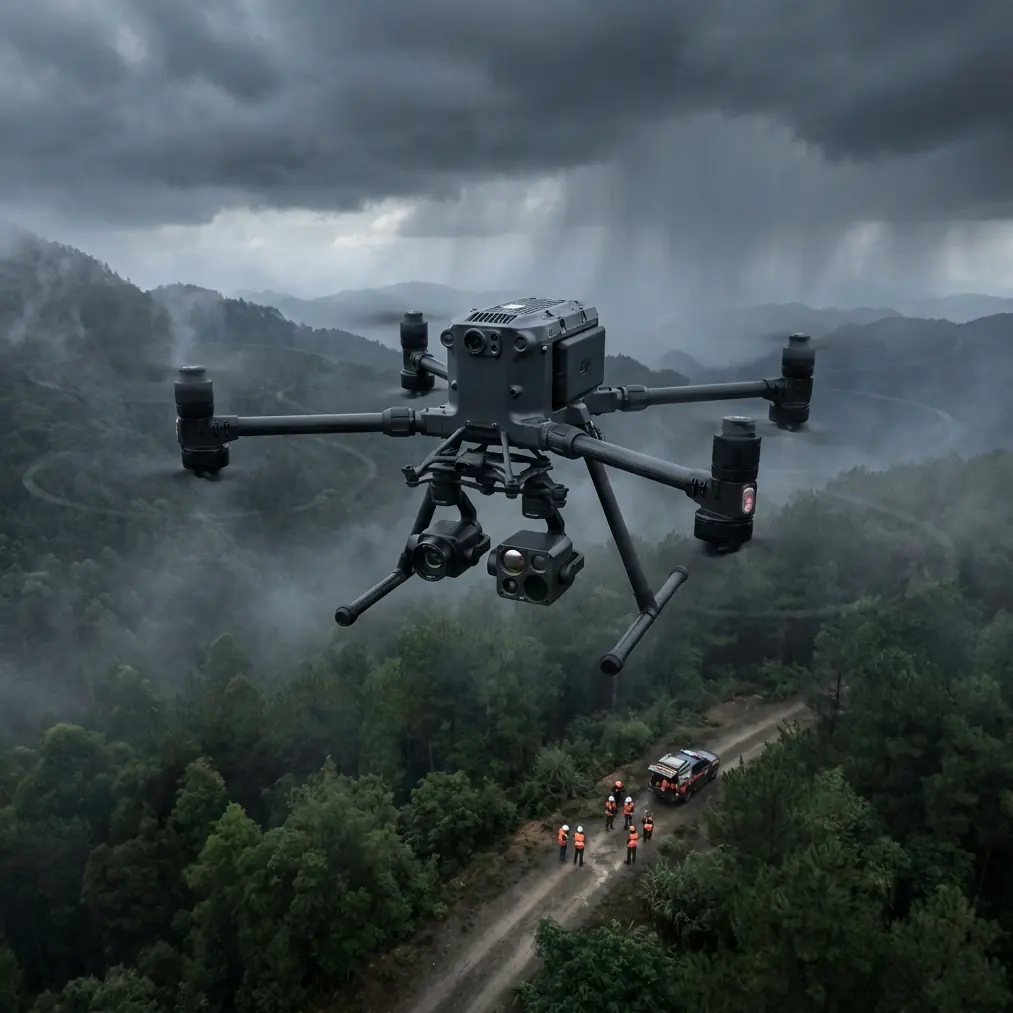
Inspecting Forests in Extreme Temperatures With Matrice 400: A Field Tutorial That Starts Before Takeoff
META: Expert tutorial on using Matrice 400 for forest inspection in extreme heat and cold, with practical guidance on thermal workflows, photogrammetry, payload setup, testing discipline, and mission reliability.
Forest inspection punishes weak planning.
Cold drains batteries faster than expected. Summer haze softens contrast. Dense canopy breaks line of sight, hides thermal anomalies, and turns a simple mapping run into a data-management problem. If you are preparing a Matrice 400 for forestry work in those conditions, the aircraft matters, but the method matters more.
What follows is the workflow I would use to configure and validate a Matrice 400 program for forest inspection when temperature extremes are part of the brief. This is not a generic drone overview. It is a practical setup guide shaped by two engineering ideas that rarely get discussed together: structural tolerance under stress, and test discipline at the system level.
Those ideas come from aircraft design references, and they are surprisingly relevant to the way you should deploy an M400 around timber stands, fire-risk corridors, and remote survey blocks.
Start with the mission profile, not the payload wish list
Forestry teams often try to solve everything in one sortie: thermal scanning, photogrammetry, corridor review, canopy health checks, and spot inspection of access tracks. On paper, Matrice 400 is the kind of platform people naturally push into that multi-role slot because it is expected to carry serious sensors, work at distance, and support more advanced mission planning than smaller airframes.
That does not mean every mission should be built as a flying compromise.
For extreme-temperature forest work, define the output before you define the aircraft configuration:
- Are you locating heat stress, smolder risk, or wildlife intrusions through thermal signature analysis?
- Are you creating measurable surface models with photogrammetry?
- Are you documenting road washouts, culverts, or slope movement where GCP strategy matters more than raw flight time?
- Are you flying deep into low-access terrain where O3 transmission stability becomes the limiting factor?
- Are you operating under internal compliance standards that require protected logs and media handling, where AES-256 workflows matter?
Once that is clear, your Matrice 400 setup becomes cleaner. In forest operations, clean systems beat overloaded systems.
Why a structural-design mindset belongs in a forest drone program
One of the reference documents describes a honeycomb sandwich aircraft panel used between fuel tank interfaces in a fuselage section. It is a relatively compact flat structural element, roughly 500 mm x 500 mm, but the details are what matter: the design allows only tightly controlled defects, with material tolerances down to 0.2 mm, panel-to-panel shear strength of at least 17 MPa, and honeycomb peel strength of at least 49 N/cm in a 90-degree peel test.
Those numbers are not about Matrice 400 specifically. They are about engineering attitude.
In forest inspection, especially in extreme heat or cold, you want to borrow that same mindset. Small dimensional drift, weak bonding, or untreated edge vulnerabilities in aircraft structures become failure points under load. The drone equivalent is looser than people admit: mount flex, connector fatigue, battery seating issues, accessory vibration, and cold-soaked plastics that behave differently at dawn than they did in the shop.
Operational significance:
Extreme temperature amplifies minor weaknesses.
A structure that is acceptable in mild weather can behave differently after repeated thermal cycling. The reference’s acceptance criteria for bonded honeycomb construction are strict because a tiny flaw can propagate under stress. For the Matrice 400 operator, this means accessory rails, gimbal mounts, antenna fittings, landing gear joints, and payload locking points deserve pre-mission inspection discipline, not a quick visual glance.Edge treatment matters in wet forestry environments.
The same structural reference mentions specific edge-fill and sealing approaches around the panel, including foam fill and glass-cloth sealing at free edges. Why should a forest team care? Because moisture intrusion, debris ingress, and repeated temperature swings attack exposed interfaces first. If you are using third-party brackets, custom mounts, external beacons, or field-installed sensor housings on an M400, sealing and strain relief are not cosmetic details. They are uptime decisions.
This is where many otherwise competent drone teams lose reliability. They think in terms of flight hours and sensor specs, but not in terms of thermal expansion, bond integrity, and edge protection.
Build the payload stack around temperature behavior
A forest inspection mission in extreme weather is usually either a thermal mission, a mapping mission, or a hybrid workflow that should really be separated into two flights.
For thermal inspection
Thermal imaging in forests is heavily influenced by timing. Midday heat can flatten contrast if your target is subtle, while sunrise and evening can sharpen differences between healthy canopy, stressed vegetation, exposed soil, and retained heat near infrastructure. If your Matrice 400 is carrying a thermal payload, calibrate your expectations as carefully as your sensor.
The key is not just “seeing heat.” It is understanding what the heat belongs to.
- Sun-loaded rocks can mimic hotspot behavior.
- Wet ground can cool faster than expected and distort comparisons.
- Conifer density can obscure targets beneath the upper canopy.
- Wind alters apparent temperature boundaries at forest edges and cut lines.
If your objective is detecting anomalies over broad acreage, keep the mission geometry stable and avoid improvising altitude changes every few minutes. Consistent thermal capture produces more reliable comparisons later.
For photogrammetry
Photogrammetry in forest terrain is less forgiving than open-field mapping. Trees move, shadows shift, and canopy texture is repetitive. That means your Matrice 400 flight plan should prioritize overlap discipline and realistic expectations about what can be reconstructed.
Ground control is still the separator between “good-looking map” and defendable survey output. A strong GCP layout helps stabilize edge zones, road intersections, clearings, and transition areas where the software can otherwise drift. In snowy or heavily shaded environments, mark design and visibility become even more important.
If you are mapping logging roads, firebreaks, erosion paths, or regeneration blocks, do not rely on automated flight defaults alone. Review sun angle, expected motion in the canopy, and whether your area includes enough open reference features to anchor the model.
Use a third-party accessory where it actually changes the result
Most accessories in this category are noise. A few genuinely improve the mission.
One useful example for forestry teams is a third-party high-visibility strobe or beacon module fitted for operations in complex terrain and low ambient light. In cold mornings, valley shadow, or smoke-affected visibility, that simple addition can make visual orientation and team coordination easier without changing your sensor stack.
The operational value is not flashy. It is practical:
- easier aircraft acquisition after passing behind tree lines,
- clearer visual status during launch and recovery,
- better coordination for spotters during long corridor work.
If you are configuring one for a Matrice 400 program and want a compatibility check before field deployment, you can message a payload integration specialist here: https://wa.me/85255379740.
That kind of accessory is worth discussing because it supports mission execution, not because it looks advanced.
Transmission discipline matters more in forests than on open sites
Forests are notorious for making pilots overestimate link stability. What looked strong over a clearing becomes uneven once the aircraft drops behind ridges, enters moisture-heavy canopy zones, or works along broken topography.
That is where O3 transmission capability becomes meaningful in the real world. Not as a spec-sheet brag, but as a margin. A better link budget and more stable video/control path can keep your mission usable when the environment is actively working against you.
Still, transmission technology is not permission to get lazy.
For forest inspection:
- keep your control point as elevated and open as practical,
- avoid standing directly against vehicles, steel fencing, or dense trunks,
- use route geometry that reduces unnecessary terrain masking,
- monitor quality trends before the signal becomes a problem.
For teams working toward BVLOS-style inspection frameworks where regulation and local approvals allow, that communication reliability becomes foundational. The aircraft can only support extended operational concepts if the full system—crew positioning, observers, route design, and contingency planning—matches the environment.
Test the whole system, not just the components
The second reference document, focused on avionics acceptance testing, makes a point that applies perfectly to professional drone operations: system-level tests should verify complete mission behavior, not get lost inspecting every internal method used to achieve it.
It describes a hierarchy where lower-level components must first pass their own acceptance checks, and then the system test evaluates the broader process. It also notes that the test should examine the sequence from setup to event trigger to stable output, with measured results compared against expected tolerances.
That is exactly how a Matrice 400 forestry team should validate a new workflow.
Operational significance:
Do not confuse component readiness with mission readiness.
Your thermal camera may pass bench checks. Your batteries may report healthy status. Your mapping app may open correctly. That does not prove the full forest inspection workflow works under field temperature, with gloves on, in wind, on uneven ground, with delayed GNSS lock, and with payload storage nearly full.Measure outputs, not assumptions.
The avionics reference stresses comparing final outputs against predefined tolerances. For Matrice 400 work, that means setting mission pass/fail thresholds before you fly:- maximum acceptable orthomosaic error,
- minimum thermal contrast needed for anomaly detection,
- battery reserve at recovery,
- acceptable link quality during route turns,
- geotag integrity across the full dataset.
This is where experienced teams separate themselves from enthusiastic teams. They do not merely launch. They validate a repeatable system.
A practical preflight sequence for extreme-temperature forestry missions
Here is the field routine I recommend.
1. Cold-soak or heat-soak planning
Do not take the aircraft from a climate-controlled vehicle and assume all readings reflect field reality. Let the system stabilize. Batteries, sensors, and optics need time to match ambient conditions.
2. Mount and edge inspection
Take the structural mindset seriously. Check payload latches, cable bends, gimbal damping elements, accessory fasteners, and exposed sealing points. In rough environments, these are your first weak links.
3. Battery strategy
If your Matrice 400 setup supports hot-swap batteries, use that capability strategically rather than casually. In cold conditions, rapid turnaround reduces downtime but only if replacement packs are stored correctly and inserted into a workflow that verifies temperature and seating status before relaunch.
4. Link check in actual terrain
Do not validate transmission from the staging table and call it done. Lift to a safe test altitude and assess behavior in the real topographic context.
5. Sensor-specific verification
For thermal missions, confirm scene contrast over at least one known reference object. For mapping missions, capture a short sample line and inspect sharpness before committing to the full block.
6. Output criteria confirmation
Remind the crew what a successful sortie must produce. That sounds obvious. It is not. Teams under weather pressure often fly a mission first and define usefulness later.
Extreme temperatures change crew behavior too
There is one more reason the testing reference matters. It explicitly frames acceptance testing as a sequence with defined initial conditions, trigger events, and stable end states. Human crews need the same discipline.
In deep cold, crews rush. In high heat, they cut corners to shorten exposure. Both create preventable errors:
- missed SD or SSD checks,
- poor GCP placement,
- hurried battery swaps,
- thermal lens contamination left unnoticed,
- recovery zones chosen for convenience instead of link quality.
Write the mission flow so it still works when the crew is uncomfortable. That is a real-world system design principle, not paperwork.
What the Matrice 400 should represent in forest inspection
A serious aircraft is not just a stronger airframe with a better payload chart. It is a platform that earns trust through repeatable outputs in difficult conditions.
The most useful lesson from the reference materials is not hidden in any single line item. It is in the engineering culture they reflect. One document enforces tight structural quality with measurable thresholds like 17 MPa shear strength and 49 N/cm peel strength. The other insists that system acceptance must verify the whole operational chain rather than admire internal complexity.
That is exactly how to approach a Matrice 400 forestry program.
If you inspect forests in extreme temperatures, do not build your process around marketing categories. Build it around tolerances, edge conditions, link behavior, sensor purpose, and end-result verification. When those pieces are right, the aircraft becomes more than capable. It becomes dependable.
Ready for your own Matrice 400? Contact our team for expert consultation.