
Mountain Forest Inspection With Matrice 400
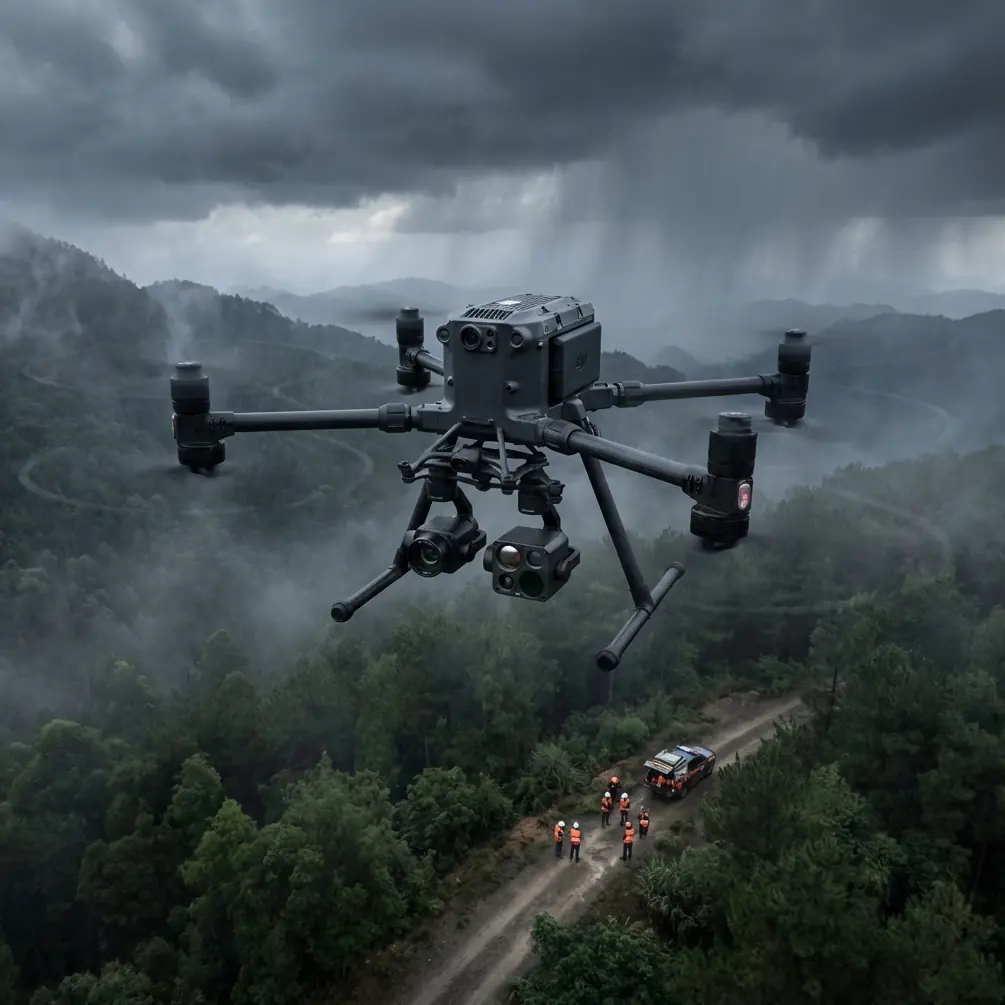
Mountain Forest Inspection With Matrice 400: A Field Case Study on Stability, Sensor Control, and Mid-Flight Adaptation
META: A practical Matrice 400 case study for mountain forest inspection, covering thermal signature work, photogrammetry, transmission reliability, encrypted data links, and how curve-based control logic matters when weather shifts in flight.
I’ve spent enough time around aircraft systems to know that mountain forestry missions rarely fail because of one dramatic mistake. They usually unravel through small mismatches: throttle response that feels slightly off in thin air, sensor passes that drift when wind rolls across a ridgeline, or a mapping plan that looked clean on paper but falls apart once cloud and temperature change the scene.
That is why the Matrice 400 deserves to be discussed through a real operating scenario rather than a feature list. On a recent mountain forest inspection profile, the aircraft’s value showed up not in headline specs, but in how controllable the whole mission remained when conditions moved from stable to awkward in less than twenty minutes.
The mission profile: forest inspection in broken mountain terrain
The assignment was typical of modern civil forestry work. We needed to inspect a large mountain section containing mixed canopy density, steep elevation changes, and a few erosion-prone corridors near access roads. The client wanted two outputs from one deployment window: first, thermal signature review for anomaly detection in stressed tree clusters; second, a photogrammetry set suitable for later terrain and canopy analysis with GCP-backed alignment.
That combination is harder than it sounds. Thermal work wants consistency in viewing geometry and timing. Photogrammetry wants disciplined overlap, stable altitude control, and repeatable motion through uneven relief. Mountains push both requirements at once.
The Matrice 400 was the right platform for that blend because the job was not just about lifting a payload. It was about preserving precision while the aircraft transitioned between observation styles.
Why a control-curve mindset still matters on a modern enterprise platform
One of the reference materials behind this article comes from a flight control manual discussing a 5-point throttle curve and a matching 5-point pitch curve. At first glance, that sounds remote from an enterprise forestry drone. It isn’t.
The underlying lesson is operationally relevant: aircraft handling is not only about maximum power. It is about how response is distributed across the control range. In that manual, the first point is preset at 0% and the fifth at 100%, with intermediate points used to tune behavior. The same logic appears in any serious UAV workflow, even if the pilot interacts through more advanced software and flight modes. You still care about the shape of response, not just the endpoints.
In mountain forestry inspection, this matters for two reasons.
First, low-speed precision near canopy edges depends on smooth authority at the bottom and middle of the control envelope. If the aircraft reacts too bluntly to pilot input or automated path corrections, image geometry degrades. Second, as conditions change, the aircraft must keep rotor and propulsion output in a band that matches the load case rather than simply surging to compensate.
That old manual also makes another point worth carrying into the Matrice 400 discussion: a pitch or thrust-related curve should not be pushed beyond what the rotor speed can support effectively. In practical terms, that means performance has to stay balanced. During a mountain mission, especially when wind arrives suddenly, an aircraft that can maintain stable, well-matched control response gives better inspection data than one that merely claims strong power.
This is where the Matrice 400 feels like a professional tool. It lets the operator think in terms of mission quality, not just aircraft survival.
The weather changed at the worst point of the route
We launched in a cool morning window with relatively calm air at the staging point. The first leg climbed along a forested slope to capture visible-light mapping passes, using a photogrammetry plan built around terrain awareness and GCP references placed in accessible openings below the densest canopy sections.
About halfway through the upper transects, the weather shifted. A moving cloud layer crossed the ridge and dragged a gust front with it. Light changed first. Then the aircraft began encountering inconsistent cross-slope air. Anyone who flies mountain environments knows this pattern: the ground crew may still feel only modest wind, while the aircraft starts working much harder fifty or a hundred meters above a broken tree line.
This is where a lot of inspection missions become compromised. Even if the drone remains airborne safely, the data often loses consistency. Overlap suffers. Thermal scenes become harder to compare. Small heading corrections can produce subtle image alignment penalties downstream.
The Matrice 400 handled the transition with the kind of composure that matters more than brochure language. The aircraft held its route cleanly enough for us to preserve the mapping segment rather than aborting immediately. O3 transmission stability was not a side note here. In mountain work, transmission reliability is part of flight quality because broken terrain can create awkward geometry between aircraft and pilot position. When the weather changed, maintaining a dependable live link meant we could judge whether to continue, shorten the leg, or switch collection priorities without guesswork.
That same resilience supports BVLOS-style planning logic, even when the operation itself follows local visual and regulatory requirements. In other words, the aircraft must behave like a system designed for extended professional routing, not like a platform that only feels comfortable in open flatland.
Thermal work in forests is not just about seeing heat
Once the gusts stabilized, we shifted to the thermal signature phase and prioritized a narrower set of target areas. This is where mountain forest inspection gets interesting. Thermal imaging in wooded terrain is not merely a matter of spotting hot or cold patches. The operator has to interpret how canopy density, shadow migration, slope aspect, and recent moisture interact.
A sudden weather change can actually help reveal differences in thermal retention, but only if the aircraft can hold repeatable observation angles. The Matrice 400 gave us that confidence. We were able to revisit selected corridors and compare suspicious sections without fighting the platform.
That matters operationally because false interpretation is expensive. If the drone drifts too much in variable air, the team may attribute a thermal difference to plant stress when the real cause was angle change, partial occlusion, or timing inconsistency. Stable flight is data quality.
Photogrammetry in steep terrain lives or dies by discipline
Forestry clients often ask for “mapping” as though it were a single deliverable. In reality, mountain photogrammetry is a chain of dependencies. You need planned overlap, enough light consistency to support matching, and a route that respects the terrain rather than pretending the slope is flat. GCP placement adds another layer, especially where access is limited.
The second reference source, a civil aircraft design handbook, might seem far removed from a drone in the woods, but one of its core ideas is directly relevant: aircraft design is always a compromise between aerodynamic efficiency, structural practicality, and mission needs. It discusses how wings for transport aircraft often use around 35° of sweep to reduce wave drag at high subsonic cruise, but that decision carries weight and layout tradeoffs. It also notes aspect ratio ranges of 8 to 12 for reducing induced drag.
Why bring that into a Matrice 400 forestry case study? Because the principle is identical at the mission level. There is no free lunch in mountain inspection. If you optimize purely for area coverage, you usually give up thermal repeatability or image quality. If you optimize only for perfect thermal geometry, you may lose mapping efficiency. Good operators think like aircraft designers: every gain comes with a trade.
That mindset shaped our route change after the weather moved in. Instead of forcing the full-area photogrammetry plan, we preserved the highest-value corridors and protected dataset integrity. Better a smaller clean model than a broad flawed one.
Encryption and transmission are operational issues, not IT footnotes
Many forestry inspections now touch sensitive land-use questions, insurance documentation, utility-adjacent corridors, or environmental compliance reviews. That means data handling deserves as much attention as flight time. AES-256 link protection is not there for marketing decoration. In practical field terms, it supports confidence that live feeds and mission data are not casually exposed while operating in remote but not necessarily isolated areas.
Combined with robust O3 transmission, this changes how teams work. The pilot, sensor operator, and client-side observer can make decisions from a stable information stream rather than relying on patchy feedback. In a mountain setting where line-of-sight geometry may be imperfect, communication quality has direct consequences for whether a mission stays efficient and safe.
Hot-swap batteries changed the pacing of the day
Battery handling rarely makes for glamorous storytelling, but experienced operators know it can define the economics of a forest inspection day. In steep terrain, every reset, relaunch, and reorientation costs time. Hot-swap batteries matter because they reduce dead space between mission segments.
On this job, the ability to turn the aircraft around quickly let us exploit a brief weather opening after the initial gust front passed. We did not lose momentum to a full restart cycle. That meant one more useful thermal revisit and a tighter set of visual passes over a drainage line the client cared about most.
The practical significance is simple: in mountain environments, weather windows are often shorter than your task list. Aircraft uptime is mission value.
What the manual-style references teach us about real drone operations
The two source documents behind this article come from very different corners of aviation. One is a control manual focused on a 5-point curve system for matching engine and rotor behavior. The other explains how civil aircraft design choices are shaped by aerodynamic tradeoffs, structural loads, and stability requirements. Read together, they say something valuable about the Matrice 400 in forest inspection.
A serious aircraft is never just “powerful” or “stable.” It is useful because its responses are matched to the mission.
The control-manual reference highlights that settings at 0% and 100% are only the boundaries; what happens between them determines whether the aircraft behaves gracefully. For a forest inspection drone, that translates into smoother low-speed positioning, better sensor consistency, and fewer disruptions when the air mass shifts.
The aircraft design handbook reminds us that every stable, efficient flying machine is the result of balancing competing demands. In our case, that meant choosing when to keep mapping, when to narrow thermal priorities, and how to manage route geometry in changing air over a mountain ridge. Good drone work is applied systems thinking.
Lessons from the flight
The Matrice 400 did not “win” this mission because it ignored the weather. It succeeded because it gave us room to respond intelligently after conditions changed.
Here are the points that mattered most in the field:
- Stable route holding protected photogrammetry quality when cross-ridge gusts arrived.
- Thermal revisits remained interpretable because the aircraft could maintain reliable observation geometry.
- O3 transmission reduced uncertainty during a terrain-complicated segment where quick judgment calls were needed.
- AES-256 added practical confidence for handling location-sensitive forestry imagery.
- Hot-swap batteries preserved a narrow recovery window and extended the useful part of the day.
- A control philosophy rooted in balanced response, not brute output, proved more valuable than raw thrust alone.
If you’re building a mountain forest inspection workflow around the Matrice 400, that is the real takeaway. The platform’s worth shows up when the mission stops being tidy.
Final view from the operator’s side
Forestry inspection in the mountains exposes whether a drone is merely capable or genuinely field-ready. The difference appears when lighting drops, airflow turns uneven, and the operator has to protect both aircraft stability and dataset integrity at the same time.
The Matrice 400 belongs in that second category. Not because every mission will be dramatic, but because the aircraft supports the kind of disciplined adaptation that serious inspection work demands. It lets you think like an aviation professional: control response matters, payload data quality matters, transmission confidence matters, and mission tradeoffs should be managed deliberately rather than discovered too late.
If you’re planning a similar workflow and want to compare payload, transmission, or mountain-route setup options, you can message our field team directly here: https://wa.me/85255379740
Ready for your own Matrice 400? Contact our team for expert consultation.