
Matrice 400 for Urban Power Line Inspection
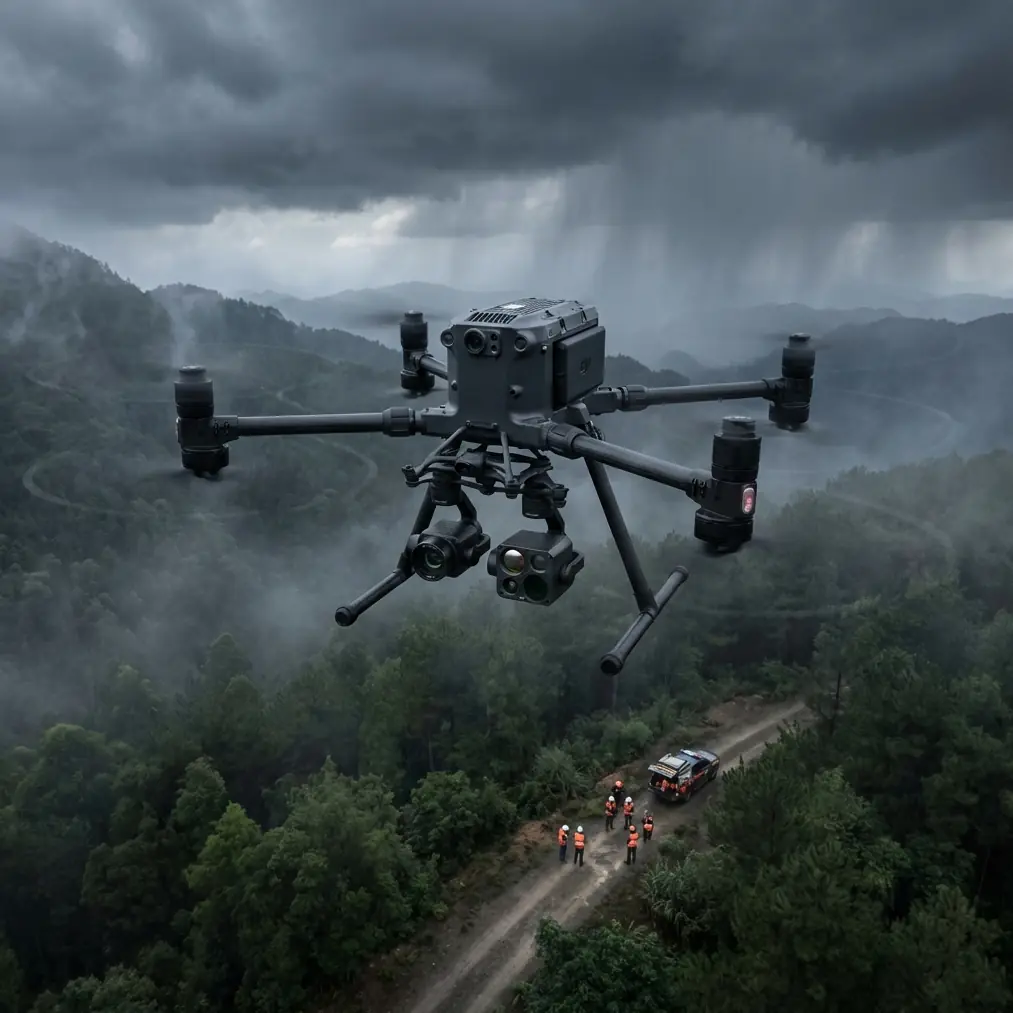
Matrice 400 for Urban Power Line Inspection: A Practical Workflow That Holds Up When Conditions Shift
META: A field-tested tutorial on using Matrice 400 for urban power line inspection, covering photogrammetry, thermal analysis, long-corridor oversight, and resilient operations when weather changes mid-flight.
By Dr. Lisa Wang, Specialist
Urban power line inspection looks simple from a distance. Launch, follow the corridor, capture images, go home. In practice, it is one of the more demanding civilian drone workflows because cities compress risk, data volume, and decision-making into a narrow airspace and a tight schedule. You are dealing with linear assets, dense surroundings, reflective surfaces, shifting wind around buildings, and the need to document not just a defect but its exact location and context.
That is where a platform like the Matrice 400 becomes useful—not as a headline feature machine, but as the center of an inspection system that has to deliver repeatable evidence.
The most overlooked part of that system is not the aircraft. It is the workflow behind it.
The reference material here points to two ideas that matter more than most operators admit. First, long linear infrastructure is hard to manage because work points are scattered and transportation cycles between them are slow. Second, the value of aerial capture rises sharply when the imagery does not stop at collection, but feeds a complete spatial information workflow: acquisition, measurement, display, management, publishing, and sharing. Those are not abstract software terms. For urban utilities, that is the difference between “we flew the line” and “we produced inspection intelligence the engineering team can act on.”
Why Matrice 400 fits the urban corridor problem
Power line inspection in cities is a corridor mission. That sounds obvious, but it changes everything about how the aircraft should be used.
A corridor mission is not just about photographing components. It is about maintaining consistent geometry over a long, interrupted route while capturing enough visual and thermal evidence to support engineering review later. The source material on catenary construction described a similar challenge: lines are long, job sites are numerous, and management becomes difficult when field visibility is fragmented. The same logic applies to urban distribution and transmission inspections. A drone must help the team maintain panoramic control across the full route, not just at isolated poles or towers.
That makes the Matrice 400 especially relevant when paired with a disciplined data pipeline. The aircraft’s role is to gather stable, high-resolution, multi-pass evidence even when environmental conditions change. The operational significance is straightforward: in an urban setting, a missed span often means a repeat deployment, extra traffic coordination, and delayed maintenance decisions.
Start with the inspection objective, not the route
Before propellers move, define which of these tasks you are actually performing:
- Visual defect inspection
- Thermal anomaly detection
- Geometry documentation for engineering records
- Progress oversight for construction or retrofit work
- Corridor-wide situational review for maintenance planning
Most teams try to combine all five in a single sortie and end up degrading each one.
A practical Matrice 400 mission in an urban power environment usually benefits from splitting tasks into at least two flight profiles:
- Close visual and thermal pass for insulators, connectors, clamps, jumpers, and attachment points
- Higher photogrammetric or corridor-context pass for spatial documentation and asset positioning
This division is supported by the photogrammetry references. Software environments such as LPS were built to handle image orientation, aerial triangulation, and multiple sensor types, including multispectral and hyperspectral imagery. That matters operationally because utility inspections increasingly need more than raw photographs. If your Matrice 400 imagery is intended to support measurements, orthomosaics, or terrain-aware corridor analysis, flight geometry has to be planned for processing from the start.
The pre-flight setup that saves the mission later
Urban inspections punish rushed setup. My baseline checklist for Matrice 400 power line work includes the following:
1. Define the thermal question
Do not just “collect thermal.” Identify what abnormal heating would indicate in this specific grid segment. A loose connection? Phase imbalance? Overloaded hardware? Sun angle and surface heating can confuse interpretation, so timing matters.
2. Plan GCP use only where it adds value
Ground control points are useful when the deliverable includes accurate mapping or engineering-grade corridor records. But not every urban line patrol needs a full GCP framework. For fast defect missions, existing control and onboard positioning may be enough. For reconstruction, retrofit planning, or precise asset indexing, GCP-backed photogrammetry improves trust in the final map.
3. Build for data continuity
The source material highlighted a complete workflow that extends from collection through sharing. Treat that as a field rule. File naming, segment IDs, pole numbering, and timestamp synchronization should be defined before takeoff. A thermal hotspot with no clean chain of reference is just an interesting picture.
4. Confirm transmission and security settings
In a city, radio environment is never neutral. O3 transmission stability matters because signal resilience directly affects pilot confidence near cluttered structures and reflective surfaces. If inspection data will be transferred or stored in sensitive utility environments, secure handling matters too. AES-256 is not a marketing extra in these workflows; it is a sensible layer for protecting infrastructure imagery and associated records.
5. Set battery strategy around the corridor, not the launch point
Hot-swap batteries are one of those features that only seems ordinary until the mission is under pressure. On a long urban corridor, reducing turnaround time between segments helps preserve lighting consistency and team rhythm. It also limits the temptation to overextend a single sortie.
A real field moment: when the weather changed mid-flight
On one recent-style urban corridor workflow, conditions began clean enough for a standard two-pass inspection plan. The first pass targeted visual and thermal evidence on hardware along a built-up section where wind was partially shielded by mid-rise buildings. About halfway through the route, the weather shifted. Nothing dramatic. That is usually how it happens.
A moving cloud layer flattened the scene contrast, and gusts started curling unpredictably around rooflines. On the thermal side, the reduced solar loading actually helped by lowering some background heat noise. On the flight side, the corridor became less forgiving.
This is where aircraft stability is only part of the story. The Matrice 400’s value in that moment is not that it “handled weather” in a vague sense. It is that the platform allowed the team to maintain inspection discipline while adjusting the mission:
- The close hardware pass was shortened to prioritize the most failure-critical structures.
- The second photogrammetric pass was re-flown over the affected segment with revised overlap expectations.
- Battery turnover stayed fast through hot-swap replacement, so the team preserved temporal continuity instead of pausing long enough for conditions to shift again.
- Transmission reliability remained usable in an RF-noisy urban block, which prevented a conservative abort from becoming a data gap.
That last point is often underestimated. In urban infrastructure work, continuity of command link and video feed shapes whether the pilot can confidently finish a structured inspection after conditions deteriorate. A technically flyable aircraft is not enough if situational awareness degrades.
Turning Matrice 400 imagery into engineering-grade outputs
A successful inspection is not the flight. It is the handoff.
The reference data on ERDAS and related photogrammetry systems is useful here because it reminds us what mature geospatial workflows are designed to do: ingest imagery from varied sensors, orient it, measure it, model terrain, mosaic outputs, and publish usable information across teams. That is exactly the framework urban utilities need from a Matrice 400 operation.
Visual inspection output
This should include:
- Defect images tied to asset IDs
- A severity tagging scheme
- Cross-referenced location context
- Notes on environmental conditions at time of capture
Thermal signature output
Thermal findings should never stand alone. Pair each anomaly with:
- A visible-light companion image
- Equipment identification
- Approximate load or operational context if available
- Time of day and weather notes
In power line inspection, “thermal signature” is only meaningful when interpreted within operating conditions. The weather change example above shows why. Cloud cover can either clarify or complicate a finding.
Photogrammetry output
Where the mission requires corridor mapping, process the image set into:
- Orthomosaic products
- 3D corridor context
- Measured distances or clearances where appropriate
- Change detection layers for construction or maintenance comparison
This is where one detail from the source material becomes operationally significant: LPS includes an Automatic Terrain Extraction module for digital ground model generation. For urban utility work, terrain and surface modeling can help separate line features from surrounding built form and support route understanding beyond a flat image. Even if your exact processing stack differs, the principle stands: extracting structured spatial information from imagery makes drone inspection more than visual documentation.
Why large-scale aerial measurement matters for urban utilities
The catenary reference emphasized four practical advantages of UAV aerial measurement: high resolution, large scale, lower operational cost, and all-weather capability, even suggesting 24-hour uninterrupted work in maintenance scenarios. For urban power line inspection, those points should be interpreted carefully but seriously.
The “large-scale” advantage is especially useful. Urban utility teams rarely fail because they cannot inspect one component. They fail because they cannot maintain oversight across the whole line, across time, and across different crews. A Matrice 400 deployment can help create that corridor-wide view, which is exactly what the source describes as panoramic control.
Operationally, that means:
- Tracking construction or repair progress along long segments
- Comparing conditions between multiple work points in one consistent visual system
- Reducing the delay between field observation and management visibility
- Giving planners, inspectors, and asset owners the same spatial reference
That workflow is far closer to enterprise asset management than to hobbyist aerial photography.
A step-by-step tutorial for an urban power line mission
Here is the field method I recommend.
Step 1: Break the route into logical segments
Do not plan one monolithic city mission. Split by line type, street density, interference risk, and access points.
Step 2: Assign one mission goal per pass
Thermal and photogrammetry often compete with each other on altitude, speed, and angle. Separate them whenever the deliverable matters.
Step 3: Capture corridor context first if weather is uncertain
If conditions look unstable, secure the broader route record early. Detailed close-up inspection can then be focused where needed.
Step 4: Use repeatable camera geometry
Consistency beats improvisation. Repeatable angles improve comparison between structures and simplify post-processing.
Step 5: Validate a sample set in the field
Check thermal readability, focus, metadata consistency, and asset tagging before moving too far down the line.
Step 6: Rotate batteries on a schedule, not on hope
Hot-swap procedures should be rehearsed. In city operations, quick turnaround protects both productivity and consistency.
Step 7: Process for decisions, not for archives
The final package should answer: What is wrong, where is it, how certain are we, and who needs to act?
The BVLOS question in urban inspection
BVLOS is often discussed as though it is simply a range issue. For urban power line inspection, it is really a systems issue involving procedure, regulation, communications reliability, and risk control. Even when operations remain within current visual constraints, building a Matrice 400 workflow with BVLOS discipline in mind is smart practice. That means stronger route segmentation, cleaner metadata, better redundancy planning, and more formalized handoff between flight and analysis teams.
In other words, mature inspection programs do not wait for advanced permissions to start behaving like advanced operators.
Where teams usually lose value
Not in flight quality. In integration.
They gather excellent imagery and then fail to connect it to the utility’s maintenance workflow. The source material’s emphasis on a unified chain—capture, measurement, management, publishing, sharing—should be treated as the real lesson. The drone is one node in a larger evidence system.
If your Matrice 400 program is being built for urban power line inspection, ask one hard question: can a thermal anomaly found today be traced tomorrow by engineering, compared next month against a mapped corridor record, and reviewed next year as part of trend analysis?
If not, the aircraft is underused.
For teams refining that workflow, it can help to discuss mission architecture with someone who understands both flight operations and geospatial deliverables. If you want to compare inspection layouts, payload logic, or post-processing structure for a specific corridor, you can message our UAV workflow specialist here.
The real promise of Matrice 400 in urban power work
The promise is not just better aerial access.
It is the ability to turn scattered urban line assets into a measurable, reviewable, shared operating picture. The source references make that point from two directions. One comes from the drone side: long, difficult infrastructure projects benefit from aerial measurement because they need full-line visibility, inspection support, and progress control. The other comes from the photogrammetry side: image collection only becomes operationally powerful when it feeds a complete spatial workflow with higher precision and larger data handling capacity.
That is the frame in which the Matrice 400 should be evaluated.
Not as a flying camera alone, but as a field instrument for utility intelligence—especially when the weather shifts, the corridor is long, and the people making decisions are not standing next to the aircraft.
Ready for your own Matrice 400? Contact our team for expert consultation.