
Matrice 400 on Windy Solar Farms: A Field Case Study
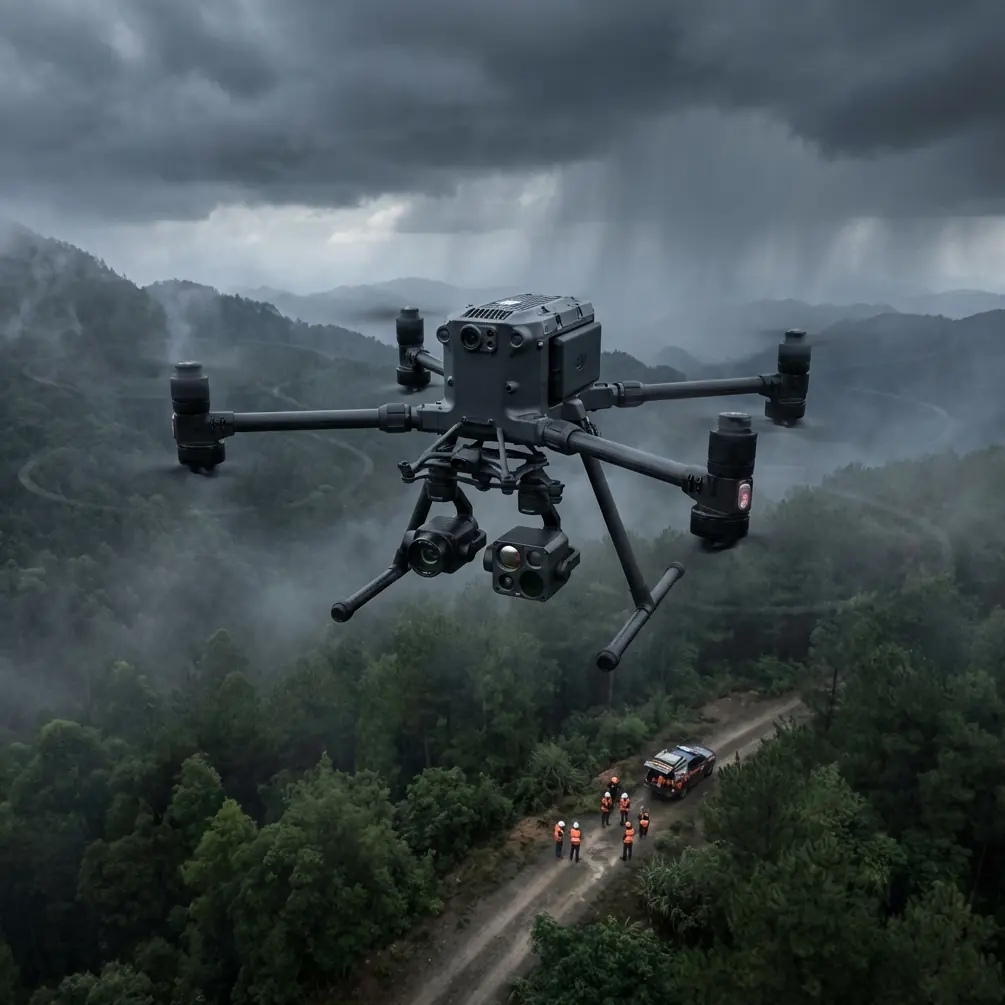
Matrice 400 on Windy Solar Farms: A Field Case Study in Uptime, Access, and Stable Data
META: Expert case study on using Matrice 400 for windy solar farm inspections, with practical insight on maintenance-friendly design, airflow realities, thermal capture, and mission uptime.
By James Mitchell
A utility-scale solar site looks simple from the road. Long rows of modules. Service tracks. Inverters. Maybe a substation off to one side. Once you start inspecting one by air, the simplicity disappears.
Wind behaves differently above panel rows than it does over open ground. Heat shimmer can distort visual interpretation. Dust gets everywhere. And if you are covering large acreage on a tight weather window, the real constraint is not just flight endurance. It is how quickly the aircraft can be turned, checked, cleaned, and sent back out without introducing avoidable failure points.
That is the angle from which the Matrice 400 becomes interesting.
This is not a generic “big drone for big jobs” story. On a recent windy solar farm inspection, what stood out was how aircraft design logic from manned aviation still maps directly onto UAV productivity: accessibility, modularity, fault isolation, and mission continuity. Those principles sound abstract until you are standing next to an aircraft with a thermal payload, trying to finish a high-resolution inspection before afternoon gusts turn marginal.
The operating day: wind, glare, and one unexpected bird
The site was a sprawling solar installation with exposed sections that funneled crosswinds between terrain undulations. Mid-morning was manageable. By early afternoon, gusts had started to push harder along the east-west rows, especially where the panel arrays opened into maintenance corridors. We were flying thermal and RGB passes for anomaly detection and photogrammetry, with GCP-backed checks to keep mapping outputs defensible for engineering review.
Partway through one leg, a large bird lifted from the edge of a drainage channel and cut across the inspection route at low altitude. Not dramatic. Still, it was the sort of moment that tests whether the operator is managing the mission or merely reacting to it. The aircraft’s sensing and route awareness gave enough margin to avoid a rushed correction, and the pilot was able to adjust smoothly without breaking the inspection pattern. In solar work, that matters more than people admit. Every abrupt interruption risks inconsistent overlap, uneven thermal timing, or gaps in the record that later force a reflight.
The point is not wildlife spectacle. It is mission continuity. Solar inspections live or die on repeatable capture.
Why maintenance design matters more than spec-sheet bravado
When people evaluate a platform like the Matrice 400 for solar work, they often jump straight to payload capability, transmission stability, or whether the aircraft can support BVLOS operations under the right regulatory framework. Those are valid considerations. But for repeated inspection work on dusty, windy sites, maintainability often has a larger effect on annual output than one or two headline performance numbers.
A useful reference from civil aircraft design emphasizes that onboard equipment should be placed according to failure rate, adjustment difficulty, disassembly time, weight, volume, labeling visibility, and installation requirements. More importantly, it stresses that when one failed component needs maintenance or removal, the design should avoid forcing technicians to remove other equipment, wiring, cables, or linkages just to get to it.
That idea translates beautifully to professional drones.
In field terms, it means a better aircraft is not simply the one that flies longest. It is the one that lets the crew inspect key components quickly, isolate a problem without tearing half the platform apart, and get back to work with confidence. On a solar farm, where dust intrusion, repetitive battery cycling, and transport-related wear are routine, access is not a luxury. It is an uptime multiplier.
If your aircraft forces layered disassembly to reach a common service item, every mid-day issue becomes an operational drag. If it supports more modular intervention, the crew can keep the inspection program moving.
The hidden value of modular structure on solar inspection jobs
Another reference point from civil aircraft design recommends a combined or modular structure to simplify repair or replacement of faulted parts, while also avoiding centralized overhauls. It also calls for replaceable wear surfaces, service margin in bushings, easy-to-replace seals, and local quick-disassembly features.
That reads like engineering housekeeping. On a solar farm, it becomes very practical.
Windy utility sites are harsh on systems over time. Fine dust works into seals and moving joints. Repeated setup and teardown cycles create their own wear patterns. Even when no major failure occurs, the difference between a modular field-service mindset and a workshop-dependent mindset shows up in schedule reliability.
This is one of the strongest operational arguments for using a serious enterprise platform like the Matrice 400. Not because every part will fail less often by magic, but because the inspection business rewards systems that are easier to check, swap, verify, and return to service. The same reference text also notes that line-replaceable components whose failure affects dispatch availability should support fault isolation and convenient replacement. That concept is directly relevant to drone crews trying to protect sortie count in a shifting wind window.
If your payload, power subsystem, or a mission-critical accessory can be evaluated and exchanged without a cascading teardown, you do not just save technician time. You preserve data continuity, which is usually the more expensive asset.
Windy solar sites are aerodynamic environments, not just open land
There is another technical thread worth bringing in, and it comes from wing aerodynamics rather than maintenance. One source describes how the aerodynamic behavior of high-lift devices changes with wing planform, especially aspect ratio. In a tested straight wing example, reducing aspect ratio from 5 to 2 decreased lift-curve slope, increased the zero-lift angle increment, and increased the critical angle of attack. It also changed pitching moment behavior. At the same time, lower aspect ratio increased profile and induced drag, reducing maximum lift-to-drag performance.
Why does that matter for a Matrice 400 article about solar inspections?
Because many drone operators talk about wind resistance as if it were just a motor-power problem. It is not. Stability in gusty inspection corridors is always tied to aerodynamic compromise. Any aircraft working slowly over infrastructure while carrying sensors has to balance control authority, drag, attitude changes, and imaging consistency. The manned-aircraft data above is a reminder that geometry shapes how an aircraft responds near the edges of its envelope.
For inspection work, the practical takeaway is simple: in wind, “can stay airborne” is not the same as “can collect clean, usable data.” An aircraft may technically hold position while still producing worse thermal alignment, inconsistent photogrammetry overlap, or unnecessary pitch behavior that degrades interpretation. That distinction is often ignored until a data processor starts rejecting sections of the map.
The Matrice 400 conversation should therefore include not just endurance or transmission range, but also how stable the aircraft remains as a data platform when airflow over panel rows becomes irregular. That is where enterprise flight control maturity, payload stabilization, and robust link performance such as O3-class transmission resilience become materially useful.
Thermal signature work in wind is a timing problem
Solar thermal inspection has a narrow band of usefulness. You need irradiance, controlled timing, and enough consistency in pass execution to compare one string against another without introducing your own errors. Wind complicates this because convective cooling can mask or soften thermal signatures.
On the day I am describing, the Matrice 400’s role was less about brute force and more about disciplined repeatability. The goal was to maintain route quality even as gusts changed between row groups. Thermal anomalies in modules and connectors are often subtle before they become obvious failures. If the aircraft wanders, pitches too aggressively, or forces uneven stand-off distance, you may still get imagery, but not equally trustworthy imagery.
That is where a large, stable inspection platform earns its keep. Not by making the atmosphere cooperative, but by reducing how much aircraft behavior adds to the noise floor.
Fast servicing reduces thermal-data risk
One understated point in the aircraft design reference is that service points and access doors should be arranged so ground tasks can happen simultaneously, reducing downtime. In manned aviation, that means refueling, loading, cleaning, and servicing without bottlenecks. For UAV inspection teams, the equivalent is preflight checks, payload swaps, lens cleaning, battery exchange, SD management, and quick visual inspections all happening without unnecessary sequencing.
This is exactly why hot-swap batteries matter on long solar jobs. The raw battery feature is obvious; the deeper advantage is workflow compression. If the aircraft supports quick, orderly turnaround, the crew can keep the thermal inspection inside its preferred weather and irradiance window. Lose too much time between sorties and your comparison set starts drifting with the environment.
That is not a convenience issue. It is data quality protection.
The same logic applies to filters, access panels, and visible test points. Another maintenance principle in the source text says important inspection points, test points, lubrication locations, and fluid fill points should be arranged in accessible positions, and maintenance hatches should ideally support quick opening, preferably without tools. On drone operations, every reduction in tool-driven disassembly lowers the chance of field contamination, missed fasteners, or rushed reassembly.
When the wind is climbing and the site manager wants progress updates, those little design choices become large operational advantages.
Security and transmission are not side topics on infrastructure jobs
Solar developers, EPCs, and asset managers have become far more aware of data governance. Inspection datasets can reveal layout strategy, equipment configuration, maintenance status, and performance trends across critical energy assets. Secure transmission and storage are no longer back-office concerns.
That is why operators increasingly ask about encrypted links, not just video quality. AES-256 support is relevant here because infrastructure inspection often involves moving sensitive imagery across workflows that include remote stakeholders. Pair that with stable transmission architecture, and you get fewer avoidable interruptions during long route execution and better confidence when operations expand toward more advanced mission structures, including compliant BVLOS programs where permitted.
Again, this is not a spec-box exercise. If you lose confidence in the link or in how the data is handled, your operating model changes. You shorten routes. You add caution stops. You create inefficiency. Strong transmission and security support smoother field decisions.
Where Matrice 400 fits on solar farms
The Matrice 400 makes the most sense on solar farms when the operator values three things at once:
- Stable capture in imperfect air
- Fast turnarounds between sorties
- A maintenance philosophy that supports uptime instead of workshop dependency
That combination is more meaningful than raw top-line claims. Windy solar inspections are repetitive, technical, and unforgiving of casual workflow design. The aircraft needs to be a reliable sensor carrier, but it also needs to be a serviceable machine.
The civil aircraft design references used here may seem distant from UAV marketing language, yet they frame the real issue better than most product pages. Accessibility matters. Modular replacement matters. Fault isolation matters. Ground servicing layout matters. Those are not old textbook concerns. They are exactly what determine whether a drone team finishes the site before conditions turn.
And the aerodynamic reference adds another useful caution: airframe behavior is about geometry and trade-offs, not just power. When aspect ratio changes from 5 to 2, lift-curve slope drops and drag penalties rise. In other words, the way an aircraft behaves while trying to produce useful low-speed performance is never free. For drone operators, that should reinforce a healthy respect for stable mission planning, conservative route design, and platform choice based on data reliability rather than brochure drama.
Final field note
By the time we wrapped that inspection, the wind had become the kind that makes crews talk louder without noticing. We had the thermal set, the RGB mapping, and the anomaly review notes tied back to ground observations. No unnecessary reflight. No major interruption from the bird crossing. No avoidable delays between launches.
That is the benchmark I would use for a Matrice 400 deployment on solar farms: not whether it looks impressive on arrival, but whether it protects usable inspection output when the site is dusty, the wind is building, and the workday has no spare hours.
If you are planning a similar workflow and want to compare payload, thermal capture strategy, or field servicing considerations, you can message the integration team directly here.
Ready for your own Matrice 400? Contact our team for expert consultation.