
Matrice 400 in Windy Solar Inspections: A Field Report
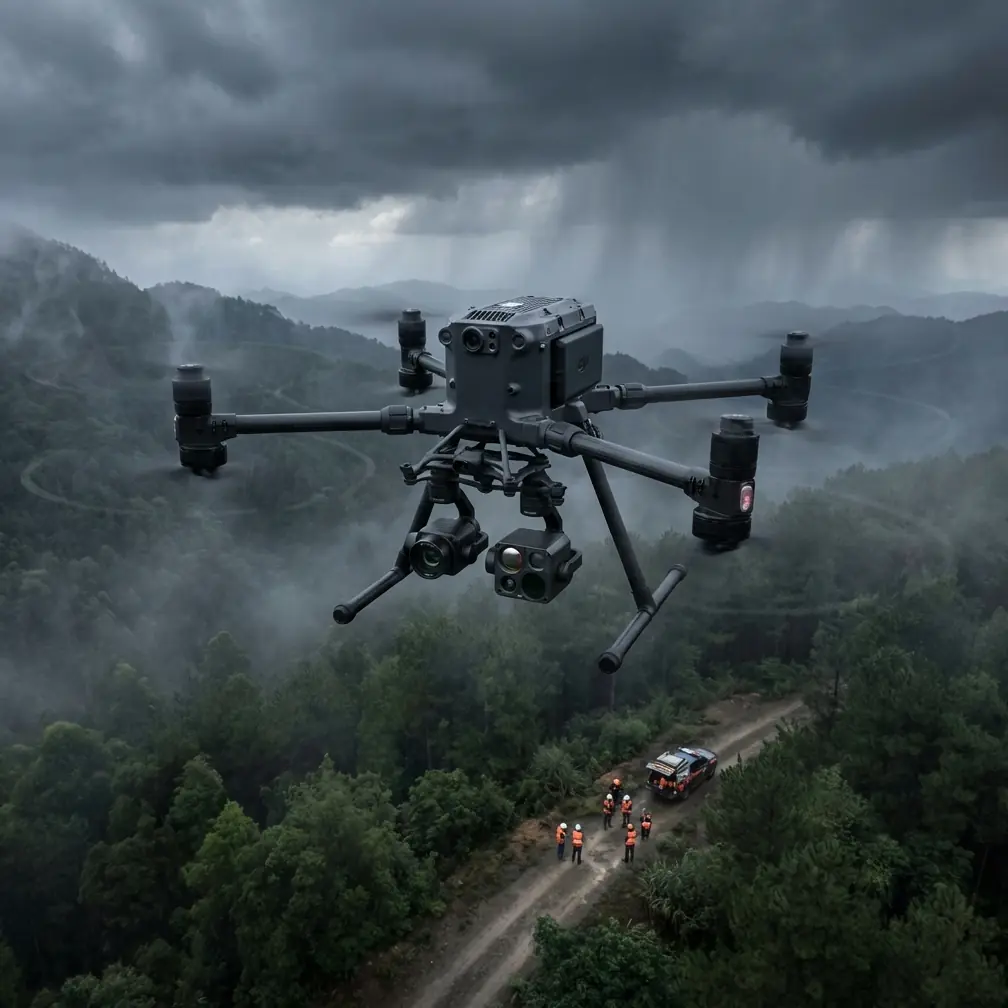
Matrice 400 in Windy Solar Inspections: A Field Report on Reliability, Visibility, and Mid-Flight Weather Change
META: A field-based expert analysis of Matrice 400 solar farm inspections in wind, focusing on reliability engineering, weather handling, visibility, thermal workflow, and mission continuity.
By Dr. Lisa Wang, Specialist
A drone platform reveals its real character when the plan starts to fray.
That is especially true on utility-scale solar sites, where the mission looks straightforward on paper—cover long rows, collect thermal signature data, document anomalies, build photogrammetry outputs where needed, and get out before the weather shifts. In practice, windy environments turn even clean inspection geometry into a test of aircraft discipline, sensor usefulness, pilot decision-making, and system design.
The Matrice 400 story becomes interesting here, not as a product headline, but as an operational question: what kind of aircraft architecture actually holds together when a solar inspection stops being tidy?
On one recent windy-site workflow, the answer had less to do with headline specs and more to do with something older and more fundamental: reliability and maintainability principles that aviation engineers have been emphasizing for decades. The reference material behind this piece comes from aircraft design manuals, and although those texts were written for crewed aircraft and helicopters, their logic translates directly to high-end UAV operations. The key lesson is simple: a capable airframe is not enough. Performance in the field depends on early reliability planning, disciplined system integration, heat management, and a work structure where design choices and maintenance realities are connected from the beginning.
That sounds abstract until the weather changes halfway through a solar mission.
The day the wind stopped being background noise
The site was large, open, and exposed. Typical solar terrain. Wind moved across panel rows with very little interruption, building unevenly along the edges of service roads and inverter blocks. The mission profile combined thermal signature capture with visible-light verification so the client could isolate suspect strings, prioritize on-foot checks, and update asset records without revisiting the entire field.
The first part of the flight was routine. Grid planning was conservative. GCP placement had already been confirmed for the mapping segment. Transmission health remained stable, and the aircraft was holding a predictable track. Then conditions changed. A weather front did not arrive dramatically; it just started to degrade the consistency that inspection crews rely on. Gusts became more irregular. Airborne moisture increased. Contrast shifted across the scene. The sort of moment where operators stop thinking in terms of route efficiency and start thinking in terms of information quality and recovery margin.
This is where the conversation around the Matrice 400 should be more serious than “can it fly in wind?”
Of course that matters. But for solar inspection, the real question is whether the aircraft can continue producing usable inspection data while the environment begins attacking the weak points of the entire workflow: image stability, sensor confidence, pilot visibility, thermal interpretation, return planning, and battery-change timing.
Why an old helicopter reliability lesson matters to a modern drone
One of the most useful references in the source material is from a helicopter design handbook discussing reliability, maintainability, and supportability. It argues that reliability growth must be planned early, funded early, and built through close collaboration between traditional designers and reliability engineers. It also explicitly calls for stronger control over electronic component selection, thermal design, and environmental stress screening.
That is not theory for a library shelf. It is field reality for a drone like the Matrice 400.
A solar inspection aircraft works under repeated environmental stress. Heat from exposed ground. Wind loading over long transects. Start-stop operational cycles. Payload power demands. Transport between sites. Sometimes harsh storage transitions from air-conditioned vehicle to full sun. If a platform is not engineered with thermal discipline and component-level robustness in mind, the first signs often show up not as a dramatic failure, but as small degradations that corrupt commercial missions: inconsistent payload behavior, shortened operational windows, unstable links, maintenance burden, and crew hesitation.
The source text also insists that reliability teams should not be isolated from practical engineering work. In modern UAV terms, that principle matters because flight teams, maintenance technicians, payload specialists, and mission planners all see different failure modes first. The pilot notices handling drift in gusts. The thermography specialist notices that environmental changes are making defect interpretation less clean. The maintenance crew sees connector wear, latch fatigue, and cooling contamination before anyone at a desk does. If those observations are not integrated, the platform may still look capable on a brochure while becoming expensive in the field.
For operators evaluating the Matrice 400 for wind-prone solar assets, this is the deeper lens: not simply whether it flies, but whether its design philosophy supports sustained, repeatable inspection output under stress.
Visibility is not just a cockpit problem
A second reference from the aircraft design manual focuses on windshield rain removal. At first glance, that seems far removed from an unmanned solar mission. It is not.
The manual states that a rain-removal system must preserve enough transparent area for the pilot to maintain forward visibility across all relevant flight conditions. It also gives a concrete design rain benchmark: heavy rain at 15 mm/h, with average droplet volume size around 1500 μm, while noting some environments may demand tolerance beyond that, up to 40.6 mm/h and larger 2300 μm droplets.
For a drone operator, the operational significance is immediate. We may not be cleaning a crewed aircraft windshield, but we are still managing the same problem in another form: preserving usable visibility and sensor clarity as water, mist, and airflow begin to interfere with the mission.
On a solar site, that affects three layers at once.
First, the pilot’s situational confidence. Even with strong digital transmission systems such as O3-class links, the human operator still depends on clear visual interpretation of the live feed, horizon behavior, obstacle context, and landing environment.
Second, payload image quality. Thermal signature collection is only valuable if changing atmospheric conditions do not undermine the interpretation of hotspots, diode issues, string faults, or soiling patterns. Wind can cool surfaces unevenly. Moisture can alter apparent contrast. A technically successful flight can still produce commercially weaker data if environmental conditions shift outside the inspection logic.
Third, recovery safety. When visibility changes, landing quality matters. Dust, moisture, glare, and crosswind all compress the margin for a clean return and a smooth battery swap.
The older aviation standard is useful because it reminds us to think in thresholds, not impressions. “A little rain” is not a meaningful operational category. A system must preserve usable transparency and decision quality through defined environmental stress.
That mindset belongs in every Matrice 400 deployment plan.
The practical value of maintainability on a long solar day
The helicopter handbook also recommends establishing a dedicated reliability and maintainability work system under formal technical leadership, with clear responsibilities assigned across the design organization. Stripped of its original institutional language, the message is straightforward: somebody must own mission continuity.
For field operators, maintainability is where continuity lives.
A windy solar inspection day punishes delays. If your crew loses time during battery changes, payload handling, preflight resets, or troubleshooting after an environmental shift, the cost is not merely schedule inconvenience. Solar thermal windows are time-sensitive. Irradiance changes. Module temperature behavior changes. Shadows move. Wind alters panel cooling. By the time a team recovers from a clumsy interruption, the data consistency needed for comparison may already be gone.
That is why hot-swap batteries are not a convenience feature in this context. They are part of data integrity strategy. When conditions are changing, faster turnarounds help preserve continuity between sorties so that one block of arrays can still be compared with the next under similar field conditions. The aircraft is not just staying airborne longer. The operation is staying coherent.
The same logic extends to transmission security and link reliability. AES-256 encryption may sound like an IT checkbox to some teams, but on infrastructure jobs it matters operationally. Solar developers, EPCs, utilities, and O&M contractors increasingly care about the handling of inspection data, especially when missions are tied to asset condition, maintenance prioritization, and site records. Secure, stable transmission is part of professional readiness, not a side note.
What happened when the weather turned
Back to the field.
As the wind became more erratic, the inspection team had to make a quick judgment: continue the thermal run, pause, or switch the mission sequence. This is where a mature platform helps not by removing decision-making, but by giving the team enough control to make the right decision early instead of late.
The Matrice 400 held the mission long enough to preserve useful data from the active block, but the more important move was procedural. The crew did not keep pushing the original template. They shortened the thermal segment, marked questionable rows for revisit, and used the remaining stable window to secure visible-light reference coverage that would support later review. That kind of adaptation reflects another point from the helicopter reliability guidance: major tests and critical activities should be approached with risk analysis aimed at reducing risk to an acceptable level.
In UAV inspection terms, that means the best operators are not the ones who insist on finishing the plan exactly as written. They are the ones who know when the environment has started to erode data trustworthiness and can restructure the mission before quality collapses.
That is also why BVLOS conversations around aircraft like the Matrice 400 should remain grounded in operational discipline. Extended reach is useful, but on solar assets the value of range only materializes if crews can maintain link confidence, mission awareness, environmental interpretation, and safe contingency logic all the way through the expanded envelope. Distance without reliability is just deferred trouble.
Why wind changes the interpretation of thermal results
One point often missed by teams new to solar thermography: wind is not merely a flight-control variable. It is a measurement variable.
Strong or shifting airflow can change panel cooling behavior enough to reduce the visibility of some thermal anomalies or exaggerate others. That matters because clients do not purchase drone flights. They purchase decision-grade findings.
A Matrice 400 mission on a windy day therefore works best when the crew treats thermal capture, photogrammetry, and field notes as one integrated evidence set. If the thermal signal weakens in a gusty section, visible imagery, georeferenced flight records, and ground verification paths become more important. If GCP-supported mapping is part of the program, that positional discipline can help maintenance teams return to the exact module or string faster, even when the thermal evidence from one pass is less than ideal.
This is another place where the source references help. The aviation manual’s emphasis on early planning and system-level coordination is exactly right. High-value drone inspections do not succeed because one sensor sees everything perfectly. They succeed because the workflow is built so that one dataset strengthens the others when conditions become less cooperative.
A better way to evaluate the Matrice 400
If you are assessing the Matrice 400 for wind-prone solar inspection, I would not start with generic feature comparisons. I would ask five harder questions:
- How well does the platform preserve data usefulness, not just flight capability, when wind and moisture begin changing scene conditions?
- How much downtime is introduced by battery swaps, payload handling, and field resets?
- Does the transmission system support confident decision-making at distance while meeting infrastructure data security expectations?
- Can the operation maintain consistency between thermal and visible workflows when the weather forces a mid-mission adaptation?
- Do the crew’s planning and maintenance practices reflect the reliability-first mindset that aviation engineers have long insisted on?
Those questions are tougher because they point to real operational cost.
The manuals cited in the source material may come from traditional aircraft engineering, but they illuminate the Matrice 400 conversation in a useful way. Reliability should be designed in early. Thermal management matters. Environmental stress matters. Clear responsibility matters. Visibility under rain and changing atmospheric conditions is a serious design issue, not a cosmetic one. Heavy rain design references like 15 mm/h and droplet sizes around 1500 μm are reminders that aviation performance is often decided by specific thresholds, not vague confidence.
That same discipline separates a drone mission that merely flies from one that delivers trusted inspection output.
Final field takeaway
The best thing I can say about the Matrice 400 in windy solar work is not that it makes hard conditions disappear. It doesn’t. No professional platform does.
Its value shows up when conditions become less forgiving and the operation still has structure. The aircraft can support a crew that thinks in terms of reliability, maintainability, secure transmission, and data continuity rather than just airtime. On a solar farm, that difference is substantial. It affects whether a weather-shifted mission still produces actionable thermal findings, whether the site team can keep moving, and whether the client gets a result they can trust.
If your team is planning similar windy-environment inspections and wants to compare workflow options, you can message our field specialists directly to discuss payload planning, thermal capture strategy, and mission design.
Ready for your own Matrice 400? Contact our team for expert consultation.