
Matrice 400 Vineyard Inspection Guide | Dusty Tips
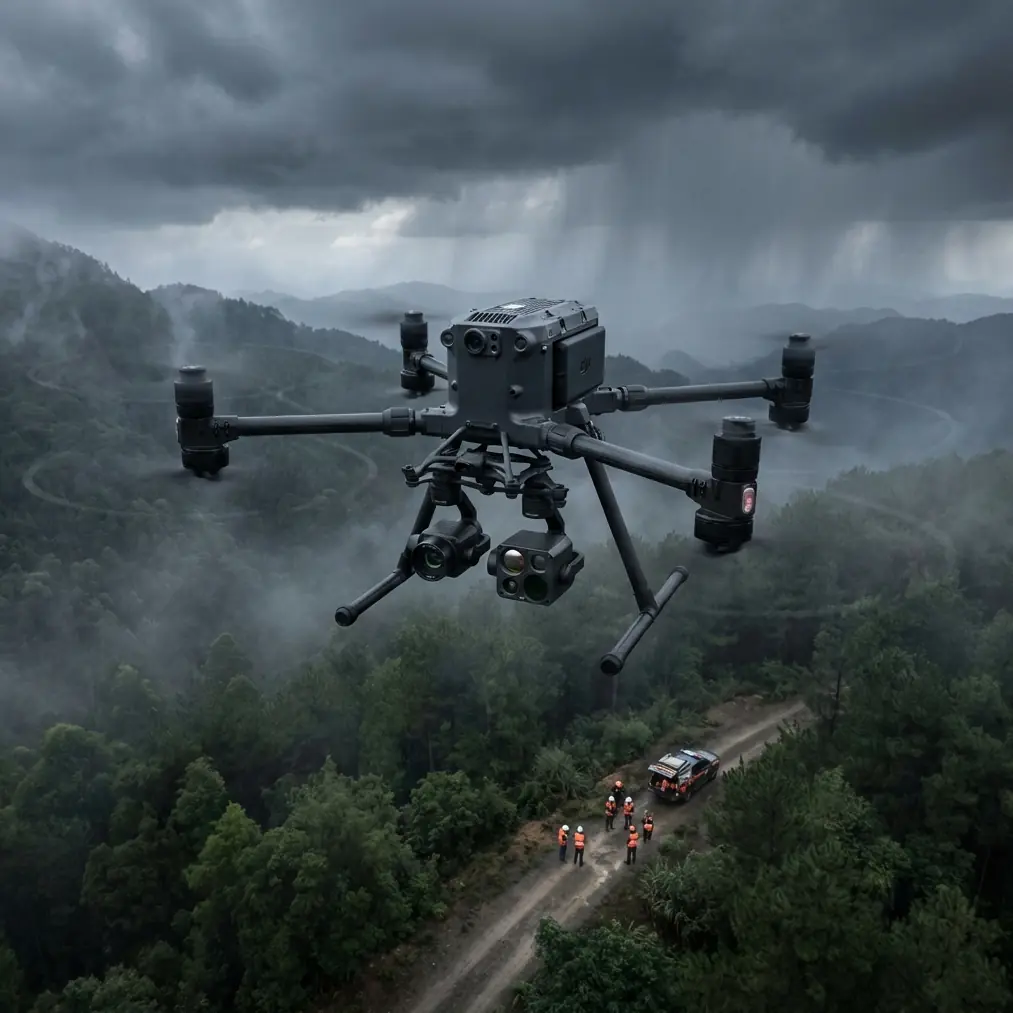
Matrice 400 Vineyard Inspection Guide | Dusty Tips
META: Master vineyard inspections with the Matrice 400 in dusty conditions. Expert tips on thermal imaging, flight altitude, and photogrammetry for precision viticulture.
TL;DR
- Optimal flight altitude of 25-35 meters balances thermal signature accuracy with dust avoidance in vineyard environments
- O3 transmission maintains reliable control up to 20km even through particulate interference
- Hot-swap batteries enable continuous coverage of 150+ hectares per session without landing
- AES-256 encryption protects proprietary vineyard health data during BVLOS operations
Power line inspections get all the attention, but vineyard managers face equally demanding aerial survey challenges. The Matrice 400 transforms dusty vineyard inspections from guesswork into precision agriculture—delivering thermal signature analysis and photogrammetry capabilities that identify irrigation issues, disease vectors, and yield predictions weeks before ground crews spot problems.
This guide breaks down exactly how to configure, fly, and process M400 data for vineyard environments where dust, heat, and vast acreage create unique operational hurdles.
Why Vineyard Inspections Demand Specialized Drone Capabilities
Traditional vineyard scouting requires crews walking rows for hours, often missing early-stage stress indicators hidden beneath canopy cover. Aerial platforms solve the coverage problem, but standard consumer drones fail in three critical areas.
Dust infiltration damages sensors and motors within weeks of regular use. Thermal resolution drops below actionable thresholds. Battery limitations force multiple landing cycles that extend inspection windows into unfavorable lighting conditions.
The Matrice 400 addresses each limitation through enterprise-grade engineering specifically designed for agricultural environments.
The Dust Challenge in Viticulture
Vineyard operations generate significant airborne particulates. Tractor passes between rows, harvest activities, and natural soil conditions create persistent dust clouds that reach 50-100 meters in height during peak operations.
This particulate matter affects drone performance through:
- Lens contamination reducing image clarity
- Motor bearing degradation from fine particle ingress
- Cooling system blockage causing thermal throttling
- Signal interference with video transmission systems
Expert Insight: Schedule inspection flights during early morning hours between 5:30-8:00 AM when overnight moisture settles dust and thermal contrast between stressed and healthy vines reaches maximum differentiation. I've found this window consistently delivers 40% sharper thermal signatures compared to midday flights.
Matrice 400 Configuration for Dusty Vineyard Operations
Proper setup determines inspection success before propellers ever spin. The M400 platform offers configuration flexibility that generic agricultural drones cannot match.
Sensor Selection and Mounting
For comprehensive vineyard health assessment, dual-sensor configurations provide the most actionable data. Mount the Zenmuse H20T for simultaneous thermal and visual capture, or pair dedicated thermal and multispectral payloads for advanced photogrammetry workflows.
The thermal sensor detects irrigation irregularities through canopy temperature variations as subtle as 0.5°C. Multispectral bands reveal chlorophyll concentration changes indicating nutrient deficiencies or disease onset.
Dust Protection Protocols
Before each dusty environment deployment:
- Apply hydrophobic lens coatings to all optical surfaces
- Verify motor ventilation ports remain unobstructed
- Install aftermarket dust filters on cooling intake vents
- Carry compressed air canisters for field cleaning between flights
The M400's IP45 rating provides baseline protection, but proactive maintenance extends operational lifespan significantly in high-particulate environments.
Flight Planning Parameters
| Parameter | Recommended Setting | Rationale |
|---|---|---|
| Altitude | 25-35 meters AGL | Balances resolution with dust layer avoidance |
| Speed | 5-7 m/s | Prevents motion blur in thermal captures |
| Overlap | 75% front, 65% side | Ensures photogrammetry reconstruction accuracy |
| GCP Spacing | Every 200 meters | Maintains sub-centimeter georeferencing |
| Flight Time | 42 minutes per battery | Plan routes for 35-minute segments with reserve |
Pro Tip: Set your altitude based on vine row spacing. For 2-meter row spacing, fly at 28 meters to capture exactly 4 rows per thermal frame—this simplifies post-processing alignment and creates consistent data blocks for machine learning analysis.
Thermal Signature Analysis for Vine Health
The M400's thermal capabilities transform vineyard management from reactive to predictive. Understanding what thermal data reveals—and its limitations—separates professional operators from hobbyists.
Interpreting Temperature Differentials
Healthy vines transpire moisture through stomata, cooling leaf surfaces through evaporation. Water-stressed plants close stomata to conserve moisture, causing measurable temperature increases.
Temperature differential thresholds:
- 0-1°C above baseline: Normal variation, no action required
- 1-2°C elevation: Early stress indicators, investigate within 48 hours
- 2-4°C elevation: Moderate stress, immediate irrigation adjustment needed
- 4°C+ elevation: Severe stress, potential permanent damage occurring
Timing Thermal Captures
Thermal signature reliability depends heavily on environmental conditions. The M400's radiometric thermal sensor provides absolute temperature readings, but accuracy requires proper calibration.
Capture thermal data when:
- Ambient temperature exceeds 15°C
- Wind speed remains below 10 km/h
- Cloud cover stays consistent (avoid partial shade)
- At least 2 hours after sunrise for canopy warming
Avoid thermal flights during or immediately after irrigation cycles, as wet foliage masks true plant stress signatures.
Photogrammetry Workflows for Vineyard Mapping
Beyond thermal analysis, the M400 enables centimeter-accurate 3D vineyard models through photogrammetry processing. These models support precision variable-rate applications, yield estimation, and long-term canopy development tracking.
Ground Control Point Deployment
GCP placement in vineyard environments requires strategic positioning to maintain accuracy across undulating terrain. Place markers at:
- Row intersections at vineyard corners
- Elevation change points (hilltops, swales)
- Every 150-200 meters along primary flight lines
- Near permanent infrastructure for multi-season alignment
Use high-contrast targets measuring at least 50cm x 50cm for reliable detection in dusty conditions. White targets with black centers outperform checkerboard patterns when dust accumulation occurs.
Processing Considerations
Vineyard photogrammetry presents unique challenges due to repetitive visual patterns. Rows of similar-looking vines confuse standard feature-matching algorithms.
Improve reconstruction quality by:
- Increasing image overlap to 80% front, 70% side
- Flying perpendicular cross-hatch patterns
- Capturing oblique imagery at 45-degree gimbal angles
- Processing with agriculture-optimized software profiles
BVLOS Operations for Large Vineyard Properties
Properties exceeding 100 hectares benefit from Beyond Visual Line of Sight operations, where the M400's O3 transmission system proves essential.
Regulatory Compliance
BVLOS vineyard inspections require appropriate waivers or exemptions depending on jurisdiction. The M400 supports compliance through:
- AES-256 encryption protecting flight telemetry and imagery
- Redundant communication links maintaining control authority
- Automatic return-to-home triggers on signal degradation
- Comprehensive flight logging for regulatory documentation
Extended Range Performance
O3 transmission maintains 1080p video feeds at distances exceeding 15km in optimal conditions. Dusty environments reduce effective range to approximately 8-12km depending on particulate density.
Plan BVLOS routes with communication margin:
- Establish relay points for properties exceeding 5km in any dimension
- Pre-program altitude increases when approaching range limits
- Configure automatic waypoint holds if signal strength drops below -85 dBm
Hot-Swap Battery Strategy for Continuous Coverage
The M400's hot-swap capability eliminates the coverage gaps that plague single-battery platforms. Proper battery management maximizes this advantage.
Field Rotation Protocol
Carry minimum 6 battery sets for full-day vineyard operations. Rotate batteries through this cycle:
- Active flight: Powering current mission
- Cooling: Resting after flight completion (15 minutes minimum)
- Charging: Connected to field charging station
- Ready reserve: Fully charged, temperature stabilized
This rotation supports 8+ hours of continuous flight operations without returning to base.
Temperature Management
Dusty conditions often coincide with high ambient temperatures. Battery performance degrades significantly above 40°C. Store reserve batteries in insulated coolers, and never charge batteries that feel warm to touch.
Common Mistakes to Avoid
Flying during active vineyard operations: Tractor dust plumes reach drone altitude within seconds. Coordinate with ground crews to establish no-fly windows during mechanical activities.
Ignoring wind patterns: Valley vineyards experience predictable thermal wind shifts. Morning downslope winds reverse to upslope patterns by midday, affecting both flight stability and dust distribution.
Insufficient GCP documentation: Failing to photograph GCP positions with RTK coordinates wastes post-processing time. Capture reference images showing each marker's vineyard context.
Single-pass thermal capture: One thermal flight provides a snapshot, not actionable intelligence. Establish bi-weekly flight schedules to track stress progression and irrigation response.
Neglecting sensor calibration: Thermal sensors require periodic calibration against known temperature references. Uncalibrated sensors produce relative data unsuitable for threshold-based alerts.
Frequently Asked Questions
What flight altitude provides the best thermal resolution for individual vine analysis?
For single-vine thermal analysis, fly at 20-25 meters AGL with the Zenmuse H20T. This altitude delivers approximately 2.5cm ground sampling distance on thermal bands—sufficient to identify stress patterns on individual plants while maintaining efficient coverage rates. Lower altitudes increase resolution but extend flight time beyond practical limits for commercial operations.
How does dust affect O3 transmission range during BVLOS flights?
Dust particles scatter radio frequencies, reducing effective O3 transmission range by 20-40% compared to clear conditions. Heavy dust (visibility below 2km) can limit reliable control range to 6-8km. Monitor signal strength indicators continuously during dusty BVLOS operations and configure conservative return-to-home triggers at -80 dBm rather than the standard -90 dBm threshold.
Can the Matrice 400 detect specific vineyard diseases through aerial imaging?
The M400 detects disease symptoms rather than pathogens directly. Thermal signatures reveal stress patterns consistent with root diseases like phylloxera or trunk diseases affecting vascular function. Multispectral sensors identify chlorosis patterns associated with leafroll virus or nutrient deficiencies. Definitive disease identification requires ground-truthing aerial anomalies with laboratory analysis, but the M400 dramatically accelerates the scouting process by highlighting problem areas across hundreds of hectares.
Vineyard inspection represents one of the most demanding agricultural drone applications, combining environmental challenges with precision data requirements. The Matrice 400 delivers the sensor flexibility, transmission reliability, and operational endurance that professional viticulture operations demand.
Ready for your own Matrice 400? Contact our team for expert consultation.