
Matrice 400 in Low-Light Wildlife Inspection
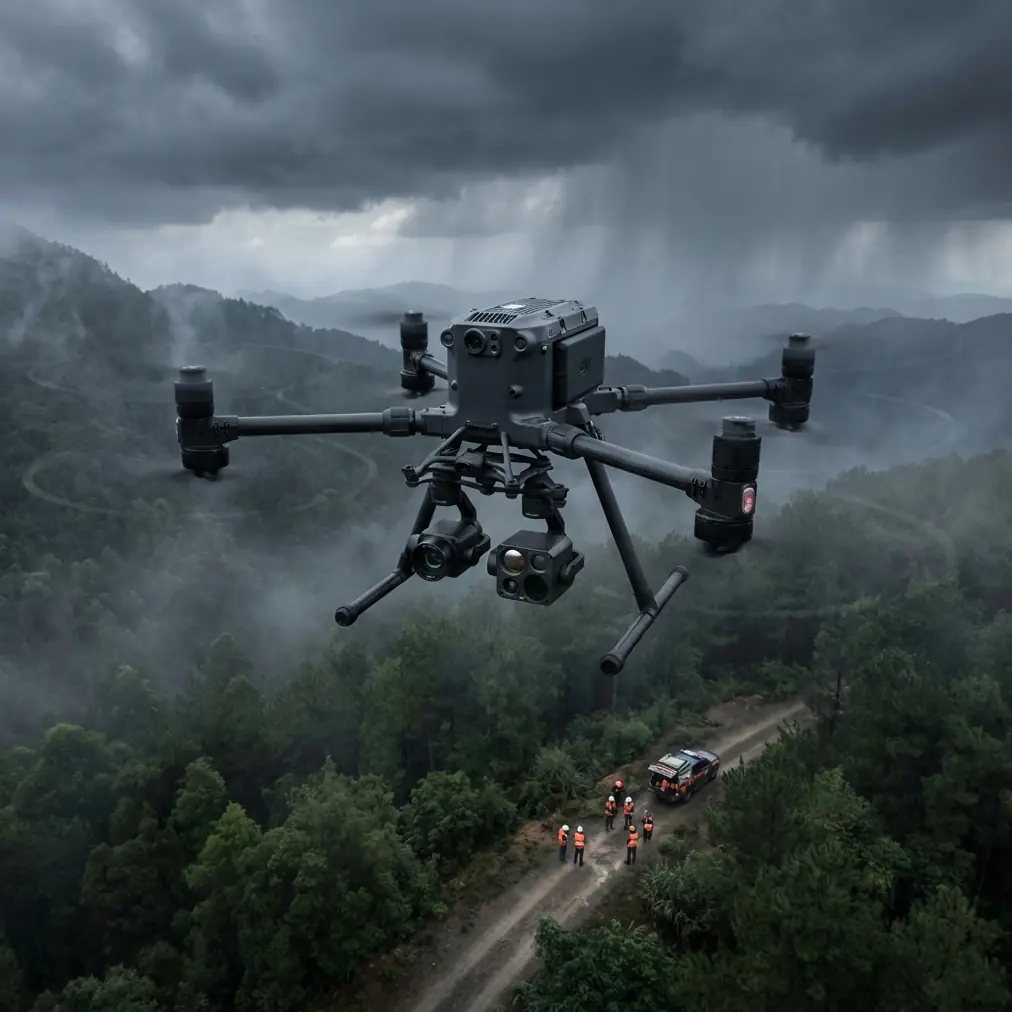
Matrice 400 in Low-Light Wildlife Inspection: What Actually Matters in the Field
META: A field-based case study on using the Matrice 400 for low-light wildlife inspection, with practical insight on thermal signature detection, transmission stability, battery continuity, and airframe design lessons drawn from aircraft engineering references.
I’ve spent enough dawn and dusk operations around wetlands, scrub edge, and utility corridors to know that “low light” is rarely the real problem. The challenge is ambiguity. At 5:20 a.m., a warm patch in grass may be a resting deer, a nest-adjacent mammal, livestock beyond the survey boundary, or retained ground heat throwing off your assumptions. Wildlife inspection succeeds when the aircraft, payload logic, and operator workflow reduce that ambiguity fast.
That is the lens I want to use for the Matrice 400.
Not as a brochure platform. As a working aircraft for a very specific job: civilian wildlife inspection in poor light, where thermal signature separation, stable data links, and endurance discipline matter more than headline specs. The most useful way to understand this aircraft is through a case study mindset, supported by a detail many drone buyers overlook: serious airframe design principles from crewed aviation still explain why some platforms hold up better in repetitive field use.
A dawn marsh survey that changed the flight plan
On one low-light habitat inspection, our team was tasked with checking a reed-lined marsh margin before maintenance vehicles were allowed onto an access track. The goal was simple: confirm whether larger animals had moved into the work zone overnight and identify any heat-producing activity near a known nesting buffer without sending people walking through sensitive ground.
The visual feed was weak in the first minutes. Flat contrast. Heavy moisture. Plenty of texture, not much certainty. Thermal was the decision-maker.
About 130 meters off the track edge, we picked up two distinct warm forms at the base of dense vegetation. At first glance, they looked like one pooled thermal mass with irregular spillover. The aircraft’s stable hover and clean sensor behavior let us hold position long enough to separate the scene properly. What looked like one signature resolved into an adult wild boar and a smaller juvenile partially obscured by brush. That distinction mattered operationally. A single animal would have triggered a delay and route adjustment. A sow with a juvenile changed the risk profile entirely and widened the exclusion area.
This is where the Matrice 400 class of aircraft earns its place. In wildlife inspection, you are not chasing cinematic imagery. You are buying time, certainty, and controlled observation windows.
Why the airframe matters more than people think
Many discussions around inspection drones focus on payloads first. Fair enough. But if you’re flying repeat missions in low light, often with moisture, changing temperature gradients, and extended hover periods, the airframe’s structural logic matters just as much.
One of the provided aircraft design references describes a helicopter structural approach that blends unidirectional carbon fabric, bidirectional carbon fabric, glass fabric, and a paper honeycomb core with a density of 48 kg/m³ and height of 6 mm. Another section identifies a tail gearbox mounting tube as a critical part under alternating loads, built primarily from carbon fabric with localized glass fabric wrapping in 15 and 16 layers around two sections to serve as bush interfaces.
Those are not random material notes from another industry. They illustrate a principle that directly maps to serious drone operations: different parts of an aircraft should not all be built the same way, because they do not carry the same loads, absorb the same vibration, or tolerate damage in the same way.
For a Matrice 400 used in low-light wildlife work, that principle has immediate significance.
- Alternating load resistance matters because wildlife inspection is hover-heavy, stop-start, and often flown in wind-sheltered but turbulent edge environments like tree lines and ravines.
- Material zoning matters because a drone that combines stiffness in primary load paths with more forgiving structures in fairings and non-load-bearing sections tends to preserve alignment and reduce long-term sensor performance drift.
- Sandwich structures matter because lightweight cores can keep mass under control without giving away too much rigidity, which helps maintain predictable flight behavior during extended observation holds.
The same reference also distinguishes non-load-bearing fairings built with aramid fabric skins and foam core. That detail is operationally useful. Aramid-based outer structures are often chosen where impact tolerance and weight efficiency matter, but without demanding that the panel carry the primary structural burden. In practical drone terms, this is a reminder that not every exterior component should be judged the same way. A wildlife operator cares less about cosmetic panel robustness than about whether the core structure stays true after dozens of transport cycles and repeated launches from uneven field setups.
That is one reason I evaluate aircraft like the Matrice 400 through a systems engineering lens. If the platform is meant to support thermal work, photogrammetry passes, and long observation missions, then the hidden mechanical choices are not secondary. They govern whether your imagery remains trustworthy after the 40th field day, not just the first demo.
Low-light wildlife inspection is really a data confidence problem
In the field, the Matrice 400’s value comes from how it supports confidence stacking.
You start with thermal signature detection. Then you validate position, movement, and shape using visual context when available. If needed, you follow with mapped reference imagery, waypoint revisit, or measured stand-off observation. In some projects, especially habitat restoration or protected area management, that process can extend into photogrammetry for terrain or vegetation documentation, where GCP planning still matters if you want defensible spatial outputs rather than rough visuals.
This is where the broader mission profile becomes important. A wildlife team may launch for one reason and finish with three datasets:
- low-light thermal inspection of animal presence
- daylight orthomosaic or corridor mapping for habitat condition
- repeatable georeferenced records for compliance documentation
The Matrice 400 sits in that overlap zone well because operators increasingly need one aircraft to serve both reactive and structured missions. A thermal alert at dawn is useful. A thermal alert tied to repeatable location data and follow-up mapping is far more useful.
Transmission integrity is not a luxury when wildlife is moving
One of the less glamorous but more important clues from the second aviation reference concerns how flight systems manage data output and state logic. It discusses digital output formatting, update timing, and the need to maintain powered states even when active interrogation pauses. It also notes a BCD output transmission rate of 6 per second, and in another mode a scan cycle across multiple foreground stations with average time not exceeding 5 seconds, while measured output time does not exceed 0.2 seconds.
I’m not bringing that up to compare avionic buses to drone links one-to-one. The lesson is architectural: in an aircraft system, data timing and state persistence are part of operational reliability, not an afterthought.
That is exactly why O3 transmission and secure telemetry handling such as AES-256 matter in Matrice 400 wildlife inspection workflows.
In low light, the operator is often making a judgment call from a narrow observation window. An animal steps from cover, pauses, then disappears. If your transmission link is unstable, if latency jumps, or if the data feed drops during the briefest confirmation moment, your mission outcome changes. A robust link does more than preserve image quality. It preserves decision timing.
The security side matters too, especially in environmental work tied to protected species, private land boundaries, or sensitive conservation areas. A platform using AES-256 aligned security practices helps keep location data, habitat findings, and mission records inside the right circle of control. That is not a marketing checkbox. On some wildlife contracts, it is part of responsible data stewardship.
The overlooked advantage of hot-swap workflow
Wildlife activity rarely aligns with battery cycles. The best movement can happen just as you are deciding whether to recover. That is why hot-swap batteries are not simply a convenience feature on a platform like the Matrice 400.
They change the way you plan continuity.
On low-light inspections, we often divide the mission into three phases:
- initial thermal sweep
- hold-and-confirm observation
- secondary route or perimeter verification
Without rapid battery turnover, teams tend to compress phase two, which is exactly when errors happen. They rush classification. They break off before behavior is confirmed. They avoid revisiting a thermal anomaly from a different angle.
Hot-swap capability supports a more disciplined method. Bring the aircraft in, rotate power quickly, relaunch, and maintain operational tempo without rebuilding the entire mission flow. For wildlife inspection teams working under short dawn or dusk windows, that continuity is worth more than another abstract endurance claim.
BVLOS changes wildlife inspection from local spotting to area management
For broader conservation parcels, riverbanks, utility easements crossing habitat, or large agricultural interfaces, BVLOS capability shifts the mission from isolated animal detection to managed area awareness.
Used properly and within the applicable regulatory framework, BVLOS opens up a different scale of observation. You are no longer inspecting only the zone immediately around a launch site. You can build patrol logic around migration edges, water access points, fence-line breaches, and morning heat concentration areas. That matters in low light because wildlife movement patterns are often transitional. They appear at the edge, not in the center.
The Matrice 400 becomes more valuable when the aircraft is not treated as a single-scene camera in the sky, but as a repeatable monitoring node in a larger environmental workflow.
A note on payload discipline
The temptation with a capable platform is to configure for every possibility at once. For wildlife work, restraint usually produces better results.
If the mission priority is thermal detection in low light, build around that first. If visual confirmation is essential, ensure the second sensor supports classification rather than merely prettier footage. If mapping is part of the same project, plan a separate photogrammetry block with proper overlap and ground control expectations. Don’t turn one sortie into an overloaded compromise.
That may sound obvious, but many teams dilute the Matrice 400’s strengths by treating it like a universal airborne toolbox. It is better understood as a stable, adaptable mission platform that rewards clear intent.
What the reference materials quietly teach us about Matrice 400 operations
The two source documents might look distant from a modern drone deployment. They are not.
The first gives us a structural design lesson: use the right material in the right place. The mention of 48 kg/m³, 6 mm honeycomb core, carbon fabrics, glass reinforcement, and aramid-faced foam-core fairings points to a hierarchy of functions inside an aircraft. For Matrice 400 operators, that translates into a simple truth: reliability comes from thoughtful structural distribution, not just from power and sensors. If you want consistent low-light imagery, the aircraft must remain mechanically honest under repetitive load cycles.
The second gives us a systems lesson: output timing, state logic, and transmission reliability are operational features. The details around 6-per-second output, multi-station scan timing, and “remain powered while transmission pauses” reflect a design culture where continuity is engineered. For Matrice 400 missions using O3 transmission, secure AES-256 handling, and structured wildlife workflows, that same mindset is essential. Good aircraft do not merely capture data. They preserve trust in the chain from sensor to operator.
Practical field advice for wildlife teams considering Matrice 400
If your use case is low-light wildlife inspection, here is the standard I would apply.
Choose the Matrice 400 if you need an aircraft that can:
- hold stable observation over uncertain thermal targets
- support secure and reliable long-range transmission behavior
- transition from dawn detection to daytime mapping without changing platforms
- keep mission continuity through hot-swap batteries
- scale toward corridor or reserve monitoring where BVLOS becomes strategically useful
But also commit to a workflow that respects what the platform is for.
Build species-specific thermal interpretation libraries. Log false positives. Cross-check thermal with visible structure when available. Separate incident response flights from mapping flights. Treat transmission quality as part of biological data quality, not just pilot convenience.
If you are shaping a Matrice 400 workflow for habitat surveys, reserve monitoring, or low-light animal exclusion checks, it helps to talk through sensor selection and mission design with someone who has actually built these programs in the field. You can start that conversation here via direct field workflow chat.
The Matrice 400 is most impressive when it shortens the distance between detection and confidence. In wildlife inspection, that distance is everything. It protects animals, reduces unnecessary site intrusion, and gives project teams a defensible basis for action before daylight fully arrives.
Ready for your own Matrice 400? Contact our team for expert consultation.