
Mapping Dusty Construction Sites With Matrice 400
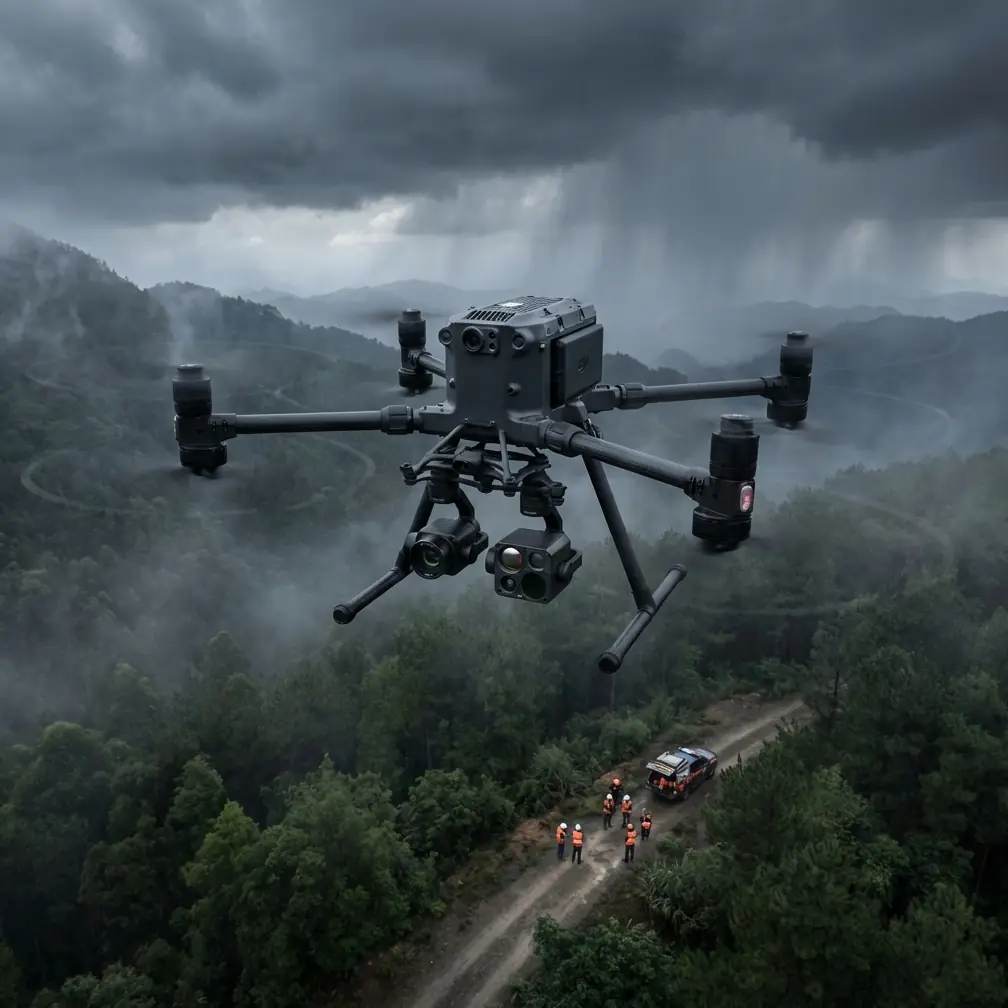
Mapping Dusty Construction Sites With Matrice 400: What Actually Matters in the Field
META: Practical Matrice 400 mapping advice for dusty construction sites, with expert insights on inspection access, fluid-system checks, EMI handling, payload reliability, and maintenance logic drawn from aircraft design and continued airworthiness principles.
Dust changes everything.
On paper, a construction-site mapping mission sounds routine: establish GCPs, launch, fly the grid, process the photogrammetry, deliver surface models and progress data. In reality, dust gets into seals, covers optical surfaces, obscures thermal signature interpretation, and quietly shortens the useful life of components that looked perfectly fine in the lab. If the platform is the Matrice 400, the question is not whether it can map a dirty site. It can. The real question is how to operate it with the kind of discipline that keeps data quality high and downtime low.
That discipline starts with a mindset borrowed from full-scale aircraft engineering.
One of the reference documents behind this discussion comes from a civil aircraft airworthiness framework issued under CAAC guidance in 1991. It may seem far removed from a modern UAV workflow, but the maintenance logic is directly relevant: continued airworthiness documentation should clearly identify maintenance points, fluid container capacities, fluid types, system pressures, inspection and service access cover locations, lubrication points, required support equipment, towing limitations, tie-down procedures, jacking, and leveling data. That is not bureaucratic clutter. It is the operating backbone of any aircraft system expected to work reliably over time.
For a Matrice 400 working a dusty construction corridor, that same logic is the difference between repeatable outputs and avoidable field problems.
The hidden failure chain in dusty mapping work
Dust rarely causes a dramatic failure all at once. More often, it stacks small degradations.
A lens picks up fine particulate and contrast drops. Cooling paths become less efficient. Battery contact areas and external connectors need closer inspection. Access covers that are repeatedly opened in bad conditions stop sealing as cleanly as they did when new. An antenna gets mounted in a less-than-ideal orientation after a rushed battery swap, and suddenly your transmission margin near steel structures is not what it was on the previous flight.
The result may show up as:
- less consistent image quality for photogrammetry
- thermal readings that are harder to interpret
- intermittent transmission weakness near cranes, temporary power distribution, or reinforced concrete cores
- more frequent aborts during long mapping runs
- maintenance time expanding without a formal process to control it
That is why continued-airworthiness thinking matters even for a drone team. The reference material specifically highlights the need to document inspection access locations and system pressures, and both have operational significance on a heavy-duty mapping platform.
Inspection access matters because dusty jobs punish every shortcut. If your preflight and postflight routine does not deliberately cover access points, connectors, cooling inlets, payload interfaces, and battery seating surfaces, contamination becomes a creeping variable in your dataset. System pressure matters because aircraft reliability depends on understanding how contained systems behave under load; translated to UAV operations, the same engineering habit means taking battery, cooling, and environmental load seriously rather than assuming the platform will tolerate endless abuse simply because it flew yesterday.
Why structural engineering concepts matter to UAV operators
The other reference document is a pressure-vessel design text. That might sound even more removed from drone mapping, but the lesson is sharp.
It states that when the ratio of wall thickness to curvature radius exceeds 1/10, the structure behaves as a thick wall, and stress is no longer uniform through the thickness. At that point, bending stress and meridional stress can no longer be ignored, and a bending-theory solution is required. It also points out that boundary effects occur where thickness changes abruptly, loads are discontinuous, or supports meet the structure. Those local stresses decay as you move away from the discontinuity, but they are real and must be accounted for near the joint.
Why should a Matrice 400 operator care?
Because dusty construction work creates exactly the kind of local-condition thinking that separates casual operation from professional operation. Not every problem is global. Many are concentrated at boundaries: payload mounts, gimbal interfaces, battery latches, cover edges, connector housings, antenna brackets, and any place one material or geometry meets another. These are the UAV equivalents of stress concentration zones. They are where dust intrusion, vibration, mounting errors, and wear tend to reveal themselves first.
You do not need to run shell-theory equations on the flight line. But you do need to adopt the engineering habit the source material teaches: pay disproportionate attention to transition zones, because that is where trouble often begins.
The Matrice 400 workflow that holds up on dusty sites
When I configure a Matrice 400 for construction mapping, I do not start with route planning software. I start with mission architecture.
1. Define the data package before you pick the flight plan
A dusty site often needs more than one map product. Standard RGB photogrammetry may be enough for volume calculations and progress tracking, but not always. If haul roads, active stockpiles, recently compacted surfaces, or freshly graded earth are involved, thermal signature can sometimes help identify moisture differences, heat retention, or equipment impact areas that visual imagery does not explain cleanly.
That does not mean thermal should replace photogrammetry. It means the Matrice 400 should be treated as a data platform, not just an airborne camera stand. If you know in advance that thermal outputs are supplemental rather than primary, you can protect schedule and battery use for the imagery that actually drives the deliverable.
2. Build the GCP plan around dust and access, not just geometry
GCPs are easy to discuss in theory and messy in practice. On construction sites, the issue is not simply getting enough control points. The issue is keeping them visible, stable, and unambiguous when dust, vehicle traffic, and changing surfaces work against you.
This is another place where the maintenance-document logic from the airworthiness reference is useful. The source emphasizes clear identification of access locations and practical maintenance procedures. In field mapping terms, that translates into making every operational touchpoint intentional: where crews walk, where batteries are changed, where payload glass is cleaned, where GCPs are checked, and where you stage the aircraft away from dust plumes kicked up by trucks and compactors.
The best GCP layout in the world is wasted if your takeoff and recovery area contaminates the payload every cycle.
3. Use hot-swap batteries to protect mission continuity, not to rush
Hot-swap batteries are one of the most practical tools on a larger drone platform, but they are often used poorly. Teams see time savings and begin treating the aircraft as if it never needs a true pause. On a dusty site, that is backwards.
The value of hot-swap capability is not merely speed. It is controlled continuity. The aircraft can remain mission-ready while the crew inserts a deliberate inspection interval at each battery event. That is the moment to check:
- payload glass and any protective surfaces
- battery seating and contact cleanliness
- antenna position
- external connectors
- vent or cooling-area contamination
- landing gear and underside accumulation
A rushed battery exchange can create the very EMI or transmission instability people later blame on the site environment.
Electromagnetic interference: fix the simple thing first
Construction sites are full of EMI contributors: temporary power systems, generators, tower cranes, comms equipment, site offices, steel framing, and reflective surfaces that complicate signal behavior. If your Matrice 400 is using O3 transmission in this environment, strong link performance depends on more than line of sight.
The fastest field correction is often antenna adjustment.
I have seen crews chase phantom problems in software, reposition the pilot station three times, and even suspect payload faults, when the root issue was basic antenna alignment after setup changes. If you move from a low open staging area to a tighter section of the site bordered by steel and concrete, revisit antenna orientation before the next leg. Small adjustments can materially improve signal resilience, particularly when multipath effects and partial obstructions start stacking.
This is where experience beats habit. Do not wait for a weak-link warning to react. If the site geometry changes, your transmission setup should change with it.
For teams running client-sensitive projects, secure data handling matters too. AES-256 support is not a marketing detail in these environments. Construction mapping often touches staged materials, progress milestones, logistics patterns, and infrastructure layouts that clients do not want floating loosely across unmanaged workflows. Secure transmission and disciplined data handling belong in the same conversation.
Dust management is a data-quality practice
People often frame dust as a maintenance problem. It is a data problem first.
A light film on optics can undermine tie-point quality in photogrammetry without looking dramatic to the naked eye. Fine contamination can also affect how confidently you read thermal signature differences, especially on surfaces already producing low-contrast thermal scenes. If the site includes reflective materials, mixed soil moisture, or heat from machinery, you need all the image integrity you can keep.
That means your Matrice 400 cleaning routine should be built around preservation of measurement quality, not just equipment appearance.
A practical field sequence looks like this:
- land away from active dust sources whenever possible
- inspect optics before battery change, not after takeoff
- check mount interfaces and covers at every mission break
- verify antenna orientation whenever the launch position or sector changes
- review a small image sample before committing to the next block
That fifth step saves more time than people think. Spot-checking image sharpness and consistency after the first section of a mission is far cheaper than discovering alignment issues during processing back at the office.
Inspection access is not paperwork. It is uptime.
The airworthiness reference specifically calls for documentation of inspection and maintenance access cover locations as well as special inspection areas, including procedures for methods such as radiographic and ultrasonic checks in manned aviation. For a Matrice 400 program, the direct lesson is straightforward: know where your access points are, standardize how they are opened and checked, and define what “acceptable condition” looks like before you get into the field.
That gives you three advantages.
First, it reduces missed defects.
Second, it makes post-mission cleaning and checks faster because nobody is improvising.
Third, it creates a maintenance record that can explain performance changes over time.
This matters even more if you are supporting repeated corridor mapping, stockpile measurement, or progress capture over months. Dust exposure is cumulative. If your fleet log only records flight hours and battery cycles, you are blind to one of the biggest variables in construction work: environmental severity.
BVLOS planning only works if the aircraft is treated like a system
For operators working toward BVLOS-style workflows where regulations and site conditions allow, the Matrice 400 becomes less forgiving of casual maintenance culture. Longer routes and broader coverage multiply the cost of small inconsistencies.
The continued-airworthiness source emphasizes that maintenance instructions should include recommended intervals for cleaning, inspection, adjustment, testing, and lubrication, along with troubleshooting information and replacement procedures. That is the right model for scaling drone operations. A BVLOS-capable mindset is not just about command-and-control range. It is about whether the aircraft, payload, transmission setup, batteries, and crew procedures remain predictable when the mission gets longer and the environment gets harsher.
If they do, BVLOS planning starts to become realistic. If they do not, you are just extending risk across more distance.
What I would prioritize on a real Matrice 400 construction mapping job
If I had to simplify all of this into a field brief for a dusty construction project, it would be this:
Treat every boundary like a potential failure point.
Treat every battery swap like an inspection window.
Treat transmission tuning as part of site adaptation, not an afterthought.
Treat dust as a measurement threat, not just a cleaning nuisance.
That approach comes straight out of the source material, even though one reference is about pressure-vessel stress and the other is about civil-aircraft continued airworthiness. The common thread is not theory for theory’s sake. It is operational realism. Local conditions matter. Inspection access matters. Maintenance documentation matters. Load paths and transition zones matter. And the teams that respect those basics usually get the cleanest data with the fewest surprises.
If you are building a Matrice 400 workflow for construction mapping and want to compare payload layout, EMI mitigation habits, or maintenance check structure, you can message our UAV team here.
On dusty sites, the aircraft is only half the story. The rest is process.
Ready for your own Matrice 400? Contact our team for expert consultation.