
Matrice 400 at Altitude: A Construction Mapping Case Study
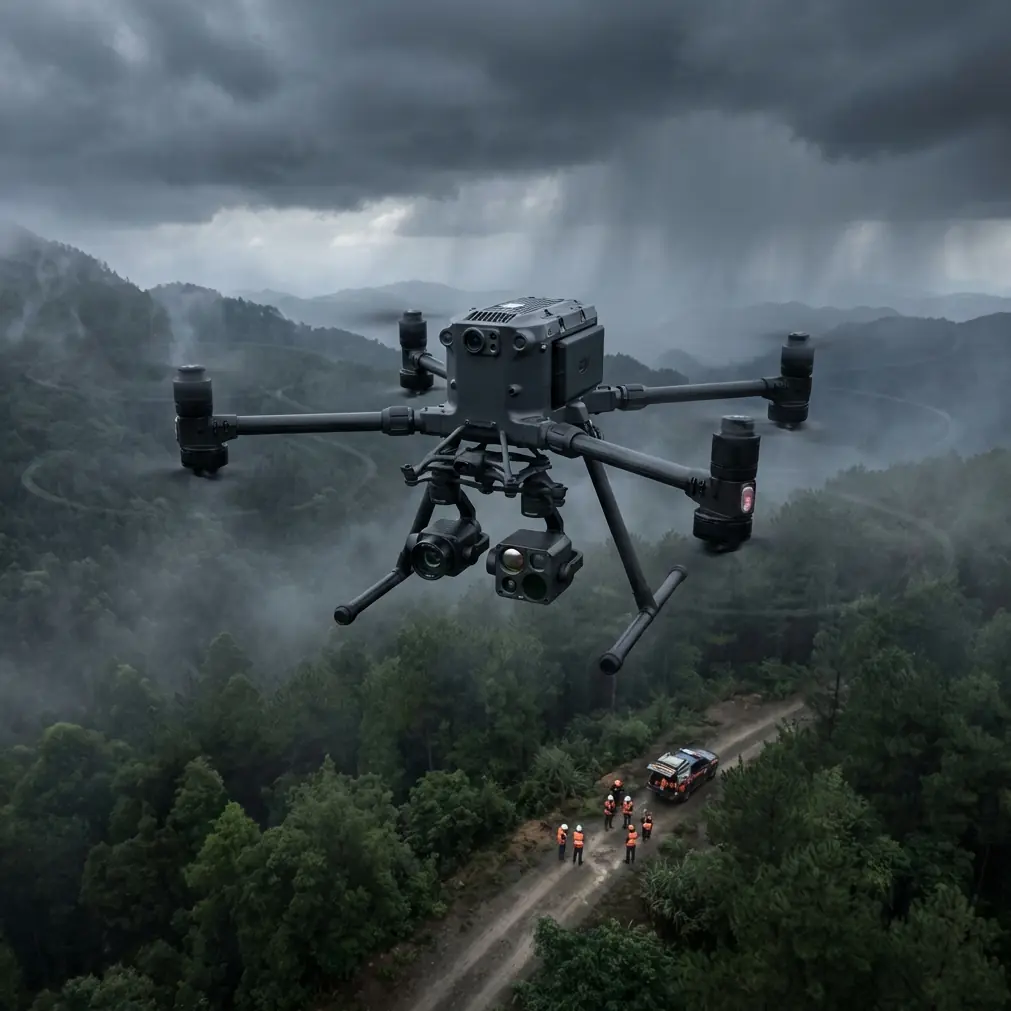
Matrice 400 at Altitude: A Construction Mapping Case Study from the Maintenance Details Most Teams Miss
META: An expert case study on using Matrice 400 for high-altitude construction mapping, connecting field reliability, photogrammetry workflow, connector design, fast maintenance, and hardware standards that matter in real operations.
A drone does not fail a mountain construction survey because the marketing brochure was inaccurate. It fails because small design decisions show up under stress.
I learned that the hard way on a high-altitude infrastructure job where our team was tasked with mapping a stepped construction site cut into a ridge line. We needed clean photogrammetry, dependable transmission, and repeatable flights in thin air with weather windows that opened late and closed early. The aircraft itself mattered, of course. But what separated a productive day from a lost one was not just flight performance. It was serviceability, connector logic, power access, and the kind of hardware discipline that usually gets ignored until something goes wrong.
That is the lens through which I look at the Matrice 400 for construction mapping at elevation.
This is not a generic overview. It is a field perspective on why the design ideas behind maintainability and electrical reliability matter so much when you are trying to produce accurate topographic models, verify grading progress, and collect thermal signature data around active site systems without burning half the shift on troubleshooting.
The high-altitude mapping problem is rarely just about flying
Construction mapping at altitude creates a layered operational problem.
First, you are dealing with terrain. Sloped launch points, uneven access roads, temporary work pads, and a survey area that often expands beyond the original plan. Second, you are dealing with air. High-altitude sites expose every weakness in endurance planning, battery handling, and transmission stability. Third, you are dealing with project pressure. The superintendent wants usable orthomosaics, updated cut-and-fill views, and point cloud outputs that can be reconciled with GCPs fast enough to affect the week’s work.
On one project, our bottleneck was not image overlap or RTK workflow. It was turnaround time between sorties. We had enough daylight to capture the site, but only if the aircraft could be serviced, checked, and relaunched without tools scattered across the tailgate and without technicians second-guessing whether a connector had been seated correctly.
That is where the Matrice 400 class of platform changes the conversation. Not because it magically eliminates field friction, but because the right aircraft architecture makes disciplined operations possible.
Why maintainability becomes a mapping advantage
A buried insight from aircraft electrical system design is that equipment likely to be removed for maintenance should use connectors with enough clearance to connect and disconnect without tools. On paper, that sounds like a workshop convenience. In the field, it becomes a production multiplier.
At a high-altitude construction site, every unnecessary tool step slows your cycle time. If a payload interface, cable connection, or service point requires awkward access, you are not just losing minutes. You are increasing the chances of contamination, poor reconnection, and rushed preflight checks.
That matters on a Matrice 400 mapping workflow because construction jobs often involve mixed payload days. You might run a visible-light photogrammetry mission in the morning, switch to thermal signature verification around mechanical or electrical infrastructure, then return to a standard mapping payload for an as-built update. The easier the aircraft is to inspect and reconfigure, the more realistic that schedule becomes.
The same design reference also stresses that installed equipment should have adequate spacing for maintenance access and that plug-in components should be easy to reach with quick-release style fastening where appropriate. In practical terms, this is the difference between a drone that lives on a spec sheet and one that survives a demanding site program. At altitude, operators work in gloves, in wind, and sometimes on improvised staging areas. Good access is not a luxury. It is an error-control measure.
“Wrong part won’t fit” is more valuable than most crews realize
One of the smartest principles in the reference material is simple: design against mistakes by making incorrect assembly physically impossible. The phrase is blunt—if it is wrong, it should not install.
That mindset is especially relevant for enterprise drones like the Matrice 400. Construction mapping teams often operate under rotation. One pilot, another payload specialist, maybe a survey lead checking GCP placement, maybe a field engineer helping with data handoff. Multiple hands touch the system. That raises the risk of connector mix-ups, especially when operations become repetitive.
The source specifically notes that several electrical connectors in the same area should not only be clearly marked, but should ideally be different types to prevent misconnection. That is more than a wiring best practice. It directly supports uptime.
On a mountain project, we once lost a flight block because a team member reseated a connection incorrectly after a hasty component check. Nothing catastrophic happened. The aircraft simply refused to cooperate until we found the issue. The delay pushed our final mission into gustier conditions and the photogrammetry suffered in the upper benches. Since then, I have become almost obsessive about connector logic and anti-error design.
For Matrice 400 operators, this has operational significance in three areas:
Payload changes
If you are alternating between photogrammetry and thermal capture, any ambiguity in connections increases risk during changeovers.Battery swaps and relaunch speed
Hot-swap batteries only save meaningful time if the rest of the aircraft can be turned around just as cleanly.Training consistency
Anti-error design reduces variation between experienced crews and newer operators.
This is one of those hidden performance factors that never appears in a promotional headline but can save an entire survey day.
Ground power access says a lot about field readiness
Another detail from the electrical design source deserves more attention than it usually gets: ground power sockets should be accessible from the ground, positioned to minimize hazard to personnel, and kept away from exhaust paths or fuel service points. Even though that language comes from broader aircraft practice, the underlying lesson translates cleanly to enterprise UAV operations.
Why? Because site readiness is not just about airborne capability. It is about how safely and efficiently the aircraft interacts with the ground environment.
At a high-altitude construction site, your staging area may be a compact shelf road or a temporary pad shared with survey equipment, utility vehicles, and charging gear. Any aircraft architecture that simplifies safe external power handling, charging logistics, or service access reduces friction at the exact point where field operations tend to become chaotic.
That matters if your Matrice 400 workflow relies on sustained sortie cadence. It also matters when you are integrating encrypted data handling. Teams using O3 transmission and AES-256 are often focused, rightly, on signal integrity and data security. But secure transmission only solves one side of the operational chain. If your ground handling process is clumsy, your mission tempo still collapses.
Hardware standards are not abstract when vibration and cold show up
The second reference, on standard hardware and UNJ thread forms, looks dry until you remember what altitude does to mechanical interfaces.
The source explains that certain UNJ series thread tolerances are defined around specific engagement lengths. For example, the UNJEF, 12UNJ, and 16UNJ families are established using an engagement length equal to 9 times the thread pitch, and can be applied over a range of 5 to 15 times the pitch. It also notes limits around pitch diameter tolerance and circularity, including a threshold at 0.004 in for roundness control.
Most drone users will never cite those numbers on a job site. They still matter.
Here is why: high-altitude construction mapping means vibration, repeated packing and unpacking, temperature swings, and frequent payload or accessory handling. In that environment, fasteners are not trivial. Thread geometry, tolerance discipline, and protective coating on threaded parts all affect whether assemblies remain secure, serviceable, and repeatable over time.
The source also defines coated threads as threads with one or more protective material layers, including solid film lubricants but excluding soft liquid lubricants. Again, not glamorous. But highly relevant. Protective coatings influence wear behavior, corrosion resistance, and consistency after repeated maintenance cycles. On cold, dusty jobs, that can affect whether a component goes back together smoothly or becomes the beginning of a reliability spiral.
For a Matrice 400 used in industrial mapping, this shows up in the real world as confidence. Confidence that a mounting interface will remain true. Confidence that repeated payload swaps will not gradually degrade fit. Confidence that routine handling will not introduce subtle misalignment that later affects image quality or sensor stability.
When your deliverable is a measurable surface model, small mechanical integrity issues become data quality issues.
The real value of fast turnaround on a mountain site
The easiest way to waste a Matrice 400 on a construction project is to think only in terms of headline flight specs.
The harder and more useful approach is to optimize the mission chain.
On our ridge project, the breakthrough came when we restructured around three principles:
- fixed GCP verification before the first sortie
- payload and battery workflow that assumed rapid relaunch
- troubleshooting discipline built around accessibility and connector certainty
That combination mattered more than any single feature. Yes, reliable transmission was crucial. Yes, BVLOS planning affected corridor coverage logic where regulations and approvals allowed it. Yes, thermal signature review added value for checking certain site systems beyond visual progress alone. But none of that would have paid off if the aircraft had been awkward to maintain between flights.
This is why the maintenance concepts in the references feel so relevant to the Matrice 400 reader. They are not academic. They explain what high-performing drone programs quietly do better than everyone else.
They make inspections easy.
They avoid cross-connection mistakes.
They preserve access space around service points.
They use fastening and hardware practices that hold up under repeated field cycles.
A mapping team that respects those ideas will usually outperform a team with the same aircraft and weaker discipline.
How this changes photogrammetry quality in practice
There is a tendency to separate airframe reliability from mapping accuracy. On difficult sites, that is a mistake.
Photogrammetry depends on repeatability. Repeatable launch timing, repeatable sensor mounting, repeatable power behavior, repeatable mission execution. If maintenance access is poor, if connectors are too easy to confuse, if hardware fit degrades, repeatability suffers first. The orthomosaic issues show up later.
This is particularly true at altitude where you may already be stretching environmental margins. A clean GCP strategy can compensate for some issues in geospatial control, but it cannot fix unstable operational habits. The Matrice 400 becomes far more useful when the aircraft is treated as a maintainable system rather than just a flying camera carrier.
That is also why experienced teams care about built-in fault indication and diagnostic support. The electrical-system reference explicitly recommends fault display and onboard self-test or diagnostic means so crews can identify issues quickly and make sound judgments. On a live construction program, quick fault isolation is not just convenient. It protects your weather window and keeps minor issues from corrupting mission planning for the rest of the day.
If I were setting up a Matrice 400 program for alpine construction work today
I would focus less on feature chasing and more on workflow resilience.
I would define payload changes around anti-error procedures.
I would treat hot-swap batteries as a time-saving tool only if the rest of the turnaround supports them.
I would verify that every service point is reachable without awkward tool dependency.
I would standardize inspection around connectors, mounting interfaces, and threaded hardware condition.
I would ensure operators understand why these details affect data quality, not just maintenance neatness.
And I would build communication discipline around the realities of the site. Strong transmission and encrypted links such as O3 and AES-256 are valuable, but they should sit inside a system that is physically and procedurally robust from takeoff pad to data handoff.
If your team is evaluating that kind of setup, it helps to discuss the workflow rather than just the aircraft. You can do that directly through our field setup chat for Matrice 400 planning.
The bigger takeaway
The Matrice 400 makes the most sense on high-altitude construction mapping jobs when you judge it the way serious aviation systems are judged: not only by capability, but by reliability, maintainability, and resistance to human error.
That is where the reference details become surprisingly powerful. A connector that cannot be mistaken for its neighbor. Clearance that allows disconnection without tools. Fault indication that speeds diagnosis. Hardware standards that control engagement and tolerance, including thread systems designed around measurable ranges like 5 to 15 times pitch engagement and dimensional controls around 0.004 in. These are not side notes. They are part of what keeps a mapping operation productive when the site is remote, the air is thin, and the schedule is unforgiving.
In my experience, that is the real test.
A Matrice 400 is not just useful because it can collect data over a construction site at altitude. It is useful because the right design and maintenance logic let the crew keep collecting good data after the first battery cycle, after the second payload swap, and after the first unexpected field problem.
That is what makes the model easier to trust on serious work.
Ready for your own Matrice 400? Contact our team for expert consultation.