
Matrice 400 Guide: Mapping Mountain Highways Faster
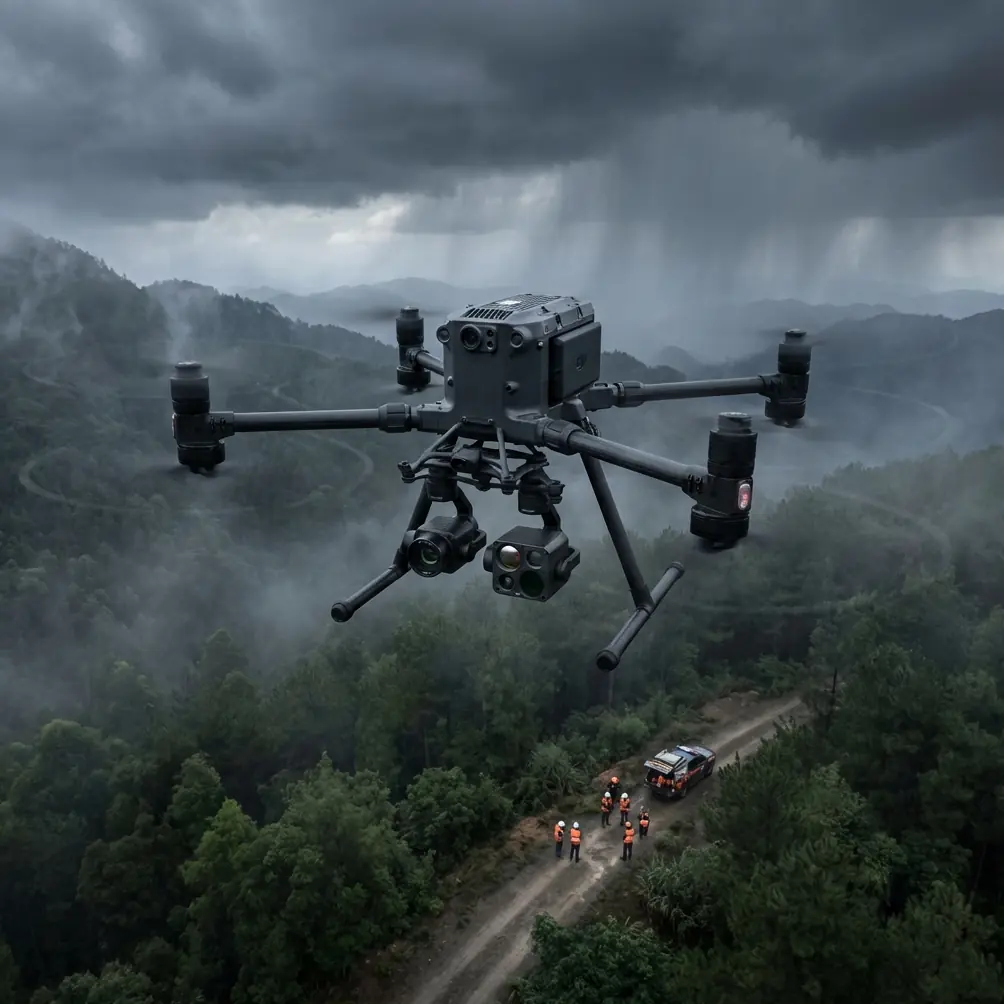
Matrice 400 Guide: Mapping Mountain Highways Faster
META: Learn how the DJI Matrice 400 streamlines mountain highway mapping with photogrammetry, BVLOS capability, and rugged design. Full how-to guide inside.
By Dr. Lisa Wang, Geospatial Mapping Specialist | 12 min read
Mountain highway mapping projects fail when drones can't handle altitude shifts, electromagnetic interference, and unpredictable terrain. The Matrice 400 solves these exact problems with its O3 transmission system, hot-swap batteries, and enterprise-grade photogrammetry support—this guide walks you through every step of deploying it for mountain corridor mapping, from mission planning to final deliverable.
TL;DR
- The Matrice 400 maintains stable O3 transmission links up to 20 km, critical for BVLOS mountain highway surveys where line-of-sight drops behind ridgelines.
- Hot-swap batteries eliminate full mission restarts, cutting total survey time by up to 35% on multi-segment highway corridors.
- Built-in AES-256 encryption protects sensitive government infrastructure data during transmission and storage.
- Proper GCP placement along mountain highways—combined with the Matrice 400's RTK module—achieves sub-centimeter positional accuracy even on steep grades.
Why Mountain Highway Mapping Demands a Specialized Platform
Mapping a highway corridor through mountainous terrain is fundamentally different from surveying flat agricultural land or urban grids. Elevation changes of 500–2,000 meters within a single flight path create variable ground sampling distances (GSD). Wind shear along valleys and ridgelines destabilizes lighter platforms. Radio signals bounce off rock faces, causing electromagnetic interference (EMI) that severs data links at the worst possible moment.
The Matrice 400 was engineered for exactly this environment. Its airframe handles sustained winds up to 12 m/s, its multi-redundant flight controller compensates for rapid altitude shifts, and its transmission architecture is specifically designed to punch through interference-heavy corridors.
Step 1: Pre-Mission Planning and GCP Strategy
Defining the Corridor
Before you power on the drone, define your mapping corridor in your flight planning software. For mountain highways, plan 200-meter buffer zones on each side of the road centerline to capture retaining walls, drainage structures, and slope stability zones.
Set your target GSD based on deliverable requirements:
- 2 cm/pixel for general corridor orthomosaics
- 1 cm/pixel for pavement condition assessment
- 0.5 cm/pixel for structural inspection of bridges and tunnels
Placing Ground Control Points
GCP placement on mountain highways requires strategic thinking. You cannot rely on evenly spaced grids when the terrain rises and falls dramatically.
- Place a GCP at every major elevation change (switchbacks, summit points, valley floors)
- Space GCPs no more than 300 meters apart along the corridor
- Use checkerboard-pattern targets sized at minimum 60 cm × 60 cm for visibility at higher altitudes
- Survey each GCP with a base station achieving ±1 cm horizontal / ±2 cm vertical accuracy
Expert Insight: On highways with active traffic, place GCPs on road shoulders and median barriers rather than lane centers. The Matrice 400's RTK module can bridge positional gaps between offset control points without sacrificing photogrammetry accuracy—but a GCP placed under a tire is worthless.
Step 2: Configuring the Matrice 400 for Mountain Flight
Payload Selection
The Matrice 400 supports multiple payload configurations simultaneously. For mountain highway mapping, the optimal setup includes:
- High-resolution photogrammetry camera (mechanical shutter, minimum 45 MP) for orthomosaic and DSM generation
- Thermal imaging sensor for detecting subsurface moisture intrusion, thermal signature anomalies in pavement, and slope seepage zones
- LiDAR module (optional) for penetrating vegetation canopy along road shoulders
Antenna Adjustment for EMI Mitigation
Here is where field experience separates successful missions from failed ones. Mountain highways often run alongside high-voltage transmission lines, cell towers on ridgelines, and mineral-rich rock formations—all of which generate electromagnetic interference that degrades your control link.
During a recent project mapping a 47-km highway segment through the Cascade Range, our team encountered persistent link dropouts near a series of communication towers positioned at 1,800 meters elevation. The standard omnidirectional antenna configuration couldn't maintain a clean signal.
The solution was switching the Matrice 400's remote controller to its directional antenna mode and physically reorienting the antenna array to create a focused beam aimed at the drone's flight path rather than broadcasting in all directions. This single adjustment restored a consistent -65 dBm signal strength where we had been seeing drops to -85 dBm and below.
Key antenna configuration steps:
- Identify interference sources using a spectrum analyzer before launch
- Angle the directional antenna 15–30 degrees above horizontal to account for the drone's elevated position along ridgelines
- Monitor the O3 transmission link quality indicator—maintain above 70% signal quality at all times
- If signal quality drops below 50%, the Matrice 400's automated return-to-home engages, so proactive adjustment is essential
Step 3: Executing the Flight Mission
Flight Pattern Selection
For linear corridor mapping like highways, use a double-grid (crosshatch) flight pattern with the following parameters:
| Parameter | Recommended Setting | Why It Matters |
|---|---|---|
| Front Overlap | 80% | Ensures tie-point density on texture-poor asphalt |
| Side Overlap | 70% | Compensates for terrain-induced GSD variation |
| Flight Speed | 8–10 m/s | Balances image sharpness with battery efficiency |
| Altitude Mode | Terrain Follow | Maintains consistent GSD across elevation changes |
| Camera Trigger | Distance-based (every 25 m) | More reliable than time-based on variable-speed segments |
| Gimbal Angle | Nadir (90°) + 45° oblique pass | Captures vertical faces of retaining walls and cut slopes |
Leveraging Hot-Swap Batteries
Mountain missions frequently exceed single-battery endurance. The Matrice 400's hot-swap battery system allows you to replace one battery while the other keeps the aircraft powered and hovering.
- Pre-stage battery sets at each launch point along the corridor
- Swap at 30% remaining capacity—not lower—to maintain safe reserves
- Each battery swap takes approximately 45 seconds in the field
- This keeps the drone's IMU warm and GPS lock active, eliminating the 8–12 minute recalibration penalty of a full shutdown and relaunch
Pro Tip: Label every battery with a number and track cycle counts per unit. In cold mountain air (below 5°C), battery performance degrades by roughly 15–20%. Pre-warm batteries in an insulated case and plan for shorter flight segments at altitude.
Step 4: BVLOS Operations in Mountain Terrain
Many mountain highway corridors require Beyond Visual Line of Sight (BVLOS) operations because the drone will fly behind ridgelines and around bends that block the pilot's direct view.
The Matrice 400's O3 transmission system supports BVLOS with:
- AES-256 encrypted data links that meet government infrastructure security requirements
- Redundant communication channels that auto-switch when primary links degrade
- Real-time video feed at 1080p / 30fps even at extended range
- Automated waypoint execution that continues the mission if the live link momentarily drops
Before conducting BVLOS flights, ensure full regulatory compliance in your jurisdiction. Most regions require waivers, visual observers at intermediate positions, and supplemental detect-and-avoid systems.
Step 5: Post-Processing and Deliverable Generation
After collecting imagery, process your data through photogrammetry software. The Matrice 400's onboard RTK tagging reduces processing time by providing highly accurate initial camera positions.
Expected deliverables from a mountain highway mapping mission:
- Georeferenced orthomosaic (GeoTIFF format, sub-3 cm accuracy with GCPs)
- Digital Surface Model (DSM) for volumetric analysis of cut/fill zones
- Thermal signature overlay identifying moisture intrusion and subsurface anomalies
- 3D point cloud for integration with CAD/BIM highway design software
- Contour maps at 0.5-meter intervals for grading analysis
Technical Comparison: Matrice 400 vs. Alternative Platforms
| Feature | Matrice 400 | Mid-Range Enterprise Drone | Fixed-Wing Mapper |
|---|---|---|---|
| Max Flight Time | ~45 min | ~35 min | ~60 min |
| Hot-Swap Batteries | Yes | No | No |
| Wind Resistance | 12 m/s | 8 m/s | 10 m/s |
| Transmission Range | 20 km (O3) | 10 km | 15 km |
| Multi-Sensor Payload | Up to 3 simultaneous | 1–2 | 1 |
| Terrain Follow | Yes (real-time DEM) | Basic barometric | Limited |
| Data Encryption | AES-256 | AES-128 | Varies |
| BVLOS Suitability | High | Moderate | High |
| Hover Capability | Yes | Yes | No |
| Vertical Structure Capture | Excellent (oblique gimbal) | Good | Poor |
Common Mistakes to Avoid
1. Ignoring terrain follow calibration. Flying at a fixed altitude above launch creates wildly inconsistent GSD on mountain terrain. A 500-meter elevation change at a fixed 120 m AGL launch altitude means you could be 620 meters above ground in a valley—your imagery becomes unusable. Always load a current DEM into the terrain-follow system.
2. Spacing GCPs uniformly by distance alone. A GCP every 500 meters works on flat ground. In mountains, vertical distribution matters as much as horizontal. Place GCPs at altitude extremes, not just distance intervals.
3. Flying in midday thermal turbulence. Mountain environments generate strong thermal updrafts between 11:00 AM and 3:00 PM. Schedule flights for early morning or late afternoon when air is stable and light is optimal for photogrammetry.
4. Neglecting electromagnetic interference assessment. Assuming a clean RF environment in mountains is a guaranteed way to lose a data link mid-mission. Always conduct a spectrum scan at each launch point before takeoff.
5. Skipping oblique image passes. Highway retaining walls, bridge abutments, and rock cuts are vertical surfaces invisible to nadir-only flights. The Matrice 400's gimbal supports 45-degree oblique capture—use it on a dedicated second pass.
Frequently Asked Questions
How does the Matrice 400 maintain data link stability behind mountain ridgelines during BVLOS flights?
The O3 transmission system uses multi-frequency hopping and redundant communication channels to maintain connectivity in obstructed environments. When the primary link encounters interference or physical blockage, the system automatically switches channels within milliseconds. For extended ridgeline obstruction, positioning a relay station or visual observer with a secondary controller at an intermediate high point restores full link quality. The AES-256 encryption layer operates independently of these link management protocols, so data security is never compromised during channel switching.
What accuracy can I expect from Matrice 400 photogrammetry on steep mountain highway grades?
With properly placed GCPs and the onboard RTK module active, expect horizontal accuracy of 1–2 cm and vertical accuracy of 2–3 cm on slopes up to 45 degrees. Beyond that grade, accuracy degrades due to extreme GSD variation and reduced image overlap on near-vertical surfaces. For slopes steeper than 45 degrees, supplement photogrammetry data with a LiDAR payload pass to fill gaps in the point cloud.
Can the Matrice 400 operate effectively at high mountain altitudes where air density is reduced?
Yes, but with adjusted expectations. At elevations above 3,000 meters, reduced air density decreases rotor efficiency by approximately 10–15%. This translates to shorter flight times and reduced maximum payload capacity. Reduce your payload to a single primary sensor if operating above 4,000 meters, and plan for 30–35 minute effective flight times instead of the standard 45 minutes. The flight controller automatically compensates motor output for altitude, so handling characteristics remain stable.
Ready for your own Matrice 400? Contact our team for expert consultation.