
Matrice 400 for Dusty Power-Line Mapping
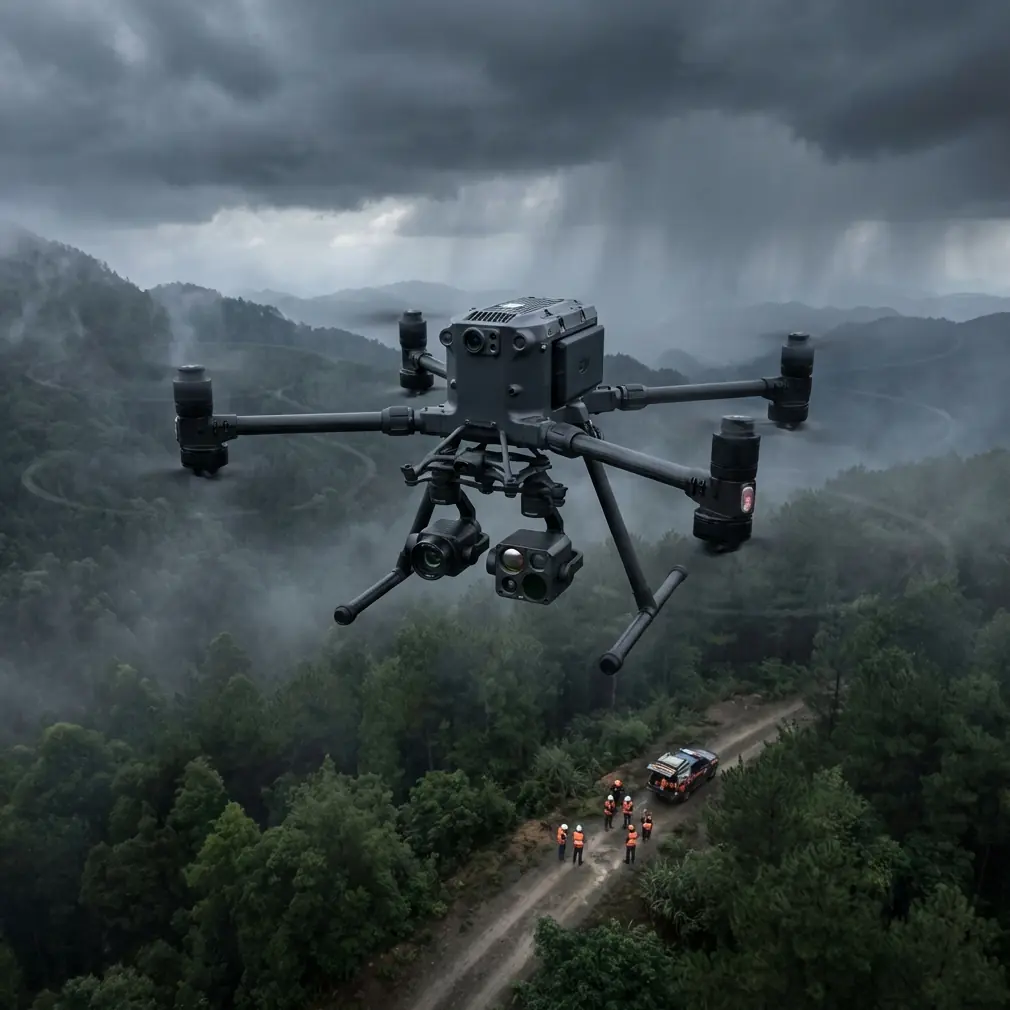
Matrice 400 for Dusty Power-Line Mapping: What Actually Matters in the Payload and Airframe
META: Expert tutorial on configuring a Matrice 400 for dusty power-line mapping, with practical insight on sensor behavior, composite structure considerations, transmission, thermal work, photogrammetry, GCP strategy, and field reliability.
Power-line mapping sounds straightforward until the site starts fighting back.
Dust in the air softens visual contrast. Repetitive tower geometry can confuse operators who rely too heavily on live view. Long linear corridors stress transmission links and mission planning discipline. And if your job involves both corridor mapping and thermal review, the payload stack starts to matter as much as the aircraft itself.
For operators looking at the Matrice 400 for this kind of work, the real question is not whether it can fly a line inspection mission. It is how to configure and operate it so the data remains usable when conditions are less forgiving. That means thinking beyond headline specs and looking at two things that often get ignored: how the sensing chain behaves under ambiguity, and how the airframe design choices affect reliability when the mission includes vibration, dust, repeated launches, and long workdays.
I want to frame this from a field-operations perspective, specifically for dusty power-line mapping with photogrammetry, thermal capture, and repeatable corridor workflows.
Start with the weak point: dusty air punishes bad sensing assumptions
One of the more useful technical ideas buried in classic avionics literature is the tradeoff between simple wideband signal detection and more selective receiver architectures. A basic crystal video receiver is described as light, compact, and inexpensive, but it loses frequency and phase information and can miss critical signals when they overlap in time with others. By contrast, a superheterodyne architecture offers better sensitivity and frequency selectivity.
Why bring that up in a Matrice 400 article?
Because it mirrors a problem drone teams run into with power-line work. In dust, glare, and background clutter, the simplest “I can see it on screen, so I can map it” mindset breaks down fast. If your payload strategy only gives you a broad visual impression, you may capture footage that looks acceptable in the field and still discover later that key details were masked by environmental noise.
That is where the Matrice 400 becomes more interesting when paired with a stronger sensor workflow rather than a bare-minimum one. On corridor jobs, especially near substations, transformer yards, or mixed terrain with heat shimmer and suspended dust, you want the operational equivalent of a more selective receiver: payloads and settings that preserve discriminating detail instead of just producing a live image.
The reference material cites a wideband superheterodyne receiver covering 4 to 26 GHz, with 80 dB mirror-frequency suppression and 300 ns recovery time. Those are avionics numbers from another domain, but the operational lesson transfers cleanly: selectivity, suppression of false responses, and fast recovery matter when the environment is busy. For Matrice 400 users, the practical translation is this:
- choose payload modes that separate thermal anomalies from solar loading and dusty haze
- avoid relying on one viewing angle or one spectral source
- use mission plans that allow fast reacquisition after brief visual degradation
- validate data in the field before moving downline
A dusty corridor is full of “false positives” in the visual sense. You need a stack that helps remove them.
The sensor stack should be built around task separation
For power-line mapping, crews often try to combine every objective into one flight: orthomosaic capture, tower modeling, conductor clearance checks, hotspot screening, and contextual video. That usually leads to compromises everywhere.
A better approach with the Matrice 400 is role separation by sortie or by segment:
1. Corridor photogrammetry pass
This flight exists to generate clean geometry. Your priorities are overlap, shutter discipline, consistent altitude above corridor, and GCP strategy where terrain or asset importance justifies it.
2. Targeted thermal pass
This flight is for thermal signature interpretation, not map-grade geometry. You want stable viewing angles, controlled speed, and attention to surface heating conditions.
3. Detail inspection pass
This is where zoom, oblique angles, and tower-specific observations come in.
The mistake is assuming one broad capture mode can answer all three needs. It usually cannot, especially in dust.
Dust changes your photogrammetry more than most teams admit
Photogrammetry in power-line environments already has some built-in difficulties: thin conductors, repeating lattice structures, deep shadows under crossarms, and long linear mission geometry. Dust adds another layer by reducing local contrast and making automated tie-point generation less reliable.
This is why GCP placement becomes more valuable than it might seem on a routine open-area survey. If the corridor has sections where visual texture drops off or suspended dust creates image softness, GCPs help keep the model anchored rather than drifting along the line. You do not need to overbuild the control network everywhere, but on critical spans, crossings, or engineering-sensitive segments, control points can save a deliverable.
I would also avoid treating the conductors themselves as your core mapping objective in a standard photogrammetry run. The stronger use case is mapping the corridor, towers, access route, and vegetation context accurately, then combining that output with targeted inspection data. The Matrice 400’s value in this setting is not just endurance or lift. It is the ability to support a workflow where each data type is captured under conditions suited to that data type.
Thermal is not just an “extra” for line work
A lot of teams still frame thermal as a secondary payload. On dusty power-line jobs, that is too limiting.
Visual dust contamination can hide surface detail while thermal still shows a useful pattern difference. Not every anomaly will present cleanly, and environmental heating can absolutely mislead interpretation, but thermal gives you another decision layer when RGB clarity drops. It is particularly useful when you are trying to distinguish a meaningful hotspot from a visually messy background.
That does not mean thermal replaces optical inspection. It means the two should be staged intelligently. If you run thermal during a period of aggressive solar loading with poor angle control, you may generate more questions than answers. If you run it with stable geometry, known emissivity assumptions, and a repeatable path around suspect components, it becomes one of the strongest reasons to deploy a Matrice 400-class platform instead of a lighter survey-only setup.
Transmission discipline matters on long corridor work
Power-line mapping missions stretch away from the takeoff point. That makes transmission resilience a real operational variable, not a spec-sheet footnote.
This is where operators naturally start thinking about O3 transmission and encrypted links such as AES-256. Those are useful features, but their value depends on workflow. On long linear flights, transmission quality should shape how you break the mission into segments, where you place observers if the operation allows it, how you handle terrain masking, and when you decide to stop and reposition instead of pressing through marginal link conditions.
Dust can also create a false sense of security here. The aircraft may still be flying cleanly while your visual confidence in the live feed drops. That is exactly when disciplined waypoint planning and conservative corridor segmentation matter. The Matrice 400 should be treated as a data collection platform with a controlled mission envelope, not a machine you stretch just because the line continues.
For teams planning toward BVLOS-type operational structures where regulations and approvals permit, this becomes even more consequential. You need route design, lost-link planning, payload validation checkpoints, and battery logic that all support the data mission. Transmission capability is only one piece.
The airframe conversation is really about fatigue and repeatability
Now to the structural side, which almost nobody brings up in practical drone buying discussions even though it directly affects uptime.
A useful design principle from composite aircraft structures is that balanced, symmetrical layups are generally preferred because they reduce warping after curing. Another point from the same reference is that areas with concentrated loads should receive local reinforcement, and the design should include a meaningful share of ±45° layers so internal forces can spread rather than focus into one vulnerable path. In connection zones, ±45° plies at 40% or more and load-aligned plies above 25% are recommended to improve shear strength, bearing strength, and load diffusion.
Again, these are not Matrice 400 factory drawings. They are engineering principles that matter when you evaluate a heavy-duty multirotor expected to carry serious payloads over repeated industrial missions.
Why does this matter for dusty power-line work?
Because these jobs punish the aircraft in boring, cumulative ways. Repeated battery changes. Transport vibration. Frequent setup on rough ground. Payload swaps. Long hours with dust infiltration and mechanical handling. If you are choosing a platform for this environment, you want confidence that the structure around mounting points, arm interfaces, landing gear stress paths, and payload connections is designed to spread loads instead of concentrating them.
That is why I pay attention to how a Matrice 400 behaves operationally with heavier sensor packages and accessories, not just how it flies in a clean demo. A platform that maintains geometry, resists alignment drift, and tolerates repeated field handling will produce better mapping outcomes over a season than one that looks impressive on day one.
One accessory can change the mission profile
The most meaningful upgrades are not always glamorous. In dusty power-line work, a good third-party landing pad and field deployment kit can materially improve results. I have seen crews gain more consistency from a robust elevated launch/landing surface and dust-control handling routine than from chasing another marginal software tweak.
A raised or structured landing solution keeps rotor wash from blasting fine dust into payload interfaces during takeoff and recovery. That protects optics, reduces contamination during battery swaps, and lowers the chance of avoidable image degradation over a long day.
If your team is building out a Matrice 400 package and wants to compare field-proven accessory options for corridor work, this direct WhatsApp line is a practical place to start: ask about deployment accessories for dusty power-line missions
That is not a minor point. In dust, launch and recovery discipline are part of data quality control.
Hot-swap batteries are only useful if your process is better than your hardware
Hot-swap batteries are often discussed as a convenience feature. For power-line mapping, they are better understood as a continuity feature.
A battery system that reduces restart friction helps you hold operational rhythm across multiple corridor segments. That matters when lighting windows are narrow, thermal timing matters, or site access is difficult. But battery efficiency in practice comes from process:
- pre-assign corridor segments by battery set
- tie battery changes to lens checks and payload wipe-downs
- confirm mission-state continuity before relaunch
- log wind and dust changes at each swap point
Without that discipline, hot-swap capability mostly saves a little time. With discipline, it preserves consistency across the day’s data.
A practical mission template for dusty power-line mapping
If I were structuring a Matrice 400 workflow for this exact scenario, I would keep it tight:
Pre-mission
- Walk the launch zone and choose the least dusty setup point available.
- Use a controlled landing surface.
- Define separate sorties for photogrammetry and thermal work.
- Place GCPs only where they strengthen engineering confidence, not by habit.
Mapping pass
- Maintain conservative speed to protect image consistency in haze.
- Favor repeatable overlap over aggressive area coverage.
- Review sample images in the field before committing to the full corridor.
Thermal pass
- Fly shorter, targeted sections.
- Keep viewing geometry consistent.
- Revisit suspect assets from a second angle before flagging them.
Turnaround
- Use hot-swap battery cycles as inspection moments.
- Clean external optical surfaces every cycle in dusty conditions.
- Confirm transmission quality and line-of-sight assumptions before each new segment.
End-of-day validation
- Check whether the dust load changed image sharpness over time.
- Compare thermal anomalies against RGB context immediately.
- Flag sections for reflights while the crew is still on site.
What makes the Matrice 400 the right fit here
For dusty power-line mapping, the Matrice 400 earns its place when it is treated as a stable carrier for a disciplined data workflow. Not just a drone with reach.
The most relevant lessons from the reference material are surprisingly practical. First, simple sensing approaches can miss or blur what matters when signals overlap; in field terms, that is your warning not to trust single-mode capture in a cluttered environment. Second, structural load paths and reinforcement strategy determine whether a platform stays reliable under repeated real-world stress; in field terms, that is your reminder that industrial drone performance is built over dozens of launches, not one demo flight.
When you combine those ideas with the real needs of power-line mapping—thermal signature interpretation, photogrammetry discipline, GCP judgment, corridor transmission planning, AES-256 link security, O3-style connectivity expectations, hot-swap battery tempo, and eventual BVLOS-ready operating maturity—you get a clearer picture of what success looks like.
Not flashy data. Defensible data.
Ready for your own Matrice 400? Contact our team for expert consultation.