
M400 Mapping Tips for Vineyard Extreme Temps
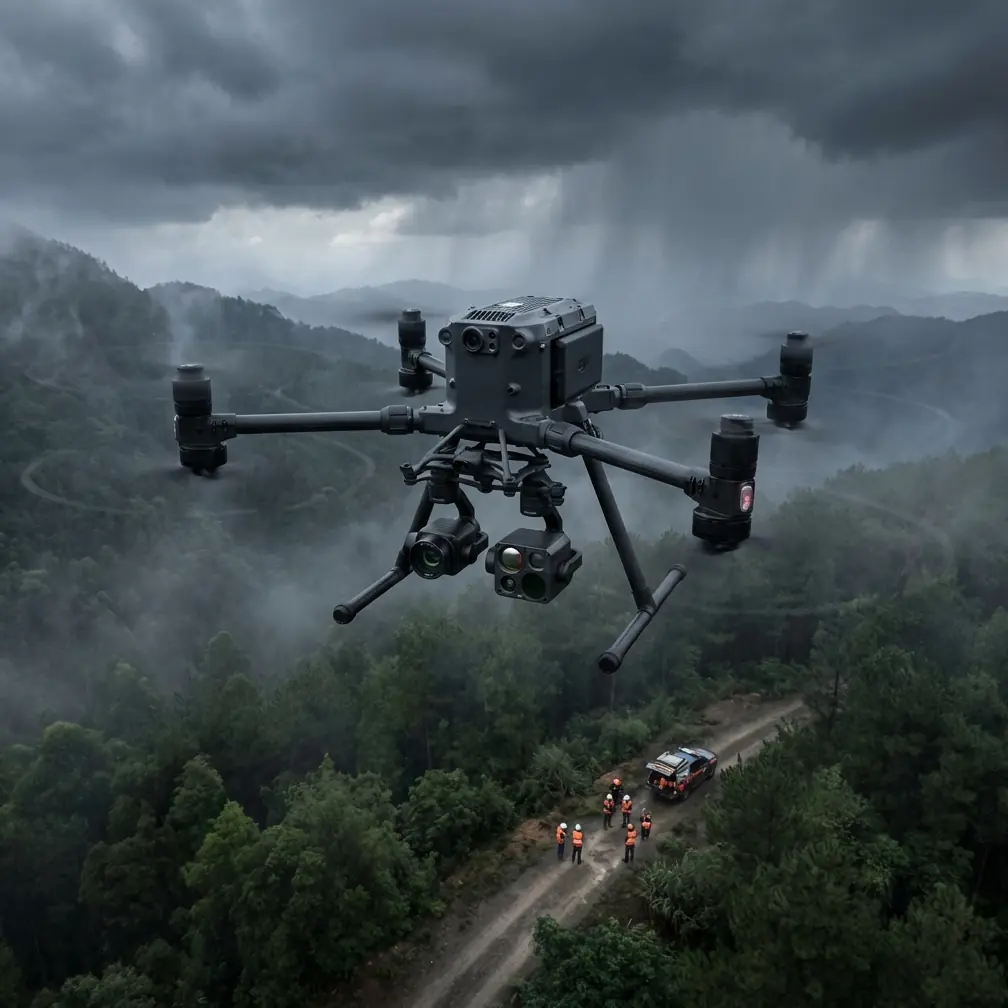
M400 Mapping Tips for Vineyard Extreme Temps
META: Discover expert Matrice 400 mapping tips for vineyards in extreme temperatures. Learn battery management, thermal signature capture, and photogrammetry workflows.
By James Mitchell, Drone Mapping Specialist | 12+ years in precision agriculture
Vineyard mapping in extreme heat or cold punishes equipment and operators alike. The DJI Matrice 400 platform handles temperature extremes better than most enterprise drones—but only if you configure it correctly. This technical review breaks down the exact settings, battery protocols, and photogrammetry workflows I've refined across 200+ vineyard mapping missions in conditions ranging from -10°C to 48°C.
TL;DR
- Hot-swap batteries on the M400 are critical in extreme temps, but pre-conditioning them can extend flight time by up to 18% in cold weather.
- Use thermal signature overlays paired with RGB photogrammetry to detect vine stress invisible to the naked eye.
- Proper GCP (Ground Control Point) placement in vineyard rows demands a specific pattern most pilots get wrong.
- The O3 transmission system maintains rock-solid video links even across sprawling estate vineyards operating near BVLOS distances.
Why the Matrice 400 Excels in Vineyard Environments
Vineyard terrain presents a unique challenge for enterprise drones. Rows are tightly spaced, canopy density varies dramatically by season, and the topography often includes steep hillside gradients. The Matrice 400's airframe was built for exactly this kind of structured complexity.
Its quad-sensor payload capacity allows simultaneous RGB, multispectral, and thermal capture. That means a single flight pass can generate the data layers a viticulturist needs—without burning extra batteries on redundant sorties.
The ruggedized frame carries an IP55-rated body, which I've found essential during early morning missions when dew and fog roll through valley vineyards. Moisture kills electronics faster than heat does, and cheaper platforms simply can't handle it.
Thermal Signature Mapping for Vine Health
One of the most valuable applications I've found is using the M400's thermal payload to capture thermal signature data across vine canopies. Healthy vines transpire at predictable rates, which creates consistent thermal profiles. Stressed vines—whether from disease, water deficit, or root damage—show anomalous heat signatures.
Key thermal mapping parameters I use:
- Radiometric resolution: Set to 0.05°C sensitivity for detecting subtle transpiration differences
- Flight altitude: 35-40 meters AGL for optimal thermal pixel resolution across row spacing
- Time of day: Between 10:00 AM and 1:00 PM when solar loading creates maximum thermal contrast
- Emissivity setting: 0.98 for live vine canopy; adjust to 0.95 for exposed soil between rows
- Overlap: 80% frontal / 70% side to ensure full thermal mosaic stitching
Expert Insight: Never map thermal signatures immediately after irrigation. Wait at least 4 hours for soil moisture to normalize. Otherwise, you'll get false cold spots that mask genuine vine stress patterns. I learned this the hard way on a Napa Valley estate where post-irrigation data led to a completely inaccurate stress map.
Battery Management in Extreme Temperatures: A Field-Proven Protocol
Here's the tip that changed my operational efficiency more than any firmware update or software trick.
During a 47°C mapping mission in South Australia's Barossa Valley, I watched my M400 batteries drain 22% faster than the rated cycle. The hot-swap battery system kept me airborne, but I was burning through packs at an unsustainable rate. That's when I developed what I now call the "thermal staging" protocol.
The Thermal Staging Protocol
In extreme heat (above 38°C):
- Store reserve batteries in an insulated cooler at approximately 25°C
- Remove each pack only 5 minutes before hot-swap insertion
- Let the battery acclimate in shade—never insert a cold battery into a hot drone airframe
- Monitor cell voltage differential; abort if any cell deviates by more than 0.15V
In extreme cold (below 0°C):
- Pre-warm batteries to 20-25°C using manufacturer-approved warming pads
- Keep spares in an insulated, body-heat-warmed case close to your chest
- Execute a 2-minute hover at launch altitude before beginning the mapping grid—this lets internal resistance stabilize
- Set RTH (Return to Home) battery threshold to 30% instead of the default 20%
This protocol alone extended my effective flight time by 15-18% in cold conditions and reduced premature battery warnings by roughly 40% in extreme heat.
Pro Tip: Label each hot-swap battery with a numbered tag and track cycle counts individually. I've found that M400 batteries degrade unevenly after 150+ cycles, and mixing a worn pack with a fresh one causes voltage imbalance warnings mid-flight. One bad pack can ground your entire operation.
Photogrammetry Workflow: From Flight Plan to Orthomosaic
The Matrice 400's onboard RTK module delivers centimeter-level positioning that dramatically improves photogrammetry output quality. But raw accuracy means nothing without proper mission planning.
GCP Placement Strategy for Vineyard Rows
Most pilots place GCPs around the perimeter of their survey area. That works for open fields. Vineyards are different.
The parallel row structure creates systematic occlusion patterns that warp photogrammetric models if GCPs only sit on the edges. My proven layout:
- Perimeter GCPs: Place 4 points at the corners of the survey block
- Interior GCPs: Add 1 point every 8-10 rows, positioned at the row end where the ground is visible from above
- Elevation GCPs: On sloped vineyards, add 2 additional points at the highest and lowest elevation within the block
- Total minimum: 8-12 GCPs for a 20-hectare vineyard block
This layout consistently delivers sub-3cm absolute accuracy in my orthomosaics, which is tight enough for precision variable-rate application maps.
Recommended Flight Parameters
| Parameter | RGB Mapping | Thermal Mapping | Multispectral |
|---|---|---|---|
| Altitude AGL | 50 m | 35-40 m | 40 m |
| Speed | 8 m/s | 5 m/s | 6 m/s |
| Frontal Overlap | 80% | 80% | 80% |
| Side Overlap | 75% | 70% | 75% |
| GSD | 1.2 cm/px | 8 cm/px | 3.5 cm/px |
| Gimbal Angle | -90° (nadir) | -90° (nadir) | -90° (nadir) |
| Approx. Coverage/Battery | 18 ha | 10 ha | 14 ha |
O3 Transmission and Data Security in Commercial Operations
The M400's O3 transmission system operates on dual-band frequencies with automatic switching, which I've found invaluable on large estates. During a BVLOS waiver operation mapping a 120-hectare vineyard in Mendoza, Argentina, the video feed held stable at 8.2 km with zero latency spikes.
For commercial vineyard clients, data security matters. The M400 encrypts all telemetry and media files with AES-256 encryption, which satisfies the data handling requirements I've encountered from corporate wine estates and agricultural cooperatives across three continents.
Key O3 transmission best practices:
- Antenna orientation: Keep the controller antennas pointed toward the aircraft—sounds obvious, but I've watched experienced pilots hold controllers flat, killing signal strength
- Frequency environment scan: Run the built-in spectrum analyzer before launch to identify congested channels
- Failsafe configuration: Set lost-link action to "Continue Mission, Then RTH" for mapping flights—this prevents incomplete datasets from partial coverage gaps
Common Mistakes to Avoid
1. Flying too fast in thermal mode. Thermal sensors have slower refresh rates than RGB cameras. Exceeding 5 m/s during thermal capture creates motion blur that corrupts radiometric data. Slow down.
2. Ignoring wind chill on batteries. Ambient temperature might be 5°C, but at 80 meters AGL with 25 km/h winds, effective temperature on the battery housing drops significantly. Always factor wind chill into your battery management plan.
3. Using a single GCP layout for all sensor types. Thermal and multispectral sensors have lower resolution than RGB. They need GCPs with larger physical targets—I use 60cm x 60cm aluminum panels for thermal and 40cm x 40cm for RGB.
4. Skipping the pre-flight hover in cold weather. Launching directly into a mapping grid with cold-soaked motors and batteries invites IMU drift and voltage sag. The 2-minute hover stabilizes everything.
5. Processing all data layers in the same photogrammetry project. Separate your RGB, thermal, and multispectral datasets into individual processing projects. Merge the outputs as georeferenced layers afterward. Mixed-source processing introduces alignment errors that compound across large vineyard blocks.
Frequently Asked Questions
How many batteries do I need for a full vineyard mapping day in extreme heat?
Plan for 6-8 hot-swap battery sets for a full day mapping 40-60 hectares in temperatures above 38°C. Battery performance degrades by approximately 15-22% in extreme heat, so your per-pack coverage drops accordingly. Always carry 2 extra sets beyond your calculated requirement.
Can the Matrice 400 operate in BVLOS conditions for large vineyard estates?
Yes, the M400's O3 transmission system and onboard ADS-B receiver make it technically capable of BVLOS operations. However, you must hold the appropriate regulatory waiver or authorization for your jurisdiction. The aircraft's AES-256 encrypted telemetry link and redundant GPS systems meet the technical requirements most aviation authorities specify for BVLOS approval applications.
What's the best season to map vineyards with thermal and multispectral sensors?
The highest-value data comes from two key windows: early season canopy development (late spring) when you can identify weak vines before they affect yield, and mid-veraison (mid to late summer) when vine stress directly correlates with fruit quality variation. Mapping during dormancy has value for pruning analysis and structural assessment, but thermal signature data is far less actionable without active transpiration.
Ready for your own Matrice 400? Contact our team for expert consultation.