
Matrice 400 in Low Light: A Practical Field Method
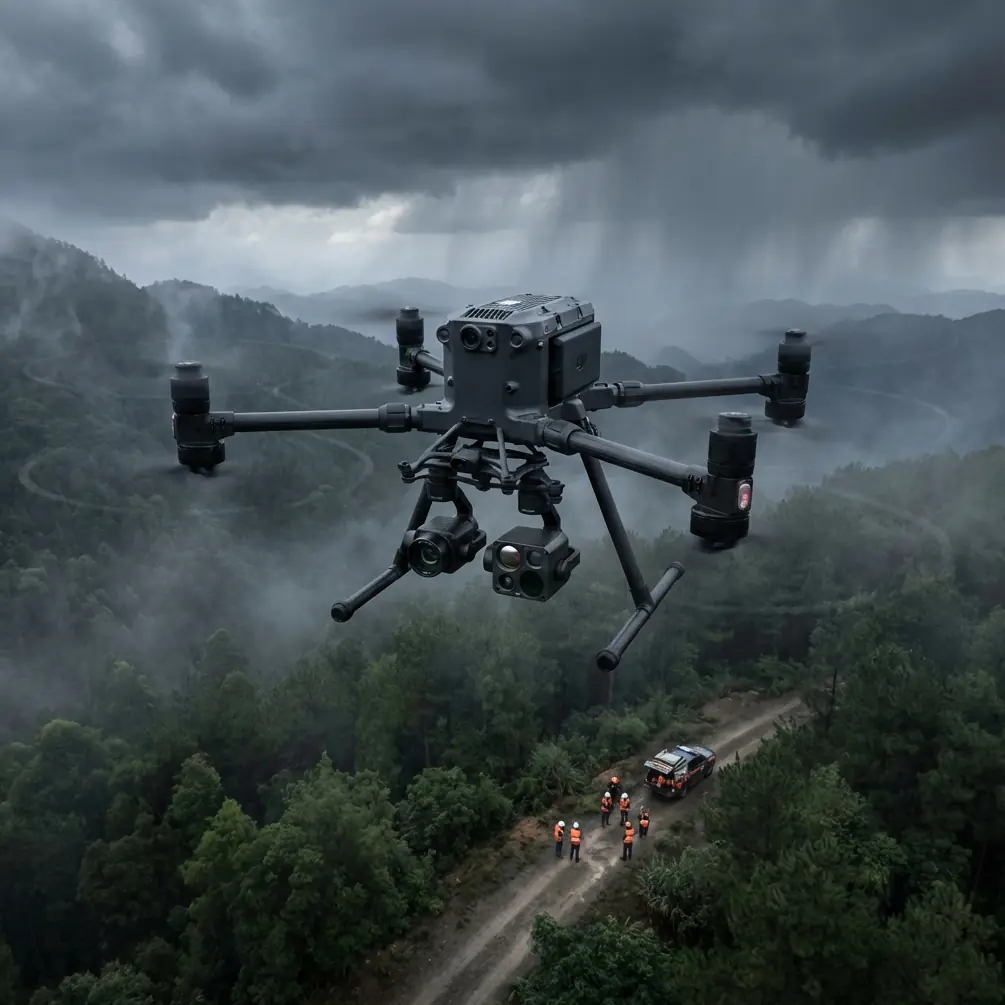
Matrice 400 in Low Light: A Practical Field Method for Construction Site Monitoring
META: Learn a field-proven low-light workflow for Matrice 400 construction monitoring, with expert guidance on power planning, fault isolation, event logging, thermal signature capture, and reliable night operations.
Low-light construction monitoring exposes the difference between a drone that merely flies and a drone system that can be trusted when site conditions get messy. Dusk pours long shadows across rebar, trench edges disappear into flat gray, and partially completed structures create false contrast that can mislead a visual pilot and corrupt inspection data. For teams planning to use the Matrice 400 on active projects, the real question is not whether it can lift a camera package. The real question is whether the aircraft, power system, and data workflow stay dependable when visibility drops and the mission still has to produce useful evidence.
That is where a more aviation-minded approach helps.
The reference material behind this discussion comes from two aircraft design sources rather than a drone brochure. That matters. One source focuses on auxiliary power design: how aircraft supply energy for starting, environmental systems, electrical loads, and backup functions on the ground and in flight. The other focuses on maintainability and fault isolation in flight control systems, including event storage, dual-system separation, and internal diagnostic access. Those ideas translate surprisingly well to a Matrice 400 workflow for construction monitoring in low light.
Why low-light construction work is really a power-and-diagnostics problem
Most drone operators treat low-light work as a sensor problem. They think first about thermal signature, ISO performance, lens choice, maybe supplemental lighting. Those are part of the story, but not the foundation.
In practice, low-light monitoring is usually constrained by two things:
- Stable energy delivery during a longer, more demanding mission window
- Confidence that the aircraft can identify, isolate, and document abnormal system behavior before it turns into a bad decision
The aircraft handbook reference on auxiliary energy design is useful here because it describes a principle commercial aviation has lived by for decades: support systems are not secondary. They are what allow the primary mission to happen. In the source, several aircraft examples rely on auxiliary power for engine start, air conditioning, hydraulic support, emergency electrical supply, and ground operations. One aircraft class cited can drive a 90 kVA AC generator on the ground and in flight. Another requirement states that electrical needs take priority over air-conditioning needs. That hierarchy is operational gold for drone teams.
A Matrice 400 crew monitoring a construction site at dawn or after sunset should think the same way. Payload ambition must not outrun electrical priority. If your mission requires thermal imaging, zoom verification, O3 transmission stability, encrypted file handling, and safe return margins, power should be allocated around mission-critical loads first. Nice-to-have tasks come second.
A better low-light workflow for Matrice 400 missions
Here is the field method I recommend for recurring site monitoring.
1. Build the mission around the site’s real contrast conditions
Do not launch because the schedule says 6:30 PM. Launch because the site has entered a useful contrast state.
For concrete curing checks, water intrusion, roof moisture anomalies, or equipment heat monitoring, low light often improves thermal separation. For earthwork progress, stockpile edge definition, and photogrammetry, low light can hurt reconstruction quality because shadows flatten texture and create uneven tie points. That means you should split the mission logic:
- Thermal pass during low light when thermal signature is cleaner
- Visible-light mapping pass closer to civil dusk or early morning with enough ambient texture for photogrammetry
- Verification orbit around critical structures with oblique angles and manual review
This matters because construction managers often ask for a single “night flight” to do everything. That usually produces compromised outputs. If you need survey-grade deliverables, plan your GCP workflow and visible-spectrum capture in a light window that still supports clean alignment. Low-light thermal is powerful, but it does not replace disciplined mapping conditions.
2. Treat battery state like auxiliary energy management, not a percentage readout
This is where field experience changes outcomes.
The aviation source describes auxiliary systems supporting essential loads on the ground and in flight, with clear prioritization of electrical demand. For Matrice 400 operations, that mindset should shape how you use hot-swap batteries. Hot-swap capability is excellent, but crews often misuse it by assuming every swap restores mission confidence. It does not. It restores available energy; it does not erase thermal history, cell imbalance risk, or mission drift.
My practical battery tip is simple: do not hot-swap straight back into a long low-light sortie without checking voltage symmetry and battery temperature trend across the pair. I have seen crews replace one battery quickly, confirm the aircraft powers up, and relaunch because the schedule is tight. The problem appears 8 to 12 minutes later when one pack carries the load differently during hovering near a reflective facade or while fighting a crosswind over a tower crane zone.
A better habit:
- Land with enough reserve to avoid a rushed turnaround
- Before hot-swap, compare pack temperatures and health indicators, not just state of charge
- Keep matched battery pairs together through the shift where possible
- If one pack came off a harder previous leg, do not pair it with a cooler, fresher partner for a precision low-light mission
- After swapping, fly a short stabilization segment before starting the core inspection run
That short segment is worth more than people think. It lets the power system normalize under load and gives the pilot time to confirm transmission quality, hover behavior, and payload response before entering tight work around structures.
3. Use thermal first, but verify with geometry
Thermal imagery is seductive. A warm conduit run, a damp roof zone, an overloaded generator cabinet, or a recently used machine jumps off the screen. But low-light thermal without geometric context can create expensive misunderstandings on a construction site.
On a Matrice 400, pair thermal observations with one of these confirmation steps:
- A zoom-visible shot from a similar perspective
- An oblique pass around the target feature
- A georeferenced marker tied to your site control or GCP plan
- A repeat capture from the same waypoint on the next monitoring cycle
The operational significance is straightforward: thermal signature tells you something is different; geometry tells you what and where it actually is.
That is especially important near façade systems, temporary power runs, HVAC staging areas, curing blankets, and recently moved equipment. Surface heat can migrate or reflect. Without a verification step, false positives spread quickly through project reporting.
Why diagnostics discipline matters as much as camera quality
The second reference source, focused on flight control and hydraulic system design, contains a concept drone operators should care about more than they usually do: unusual events should be stored and traceable. The text specifies storing up to 30 events related to disconnects, mode changes, and abnormal control states. It also stresses that in dual systems, a fault in one computation path must not affect the other, and that related wiring between “side 1” and “side 2” should be physically isolated.
That is not abstract engineering trivia. It points to a smart operating philosophy for Matrice 400 low-light missions.
4. After every low-light mission, review abnormal events before you review imagery
Most teams land and go straight to the photos. I prefer the reverse order for night or low-light site work.
Check for:
- Flight mode changes you did not intentionally command
- Temporary transmission degradation on O3 links near steel-heavy structures
- Sensor or payload reconnect events
- Compass or positioning inconsistencies near cranes, rebar mats, or temporary site power
- Gimbal stabilization anomalies during slow oblique inspection passes
Why first? Because imagery can look “good enough” while the flight log tells a different story. If the aircraft experienced an intermittent issue during the mission, your beautiful thermal image may still be evidentially weak for engineering decisions. Traceability starts with system confidence.
The aviation reference’s event-storage idea is useful because it reinforces a habit: build a record of abnormal behavior, not just mission outputs. On a recurring construction contract, that log becomes valuable. You may discover that one sector of the site consistently causes signal attenuation or that a certain payload profile pushes battery behavior in a repeatable way after sunset.
5. Separate critical functions in your workflow, even if the aircraft integrates them well
The source also emphasizes isolation between safety-related dual systems. In practical Matrice 400 terms, you should mirror that philosophy at the operational level.
Do not let one person simultaneously:
- Fly manually in a cluttered low-light environment
- Evaluate thermal anomalies live
- Manage stakeholder chatter on the radio
- Make mapping quality decisions in real time
Separate roles when the site complexity justifies it. Even on a small crew, define function boundaries:
- Pilot owns aircraft safety and route discipline
- Payload operator owns anomaly interpretation
- Visual observer monitors obstacle and ground activity
- Data lead validates whether the capture supports photogrammetry, progress tracking, or inspection evidence
This human-layer isolation reduces compounded error. Aviation solved many reliability problems by refusing to let one failure cascade across a second path. Construction drone teams should do the same with decision-making.
Transmission, encryption, and site trust
Construction monitoring often includes unfinished interiors, infrastructure routing, access control layouts, and contractor sequencing details that owners do not want casually exposed. If you are using the Matrice 400 in that environment, the technical conversation should include both link resilience and data security.
Low-light flights around steel structures, concrete cores, and mechanical floors can challenge transmission consistency. O3 transmission helps maintain a robust control and video link, but crews still need route discipline. Do not linger in self-created shadow zones behind elevator cores or under overhangs where the geometry works against the link.
On the data side, AES-256 matters because low-light inspections often document problems before the wider project team is ready to discuss them. Thermal captures showing moisture intrusion, unexpected heat at electrical equipment, or occupancy-related anomalies can have contractual consequences. Encryption is not just a spec-sheet checkbox. It is part of preserving chain of custody and client confidence.
If your team is building a recurring monitoring program and wants to compare setup notes or site-specific workflow ideas, I usually recommend starting with a direct field conversation rather than a long email chain. You can message a specialist here and sort out payload logic, battery rotation habits, and flight-window planning faster.
BVLOS thinking, even when you are not flying BVLOS
Many construction missions remain within visual line of sight, but BVLOS discipline is still useful. Why? Because BVLOS planning forces crews to think in terms of contingencies, link margin, route structure, and system health rather than improvisation.
Apply that mindset to Matrice 400 site work:
- Predefine recovery points
- Set route legs that preserve signal geometry
- Mark electromagnetic risk areas on the site map
- Assign a minimum battery threshold for aborting discretionary captures
- Separate thermal survey objectives from mapping objectives before takeoff
This turns a “quick evening look” into a repeatable monitoring program. That difference becomes obvious after the third or fourth cycle, when managers start comparing week-over-week conditions and expecting consistency.
A sample low-light mission sequence for construction monitoring
Here is a practical sequence that works well:
Preflight
- Review the day’s inspection targets: concrete cure, roof moisture, temporary power, equipment utilization, façade progress
- Confirm ambient temperature shift and expected thermal contrast
- Verify battery pair matching and note pack temperatures
- Confirm encryption settings and storage workflow
- Check GCP visibility if any mapping deliverable is expected
Initial launch
- Fly a short stabilization leg after takeoff
- Confirm O3 link quality near the site’s main structural mass
- Watch for unexpected attitude corrections or hover drift
Thermal survey
- Prioritize likely anomaly zones first while the battery pair is strongest
- Use consistent altitude and angle for repeatability
- Tag suspicious areas for visible-spectrum confirmation
Visible verification
- Capture zoom or oblique context images
- If photogrammetry is required, assess whether the remaining light supports useful reconstruction; if not, defer rather than force a bad dataset
Postflight
- Review abnormal events before image review
- Log any disconnects, mode changes, or signal drops
- Compare battery behavior across the pair
- Archive observations by site zone, not just by flight number
The real advantage of Matrice 400 in this scenario
The Matrice 400 becomes valuable on construction sites in low light not because it can simply carry advanced payloads, but because it supports a disciplined operating model. The strongest clue from the reference materials is that mature aircraft systems are designed around support energy, fault isolation, and event traceability. That same thinking makes drone operations better.
The 90 kVA aircraft examples in the auxiliary power reference are a reminder that mission capability depends on enough reserve for the systems behind the systems. The event-recording logic storing up to 30 abnormal events is a reminder that trustworthy operations require memory, not guesswork. Apply those principles to Matrice 400 work and your low-light monitoring program becomes more than image collection. It becomes an auditable site intelligence process.
That is what construction teams actually need when they fly near shift change, before concrete temperatures equalize, or after sunset when defects and progress can finally be seen clearly.
Ready for your own Matrice 400? Contact our team for expert consultation.