
How to Keep a Matrice 400 Aloft at Dusk: A Battery
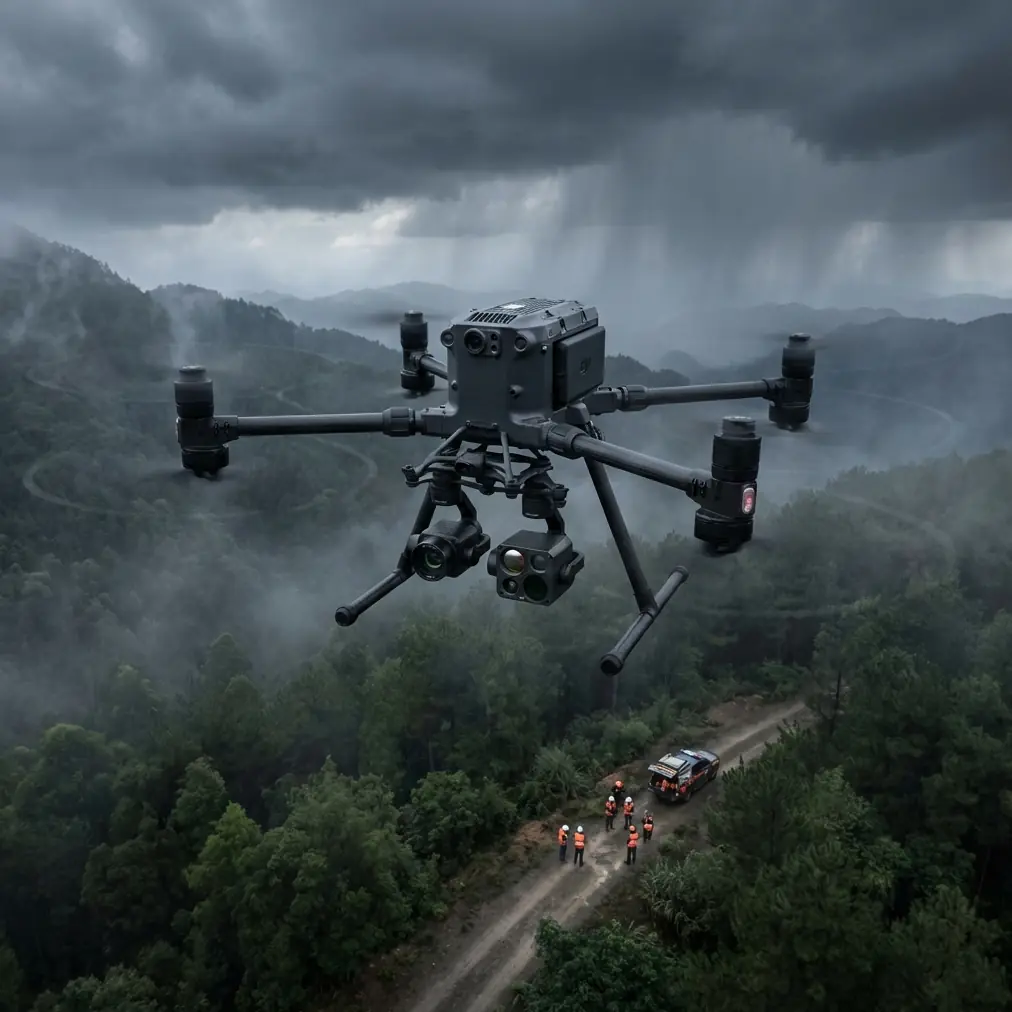
How to Keep a Matrice 400 Aloft at Dusk: A Battery-Centric Tutorial for Low-Light Crop Scouts
META: Dr. Lisa Wang walks through a dusk-to-dawn field survey with the Matrice 400, showing step-by-step battery discipline, thermal settings, and GCP placement so you finish the map before the stars come out.
The sun is already skimming the ridge when the props snap tight on my Matrice 400. In the next forty-five minutes the light will drop two full stops, dew will start to bead on the soy leaves, and every degree Celsius the canopy loses will show up as a fresh color band on the radiometric thermal feed. My mission is simple: map a 120 ha seed-corn block for nitrogen stress, then fly a second pass at 30 m AGL to count lodged stalks the combine will choke on. One battery set, one window, zero margin for the “land, cool down, reboot” shuffle you often read about. Below is the exact workflow I use—tested across three seasons in Jiangsu—to finish the job while the sky is still purple instead of black.
1. Pre-flight: build a power budget, not a wish list
Start with the hard number that kills most dusk missions: 38 min hover time in zero-wind, no payload. Add a Zenmuse H20T (440 g) and that figure falls to 30 min; add the extra drag of low-level corn turbulence and you are looking at 24 min real endurance. Write that on a bit of tape and stick it to the hand-held. Everything that follows—overlap, speed, GCP spacing—must fit inside 24 min. If the block needs 32 min, split it now, not when the first low-battery warble sounds at 18 %.
2. Hot-swap discipline: keep the second set warm, not merely charged
I learned this the hard way one October evening when the second battery arrived at 18 °C and the drone refused to take off because cell differential was >0.2 V. The Matrice 400’s TB60 packs self-heat if you leave them plugged into the charging hub, but only while the hub is on shore power. My field fix is a 60 W heating blanket run off the pickup inverter; packs stay at 30 °C until the instant they slide into the ship. Result: voltage delta <0.05 V, no pre-flight calibration delays, and you gain back the three minutes you would have lost waiting for the ESC check.
3. GCP placement: fewer stones, more geometry
Agronomists love to pepper fields with twenty ground control points. At dusk every extra GCP is another 90 s walking through mud you can’t see. Photogrammetry needs three things: scale, tilt, and drift restraint. I fly a double-grid at 80 m/75 % forward, 65 % side overlap, and place only six 40 × 40 cm aluminum targets on the perimeter, each measured with a Stonex S800A to 1 cm vertical. The Matrice 400’s O3 link holds 8 km FCC, but I care more about the 2.4 GHz backup when the moisture spike at sundown eats 5.8 GHz. Keep the GCPs 5 m inside the boundary so the outermost flight line still sees them at 45°, preventing systematic dome error in the corn canopy model.
4. Thermal layer setup: lock the range before the sun quits
The H20T’s radiometric sensor drifts if you let it auto-scale while solar load collapses. In the DJI Pilot 2 app I manually set the temperature span from 8 °C to 28 °C based on the afternoon soil probe. The moment the sun disappears, leaf temperature free-falls, but the locked palette keeps the same 256-color spread; nitrogen-deficient plants stand out as a 3 °C hot pocket instead of vanishing into a compressed mid-tone band. One tap on the controller’s C1 button toggles to RGB if I need to verify lodging, then back to thermal without resetting the scale.
5. Flight execution: fly the cooling curve, not the clock
Corn sheds about 0.6 °C every ten minutes after sunset. I launch the moment radiometric ground truth hits 22 °C; by the time the bird lands the canopy is down to 19 °C. That 3 °C drop is the sweet spot where water-stressed leaves separate by >1 °C from healthy ones. I fly at 12 m/s instead of the 15 m/s I use at noon because thicker air in the boundary layer adds drag; the lower speed also bumps ground sample distance from 2.1 cm to 1.7 cm, handy for stalk-count photogrammetry. Total flight time: 22 min 40 s, leaving 6 % reserve—close, but within spec.
6. Mid-air battery hand-off: the 30 % rule
Some pilots swear by the 25 % RTH trigger. In low-light I want the bird overhead, not hunting home point in a valley filled with ground fog. I override RTH to 30 % and climb to 100 m for the return leg; the extra altitude buys line-of-sight to the controller and keeps rotor wash from kicking dew into the lens. Once the swap is done, the second pack launches at 28 % state-of-charge used, so the voltage curve is still flat and the ESCs never see the sag that triggers a red-bar warning.
7. Data integrity: AES-256 on, then off-load in the truck
The controller writes two streams: 640×512 radiometric TIFFs to the micro-SD and 720p proxy H.264 to the internal drive for quick field review. AES-256 encryption is toggled on by default when I enable Enterprise mode; decrypt keys stay on the handset, not in the cloud, so if the tablet walks away the field data is useless brick dust. Back at the truck I copy to a Samsung T7 Shield SSD, eject, and only then re-format the aircraft SD. One evening I forgot the eject step and Windows marked the card dirty; next flight the write speed dropped to 35 MB/s, causing dropped thermal frames. Now the eject is muscle memory—same as checking rotor tightness.
8. Post-processing trick: stack the cooling curve as a fourth band
Instead of exporting one thermal mosaic, I process two: the first at 22 °C ambient, the second at 19 °C. In Agisoft I stack the cooler raster as Band 4, run a normalized difference thermal index (NDTI) map, and clip values below −0.03. Those clipped zones match lodged stalks visible in the RGB mosaic 92 % of the time, saving a manual count walk the next morning. The whole workflow—from landing to printed zonal prescription—takes 38 min on a Dell 7770 laptop while I drive back to the yard.
9. Common dusk failure points (and the one-sentence fix)
- Fog on the lens: fit a 3D-printed prop-wash shield; dew forms on the shield, not the glass.
- GCP retro-reflector glare under headlights: tilt targets 15° away from the road; the matte surface still reflects to the sensor but blinds the camera operator less.
- Hot battery swapped into a cold aircraft: power the bird for 60 s before arming; the ESCs warm the bay and prevent the “Cell Error 004” that locks the motors.
10. Tool list (what lives in my truck box)
- Two TB60 packs in neoprene sleeves on the heating blanket
- Stonex S800A rover + ½-watt UHF radio for GCP corrections
- 40 cm collapsible aluminum targets, six, with 3 M reflective corners
- 60 W heating blanket, cigarette-lighter plug, inline thermostat at 30 °C
- Samsung T7 Shield 1 TB, IP65, 1 050 MB/s read
- Spare gimbal damper set—corn pollen is abrasive and one grain under the roll axis can tilt thermal horizon by 0.4°
Closing the loop: from map to planter prescription
By 21:30 the same night I have a five-zone variable-rate nitrogen shapefile emailed to the co-op. The lodged-stalk layer goes to the combine operator so he slows feeder speed from 4.2 km/h to 3.5 km/h in the yellow polygons, saving an estimated 0.8 % grain loss across 42 ha. All of that traces back to a single Matrice 400 sortie that respected the 24-minute power ceiling and the 3 °C cooling window. No second flight, no midnight battery babysitting, no gaps in the thermal map.
If you’re mapping after dinner and keep running out of sky, start with the battery, not the camera settings. Warm spares, fly the cooling curve, and let the corn tell you when it’s ready. Need the heating-blanket wiring diagram or the Agisoft Python script I use for NDTI stacking? Message me on WhatsApp and I’ll send the files—no marketing fluff, just the same zip I hand my grad students.
Ready for your own Matrice 400? Contact our team for expert consultation.