
Matrice 400 in Dusty Field Monitoring: What Reliability
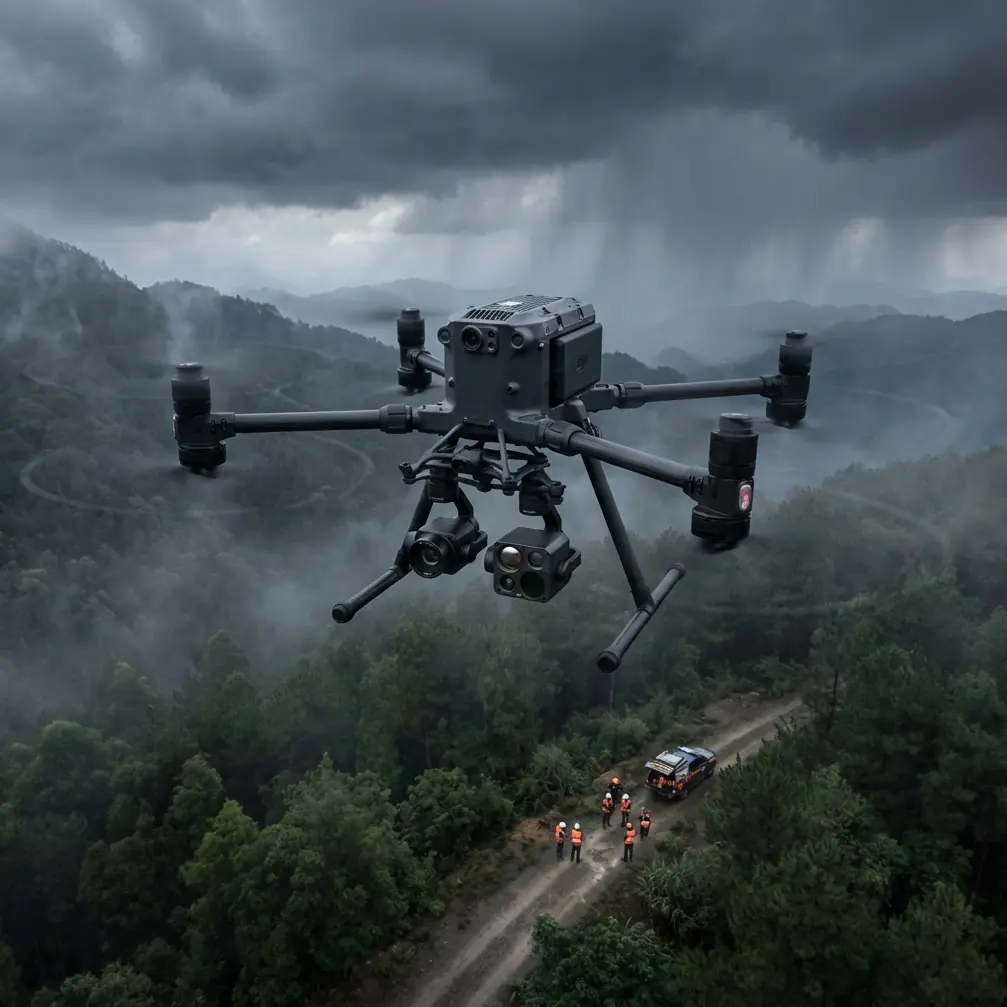
Matrice 400 in Dusty Field Monitoring: What Reliability Engineering Really Means on the Farm
META: A field-focused expert analysis of using Matrice 400 for dusty agricultural monitoring, with practical guidance on reliability, corrosion risk, battery handling, thermal workflows, and mission planning.
Dust changes everything.
Not in the brochure sense. In the real sense. It gets into connectors, settles on payload mounts, rides thermals above dry soil, and quietly exposes every weak decision in a drone workflow. If you are looking at the Matrice 400 for monitoring fields in dusty conditions, the headline specs matter, but they are not the whole story. The bigger question is whether the aircraft, payload stack, and maintenance routine can keep producing usable data after repeated exposure to abrasive air, heat, vibration, and long workdays.
That is where an engineering view becomes more useful than a feature list.
I approach the Matrice 400 the same way aviation engineers approach critical airborne systems: by looking at function, failure mode, interfaces, and environmental stress. One of the source references behind this article comes from an aircraft reliability and maintainability design manual. It stresses that analysis should not stop at the part itself; it must include the component’s main function and its relationship with interface equipment. That detail matters in agriculture because field-monitoring drones do not fail only when a motor or camera breaks. They also fail when one subsystem can no longer support another cleanly: power delivery becomes unstable, a gimbal connector picks up contamination, a cooling path gets clogged, or a payload handshake drops during a mission.
For Matrice 400 users, especially those running thermal signature surveys, photogrammetry passes, or repeat agronomy checks, that way of thinking leads to better outcomes than simply asking whether the aircraft can fly in dust.
The real problem in dusty field operations
Most agricultural drone missions in dry regions create a stacked reliability problem.
The aircraft is flying over exposed soil or crop residue. The launch zone may be an unpaved access road. Vehicle doors open and shut in wind. Cases stay open while batteries are swapped. The operator is often under pressure to complete a window before wind rises or light changes. If the mission includes thermal mapping, even minor contamination on optics or vents can distort results or reduce confidence in the dataset. If it includes photogrammetry, dust accumulation and vibration can affect image consistency, while poor battery discipline can interrupt route continuity and complicate GCP alignment.
The result is not always a dramatic failure. Often it is a degraded mission: incomplete coverage, uncertain thermal anomalies, patchy overlap, extra reflights, or long-term wear that only becomes visible after weeks.
The aircraft reliability reference is useful here because it highlights the need to document predictable failure modes, not just obvious breakages. The source even lists fault categories such as “cannot start,” “does not return,” “cannot maintain position,” and “premature operation.” Those are not just abstract engineering labels. In a dusty field-monitoring context, they translate into practical operational concerns:
- Cannot start can mean contamination at a battery or payload interface, or a latch not fully seated after a quick turnaround.
- Does not return can mean a mission interrupted by battery mismanagement, poor route planning, or degraded situational awareness in haze and dust.
- Cannot maintain position matters during low-altitude inspection, especially when wind and thermal uplift over bare ground challenge stability and data capture consistency.
- Premature operation has a real counterpart in accidental activation, improper sequencing, or launching before the system check is actually complete.
When operators skip this style of analysis, they tend to blame “the drone” for problems that are really caused by how the full system is being used.
Why Matrice 400 stands out for this kind of work
The Matrice 400 makes sense for field monitoring because it sits in the category where endurance, payload flexibility, transmission reliability, and battery workflow become central. For agriculture, that often means one aircraft doing more than one job in the same day: a visible-light mapping block in the morning, thermal checks over irrigation later, perhaps a revisit of stress zones identified in prior surveys.
That is also where details like O3 transmission, AES-256, hot-swap batteries, and potential BVLOS-oriented planning discipline become more than spec-sheet badges.
O3 transmission matters because dusty environments often come with visual haze, large open tracts, and long linear routes. Even when regulations or your operation keep you within line of sight, robust transmission is what supports smoother command confidence across large fields, tree lines, pivots, and changing topography. The operational significance is simple: fewer interruptions during structured data capture means more consistent overlap, fewer broken mission segments, and less chance of introducing avoidable gaps into a photogrammetry or thermal dataset.
AES-256 matters for a different reason. Farm monitoring is increasingly data-sensitive. Yield estimates, irrigation patterns, disease signatures, and georeferenced field health records are commercially valuable. Secure transmission and handling become relevant when flights are part of a broader digital agriculture workflow involving consultants, growers, and multi-site operations.
Hot-swap batteries are especially relevant in dusty field work, but only if the team handles them correctly.
A battery management tip from the field
Here is one habit I recommend because it solves more problems than most operators realize: never place a warm battery directly into a dust-exposed open case during swap cycles.
On paper, hot-swap capability is about keeping the aircraft active and reducing downtime. In the field, the weak point is often what happens in the 90 seconds around the swap. A battery that has just come out of the aircraft is warm. If you drop it into an open hard case sitting on dusty ground or the tailgate of a truck, that heat can create a small convection effect that attracts more fine dust than you expect. The same work rhythm that saves time can quietly contaminate contacts, seals, and nearby payload accessories.
My routine is straightforward:
- Keep one “clean zone” for fresh batteries.
- Keep removed batteries in a separate lidded container or shaded tray.
- Close every case between swaps, even if it feels inefficient.
- Use a soft, dedicated brush and non-shedding cloth to inspect seating areas before the next pack goes in.
- Rotate packs by actual duty cycle, not memory.
Why does this matter? Because power reliability is not just about charge percentage. It is about preserving stable interfaces over hundreds of field cycles. The reliability manual’s emphasis on connecting function to interfaces fits perfectly here. The battery’s function is not merely to provide energy. It must maintain dependable interaction with the aircraft power system under repeat handling, contamination, and heat stress. If that interface degrades, the mission risk goes up long before a battery is officially “bad.”
Dust is not the only environmental threat
One of the less obvious but more important reference details comes from the aircraft materials handbook on corrosion control. It notes that carbon-fiber composites have excellent inherent corrosion resistance, yet because their electrical potential is relatively high, contact with other metals can accelerate corrosion in those metals. The same source classifies material pairings into compatible, intermediate, and incompatible groups, listing alloys such as Ti-6Al-4V among compatible materials and alloys like 2024-T3 or 7075-T6 in an intermediate category depending on the contact relationship.
Why should a Matrice 400 operator monitoring dusty fields care?
Because dust rarely arrives alone. In agriculture, dust is often mixed with humidity cycles, fertilizer residue, irrigation spray, and chemical exposure. If your workflow involves aftermarket mounts, third-party brackets, field-repaired fasteners, or mixed-metal accessories around a composite airframe or payload support area, you are creating conditions where galvanic and contact-corrosion issues can progress quietly. The materials source also references protective approaches such as coatings and sealing compounds like XM-22 in contact areas and seams. The larger operational lesson is not that you need to reproduce aircraft factory processes in the field. It is that surface protection, material compatibility, and sealed interfaces are not cosmetic concerns. They directly affect service life.
On a working drone, corrosion does not always announce itself as red rust. Sometimes it appears first as stubborn fasteners, uneven electrical behavior, discoloration around mounting points, or recurring need to reseat a payload.
For dusty field monitoring, the maintenance takeaway is clear:
- Inspect mixed-material contact points regularly.
- Be cautious with unverified accessories.
- Clean off fertilizer and chemical residue promptly.
- Watch any exposed metal hardware mounted near composite structures.
- Treat small seal failures seriously before they become intermittent faults.
Thermal signature work demands cleaner habits than standard visual scouting
A lot of agricultural teams are now pairing visible imaging with thermal signature analysis to spot irrigation issues, blocked emitters, plant stress, and drainage anomalies. The Matrice 400 platform is well suited to this kind of multi-sensor workflow, but dust can degrade thermal confidence faster than many operators expect.
The issue is not only optical contamination. Dusty ground creates thermal turbulence. Midday heat plumes can soften edge definition and make anomalies look less stable from pass to pass. If the operator is also launching from bare soil, lens contamination becomes an added variable.
The fix is procedural. Fly thermal missions when environmental contrast is meaningful and atmospheric disturbance is manageable. Keep sensor glass inspection as part of every battery event, not just preflight. If your team is collecting repeatable datasets across dates, standardize launch surfaces whenever possible. Even a simple ground mat changes the amount of debris pushed up during takeoff and landing.
For teams building comparison layers over time, thermal consistency matters more than one dramatic image. Matrice 400’s value in this role is not just that it can carry the work. It is that the platform can support disciplined repetition when the operator respects environmental control.
Photogrammetry in dusty fields: small errors become expensive fast
Dust also has a way of turning average mapping practice into bad mapping practice.
In field photogrammetry, operators usually focus on overlap, altitude, speed, and GCP placement. All of that matters. But on dusty sites, there are extra concerns: launch vibration from loose ground, contamination on optics, reduced contrast in hazy conditions, and repeated battery interruptions on large acreage.
If you are using the Matrice 400 for field mapping, consistency across sorties is the priority. Keep your camera geometry and route logic stable. If the field is large enough to require multiple swaps, treat every resumed segment like part of one controlled survey, not a fresh ad hoc flight. Good GCP discipline helps here, especially when the environment offers repetitive crop patterns and fewer obvious natural tie features.
This is another place where strong transmission architecture helps. O3 is not merely about range headlines. In mapping, stable command and video links reduce the temptation to improvise when the aircraft is far out over monotonous terrain. That translates to cleaner route adherence, better confidence in overlap completion, and fewer avoidable reruns.
Build your operating method around failure modes, not optimism
The most valuable lesson from the reliability reference is that failure analysis should be exhaustive and traceable. It specifically ties each analyzed item to numbering, product identification, and an RBD, or reliability block diagram number, when the same product appears in different subsystems or failure modes. That sounds academic until you apply it to a drone program.
For a Matrice 400 used in dusty field monitoring, create your own simplified reliability map:
- Airframe
- Power system
- Payload and gimbal interface
- Transmission link
- Landing gear and launch/landing zone
- Data workflow
- Battery handling process
- Cleaning and post-flight inspection routine
Then ask for each one: what does failure look like in practice?
Not “catastrophic failure.” Operational failure.
Maybe it is incomplete irrigation thermal coverage because dust on the lens went unnoticed. Maybe it is a delayed launch because contacts were contaminated during a battery swap. Maybe it is a recurring payload disconnect caused by environmental exposure at an interface. Maybe it is gradual corrosion from mixed-material accessories and chemical residue.
If you run a team operation, this method also makes training easier. New pilots can learn not just what button to press, but where reliability actually lives.
If you want a second set of eyes on a field-monitoring setup or a battery-handling workflow, you can message our drone team here.
The practical Matrice 400 takeaway for dusty agriculture
The Matrice 400 is compelling for field monitoring not because dust stops mattering, but because the platform is strong enough to reward disciplined operators. It can support serious thermal and photogrammetry work. It can fit large-area missions where transmission stability, secure data handling, and efficient battery changes all matter. It can be part of a repeatable agricultural intelligence workflow rather than a one-off flying camera.
But dusty success does not come from airframe capability alone.
It comes from treating the aircraft like a working system:
- protect interfaces,
- control battery swap contamination,
- standardize launch conditions,
- inspect mixed-material contact points,
- and think in terms of failure modes before the field exposes them for you.
That mindset is not glamorous, but it is what separates clean, repeatable farm data from expensive rework.
Ready for your own Matrice 400? Contact our team for expert consultation.